
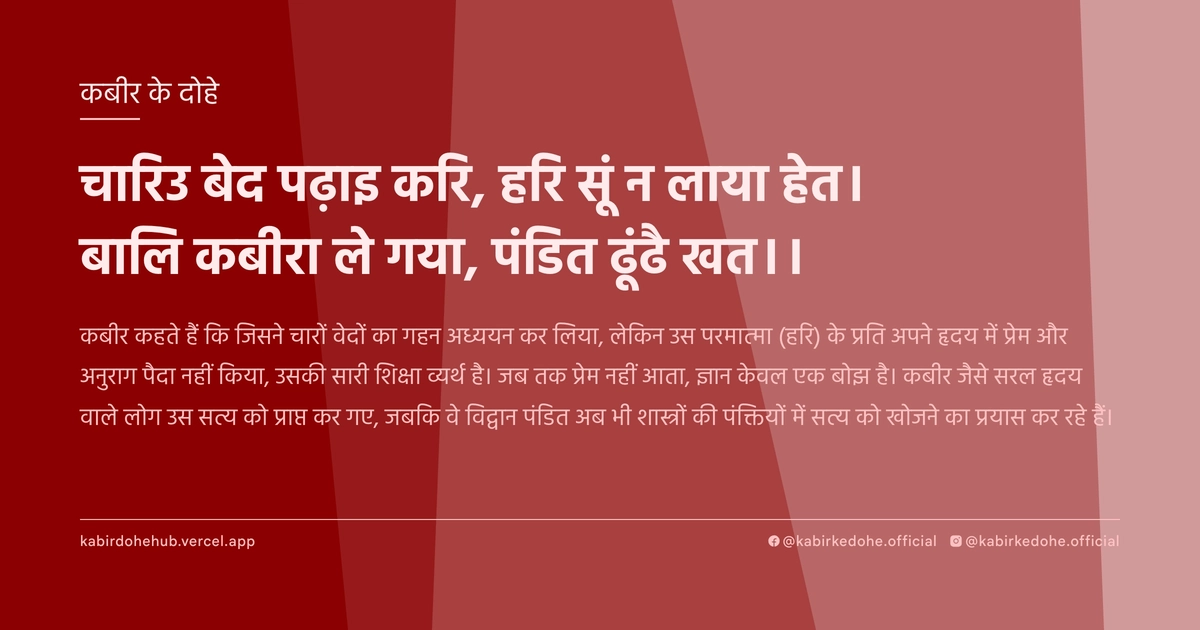
चारिउ बेद पढ़ाइ करि, हरि सूं न लाया हेत।
बालि कबीरा ले गया, पंडित ढूंढै खत।।
Chariu bed padhai kari, Hari sun na laya het. Bali Kabira le gaya, pandit dhundhai khat.
इस पृष्ठ पर इस कबीर दोहे का अर्थ (meaning), हिंदी व्याख्या और अंग्रेज़ी अनुवाद, दार्शनिक विश्लेषण और व्यावहारिक जीवन सीख दी गई है। यह दोहा धार्मिक पाखंड (Religious Hypocrisy) विषय से जुड़ा है — Kabir doha meaning and explanation in Hindi and English.
अर्थ (Meaning):
कबीर कहते हैं कि जिसने चारों वेदों का गहन अध्ययन कर लिया, लेकिन उस परमात्मा (हरि) के प्रति अपने हृदय में प्रेम और अनुराग पैदा नहीं किया, उसकी सारी शिक्षा व्यर्थ है। जब तक प्रेम नहीं आता, ज्ञान केवल एक बोझ है। कबीर जैसे सरल हृदय वाले लोग उस सत्य को प्राप्त कर गए, जबकि वे विद्वान पंडित अब भी शास्त्रों की पंक्तियों में सत्य को खोजने का प्रयास कर रहे हैं।
Kabir asserts that one who has mastered the four Vedas but failed to cultivate a heartfelt love and longing for the Divine (Hari) has gained nothing of value. Intellectual accumulation without emotional devotion is a sterile exercise. While the simple-hearted, like Kabir, have already attained the ultimate truth through love, the learned scholars remain trapped in the labyrinth of scriptures, searching for a truth that cannot be found in ink and paper.
व्याख्या (Interpretation):
इस दोहे का शाब्दिक अर्थ है कि किताबी ज्ञान ईश्वर प्राप्ति की गारंटी नहीं है। रूपकात्मक रूप से, 'चारों वेद' उस बौद्धिक अहंकार का प्रतीक हैं जो मनुष्य को सत्य से दूर ले जाता है। यहाँ 'हरि' निर्गुण ब्रह्म हैं, जिन्हें केवल प्रेम के माध्यम से अनुभव किया जा सकता है, तर्क से नहीं। यह अद्वैत वेदांत के उस सिद्धांत को दर्शाता है जहाँ ज्ञान (Jnana) और भक्ति (Bhakti) का मिलन आवश्यक है, परंतु बिना प्रेम के ज्ञान केवल 'माया' का एक और विस्तार है। कबीर यहाँ एक विरोधाभास प्रस्तुत करते हैं: जो सबसे कम पढ़ा हुआ दिखता है, वह सबसे अधिक जानता है क्योंकि उसने 'स्व' को मिटाकर परमात्मा को पाया है।
Literally, the verse suggests that scholarly achievement does not guarantee spiritual liberation. Metaphorically, the 'four Vedas' symbolize the intellectual ego and the rigid structures of formal learning that often act as a veil between the seeker and the Truth. 'Hari' represents the Nirgun Brahman—the formless Absolute—which can only be accessed through the portal of love, not the logic of the mind. This aligns with the non-duality of Advaita Vedanta, suggesting that while knowledge is a tool, without 'Bhakti' (devotion), it remains a fragment of 'Maya' (illusion). Kabir presents a profound paradox: the unlettered saint possesses the ultimate realization because he has dissolved his ego, while the scholar remains a prisoner of his own erudition.
दार्शनिक विश्लेषण (Philosophical Analysis):
कबीर का यह दोहा उनके युग के धार्मिक पाखंड और शास्त्र-केंद्रित कट्टरता पर एक तीखा प्रहार है। मध्यकालीन भारत में, वेदों का ज्ञान केवल एक विशिष्ट वर्ग तक सीमित था, जिससे एक आध्यात्मिक पदानुक्रम (hierarchy) बन गया था। कबीर इस पदानुक्रम को ध्वस्त करते हुए यह तर्क देते हैं कि ईश्वर किसी भाषा, जाति या डिग्री का मोहताज नहीं है। वे 'सहज मार्ग' की बात करते हैं, जहाँ हृदय की पवित्रता ही सबसे बड़ा शास्त्र है।
दार्शनिक रूप से, यह सूफीवाद के 'इश्क-ए-हकीकी' (ईश्वरीय प्रेम) और भक्ति आंदोलन के 'प्रेम मार्ग' का संगम है। सूफी संतों की तरह, कबीर मानते हैं कि बुद्धि केवल दिशा दिखा सकती है, लेकिन मंजिल तक केवल प्रेम ही पहुँचा सकता है। बुद्धि विश्लेषण करती है और विभाजित करती है, जबकि प्रेम एकीकृत करता है।
अद्वैत वेदांत के परिप्रेक्ष्य में, पंडित का 'खत' (लिखा हुआ शब्द) वह 'अविद्या' है जो आत्मा को परमात्मा से अलग मानती है। जब तक व्यक्ति स्वयं को 'ज्ञानी' मानता है, वह 'अहंकार' के बंधन में रहता है। कबीर का 'बालि' (सरलता/बचपना) उस अवस्था को दर्शाता है जहाँ अहंकार शून्य हो जाता है और केवल शुद्ध चेतना शेष रहती है।
यह दोहा कर्मकांड और अनुष्ठानों की निरर्थकता को उजागर करता है। यदि पूजा-पाठ और अध्ययन व्यक्ति को अधिक विनम्र और प्रेमपूर्ण नहीं बनाते, तो वे केवल मानसिक व्यायाम हैं। कबीर का उद्देश्य ज्ञान का विरोध करना नहीं, बल्कि उस ज्ञान का विरोध करना है जो मनुष्य को उसके मूल स्वभाव—प्रेम—से अलग कर देता है।
अंततः, यह मनोवैज्ञानिक रूपांतरण की बात है। जब एक व्यक्ति अपनी बौद्धिक श्रेष्ठता के भ्रम को त्याग देता है, तब वह वास्तव में 'सीखने' के योग्य बनता है। सत्य शब्दों में नहीं, बल्कि उस मौन अनुभव में है जो शब्दों के अंत के बाद शुरू होता है।
This couplet is a searing critique of the religious hypocrisy and scripture-centric orthodoxy of Kabir's era. In medieval India, Vedic knowledge was the exclusive domain of a specific caste, creating a spiritual hierarchy. Kabir dismantles this structure, arguing that the Divine is not bound by language, caste, or academic credentials. He advocates for the 'Sahaj Marg' (the Natural Path), where the purity of the heart is the only authentic scripture.
Philosophically, this is a convergence of the Sufi concept of 'Ishq-e-Haqiqi' (Divine Love) and the Bhakti movement's path of devotion. Like the Sufi mystics, Kabir posits that the intellect can only point the way, but only love can bridge the gap to the Absolute. The mind analyzes and divides, whereas love integrates and unifies.
From the lens of Advaita Vedanta, the scholar's 'khat' (written word) represents 'Avidya' (ignorance)—the delusion that the Atman is separate from Brahman. As long as an individual identifies as a 'scholar,' they remain imprisoned by the ego. Kabir's emphasis on simplicity represents the state of 'Shunya' (emptiness), where the ego dissolves, leaving only pure consciousness.
The verse highlights the futility of ritualism. If study and prayer do not render a person more humble and loving, they are merely mental gymnastics. Kabir does not oppose knowledge itself, but rather the knowledge that alienates a human being from their primordial nature—which is love.
Ultimately, this is about psychological transformation. When a person relinquishes the illusion of intellectual superiority, they become truly capable of learning. Truth does not reside in words, but in the silent experience that begins where words end.
मूल संदेश (Core Message):
- बौद्धिक अहंकार सत्य के मार्ग में सबसे बड़ी बाधा है।
- शास्त्र केवल मानचित्र हैं, प्रेम ही वास्तविक यात्रा है।
- परमात्मा शब्दों में नहीं, हृदय के अनुराग में बसते हैं।
- सादगी और सरलता ही उच्चतम आध्यात्मिक उपलब्धि है।
- ज्ञान जब प्रेम में बदल जाता है, तब वह मुक्ति बन जाता है।
- Intellectual arrogance is the greatest obstacle on the path to Truth.
- Scriptures are merely maps; love is the actual journey.
- The Divine resides not in words, but in the longing of the heart.
- Simplicity and innocence are the highest spiritual achievements.
- When knowledge transforms into love, it becomes liberation.
व्यावहारिक उदाहरण (Practical Example):
वाराणसी के एक पुराने घाट पर पंडित शिवदत्त रहते थे। उन्होंने जीवन के तीस वर्ष संस्कृत के कठिन ग्रंथों और वेदों को कंठस्थ करने में बिताए थे। शहर भर में उनकी विद्वत्ता की चर्चा थी, और वे अपनी ज्ञान-महिमा के कारण अत्यंत अभिमानी थे। वे मानते थे कि मोक्ष केवल उन्हीं को मिलेगा जिन्होंने शास्त्रों की हर सूक्ष्मता को समझा है।
उसी घाट के पास एक बूढ़ा मल्लाह रहता था, जिसका नाम माधव था। माधव अनपढ़ था, उसने कभी कोई किताब नहीं छुई थी। वह दिन भर नाव चलाता और शाम को बस एक दीया जलाकर चुपचाप गंगा की लहरों को देखता रहता। वह अक्सर मुस्कुराता और गुनगुनाता, जैसे वह किसी अदृश्य संगीत को सुन रहा हो।
शिवदत्त अक्सर माधव का मजाक उड़ाते और कहते, "अरे मूर्ख! तू क्या जाने सत्य को? तूने कभी उपनिषद नहीं पढ़े, तू तो अंधकार में है।" माधव बस विनम्रता से सिर झुका लेता और कहता, "महाराज, मैं तो बस उस प्रेमी की प्रतीक्षा कर रहा हूँ जिसने मुझे यहाँ भेजा है।"
एक बार शहर में एक महान संत आए। शिवदत्त उनके पास गए और अपनी विद्वत्ता का प्रदर्शन करने लगे। उन्होंने कठिन श्लोक सुनाए और जटिल दार्शनिक प्रश्न पूछे। संत ने उनकी बातों को सुना, लेकिन उनके चेहरे पर कोई विशेष भाव नहीं आया। संत ने महसूस किया कि शिवदत्त के शब्दों में ज्ञान तो है, लेकिन हृदय में सूखापन है।
तभी माधव वहाँ पहुँचा। वह संत के चरणों में गिर पड़ा और उसकी आँखों से अश्रु बहने लगे। उसने कोई शब्द नहीं बोला, बस एक गहरी आह भरी। संत ने अचानक माधव को गले लगा लिया और कहा, "ढूँढ लिया मैंने! जिसे यह दुनिया मूर्ख कह रही है, वही वास्तव में जागृत है।"
शिवदत्त यह देखकर स्तब्ध रह गए। उन्होंने पूछा, "यह कैसे संभव है? इसने तो एक अक्षर भी नहीं पढ़ा!"
संत ने मुस्कुराते हुए कहा, "शिवदत्त, तुमने वेदों को पढ़ा, लेकिन वेदों के सार—प्रेम—को नहीं जिया। तुमने शब्दों को इकट्ठा किया, लेकिन उस शब्द के रचयिता को नहीं खोजा। माधव ने किताबों को नहीं, बल्कि अपने भीतर के प्रेम को पढ़ा है।"
उस क्षण शिवदत्त का अहंकार टूट गया। उन्हें समझ आया कि वे अब तक केवल एक पुस्तकालय ढो रहे थे, जबकि माधव एक मंदिर बन चुका था। उन्होंने अपनी पोथियाँ किनारे रखीं और पहली बार माधव के साथ बैठकर मौन का अनुभव किया।
On an ancient ghat in Varanasi lived Pandit Shivdutt. He had spent thirty years of his life memorizing the most complex Sanskrit texts and the Vedas. His erudition was legendary throughout the city, and he had become profoundly arrogant because of his intellectual mastery. He believed that liberation was reserved only for those who had parsed every nuance of the scriptures.
Near the same ghat lived an elderly boatman named Madhav. Madhav was illiterate; he had never touched a book in his life. He spent his days rowing passengers and his evenings staring silently at the ripples of the Ganges with a single lamp lit beside him. He often smiled and hummed, as if listening to an invisible melody.
Shivdutt frequently mocked Madhav, saying, "You fool! What do you know of Truth? You have never read the Upanishads; you dwell in total darkness." Madhav would simply bow his head with humility and reply, "Master, I am merely waiting for the Lover who sent me here."
One day, a renowned saint visited the city. Shivdutt approached him and began showcasing his scholarship. He recited difficult shlokas and posed complex philosophical riddles. The saint listened, but his expression remained neutral. He sensed that while Shivdutt's words were precise, his heart was a desert.
Just then, Madhav arrived. He fell at the saint's feet, tears streaming down his face. He spoke no words, only letting out a deep, longing sigh. The saint suddenly embraced Madhav and exclaimed, "I have found it! The one whom the world calls a fool is the only one truly awake."
Shivdutt was stunned. He asked, "How is this possible? He has not read a single letter!"
The saint smiled and said, "Shivdutt, you read the Vedas, but you did not live the essence of the Vedas—Love. You collected words, but you never sought the Creator of the Word. Madhav did not read books; he read the love within his own heart."
In that moment, Shivdutt's ego shattered. He realized he had been carrying a library on his back while Madhav had become a temple. He set aside his manuscripts and, for the first time, sat beside Madhav to experience the profound power of silence.
अभ्यास मार्गदर्शन (Practice Guidance):
- दैनिक चिंतन: प्रतिदिन 20 मिनट मौन बैठें और यह विचार करें कि क्या आपका ज्ञान आपको दूसरों से श्रेष्ठ महसूस कराता है या अधिक विनम्र बनाता है।
- आत्म-पूछताछ जर्नल: लिखें कि जीवन के कौन से अनुभव आपको किताबों से अधिक सिखा गए। उन क्षणों को याद करें जब प्रेम ने तर्क को हरा दिया।
- व्यवहार परिवर्तन: किसी ऐसे व्यक्ति की सेवा करें जिसे समाज 'अशिक्षित' या 'निम्न' मानता है, और उनसे जीवन का कोई एक सरल सत्य सीखने का प्रयास करें।
- निदान चेकलिस्ट: यदि आप किसी की बात सुनने के बजाय उसे 'सुधारने' की कोशिश करते हैं, तो समझें कि आपका बौद्धिक अहंकार (Intellectual Ego) हावी है।
- Daily Contemplation: Sit in silence for 20 minutes daily and observe whether your knowledge makes you feel superior to others or more humble.
- Self-Inquiry Journaling: Document life experiences that taught you more than books ever did. Recall moments where love triumphed over logic.
- Behavioral Shift: Serve someone whom society deems 'uneducated' or 'lowly,' and consciously try to learn a simple truth of life from them.
- Diagnostic Checklist: If you find yourself trying to 'correct' others instead of listening to them, recognize that your intellectual ego is dominating your awareness.
चिंतन प्रश्न (Reflection Questions):
- क्या मेरी डिग्रियाँ और उपलब्धियाँ मेरे लिए एक ढाल बन गई हैं, जो मुझे अपनी वास्तविक कमियों को देखने से रोकती हैं?
- मैं अपनी पहचान एक 'ज्ञानी' के रूप में कितनी गहराई से जोड़ चुका हूँ, और यदि यह पहचान छीन ली जाए, तो मेरा क्या बचेगा?
- क्या मैं धर्म को नियमों के समूह के रूप में देखता हूँ या प्रेम के अनुभव के रूप में?
- मेरे जीवन में ऐसा कौन सा 'अशिक्षित' व्यक्ति है जिसने मुझे वह सिखाया जो कोई किताब नहीं सिखा सकी?
- क्या मेरा आध्यात्मिक अभ्यास मुझे अधिक समावेशी बना रहा है या अधिक विशिष्ट (exclusive)?
- Have my degrees and achievements become a shield that prevents me from seeing my own authentic flaws?
- How deeply have I tied my identity to being 'knowledgeable,' and if this identity were stripped away, what would remain of me?
- Do I perceive spirituality as a set of rules to be followed or as an experience of love to be lived?
- Who is the 'unlettered' person in my life who has taught me something no book ever could?
- Is my spiritual practice making me more inclusive of others, or more exclusive and judgmental?