
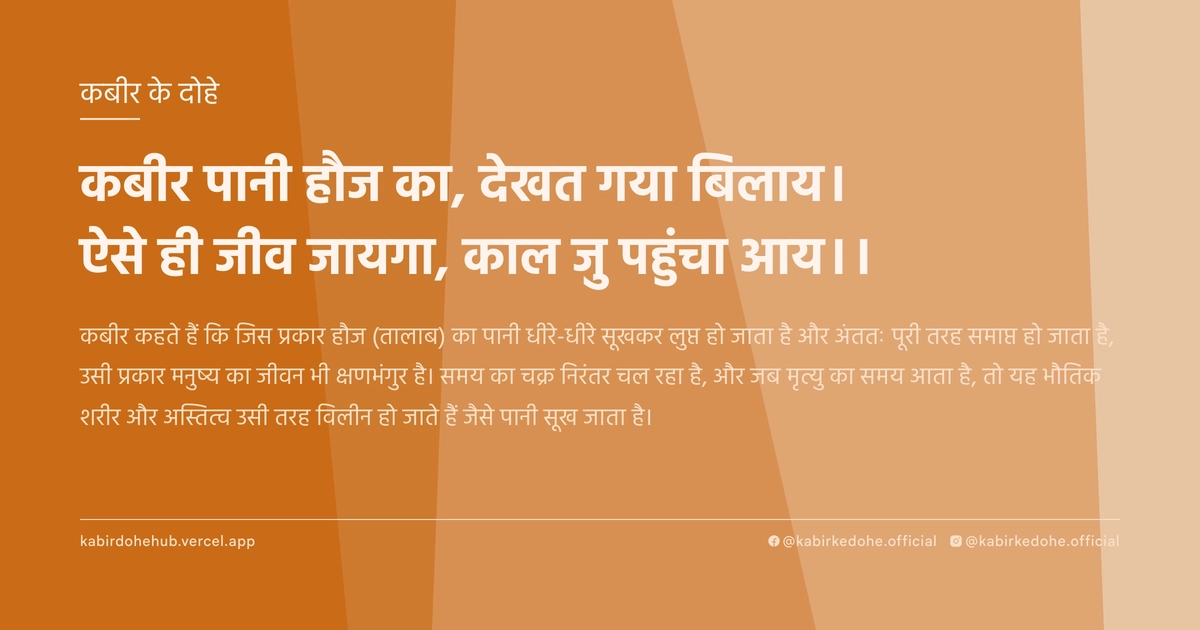
कबीर पानी हौज का, देखत गया बिलाय।
ऐसे ही जीव जायगा, काल जु पहुंचा आय।।
Kabir paani hauj ka, dekhat gaya bilay. Aise hi jeev jaayga, kaal ju pahuncha aay.
इस पृष्ठ पर इस कबीर दोहे का अर्थ (meaning), हिंदी व्याख्या और अंग्रेज़ी अनुवाद, दार्शनिक विश्लेषण और व्यावहारिक जीवन सीख दी गई है। यह दोहा अनित्य (Impermanence) विषय से जुड़ा है — Kabir doha meaning and explanation in Hindi and English.
अर्थ (Meaning):
कबीर कहते हैं कि जिस प्रकार हौज (तालाब) का पानी धीरे-धीरे सूखकर लुप्त हो जाता है और अंततः पूरी तरह समाप्त हो जाता है, उसी प्रकार मनुष्य का जीवन भी क्षणभंगुर है। समय का चक्र निरंतर चल रहा है, और जब मृत्यु का समय आता है, तो यह भौतिक शरीर और अस्तित्व उसी तरह विलीन हो जाते हैं जैसे पानी सूख जाता है।
Kabir observes that just as the water in a reservoir gradually evaporates and vanishes from sight, the human life is inherently transient. The flow of time is relentless, and when the appointed hour of death arrives, the physical existence and the individual soul's earthly presence dissolve into nothingness, mirroring the disappearance of water from a drying pond.
व्याख्या (Interpretation):
इस दोहे का शाब्दिक अर्थ जल के वाष्पीकरण और जीवन की नश्वरता के बीच एक तुलना है। रूपक के स्तर पर, 'हौज का पानी' हमारी सांसारिक पहचान, अहंकार और भौतिक शरीर का प्रतीक है। कबीर यहाँ 'माया' के प्रभाव को दर्शा रहे हैं, जहाँ मनुष्य को लगता है कि उसका अस्तित्व स्थायी है, जबकि वह वास्तव में रेत की तरह फिसल रहा है। यह निर्गुण भक्ति का सार है—यह समझना कि केवल वह 'अविनाशी' तत्व (ब्रह्म) सत्य है, जबकि यह शरीर और समयबद्ध जीवन केवल एक भ्रम है। जब 'काल' (समय/मृत्यु) आता है, तो व्यक्ति की सारी उपलब्धियां और उसकी पहचान शून्य हो जाती हैं। यह द्वैत से अद्वैत की ओर ले जाने वाला संकेत है, जहाँ जीव को यह बोध होता है कि वह शरीर नहीं, बल्कि वह चेतना है जो इस परिवर्तनशील संसार से परे है।
Literally, the couplet draws a parallel between the evaporation of water in a tank and the transience of human life. Metaphorically, the 'water in the reservoir' symbolizes our worldly identity, ego, and physical form. Kabir highlights the grip of 'Maya' (illusion), where humans perceive their existence as permanent while it is actually slipping away like sand. This aligns with Nirgun Bhakti—the realization that only the 'Imperishable' element (Brahman) is true, while the body and time-bound life are mere illusions. When 'Kaal' (Time/Death) arrives, all achievements and identities vanish. It is a pointer from duality to non-duality (Advaita), urging the soul to recognize itself not as the body, but as the consciousness that transcends this shifting world.
दार्शनिक विश्लेषण (Philosophical Analysis):
कबीर का यह दर्शन उनके युग के कट्टरपंथी कर्मकांडों और बाहरी आडंबरों के विरुद्ध एक सशक्त प्रहार है। उन्होंने देखा कि लोग तीर्थों और मंदिरों में समय व्यर्थ करते हैं, जबकि उनकी जीवन-ऊर्जा निरंतर घट रही है। यह विश्लेषण अद्वैत वेदांत के उस सिद्धांत से मेल खाता है जहाँ संसार को 'मिथ्या' कहा गया है। कबीर का तर्क है कि यदि हम केवल बाहरी शरीर और सामाजिक स्थिति (जाति, पद) से चिपके रहे, तो हम उस पानी की तरह होंगे जो सूखने के बाद कुछ नहीं छोड़ता।
सूफी मत के 'फना' (अहंकार का विनाश) के सिद्धांत के समान, कबीर यहाँ जीव को अपने 'अहं' को समय से पहले ही विलीन करने की प्रेरणा देते हैं। यदि मृत्यु हमें जबरन विलीन करती है, तो वह दुखदायी है; लेकिन यदि हम ज्ञान के माध्यम से स्वयं को ब्रह्म में विलीन कर लें, तो वह मोक्ष है। यह मनोवैज्ञानिक रूपांतरण की प्रक्रिया है जहाँ भय को जागरूकता में बदला जाता है।
ऐतिहासिक रूप से, कबीर ने समाज को यह याद दिलाया कि मृत्यु जाति, धर्म और वर्ग नहीं देखती। एक राजा और एक भिखारी दोनों का 'पानी' एक ही गति से सूखता है। यह सामाजिक समानता का सबसे गहरा आध्यात्मिक आधार है।
अक्सर लोग इस दोहे को केवल निराशावादी या मृत्यु-केंद्रित मानते हैं, लेकिन वास्तव में यह 'जागरूकता' का आह्वान है। यह हमें वर्तमान क्षण की कीमत समझने और उस शाश्वत सत्य की खोज करने के लिए प्रेरित करता है जो समय के प्रभाव से मुक्त है।
अंततः, यह विश्लेषण इस बात पर जोर देता है कि जीवन का उद्देश्य केवल जीवित रहना नहीं, बल्कि उस स्रोत को पहचानना है जहाँ से हम आए हैं और जहाँ हमें वापस जाना है। जब हम इस सत्य को स्वीकार कर लेते हैं, तो मृत्यु का भय समाप्त हो जाता है और हम पूर्ण स्वतंत्रता का अनुभव करते हैं।
Kabir's philosophy here is a potent strike against the rigid ritualism and outward ostentations of his era. He observed people wasting their lives in pilgrimages and temples while their vital energy was relentlessly depleting. This analysis aligns with the Advaita Vedanta principle where the empirical world is termed 'Mithya' (illusory). Kabir argues that if we cling only to the physical body and social status (caste, rank), we become like that water which leaves nothing behind after drying up.
Similar to the Sufi concept of 'Fana' (the annihilation of the ego), Kabir inspires the seeker to dissolve their 'I-ness' before time forces it. If death dissolves us forcibly, it is painful; but if we dissolve ourselves into Brahman through knowledge, it is liberation (Mukti). This is a process of psychological transformation where fear is converted into awareness.
Historically, Kabir reminded society that death recognizes no caste, religion, or class. The 'water' of a king and a beggar dries up at the same pace. This provides the deepest spiritual foundation for social equality.
Often, this doha is misinterpreted as pessimistic or death-centric, but it is actually a call for 'Mindfulness.' It urges us to value the present moment and seek the eternal truth that remains untouched by the ravages of time.
Ultimately, this analysis emphasizes that the purpose of life is not merely to survive, but to recognize the Source from which we emerged and to which we must return. Once this truth is embraced, the fear of death vanishes, and one experiences absolute freedom.
मूल संदेश (Core Message):
- अहंकार एक भ्रम है जो समय की लहरों में मिट जाता है।
- नश्वरता को स्वीकार करना ही वास्तविक स्वतंत्रता की पहली सीढ़ी है।
- बाहरी पहचानों का मोह केवल मानसिक बंधन पैदा करता है।
- मृत्यु अंत नहीं, बल्कि एक अस्थायी रूप का विसर्जन है।
- शाश्वत सत्य केवल वह है जो समय और परिवर्तन से परे है।
- वर्तमान क्षण में जागना ही काल के भय से मुक्ति है।
- The ego is an illusion that dissolves in the waves of time.
- Accepting impermanence is the first step toward true liberation.
- Attachment to external identities creates only mental bondage.
- Death is not an end, but the dissolution of a temporary form.
- Eternal truth is only that which exists beyond time and change.
- Awakening in the present moment is the only escape from the fear of time.
व्यावहारिक उदाहरण (Practical Example):
वाराणसी के एक पुराने घाट पर रहने वाली एक वृद्ध विधवा, जानकी, का जीवन केवल अपनी छोटी सी दुनिया और अपनी पुरानी यादों के इर्द-गिर्द सिमटा हुआ था। वह हर दिन गंगा किनारे बैठकर उन लोगों को देखती थी जो जीवन की दौड़ में व्यस्त थे। जानकी का मानना था कि उसकी पहचान उसके मृत पति के प्रति उसकी निष्ठा और उसके विधवा धर्म के कठोर पालन में है। वह अपनी इस पहचान को बहुत मजबूती से पकड़े हुए थी, जैसे वह पानी का आखिरी कतरा हो।
एक दिन, उसने एक युवा साधु को देखा जो किनारे पर रेत से चित्र बना रहा था। लहरें आतीं और उन चित्रों को मिटा देतीं, लेकिन साधु के चेहरे पर एक गहरी शांति थी। जानकी ने उससे पूछा, 'तुम्हें दुख नहीं होता कि तुम्हारी मेहनत मिट रही है?'
साधु ने मुस्कुराकर जवाब दिया, 'माँ, यह रेत का चित्र ही तो है। अगर मैं इसे स्थायी मान लूँ, तो हर लहर मुझे दुखी करेगी। लेकिन अगर मैं जान लूँ कि यह मिटने के लिए ही बना है, तो मैं हर लहर का स्वागत करूँगा।'
यह शब्द जानकी के हृदय में एक बिजली की तरह कौंध गए। उसे अचानक महसूस हुआ कि उसने पिछले तीस वर्षों से जिस 'दुख' और 'पहचान' को संजोकर रखा था, वह भी उसी रेत के चित्र की तरह था। उसने अपनी विधवा की पहचान, अपने सामाजिक दुख और अपनी कड़वाहट को एक बोझ की तरह ढोया था, यह सोचकर कि यही उसका सत्य है।
उसने महसूस किया कि वह भी उस हौज के पानी की तरह थी, जो धीरे-धीरे सूख रहा था, लेकिन उसने उस सूखने की प्रक्रिया को ही अपना जीवन मान लिया था। उसने अपनी पहचान को 'दुखी विधवा' से बदलकर 'एक मुक्त आत्मा' के रूप में देखना शुरू किया।
उसने अपने घर के दरवाजे उन बच्चों के लिए खोल दिए जिन्हें समाज ने ठुकरा दिया था। उसने अपनी कड़वाहट को करुणा में बदल दिया। अब वह अपनी यादों के मलबे में नहीं रहती थी, बल्कि वर्तमान की लहरों के साथ बहना सीख गई थी।
जब वह अंततः बिस्तर पर पड़ी, तो उसके चेहरे पर कोई भय नहीं था। उसने अपनी आँखों को बंद किया और महसूस किया कि उसका 'अहं' पूरी तरह सूख चुका है, और अब केवल वह अनंत सागर बचा है जिसमें वह विलीन होने जा रही थी।
जानकी का रूपांतरण इस बात का प्रमाण था कि जब हम अपनी अस्थायी पहचान को छोड़ देते हैं, तभी हम वास्तव में जीना शुरू करते हैं।
Janaki, an elderly widow living on an ancient ghat in Varanasi, had a life confined to her small world and old memories. Every day, sitting by the Ganges, she watched people rushing through the race of life. Janaki believed her identity lay in her loyalty to her deceased husband and the rigorous adherence to the codes of widowhood. She clung to this identity fiercely, as if it were the last drop of water in a drying pond.
One day, she noticed a young monk drawing intricate patterns in the sand by the riverbank. The waves would come and erase the drawings, yet a profound peace radiated from the monk's face. Janaki asked him, 'Does it not grieve you that your hard work is being wiped away?'
The monk smiled and replied, 'Mother, this is but a drawing in the sand. If I believe it to be permanent, every wave will bring me sorrow. But if I realize it was created to be erased, I shall welcome every wave.'
These words struck Janaki like a bolt of lightning. She suddenly realized that the 'sorrow' and 'identity' she had nurtured for the last thirty years were also like those sand drawings. She had carried her identity as a 'suffering widow' and her bitterness as a burden, believing it to be her ultimate truth.
She realized she was like the water in that reservoir, slowly drying up, yet she had mistaken the process of drying for the essence of her life. She began to shift her identity from a 'grieving widow' to a 'free soul.'
She opened the doors of her home to children rejected by society. She transformed her bitterness into compassion. No longer did she dwell in the ruins of her memories; instead, she learned to flow with the waves of the present.
When she finally lay on her deathbed, there was no fear on her face. She closed her eyes and felt that her 'ego' had completely evaporated, leaving only the infinite ocean into which she was now merging.
Janaki's transformation served as proof that only when we let go of our temporary identities do we truly begin to live.
अभ्यास मार्गदर्शन (Practice Guidance):
- दैनिक चिंतन: प्रतिदिन 15 मिनट मौन बैठें और विचार करें कि आपकी कौन सी पहचान (नाम, पद, रिश्ता) स्थायी है और कौन सी अस्थायी।
- आत्म-पूछताछ जर्नल: लिखें कि 'यदि आज मेरा सब कुछ (संपत्ति, सम्मान, शरीर) छिन जाए, तो मेरे भीतर क्या बचेगा?'
- व्यवहार परिवर्तन: किसी ऐसी वस्तु या विचार के प्रति मोह छोड़ें जिसे आप बहुत मजबूती से पकड़े हुए हैं, और देखें कि क्या आप वास्तव में उसके बिना भी पूर्ण हैं।
- निदान चेकलिस्ट: क्या आप अपनी उपलब्धियों के खोने के डर से घबराते हैं? क्या आप अपनी सामाजिक छवि को बचाने के लिए संघर्ष कर रहे हैं? यदि हाँ, तो आप अभी भी 'हौज के पानी' से चिपके हुए हैं।
- Daily Contemplation: Sit in silence for 15 minutes daily and contemplate which of your identities (name, rank, relationship) are permanent and which are transient.
- Self-Inquiry Journal: Write a response to the prompt: 'If everything I possess (wealth, honor, body) were taken away today, what would remain within me?'
- Behavioral Shift: Consciously let go of an attachment to an object or an idea you hold too tightly, and observe if you remain whole without it.
- Diagnostic Checklist: Do you panic at the thought of losing your achievements? Are you struggling to preserve your social image? If yes, you are still clinging to the 'water in the reservoir'.
चिंतन प्रश्न (Reflection Questions):
- आपकी वह कौन सी 'डिजिटल पहचान' है जिसे आप वास्तव में अपना अस्तित्व मानते हैं, जबकि वह केवल एक आभासी प्रतिबिंब है?
- यदि आपकी सामाजिक प्रतिष्ठा अचानक समाप्त हो जाए, तो क्या आप स्वयं को अभी भी मूल्यवान महसूस करेंगे?
- आप अपने जीवन के किन हिस्सों को 'स्थायी' मानकर समय व्यर्थ कर रहे हैं?
- क्या आपका डर मृत्यु से है, या उस पहचान के खोने से जिसे आपने बड़ी मेहनत से बनाया है?
- आपके भीतर का वह कौन सा हिस्सा है जो कभी नहीं सूखता, चाहे परिस्थितियाँ कैसी भी हों?
- आप अपनी आंतरिक शांति के लिए बाहरी दुनिया की किन शर्तों पर निर्भर हैं?
- Which 'digital identity' do you mistake for your actual existence, while it is merely a virtual reflection?
- If your social prestige were to vanish overnight, would you still feel inherently valuable?
- Which parts of your life are you wasting time on by assuming they are 'permanent'?
- Is your fear truly about death, or about the loss of the identity you have painstakingly constructed?
- What part of you remains undried and untouched, regardless of the external circumstances?
- Upon which external conditions do you rely for your internal peace?