
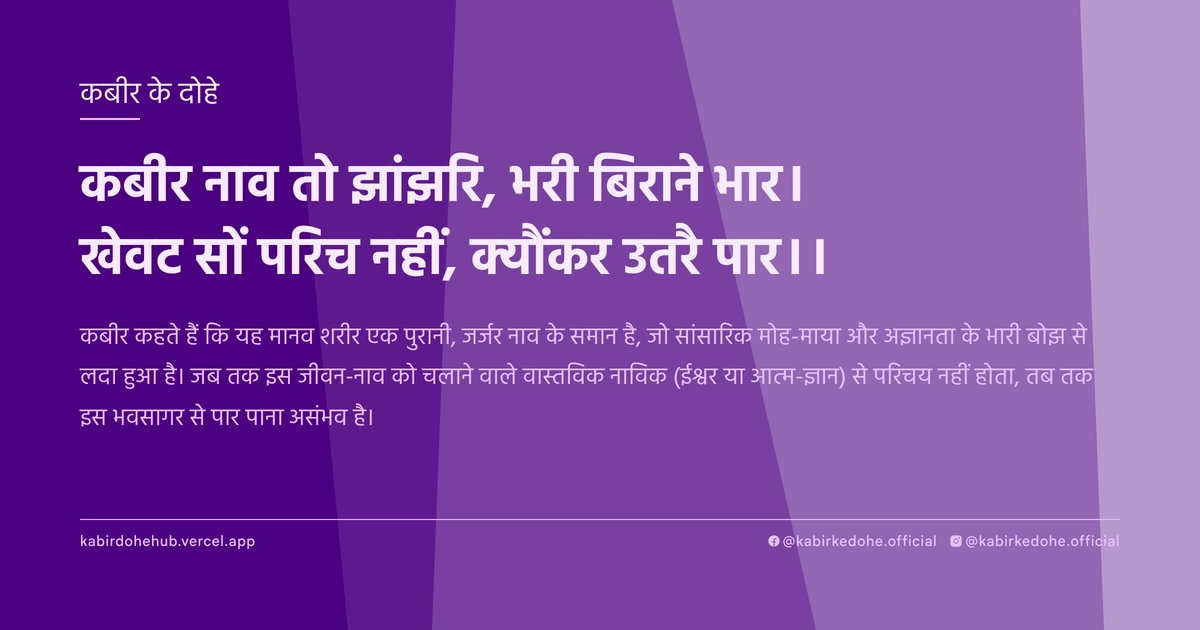
कबीर नाव तो झांझरि, भरी बिराने भार।
खेवट सों परिच नहीं, क्यौंकर उतरै पार।।
Kabir naav to jhanjhari, bhari birane bhaar. Khevat son parich nahi, kyunkar utray paar.
इस पृष्ठ पर इस कबीर दोहे का अर्थ (meaning), हिंदी व्याख्या और अंग्रेज़ी अनुवाद, दार्शनिक विश्लेषण और व्यावहारिक जीवन सीख दी गई है। यह दोहा मुक्ति (Liberation) विषय से जुड़ा है — Kabir doha meaning and explanation in Hindi and English.
अर्थ (Meaning):
कबीर कहते हैं कि यह मानव शरीर एक पुरानी, जर्जर नाव के समान है, जो सांसारिक मोह-माया और अज्ञानता के भारी बोझ से लदा हुआ है। जब तक इस जीवन-नाव को चलाने वाले वास्तविक नाविक (ईश्वर या आत्म-ज्ञान) से परिचय नहीं होता, तब तक इस भवसागर से पार पाना असंभव है।
Kabir asserts that the human body is like a fragile, leaking boat, overburdened with the heavy weights of worldly attachments and ignorance. Unless one establishes a deep, personal acquaintance with the true Boatman—the Divine Consciousness or Self-realization—it is impossible to cross the turbulent ocean of existence.
व्याख्या (Interpretation):
यहाँ 'नाव' भौतिक शरीर और मन का प्रतीक है, जो समय के साथ क्षीण होता जाता है। 'झांझरि' शब्द उस जर्जर अवस्था को दर्शाता है जहाँ अहंकार और वासनाओं ने आत्मा को घेर लिया है। 'बिराने भार' वे सांसारिक बंधन हैं जिन्हें हम अपनी पहचान मान बैठते हैं। कबीर यहाँ निर्गुण भक्ति का संकेत देते हैं, जहाँ ईश्वर किसी मूर्ति में नहीं बल्कि उस आंतरिक चेतना (खेवट) में है जो हमें माया के भ्रम से मुक्त करा सकती है। यह दोहा अद्वैत वेदांत के उस सत्य को उजागर करता है कि जब तक जीव स्वयं को शरीर मानता है, वह बंधन में रहता है; जैसे ही वह 'नाविक' यानी शुद्ध आत्मा को पहचानता है, द्वैत समाप्त हो जाता है और मोक्ष की प्राप्ति होती है।
In this verse, the 'boat' symbolizes the physical body and the psyche, which inevitably decay over time. The term 'jhanjhari' denotes a dilapidated state where the soul is besieged by ego and cravings. The 'foreign burdens' represent the worldly attachments we mistakenly identify as our true self. Kabir points toward Nirgun Bhakti, suggesting that the Divine is not found in idols but in the internal consciousness (the Boatman) capable of liberating us from the illusion of Maya. This doha illuminates the Advaita Vedanta truth: as long as the individual identifies with the body, they remain bound; once they recognize the 'Boatman'—the pure Atman—the duality vanishes, and liberation is achieved.
दार्शनिक विश्लेषण (Philosophical Analysis):
कबीर का यह दोहा उस युग की उपज है जब धर्म कर्मकांडों और बाहरी आडंबरों में सिमट गया था। कबीर ने स्पष्ट रूप से उन सभी रीति-रिवाजों को नकारा जो मनुष्य को उसके आंतरिक सत्य से दूर ले जाते थे। उनके लिए 'नाव' का जर्जर होना इस बात का प्रमाण है कि भौतिक शरीर नश्वर है और इस पर निर्भरता व्यर्थ है।
दार्शनिक स्तर पर, यह सूफी मत के 'फना' (अहंकार का विनाश) और वेदांत के 'माया' सिद्धांत का संगम है। कबीर तर्क देते हैं कि हम जीवन भर बाहरी बोझ (संपत्ति, पद, प्रतिष्ठा) इकट्ठा करते हैं, जबकि वास्तविक आवश्यकता उस नाविक को खोजने की है जो हमें इस संसार से परे ले जाए।
यहाँ 'खेवट' या नाविक केवल एक बाहरी शक्ति नहीं है, बल्कि वह अंतर्निहित चेतना है जो हर जीव में मौजूद है। कबीर का प्रहार उन लोगों पर है जो केवल शास्त्रों को पढ़ते हैं लेकिन अनुभव (अनुभव ज्ञान) से वंचित हैं। बिना व्यक्तिगत अनुभव के, ईश्वर केवल एक शब्द बनकर रह जाता है, नाविक नहीं।
यह विश्लेषण दर्शाता है कि कैसे कबीर जाति और धर्म की दीवारों को तोड़कर एक सार्वभौमिक सत्य की बात करते हैं। उनके अनुसार, चाहे कोई पंडित हो या मौलवी, यदि उसकी नाव अज्ञान के भार से दबी है और वह अपने भीतर के नाविक से अपरिचित है, तो वह भी उतना ही असहाय है जितना कोई अन्य।
अंततः, यह दोहा मनोवैज्ञानिक रूपांतरण की मांग करता है। यह हमें सिखाता है कि मुक्ति बाहरी यात्रा नहीं, बल्कि आंतरिक परिचय है। जब 'मैं' (अहंकार) का भार गिरता है, तब नाविक स्वतः प्रकट हो जाता है, क्योंकि वह हमेशा वहीं था, बस हमारी दृष्टि अवरुद्ध थी।
This doha is a product of an era where religion had shrunk into mere rituals and outward displays. Kabir explicitly rejected all customs that distanced humans from their internal truth. For him, the 'dilapidated boat' is evidence that the physical body is ephemeral and relying upon it is futile.
On a philosophical level, this is a confluence of the Sufi concept of 'Fana' (annihilation of the ego) and the Vedantic theory of 'Maya'. Kabir argues that we spend our lives accumulating external burdens—wealth, status, prestige—while the actual necessity is to find the Boatman who can ferry us beyond this mundane existence.
The 'Khewat' or Boatman is not merely an external deity but the inherent consciousness residing within every being. Kabir attacks those who merely read scriptures but lack direct experiential knowledge (Anubhava). Without personal realization, God remains a mere word, not a guide.
This analysis reveals how Kabir transcends the boundaries of caste and creed to speak a universal truth. According to him, whether one is a priest or a cleric, if their boat is weighed down by ignorance and they are strangers to their inner Boatman, they are as helpless as anyone else.
Ultimately, this doha demands a psychological transformation. It teaches that liberation is not an external journey but an internal introduction. When the burden of the 'I' (ego) is dropped, the Boatman manifests spontaneously, for He was always there, obscured only by our own blindness.
मूल संदेश (Core Message):
- शरीर नश्वर है, इसे स्थायी घर न मानें।
- अहंकार वह बोझ है जो आत्मा को डुबो देता है।
- बाहरी कर्मकांडों से ऊपर उठकर आंतरिक ज्ञान खोजें।
- सच्चा नाविक आपकी अपनी शुद्ध चेतना है।
- सांसारिक मोह का त्याग ही वास्तविक मुक्ति का मार्ग है।
- The body is ephemeral; do not mistake it for a permanent home.
- Ego is the weight that sinks the soul.
- Rise above external rituals to seek internal realization.
- The true Boatman is your own pure consciousness.
- Renouncing worldly attachment is the only path to liberation.
व्यावहारिक उदाहरण (Practical Example):
वाराणसी के एक पुराने घाट पर माधव नाम का एक वृद्ध नाविक रहता था। माधव का जीवन केवल नाव चलाने और यात्रियों को पार उतारने में बीता था। वह स्वयं को बहुत कुशल मानता था, लेकिन उसके मन में हमेशा एक बेचैनी रहती थी। वह अपनी नाव को सबसे सुंदर बनाने की कोशिश करता, नए रंग लगाता, लेकिन उसकी नाव पुरानी हो चुकी थी और उसमें कई छेद थे।
माधव का पूरा ध्यान इस बात पर था कि लोग उसकी नाव की प्रशंसा करें। वह अपनी नाव में सोने के वर्क और महंगे कपड़ों से सजावट करता, जिससे नाव का वजन बढ़ गया और वह धीरे चलने लगी। वह जितना अधिक सजावट करता, नाव उतनी ही गहराई में डूबती जाती।
एक दिन एक फकीर उसकी नाव में सवार हुआ। फकीर ने देखा कि माधव नाव को चलाने से ज्यादा उसकी बाहरी चमक को निहार रहा था। फकीर ने मुस्कुराते हुए कहा, 'माधव, तूने नाव को तो सजा लिया, लेकिन क्या तूने उस पानी को देखा है जिसमें यह तैर रही है? और क्या तूने उस नाविक को पहचाना है जो वास्तव में तुझे पार लगाएगा?'
माधव ने गर्व से कहा, 'मैं ही तो नाविक हूँ!' फकीर ने जवाब दिया, 'तू केवल शरीर का चालक है, आत्मा का नहीं। तूने अपनी नाव को बाहरी बोझ से भर दिया है, इसलिए तू खुद को डूबता हुआ महसूस कर रहा है।'
माधव को पहली बार अहसास हुआ कि उसकी 'सजावट' वास्तव में उसके अहंकार का बोझ था। उसने महसूस किया कि वह अपनी पहचान अपनी नाव और उसकी प्रसिद्धि से जोड़ चुका था, जबकि वह स्वयं एक जर्जर शरीर के भीतर कैद था।
उस रात माधव ने अपनी नाव की सारी अनावश्यक सजावट उतार फेंकी। उसने महसूस किया कि जितना कम बोझ होगा, नाव उतनी ही हल्की होगी। उसने बाहरी दिखावे को छोड़कर मौन में बैठना शुरू किया और अपने भीतर की शांति को खोजना चाहा।
धीरे-धीरे माधव का व्यवहार बदलने लगा। वह अब यात्रियों से पैसे लेने के बजाय उनकी सेवा करने लगा। उसने पाया कि जब उसने 'मैं सबसे बड़ा नाविक हूँ' का भ्रम छोड़ा, तो उसे एक ऐसी आंतरिक शक्ति का अनुभव हुआ जिसने उसे वास्तव में शांत कर दिया।
अब उसकी नाव भले ही पुरानी थी, लेकिन वह पानी पर तैर रही थी क्योंकि उसका भार अब अहंकार नहीं, बल्कि करुणा थी। माधव ने जान लिया था कि असली पार उतरना भौतिक तट तक पहुँचना नहीं, बल्कि मन के शोर से मुक्त होना है।
On an ancient ghat in Varanasi lived an elderly boatman named Madhav. Madhav's entire life had been spent rowing and ferrying passengers across the river. He considered himself highly skilled, yet a constant restlessness plagued his mind. He strove to make his boat the most beautiful, applying new paints, though the boat was old and riddled with leaks.
Madhav's entire focus was on gaining praise for his boat. He adorned it with gold leaf and expensive fabrics, which increased the boat's weight and slowed it down. The more he decorated, the deeper the boat sank into the water.
One day, a wandering dervish boarded his boat. The dervish noticed that Madhav was more concerned with the external shimmer than the act of rowing. Smiling, the dervish asked, 'Madhav, you have decorated the boat, but have you looked at the water in which it floats? And have you recognized the Boatman who will truly ferry you across?'
Madhav replied proudly, 'I am the boatman!' The dervish answered, 'You are merely the driver of the body, not the soul. You have filled your boat with external burdens, and that is why you feel yourself sinking.'
For the first time, Madhav realized that his 'decorations' were actually the burdens of his ego. He understood that he had tied his identity to his boat and its fame, while he himself was imprisoned within a decaying body.
That night, Madhav stripped away all the unnecessary adornments from his boat. He realized that the lighter the load, the easier the boat would float. Abandoning external show, he began to sit in silence, seeking the peace within.
Gradually, Madhav's behavior transformed. Instead of focusing on the fares, he began to serve his passengers with genuine love. He discovered that once he dropped the illusion of 'I am the greatest boatman,' he experienced an inner power that brought him true tranquility.
Now, though his boat remained old, it glided effortlessly on the water because its weight was no longer ego, but compassion. Madhav had learned that truly crossing over is not about reaching a physical shore, but about becoming free from the noise of the mind.
अभ्यास मार्गदर्शन (Practice Guidance):
- प्रतिदिन 20 मिनट का मौन अभ्यास करें, जहाँ आप स्वयं को केवल एक 'साक्षी' के रूप में देखें, न कि कर्ता के रूप में।
- एक डायरी लिखें जिसमें उन 'सांसारिक बोझों' (जैसे पद, प्रतिष्ठा, दूसरों की राय) की सूची बनाएं जो आपकी मानसिक शांति को बाधित कर रहे हैं।
- स्व-पूछताछ (Self-Inquiry) का अभ्यास करें: जब भी क्रोध या अहंकार जागे, पूछें 'यह बोझ कौन ढो रहा है? क्या यह वास्तव में मैं हूँ?'
- निदान चेकलिस्ट: क्या आप अभी भी अपनी पहचान अपनी उपलब्धियों से जोड़ते हैं? क्या आप बाहरी प्रशंसा के बिना अधूरा महसूस करते हैं? यदि हाँ, तो आपकी नाव अभी भी बोझिल है।
- Practice 20 minutes of daily silence, observing yourself solely as a 'witness' rather than the 'doer'.
- Maintain a journal listing the 'worldly burdens' (such as status, prestige, or others' opinions) that obstruct your mental peace.
- Engage in Self-Inquiry: Whenever anger or ego arises, ask, 'Who is carrying this burden? Is this truly me?'
- Diagnostic Checklist: Do you still tie your identity to your achievements? Do you feel incomplete without external validation? If yes, your boat is still overburdened.
चिंतन प्रश्न (Reflection Questions):
- मेरी वह कौन सी 'सजावट' है जिसे मैं अपनी पहचान मानता हूँ, लेकिन वह वास्तव में एक बोझ है?
- यदि आज मेरी सारी सामाजिक प्रतिष्ठा छीन ली जाए, तो मेरे भीतर क्या बचेगा?
- मैं अपनी डिजिटल पहचान (Social Media Ego) को पालने के लिए कितनी मानसिक ऊर्जा व्यर्थ कर रहा हूँ?
- क्या मैं वास्तव में अपने जीवन का नाविक हूँ, या मैं केवल परिस्थितियों की लहरों द्वारा संचालित हूँ?
- मेरे जीवन में 'बिराने भार' (पराए बोझ) कौन से हैं जिन्हें मैंने अपना मान लिया है?
- What 'decorations' do I consider my identity, which are actually burdens?
- If all my social prestige were stripped away today, what would remain within me?
- How much mental energy am I wasting to sustain my digital identity (Social Media Ego)?
- Am I truly the boatman of my life, or am I merely driven by the waves of circumstance?
- What are the 'foreign burdens' in my life that I have mistakenly claimed as my own?