
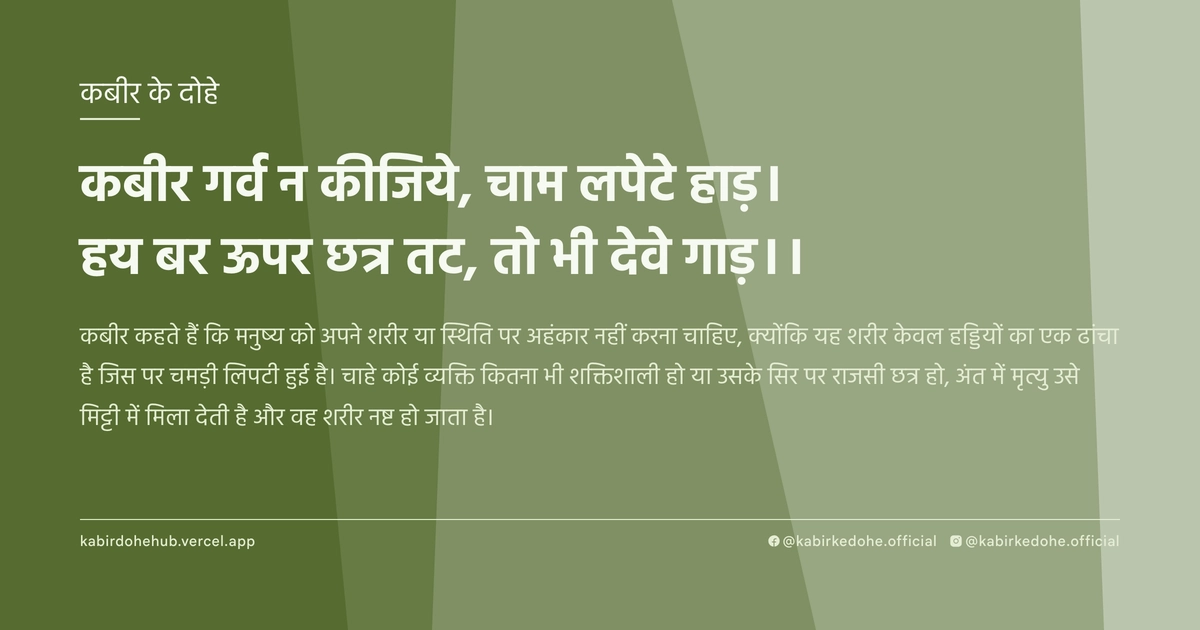
कबीर गर्व न कीजिये, चाम लपेटे हाड़।
हय बर ऊपर छत्र तट, तो भी देवे गाड़।।
Kabir garv na kariye, cham lapete haad. Hay bar upar chhatra tat, to bhi deve gaad.
इस पृष्ठ पर इस कबीर दोहे का अर्थ (meaning), हिंदी व्याख्या और अंग्रेज़ी अनुवाद, दार्शनिक विश्लेषण और व्यावहारिक जीवन सीख दी गई है। यह दोहा अभिमान (Pride) विषय से जुड़ा है — Kabir doha meaning and explanation in Hindi and English.
अर्थ (Meaning):
कबीर कहते हैं कि मनुष्य को अपने शरीर या स्थिति पर अहंकार नहीं करना चाहिए, क्योंकि यह शरीर केवल हड्डियों का एक ढांचा है जिस पर चमड़ी लिपटी हुई है। चाहे कोई व्यक्ति कितना भी शक्तिशाली हो या उसके सिर पर राजसी छत्र हो, अंत में मृत्यु उसे मिट्टी में मिला देती है और वह शरीर नष्ट हो जाता है।
Kabir warns against the vanity of human existence, reminding us that the body is merely a skeletal frame wrapped in skin. Regardless of one's status, power, or the royal canopy of prestige they may hold in life, death is the ultimate equalizer that buries every ego beneath the earth.
व्याख्या (Interpretation):
इस दोहे का शाब्दिक अर्थ शारीरिक नश्वरता की याद दिलाना है। गहरे स्तर पर, यह 'माया' के उस भ्रम का विश्लेषण है जहाँ मनुष्य अपनी बाहरी पहचान को ही अपनी वास्तविक सत्ता मान लेता है। कबीर यहाँ 'चाम लपेटे हाड़' के माध्यम से शरीर की क्षणभंगुरता को दर्शाते हैं, जो अद्वैत वेदांत के उस सिद्धांत से जुड़ा है कि आत्मा अविनाशी है जबकि शरीर नश्वर है। 'छत्र' यहाँ सामाजिक प्रतिष्ठा, पद और अहंकार का प्रतीक है। यह विरोधाभास है कि जिस शरीर की रक्षा के लिए मनुष्य महल और सेना खड़ी करता है, वह अंततः एक मुट्ठी मिट्टी में विलीन हो जाता है। यह बोध हमें 'निर्गुण भक्ति' की ओर ले जाता है, जहाँ बाहरी आडंबरों का त्याग कर उस निराकार सत्य की खोज की जाती है जो समय और मृत्यु से परे है।
Literally, the verse serves as a memento mori, a reminder of physical decay. Metaphorically, it dismantles the illusion of 'Maya,' where humans mistake their external identity for their eternal essence. By describing the body as 'bones wrapped in skin,' Kabir strips away the vanity of the flesh, aligning with Advaita Vedanta's premise that while the Atman is eternal, the physical vessel is transient. The 'canopy' (chhatra) symbolizes social prestige, power, and the ego's desire for protection and superiority. The central paradox lies in the futility of guarding a body that is destined for the earth. This realization steers the seeker toward 'Nirgun Bhakti,' urging a shift from the worship of form and status to the realization of the formless, timeless Truth that transcends the cycle of birth and death.
दार्शनिक विश्लेषण (Philosophical Analysis):
कबीर का यह दोहा उस युग की प्रतिक्रिया है जहाँ जाति, कुल और राजसी वैभव को आध्यात्मिक श्रेष्ठता का पैमाना माना जाता था। उन्होंने स्पष्ट रूप से कर्मकांडों और बाहरी दिखावे का खंडन किया है। दार्शनिक रूप से, यह सूफी मत के 'फना' (अहंकार का विनाश) और वेदांत के 'अहं ब्रह्मास्मि' के बीच एक सेतु है। कबीर तर्क देते हैं कि जब शरीर केवल हड्डियों का एक ढांचा है, तो 'मैं' और 'मेरा' का भाव पूरी तरह निराधार है।
यहाँ अहंकार का विलोपन ही वास्तविक मुक्ति है। कबीर का दृष्टिकोण मनोवैज्ञानिक है; वे जानते हैं कि जब तक मनुष्य अपनी मृत्यु और नश्वरता को स्वीकार नहीं करता, वह सत्य की खोज नहीं कर सकता। वे उस सामाजिक पदानुक्रम को चुनौती देते हैं जो मनुष्य को उसकी उपाधियों से आंकता है। उनके लिए, एक राजा और एक भिखारी दोनों अंततः एक ही मिट्टी में मिल जाते हैं।
यह शिक्षण हमें यह समझने पर मजबूर करता है कि जिसे हम 'अस्तित्व' कहते हैं, वह वास्तव में एक अस्थायी मुखौटा है। यह 'अद्वैत' की स्थिति है जहाँ द्वैत (मैं बनाम तुम, उच्च बनाम निम्न) समाप्त हो जाता है। जब व्यक्ति यह समझ लेता है कि उसकी भौतिक पहचान शून्य है, तब वह उस सार्वभौमिक चेतना के साथ एकाकार हो जाता है।
कबीर की इस चेतावनी का उद्देश्य डराना नहीं, बल्कि जगाना है। वे चाहते हैं कि साधक अपनी ऊर्जा को बाहरी दुनिया के 'छत्र' सजाने में व्यर्थ न करे, बल्कि आंतरिक शुद्धता पर ध्यान दे। यह भौतिकवाद के विरुद्ध एक आध्यात्मिक विद्रोह है।
अंततः, यह दोहा हमें सिखाता है कि विनम्रता कोई कमजोरी नहीं, बल्कि सर्वोच्च सत्य की पहचान है। जो व्यक्ति अपनी नश्वरता को गले लगाता है, वह वास्तव में अमरता (मोक्ष) के मार्ग पर अग्रसर होता है क्योंकि उसने उस 'अहं' को मार दिया है जो उसे परमात्मा से अलग करता था।
This verse is a visceral reaction to an era where caste, lineage, and royal splendor were mistaken for spiritual superiority. Kabir explicitly rejects ritualism and the performative nature of piety. Philosophically, this teaching acts as a bridge between the Sufi concept of 'Fana' (the annihilation of the self) and the Vedantic realization of non-duality. Kabir argues that if the body is merely a skeletal frame, the notions of 'I' and 'Mine' are fundamentally baseless.
The dissolution of the ego is presented here as the only true liberation. Kabir’s approach is deeply psychological; he recognizes that until a human accepts their own mortality and fragility, the quest for Truth remains superficial. He challenges the social hierarchies that quantify human worth through titles and possessions, asserting that the king and the beggar are identical in the eyes of the earth.
This teaching forces us to confront the reality that what we call 'identity' is merely a temporary mask. This is the essence of Advaita—the collapse of duality (the distinction between high and low, self and other). When an individual realizes their physical identity is a void, they merge with the universal consciousness.
Kabir’s warning is not intended to incite fear, but to provoke awakening. He urges the seeker not to waste spiritual energy decorating the 'canopy' of the external world, but to cultivate internal purity. It is a spiritual rebellion against the materialism of the age.
Ultimately, the verse teaches that humility is not a weakness but the recognition of the highest truth. One who embraces their mortality is actually stepping toward immortality (Moksha), for they have slain the 'ego' that served as the primary barrier between the individual soul and the Divine.
मूल संदेश (Core Message):
- शरीर केवल एक अस्थायी आवरण है, इसे स्थायी न मानें।
- अहंकार वह पर्दा है जो हमें सत्य देखने से रोकता है।
- सामाजिक प्रतिष्ठा और पद मृत्यु के सामने शून्य हैं।
- विनम्रता ही वह कुंजी है जो आत्मा के द्वार खोलती है।
- नश्वरता को स्वीकार करना ही वास्तविक स्वतंत्रता की शुरुआत है।
- बाहरी आडंबरों को त्यागकर आंतरिक शून्य में विलीन हों।
- The body is a temporary veil; do not mistake it for the eternal.
- Ego is the curtain that obscures the vision of Truth.
- Social prestige and titles are void in the face of death.
- Humility is the only key that unlocks the doors of the soul.
- Accepting mortality is the first step toward true liberation.
- Discard external ornaments to merge into the internal void.
व्यावहारिक उदाहरण (Practical Example):
वाराणसी के घाटों पर रहने वाले एक वृद्ध विधवा, जानकी की कहानी है। जानकी ने अपना पूरा जीवन धर्म और कठोर नियमों के पालन में बिताया था। वह अक्सर अन्य महिलाओं को उनके 'अशुद्ध' व्यवहार के लिए टोकती थी और स्वयं को आध्यात्मिक रूप से अधिक श्रेष्ठ मानती थी क्योंकि वह नियमों का सख्ती से पालन करती थी। उसका अहंकार उसके सफेद वस्त्रों और उसकी कठोर दिनचर्या के पीछे छिपा था।
एक दिन, जानकी ने देखा कि एक युवा लड़का, जो समाज की नजर में 'अछूत' था, एक मरते हुए कुत्ते की सेवा कर रहा था। वह लड़का बिना किसी दिखावे के, केवल करुणा के साथ उस पशु की अंतिम सांसों तक साथ रहा। जानकी ने उसे टोका कि वह एक अशुद्ध पशु को छूकर अपनी पवित्रता नष्ट कर रहा है।
उस लड़के ने बड़ी विनम्रता से उत्तर दिया, 'माँ, जब यह कुत्ता मरेगा, तो इसमें केवल हड्डियाँ बचेंगी। जब मैं मरूँगा, तो मुझमें भी केवल हड्डियाँ बचेंगी। फिर पवित्रता और अशुद्धता का यह भेद किस काम का, जब हम दोनों एक ही मिट्टी में मिलने वाले हैं?'
यह शब्द जानकी के हृदय पर प्रहार कर गए। उसे अचानक कबीर का वह बोध याद आया कि शरीर केवल 'चाम लपेटे हाड़' है। उसे महसूस हुआ कि उसकी सारी 'पवित्रता' और 'श्रेष्ठता' केवल एक मानसिक छत्र था, जिसे उसने अपने अहंकार को ढंकने के लिए ओढ़ा हुआ था।
उस क्षण जानकी का आंतरिक रूपांतरण हुआ। उसने महसूस किया कि जिस श्रेष्ठता का वह गर्व कर रही थी, वह वास्तव में एक बंधन था जिसने उसे मानवता से दूर कर दिया था।
अगले दिन से, जानकी का व्यवहार पूरी तरह बदल गया। उसने दूसरों को सुधारने की कोशिश छोड़ दी और स्वयं सेवा के मार्ग पर चल पड़ी।
वह अब घाटों पर आने वाले बीमारों और असहायों की सेवा करने लगी, बिना यह सोचे कि वे कौन हैं या किस जाति के हैं।
उसने पाया कि जब उसने अपने 'श्रेष्ठता के छत्र' को त्याग दिया, तो उसे एक ऐसी शांति मिली जो उसे वर्षों के कठोर नियमों से नहीं मिली थी।
उसकी आँखों में अब निर्णय नहीं, बल्कि करुणा थी। उसने समझ लिया था कि असली धर्म हड्डियों के ढांचे की पूजा करना नहीं, बल्कि उस चेतना को पहचानना है जो सबको जोड़ती है।
जानकी अब वास्तव में स्वतंत्र थी, क्योंकि उसने मृत्यु के सत्य को स्वीकार कर जीवन को जीना सीख लिया था।
Consider the story of Janaki, an elderly widow living on the ghats of Varanasi. Janaki had spent her entire life adhering to rigid religious codes and strict rituals. She often criticized other women for their 'impure' behavior, believing herself to be spiritually superior because of her unwavering discipline. Her ego was carefully hidden behind her white robes and her austere routine.
One day, Janaki observed a young boy, deemed 'untouchable' by society, tending to a dying dog. The boy stayed with the animal until its final breath, acting out of pure, selfless compassion without any desire for recognition.
Janaki reprimanded him, claiming he was destroying his purity by touching an impure animal. The boy replied with profound humility, 'Mother, when this dog dies, only bones will remain. When I die, only bones will remain. What use is this distinction of purity and impurity, when we are both destined for the same earth?'
These words struck Janaki like a bolt of lightning. She was suddenly reminded of Kabir’s truth: that the body is merely 'bones wrapped in skin.' She realized that her perceived 'superiority' was nothing more than a mental canopy she had used to shield her ego from the truth of her own fragility.
In that moment, a deep internal transformation occurred. She understood that the pride she took in her piety was actually a prison that had alienated her from true humanity.
From the next day, Janaki’s behavior changed completely. She stopped trying to correct others and instead embraced the path of selfless service.
She began caring for the sick and the destitute who came to the ghats, regardless of their caste or social standing.
She discovered that once she discarded the 'canopy of superiority,' she experienced a peace that years of rigid ritualism had never provided.
Her eyes, once filled with judgment, were now filled with compassion. She understood that true religion is not about polishing the skeletal frame, but recognizing the consciousness that unites all beings.
Janaki was finally free, for by accepting the truth of death, she had finally learned how to truly live.
अभ्यास मार्गदर्शन (Practice Guidance):
- प्रतिदिन 10 मिनट 'शव ध्यान' (Death Meditation) करें: कल्पना करें कि शरीर मिट्टी में मिल रहा है और केवल शुद्ध चेतना शेष है।
- आत्म-पूछताछ जर्नल: लिखें कि आपकी कौन सी सामाजिक पहचान (पद, डिग्री, रूप) आपको दूसरों से श्रेष्ठ महसूस कराती है और पूछें, 'यदि यह शरीर न रहे, तो इस पहचान का क्या मूल्य है?'
- व्यवहार परिवर्तन: दिन में कम से कम एक बार किसी ऐसे व्यक्ति की निस्वार्थ सेवा करें जिसे समाज 'निम्न' मानता है, ताकि आपके भीतर का 'छत्र' गिर सके।
- निदान चेकलिस्ट: क्या आप किसी की आलोचना करते समय स्वयं को श्रेष्ठ महसूस करते हैं? क्या आप अपनी उपलब्धियों का श्रेय केवल स्वयं को देते हैं? यदि हाँ, तो आपका अहंकार अभी सक्रिय है।
- Practice 'Death Meditation' for 10 minutes daily: Visualize the body returning to the earth, leaving only pure, formless consciousness.
- Self-Inquiry Journaling: List the social identities (titles, degrees, appearance) that make you feel superior and ask, 'If this body ceases to exist, what is the actual value of this identity?'
- Behavioral Shift: Perform one act of selfless service daily for someone marginalized by society, consciously working to dismantle your own internal 'canopy' of superiority.
- Diagnostic Checklist: Do you feel a sense of superiority while criticizing others? Do you attribute all your successes solely to your own effort? If yes, your ego is still dominating your awareness.
चिंतन प्रश्न (Reflection Questions):
- यदि आज आपकी सारी उपाधियाँ और संपत्ति छीन ली जाएँ, तो आपके पास 'मैं' कहने के लिए क्या बचेगा?
- आपकी कौन सी ऐसी गुप्त आदतें हैं जो आपको दूसरों से श्रेष्ठ दिखाती हैं, लेकिन वास्तव में आपका अहंकार बढ़ाती हैं?
- क्या आप अपनी डिजिटल पहचान (सोशल मीडिया इमेज) को ही अपना वास्तविक अस्तित्व मान बैठे हैं?
- मृत्यु का भय आपको जीवन में क्या करने से रोकता है, और यह भय आपके अहंकार से कैसे जुड़ा है?
- जब आप किसी की मदद करते हैं, तो क्या वह करुणा से प्रेरित होता है या आपकी 'दाता' होने की श्रेष्ठता से?
- क्या आप वास्तव में अपनी नश्वरता को स्वीकार करते हैं, या आप केवल शब्दों में ऐसा कहते हैं?
- If all your titles and possessions were stripped away today, what would remain of the 'I' you claim to be?
- What hidden habits do you maintain to appear superior to others, and how do these feed your ego?
- Have you mistaken your digital persona (social media image) for your actual existence?
- What does the fear of death prevent you from doing in life, and how is this fear linked to your ego?
- When you help someone, is it driven by genuine compassion or by the superiority of being the 'giver'?
- Do you truly accept your mortality, or do you merely recite the acceptance of it in words?