
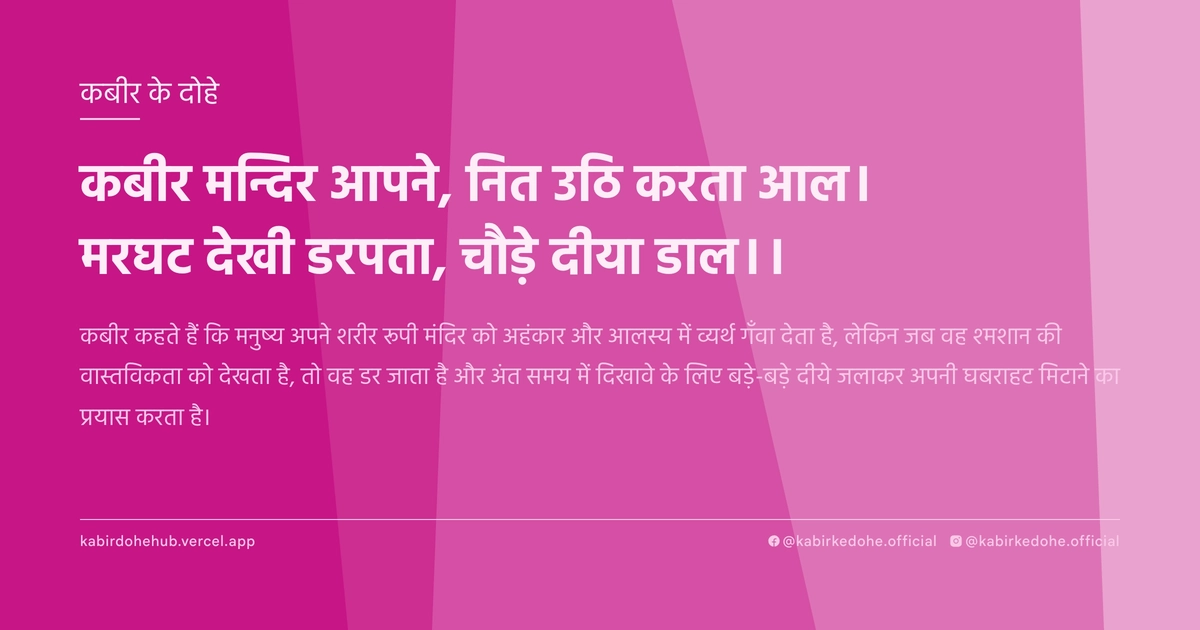
कबीर मन्दिर आपने, नित उठि करता आल।
मरघट देखी डरपता, चौड़े दीया डाल।।
Kabir mandir aapne, nit uthi karta aal. Marghat dekhi darpata, chaude diya daal.
इस पृष्ठ पर इस कबीर दोहे का अर्थ (meaning), हिंदी व्याख्या और अंग्रेज़ी अनुवाद, दार्शनिक विश्लेषण और व्यावहारिक जीवन सीख दी गई है। यह दोहा मृतुक्यता (Mortality) विषय से जुड़ा है — Kabir doha meaning and explanation in Hindi and English.
अर्थ (Meaning):
कबीर कहते हैं कि मनुष्य अपने शरीर रूपी मंदिर को अहंकार और आलस्य में व्यर्थ गँवा देता है, लेकिन जब वह श्मशान की वास्तविकता को देखता है, तो वह डर जाता है और अंत समय में दिखावे के लिए बड़े-बड़े दीये जलाकर अपनी घबराहट मिटाने का प्रयास करता है।
Kabir observes that man squanders the temple of his own body in arrogance and spiritual lethargy. However, when confronted with the stark reality of the cremation ground, he is seized by terror and attempts to mask his fear by lighting grand lamps, seeking a superficial solace in the face of inevitable death.
व्याख्या (Interpretation):
यहाँ 'मंदिर' शरीर का प्रतीक है और 'आल' मोह-माया के कारण उत्पन्न जड़ता का। कबीर संकेत करते हैं कि हम बाहरी पूजा-पाठ में समय नष्ट करते हैं जबकि वास्तविक ईश्वर भीतर है। श्मशान का भय यह दर्शाता है कि जब तक अहंकार जीवित है, मृत्यु एक बाहरी डरावनी घटना है, लेकिन जब अहंकार मिटता है, तब मृत्यु केवल एक परिवर्तन है। यह दोहा निर्गुण भक्ति के उस सिद्धांत पर आधारित है जहाँ शरीर को नश्वर मानकर आत्मा के शाश्वत स्वरूप की खोज की जाती है। माया हमें यह विश्वास दिलाती है कि हम अमर हैं, और यही सबसे बड़ा भ्रम है।
The 'temple' symbolizes the human body, and 'aal' represents the spiritual inertia born of worldly attachment. Kabir suggests that we waste our existence in external rituals while the true Divine resides within. The fear of the cremation ground signifies that as long as the ego persists, death is perceived as a terrifying external event; however, once the ego dissolves, death becomes a mere transition. This doha is rooted in the Nirgun Bhakti principle of recognizing the body as transient to seek the eternal nature of the Atman. Maya creates the illusion of permanence, which is the primary obstacle to liberation.
दार्शनिक विश्लेषण (Philosophical Analysis):
कबीर का यह दोहा तत्कालीन समाज में व्याप्त कर्मकांडीय पाखंड पर एक तीखा प्रहार है। वे देखते हैं कि लोग मंदिरों और मस्जिदों में समय बिताते हैं, लेकिन अपने स्वयं के अंतर्मन की शुद्धि के लिए कोई प्रयास नहीं करते। यह दृष्टिकोण अद्वैत वेदांत के करीब है, जहाँ शरीर को 'माया' का एक आवरण माना गया है। कबीर का तर्क है कि यदि व्यक्ति अपने शरीर को ही मंदिर मानकर उसमें साधना करे, तो उसे बाहरी तीर्थों की आवश्यकता नहीं होगी।
सूफी मत के 'फना' (अहंकार का विनाश) के सिद्धांत के समान, कबीर यहाँ मृत्यु के भय के माध्यम से अहंकार के विसर्जन की बात कर रहे हैं। जब मनुष्य यह समझ जाता है कि वह केवल यह हाड़-मांस का शरीर नहीं है, बल्कि वह उस अनंत ब्रह्म का अंश है, तब श्मशान का भय समाप्त हो जाता है। यह मनोवैज्ञानिक रूपांतरण है जहाँ भय, जागरूकता में बदल जाता है।
ऐतिहासिक रूप से, कबीर ने जाति और धर्म के बंधनों को तोड़कर एक ऐसी आध्यात्मिकता पेश की जो अनुभव पर आधारित थी, न कि शास्त्रों के रटने पर। वे चेतावनी देते हैं कि मृत्यु के समय किया गया पश्चाताप या दिखावा (बड़े दीये जलाना) व्यर्थ है। वास्तविक तैयारी जीवन के दौरान आत्म-साक्षात्कार के माध्यम से होनी चाहिए।
यहाँ 'चौड़े दीया' का अर्थ केवल भौतिक दीपक नहीं, बल्कि मृत्यु के समय किए जाने वाले आडंबरपूर्ण अनुष्ठान हैं। कबीर यह समझाते हैं कि जो व्यक्ति जीवन भर जागृत नहीं रहा, वह अंत समय में भयभीत होकर बाहरी सहारे खोजता है। यह एक गहरा मनोवैज्ञानिक विश्लेषण है कि कैसे मनुष्य अपनी आंतरिक शून्यता को बाहरी शोर और चमक से भरने की कोशिश करता है।
अंततः, यह दोहा हमें 'जीवन्मुक्ति' की ओर ले जाता है। जब हम जीवित रहते हुए ही अपनी नश्वरता को स्वीकार कर लेते हैं और अहंकार का त्याग कर देते हैं, तो हम मृत्यु के भय से मुक्त हो जाते हैं। यही निर्गुण भक्ति का सार है—बिना किसी आकार या मूर्ति के, केवल शुद्ध चेतना के साथ एक होना।
This doha is a sharp critique of the ritualistic hypocrisy prevalent in Kabir's era. He observes people spending lifetimes in temples and mosques while neglecting the purification of their own inner selves. This perspective aligns closely with Advaita Vedanta, where the body is viewed as a veil of 'Maya'. Kabir argues that if one treats the body as the true temple and practices internal discipline, external pilgrimages become redundant.
Parallel to the Sufi concept of 'Fana' (the annihilation of the ego), Kabir uses the fear of the cremation ground to advocate for the dissolution of the self. When a person realizes they are not merely this frame of flesh and bone, but a spark of the infinite Brahman, the terror of the graveyard vanishes. This is a psychological transformation where fear is transmuted into awareness.
Historically, Kabir dismantled caste and religious barriers to present a spirituality based on direct experience rather than scriptural rote learning. He warns that repentance or ostentatious displays (lighting grand lamps) at the hour of death are futile. True preparation must occur during life through the realization of the Self.
The 'wide lamps' represent not just physical lights, but the elaborate rituals performed during death. Kabir explains that those who remained asleep during their life seek external crutches when faced with the end. This is a profound psychological analysis of how humans attempt to fill their inner void with external noise and brilliance.
Ultimately, this doha leads us toward 'Jivanmukti' (liberation while living). By accepting our mortality and shedding the ego while still alive, we transcend the fear of death. This is the essence of Nirgun Bhakti—becoming one with pure consciousness, devoid of form or idol.
मूल संदेश (Core Message):
- शरीर को मंदिर मानें, इसे वासनाओं में व्यर्थ न करें।
- अहंकार वह पर्दा है जो हमें सत्य देखने से रोकता है।
- मृत्यु का भय केवल अज्ञानता और मोह का परिणाम है।
- बाहरी दिखावा अंत समय में कोई सहायता नहीं करता।
- आंतरिक जागृति ही एकमात्र वास्तविक सुरक्षा है।
- नश्वरता को स्वीकार करना ही मुक्ति का पहला कदम है।
- Treat the body as a temple; do not waste it on fleeting desires.
- Ego is the veil that prevents us from perceiving the ultimate truth.
- The fear of death is merely a result of ignorance and attachment.
- External ostentation provides no solace at the final hour.
- Inner awakening is the only true security in existence.
- Accepting transience is the first step toward liberation.
व्यावहारिक उदाहरण (Practical Example):
वाराणसी के घाटों पर रहने वाले एक वृद्ध बुनकर, रामदीन की कहानी है। रामदीन ने अपना पूरा जीवन केवल बेहतरीन रेशमी कपड़े बुनने और धन संचय करने में बिता दिया। वह खुद को शहर का सबसे कुशल बुनकर मानता था और उसका अहंकार उसके कपड़ों की चमक से भी अधिक था।
वह अक्सर अन्य बुनकरों को नीचा दिखाता और यह मानता कि उसकी सामाजिक प्रतिष्ठा ही उसकी असली पहचान है। उसने कभी भी ध्यान या आत्म-चिंतन में समय नहीं लगाया, क्योंकि उसे लगता था कि उसके पास समय की कमी है।
एक दिन, रामदीन ने अपने सबसे करीबी मित्र को श्मशान घाट पर जलते देखा। उस दृश्य ने उसे भीतर तक हिला दिया। उसने देखा कि जिस मित्र के पास उससे भी अधिक धन और प्रतिष्ठा थी, वह अब केवल राख की एक ढेरी बन चुका था।
उस रात रामदीन सो नहीं सका। उसे महसूस हुआ कि उसने अपने शरीर रूपी मंदिर को केवल बाहरी चमक-धमक और अहंकार की धूल से भर दिया है। उसने महसूस किया कि वह अब तक एक गहरी नींद (आल) में था।
उसने देखा कि लोग अपने मृत परिजनों के लिए महंगे दीये और फूल चढ़ा रहे थे, लेकिन वह जानता था कि यह सब केवल जीवितों को तसल्ली देने के लिए था। वह 'चौड़े दीयों' का ढोंग उसे अब व्यर्थ लगने लगा।
अगले दिन से रामदीन ने अपना जीवन बदल लिया। उसने अपनी कमाई का एक बड़ा हिस्सा गरीबों में बाँटना शुरू किया और हर सुबह शांत बैठकर अपनी सांसों का अवलोकन करने लगा।
उसने अब रेशम की चमक में नहीं, बल्कि आत्मा की शांति में आनंद खोजना शुरू किया। उसका अहंकार धीरे-धीरे पिघलने लगा और वह दूसरों के प्रति करुणा से भर गया।
जब वर्षों बाद रामदीन की मृत्यु का समय आया, तो उसके चेहरे पर कोई भय नहीं था। उसने कोई बड़ा अनुष्ठान नहीं माँगा, क्योंकि उसने अपने भीतर के मंदिर को पहले ही शुद्ध कर लिया था।
उसका जीवन अब एक उदाहरण बन गया था कि कैसे मृत्यु का बोध हमें वास्तव में जीना सिखाता है। वह अब श्मशान से डरने वाला व्यक्ति नहीं, बल्कि सत्य को जानने वाला साधक था।
रामदीन की यह यात्रा दिखाती है कि जब हम बाहरी दिखावे को छोड़कर आंतरिक सत्य को अपनाते हैं, तभी हम वास्तविक मुक्ति प्राप्त करते हैं।
This is the story of Ramdeen, an elderly weaver living on the ghats of Varanasi. Ramdeen spent his entire life crafting the finest silk fabrics and accumulating wealth. He considered himself the most skilled weaver in the city, and his ego was more brilliant than the sheen of his fabrics.
He often belittled other weavers, believing that his social prestige was his true identity. He never invested time in meditation or self-reflection, feeling that he was too busy with the demands of his trade.
One day, Ramdeen witnessed the cremation of his closest friend. The sight shook him to his core. He saw that his friend, who possessed even more wealth and prestige than he did, was now nothing more than a pile of ash.
That night, Ramdeen could not sleep. He realized that he had filled the temple of his body with nothing but external glitter and the dust of arrogance. He felt that he had been living in a profound spiritual slumber (aal).
He observed people offering expensive lamps and flowers to the deceased, but he realized this was merely to comfort the living. The pretense of 'wide lamps' now seemed utterly futile to him.
From the next day, Ramdeen transformed his life. He began donating a large portion of his earnings to the poor and started spending every morning in silent observation of his breath.
He stopped seeking joy in the luster of silk and began finding it in the peace of the soul. His ego gradually melted away, replaced by a deep compassion for others.
Years later, when the time of Ramdeen's passing arrived, there was no fear on his face. He requested no grand rituals, for he had already purified the temple within.
His life became a testament to how the awareness of death can actually teach us how to live. He was no longer a man terrified of the graveyard, but a seeker who had known the Truth.
Ramdeen's journey demonstrates that when we abandon external appearances and embrace internal truth, we attain genuine liberation.
अभ्यास मार्गदर्शन (Practice Guidance):
- प्रतिदिन 20 मिनट मौन रहकर इस विचार पर चिंतन करें कि शरीर नश्वर है और केवल चेतना शाश्वत है।
- एक डायरी लिखें जिसमें आप अपने उन व्यवहारों को दर्ज करें जो अहंकार (Ego) से प्रेरित थे और उन्हें सुधारने का संकल्प लें।
- सेवा का अभ्यास करें: बिना किसी पहचान की इच्छा के किसी अनजान व्यक्ति की मदद करें ताकि 'मैं' का भाव मिट सके।
- निदान चेकलिस्ट: क्या मैं अभी भी दूसरों से अपनी तुलना कर रहा हूँ? क्या मैं मृत्यु के विचार से डरता हूँ? क्या मेरी खुशी बाहरी वस्तुओं पर निर्भर है? (यदि हाँ, तो आप अभी भी 'आल' में हैं)।
- Spend 20 minutes daily in silence, contemplating that the body is transient and only consciousness is eternal.
- Maintain a journal recording behaviors driven by ego, consciously resolving to transform them into humility.
- Practice selfless service: help a stranger without seeking recognition to dissolve the sense of 'I' or individual identity.
- Diagnostic Checklist: Am I still comparing myself to others? Do I fear the thought of death? Is my happiness dependent on external objects? (If yes, you are still in spiritual slumber).
चिंतन प्रश्न (Reflection Questions):
- यदि आज मेरा अंतिम दिन हो, तो क्या मेरा 'सार्वजनिक व्यक्तित्व' मेरे 'वास्तविक स्वरूप' से मेल खाता है?
- मैं अपनी उपलब्धियों के माध्यम से किस तरह के 'अदृश्य मंदिर' का निर्माण कर रहा हूँ, और क्या वह मंदिर वास्तव में मेरा है?
- मेरे जीवन का कौन सा हिस्सा केवल दूसरों को प्रभावित करने के लिए 'चौड़े दीये' जलाने जैसा है?
- क्या मैं अपनी मृत्यु के भय को छिपाने के लिए भौतिक सुखों का सहारा ले रहा हूँ?
- यदि मेरा नाम, पद और संपत्ति छीन ली जाए, तो मेरे भीतर क्या बचेगा?
- मैं अपनी आत्मा की आवाज़ सुनने के बजाय बाहरी शोर को प्राथमिकता क्यों देता हूँ?
- If today were my final day, would my 'public persona' align with my 'true essence'?
- What kind of 'invisible temple' am I building through my achievements, and does that temple truly belong to me?
- Which parts of my life are merely like 'lighting wide lamps' to impress others?
- Am I using material comforts as a shield to hide my fear of mortality?
- If my name, title, and possessions were stripped away, what would remain within me?
- Why do I prioritize external noise over the silent voice of my own soul?