
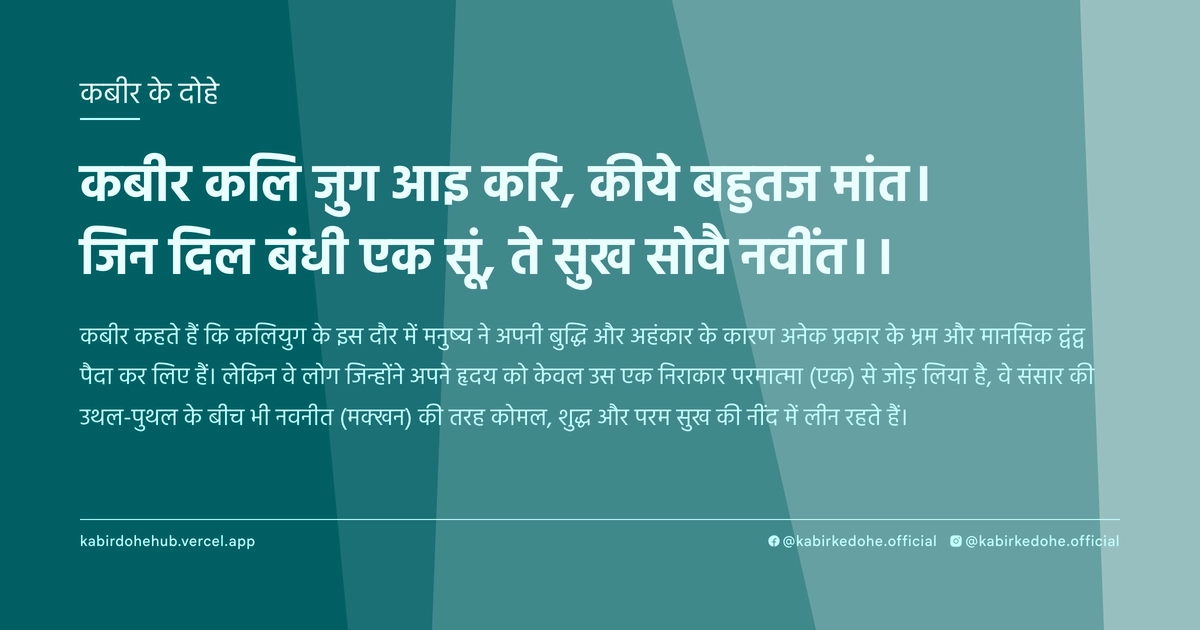
कबीर कलि जुग आइ करि, कीये बहुतज मांत।
जिन दिल बंधी एक सूं, ते सुख सोवै नवींत।।
Kabir kali jug aai kari, kiye bahutaj maant. Jin dil bandhi ek soon, te sukh sovai navint.
इस पृष्ठ पर इस कबीर दोहे का अर्थ (meaning), हिंदी व्याख्या और अंग्रेज़ी अनुवाद, दार्शनिक विश्लेषण और व्यावहारिक जीवन सीख दी गई है। यह दोहा सहज योग (Sahaja Yoga) विषय से जुड़ा है — Kabir doha meaning and explanation in Hindi and English.
अर्थ (Meaning):
कबीर कहते हैं कि कलियुग के इस दौर में मनुष्य ने अपनी बुद्धि और अहंकार के कारण अनेक प्रकार के भ्रम और मानसिक द्वंद्व पैदा कर लिए हैं। लेकिन वे लोग जिन्होंने अपने हृदय को केवल उस एक निराकार परमात्मा (एक) से जोड़ लिया है, वे संसार की उथल-पुथल के बीच भी नवनीत (मक्खन) की तरह कोमल, शुद्ध और परम सुख की नींद में लीन रहते हैं।
Kabir observes that in the age of Kali Yuga, humanity has created countless delusions and mental conflicts through intellectual pride and ego. However, those who have anchored their hearts to the One Formless Reality remain immersed in a state of supreme bliss and purity, sleeping as peacefully and softly as fresh butter, undisturbed by the chaos of the external world.
व्याख्या (Interpretation):
इस दोहे का शाब्दिक अर्थ है कि वर्तमान युग भ्रम का युग है जहाँ लोग बाहरी आडंबरों में उलझे हैं। रूपक के तौर पर, 'बहुतज मांत' उस मानसिक शोर और विखंडन को दर्शाता है जो माया के कारण उत्पन्न होता है। कबीर यहाँ 'एक' शब्द का प्रयोग निर्गुण ब्रह्म के लिए करते हैं, जो अद्वैत वेदांत के उस सत्य को दर्शाता है जहाँ आत्मा और परमात्मा एक हैं। 'नवनीत' या मक्खन का संदर्भ शुद्धता और सूक्ष्मता का है; जैसे दूध मथने के बाद सार तत्व निकलता है, वैसे ही साधना के बाद अहंकार मिटता है और केवल आनंद बचता है। यह विरोधाभास है कि बाहर युद्ध और अशांति है, परंतु भीतर एक गहरा मौन और सुख है। यह स्थिति केवल उसी को प्राप्त होती है जो द्वैत (दो होने का भाव) को त्याग कर अद्वैत (एकता) को अपनाता है।
Literally, the verse speaks of the current era as one of confusion where people are entangled in external rituals. Metaphorically, 'bahutaj maant' represents the mental noise and fragmentation caused by Maya (illusion). Kabir uses the term 'Ek' (One) to refer to the Nirgun Brahman, echoing the Advaita Vedanta truth of non-duality between the Atman and the Absolute. The reference to 'Navint' (fresh butter) symbolizes purity and the essence of being; just as butter is the refined essence of milk, spiritual bliss is the refined essence of a life stripped of ego. It presents a profound paradox: while the external world is in turmoil, the internal state remains in a state of serene, soft repose. This state is accessible only to those who transcend duality and merge into the singular consciousness of the Divine.
दार्शनिक विश्लेषण (Philosophical Analysis):
कबीर का यह दर्शन उनके समय के सामाजिक और धार्मिक संघर्षों की उपज है। उन्होंने देखा कि लोग धर्म के नाम पर बंटे हुए थे और कर्मकांडों में डूबे थे, जिसे उन्होंने 'बहुतज मांत' या मानसिक भ्रम कहा। उनका प्रहार उन पर था जो ईश्वर को मूर्तियों या विशिष्ट ग्रंथों में खोजते थे, जबकि ईश्वर उनके अपने भीतर 'एक' रूप में विद्यमान था। यह दृष्टिकोण सूफी मत के 'वहदत-उल-वजूद' (अस्तित्व की एकता) और अद्वैत वेदांत के समान है, जहाँ केवल एक ही चेतना सर्वव्यापी है।
कबीर ritualism (कर्मकांड) का विरोध इसलिए करते हैं क्योंकि वह व्यक्ति को बाहरी दुनिया और दिखावे से जोड़ता है, जिससे अहंकार (Ego) बढ़ता है। जब व्यक्ति कहता है कि 'मैं यह पूजा कर रहा हूँ', तो वह 'मैं' और 'परमात्मा' के बीच एक दूरी पैदा करता है। कबीर इस दूरी को मिटाने की बात करते हैं। उनके लिए भक्ति कोई बाहरी क्रिया नहीं, बल्कि आंतरिक विलीनीकरण है।
मनोवैज्ञानिक स्तर पर, यह दोहा मानसिक विखंडन (Fragmentation) की समस्या को संबोधित करता है। आधुनिक मनुष्य कई पहचानों के बीच बंटा हुआ है, जिससे तनाव और दुख पैदा होता है। कबीर का समाधान 'एक' में केंद्रित होना है, जो वास्तव में मन की एकाग्रता और आत्म-साक्षात्कार की प्रक्रिया है।
यहाँ 'कलियुग' केवल एक समय नहीं, बल्कि एक मानसिक अवस्था है जहाँ सत्य धुंधला हो गया है। कबीर का तर्क है कि इस अंधकार में केवल वही बच सकता है जिसने अपनी पहचान को उस सार्वभौमिक सत्य के साथ जोड़ लिया है। यह 'अहं' का विसर्जन है, जहाँ व्यक्ति अपनी छोटी पहचान को छोड़कर विराट सत्ता का हिस्सा बन जाता है।
अंततः, यह शिक्षण हमें सिखाता है कि सुख बाहरी परिस्थितियों का परिणाम नहीं, बल्कि आंतरिक संरेखण (Alignment) का परिणाम है। जब हृदय 'एक' से बंध जाता है, तो संसार की सारी विषमताएं अर्थहीन हो जाती हैं और साधक एक ऐसी शांति प्राप्त करता है जो भौतिक सुखों से परे और स्थायी होती है।
Kabir's philosophy is a direct response to the socio-religious conflicts of his era. He witnessed a society fractured by rigid caste hierarchies and hollow ritualism, which he characterizes as 'bahutaj maant' or mental delusions. His critique targets those who seek the Divine in idols or exclusive scriptures, ignoring the 'One' residing within. This perspective aligns seamlessly with the Sufi concept of 'Wahdat-al-Wujud' (Unity of Existence) and the Advaita Vedanta principle that only one consciousness pervades the universe.
Kabir rejects ritualism because it anchors the individual to external appearances, thereby inflating the ego. The moment a practitioner thinks, 'I am performing this ritual,' a perceived distance is created between the 'I' and the 'Divine.' Kabir advocates for the annihilation of this distance. For him, Bhakti is not a set of actions but a process of internal merging and dissolution.
On a psychological level, this Doha addresses the crisis of mental fragmentation. The human condition is often a struggle between conflicting identities and desires, leading to chronic unrest. Kabir's solution is 'centering'—anchoring the heart to the One—which is essentially the practice of mindfulness and self-realization.
'Kali Yuga' here is not merely a chronological age but a psychological state where truth is obscured by noise. Kabir argues that in this darkness, survival and peace are only possible for those who have aligned their individual identity with the universal truth. This is the death of the ego, where the small 'i' is sacrificed for the vast 'All.'
Ultimately, this teaching posits that happiness is not a byproduct of external circumstances but a result of internal alignment. When the heart is bound to the One, the dualities of the world—pain and pleasure, success and failure—lose their grip, allowing the seeker to experience a serenity that is transcendental and permanent.
मूल संदेश (Core Message):
- मानसिक विखंडन ही दुख का मूल कारण है।
- बाहरी कर्मकांड केवल अहंकार को पोषित करते हैं।
- सत्य एक है, बाकी सब केवल मानसिक शोर है।
- अहंकार का विसर्जन ही वास्तविक शांति का द्वार है।
- आंतरिक स्थिरता बाहरी परिस्थितियों से स्वतंत्र होती है।
- शुद्धता और आनंद केवल अद्वैत भाव में संभव हैं।
- Mental fragmentation is the root cause of all suffering.
- External rituals only serve to nourish the ego.
- Truth is One; everything else is merely mental noise.
- The dissolution of ego is the only gateway to real peace.
- Internal stability is independent of external circumstances.
- Purity and bliss are possible only in the state of non-duality.
व्यावहारिक उदाहरण (Practical Example):
वाराणसी के एक पुराने घाट पर रामदीन नाम का एक वृद्ध नाविक रहता था। वह जीवन भर नाव चलाता रहा, लेकिन उसका मन हमेशा अशांत रहता था। वह दूसरों को देखकर जलता था कि उनके पास बड़ी नावें हैं या वे अधिक पैसे कमाते हैं। वह धर्म के नाम पर कई पंडितों के पास गया, महंगे अनुष्ठान किए और घंटों मंत्र जाप किया, फिर भी उसके भीतर की बेचैनी कम नहीं हुई। वह जितना अधिक 'धर्म' के नियमों में उलझा, उतना ही वह चिड़चिड़ा होता गया।
एक दिन उसकी मुलाकात एक फकीर से हुई जो घाट की सीढ़ियों पर चुपचाप बैठा था। रामदीन ने उससे पूछा, "बाबा, मैंने इतने अनुष्ठान किए, इतनी पूजा की, फिर भी मन में शांति क्यों नहीं है?"
फकीर ने मुस्कुराकर कहा, "तूने बहुत सी नावों में सवारी की, लेकिन तूने कभी उस नदी को नहीं देखा जिसमें वे नावें तैर रही हैं। तूने बाहरी शोर को ही अपना धर्म मान लिया। तूने 'बहुतज मांत' यानी भ्रमों का जाल बुना है। बस एक बार अपनी आँखें बंद कर और उस एक मौन को पकड़, जो तेरे भीतर और इस नदी के बहाव में एक ही है।"
रामदीन ने उस दिन पहली बार अपनी बाहरी उपलब्धियों और धार्मिक पहचान को किनारे रखा। उसने महसूस किया कि उसकी बेचैनी इस बात से थी कि वह खुद को एक 'गरीब नाविक' के रूप में देख रहा था, न कि उस अनंत चेतना के हिस्से के रूप में। उसने बाहरी कर्मकांडों को छोड़कर केवल अपने भीतर के उस 'एक' बिंदु पर ध्यान केंद्रित करना शुरू किया।
धीरे-धीरे, रामदीन का व्यवहार बदलने लगा। अब वह अपनी छोटी नाव से खुश था। जब अन्य नाविक आपस में लड़ते, वह शांत रहता। उसकी शांति इतनी गहरी थी कि लोग उससे पूछने लगे कि उसने कौन सा नया मंत्र सीखा है।
रामदीन बस इतना कहता, "मैंने मंत्र नहीं सीखा, मैंने बस शोर को छोड़कर संगीत को सुनना शुरू किया है।"
उसकी नींद अब गहरी और सुखद थी, जैसे नवनीत। उसे अब इस बात की चिंता नहीं थी कि कल कितनी सवारी मिलेगी, क्योंकि उसने जान लिया था कि वह उस एक परम सत्ता का अंश है जो कभी खाली नहीं होता।
उसका जीवन अब एक उदाहरण था कि कैसे बाहरी शोर के बीच भी आंतरिक स्थिरता प्राप्त की जा सकती है। उसने अपनी पहचान को 'नाविक' से बदलकर 'साक्षी' बना लिया था।
यह बदलाव उसके परिवार में भी दिखा; उसका बेटा, जो पहले उससे लड़ता था, अब उसके चेहरे की शांति देखकर शांत रहने लगा। रामदीन ने बिना किसी उपदेश के, केवल अपने अस्तित्व से सबको सत्य दिखा दिया।
अंत में, वह नाविक जिसने कभी शांति को मंदिरों और अनुष्ठानों में खोजा था, उसे अपने ही हृदय के मौन में पा लिया।
On an ancient ghat in Varanasi lived an elderly boatman named Ramdin. He had spent his entire life rowing, yet his mind was a storm of unrest. He envied others who owned larger boats or earned more money. He visited numerous priests, performed expensive rituals, and spent hours chanting mantras, yet the restlessness within him never subsided. The more he entangled himself in the 'rules' of religion, the more irritable he became.
One day, he encountered a wandering fakir sitting silently on the stone steps of the ghat. Ramdin asked, "Baba, I have performed so many rituals, so many prayers, yet why is there no peace in my heart?"
The fakir smiled and replied, "You have sailed in many boats, but you never looked at the river in which those boats float. You have mistaken the external noise for religion. You have woven a web of 'bahutaj maant'—countless delusions. Just once, close your eyes and hold onto that one silence which exists both within you and in the flow of this river."
For the first time, Ramdin set aside his external achievements and his religious identity. He realized that his agony stemmed from identifying himself as a 'poor boatman' rather than a part of the infinite consciousness.
He stopped the mechanical rituals and began focusing on that 'One' point of stillness within. Slowly, Ramdin's behavior transformed. He became genuinely content with his small boat. While other boatmen argued over fares, he remained serene.
His peace was so palpable that people began asking him which new mantra he had mastered. Ramdin would simply reply, "I haven't learned a mantra; I have simply stopped listening to the noise and started listening to the music."
His sleep became deep and sweet, like fresh butter. He no longer worried about how many passengers he would get the next day, for he knew he was a part of the One Absolute that is never empty.
His life became a living testament to how internal stability can be achieved amidst external chaos. He had shifted his identity from being a 'boatman' to being a 'witness.'
This change radiated to his family; his son, who used to clash with him, became calm upon seeing his father's tranquility. Without a single sermon, Ramdin showed the truth through his mere existence.
In the end, the boatman who had searched for peace in temples and rituals found it in the silence of his own heart.
अभ्यास मार्गदर्शन (Practice Guidance):
- दैनिक मौन अभ्यास: प्रतिदिन 20 मिनट के लिए पूर्ण मौन रहें। किसी भी विचार या बाहरी शोर को रोकने की कोशिश न करें, बस एक 'साक्षी' की तरह उन्हें देखें और अंत में उस एक शून्य (Zero point) पर ध्यान केंद्रित करें जहाँ से विचार जन्म लेते हैं।
- आत्म-पूछताछ जर्नल: प्रतिदिन एक ऐसी स्थिति लिखें जहाँ आपने अपनी पहचान (जैसे- पद, जाति, धर्म) के कारण तनाव महसूस किया। फिर लिखें कि यदि आप केवल 'एक चेतना' होते, तो उस स्थिति के प्रति आपकी प्रतिक्रिया क्या होती।
- व्यवहारिक परिवर्तन: दिन भर में कम से कम तीन बार, जब आप किसी विवाद या तनाव में हों, तो मन में कहें, "यह शोर है, मैं वह एक मौन हूँ।" अपनी पहचान को समस्या से अलग करें।
- निदान चेकलिस्ट (Diagnostic Checklist): यदि आप निम्नलिखित अनुभव कर रहे हैं, तो आप अभी भी 'बहुतज मांत' (भ्रम) में हैं: 1. दूसरों की सफलता से जलन होना। 2. बाहरी प्रशंसा पर अत्यधिक निर्भरता। 3. ईश्वर को केवल मंदिर/मस्जिद में खोजना। 4. छोटी बातों पर मानसिक उथल-पुथल।
- Daily Silence Practice: Spend 20 minutes in absolute silence daily. Do not try to suppress thoughts or external noise; instead, observe them as a 'witness' and eventually focus on the 'Zero Point' from which all thoughts emerge.
- Self-Inquiry Journaling: Daily, record a situation where you felt stress due to your identity (e.g., status, caste, religion). Then write how your reaction would differ if you identified solely as 'One Consciousness.'
- Behavioral Shift: At least three times a day, during conflict or stress, mentally affirm: "This is noise; I am the One Silence." Detach your core identity from the immediate problem.
- Diagnostic Checklist: You are still trapped in 'bahutaj maant' (delusion) if: 1. You feel jealousy toward others' success. 2. You are overly dependent on external validation. 3. You seek the Divine only in physical structures. 4. You experience frequent mental turmoil over trivialities.
चिंतन प्रश्न (Reflection Questions):
- मेरी वह कौन सी 'पहचान' है जिसे मैं सबसे अधिक पकड़ कर रखता हूँ, और यदि वह छिन जाए, तो क्या मैं शून्य महसूस करूँगा?
- क्या मेरी आध्यात्मिक साधना मुझे विनम्र बना रही है, या यह मेरे भीतर एक 'धार्मिक श्रेष्ठता' का अहंकार पैदा कर रही है?
- मैं दुनिया को जिस नजरिए से देखता हूँ, क्या वह सत्य है या केवल मेरे पूर्वग्रहों (biases) का एक संग्रह है?
- मेरे जीवन का वह कौन सा 'शोर' है जिसे मैं संगीत समझने की गलती कर रहा हूँ?
- यदि मैं इस समय अपनी सभी सामाजिक और डिजिटल पहचान मिटा दूँ, तो वास्तव में 'मैं' कौन हूँ?
- क्या मैं वास्तव में 'एक' की खोज कर रहा हूँ, या मैं केवल अपनी इच्छाओं की पूर्ति के लिए एक नया सहारा ढूँढ रहा हूँ?
- Which 'identity' do I cling to most fiercely, and if it were stripped away, would I feel like a void?
- Is my spiritual practice making me humble, or is it creating a sense of 'religious superiority' within me?
- Is the way I perceive the world the actual truth, or is it merely a collection of my own biases?
- What is that specific 'noise' in my life that I am mistakenly perceiving as music?
- If I were to erase all my social and digital identities right now, who would 'I' actually be?
- Am I truly seeking the 'One,' or am I simply looking for a new crutch to fulfill my personal desires?