
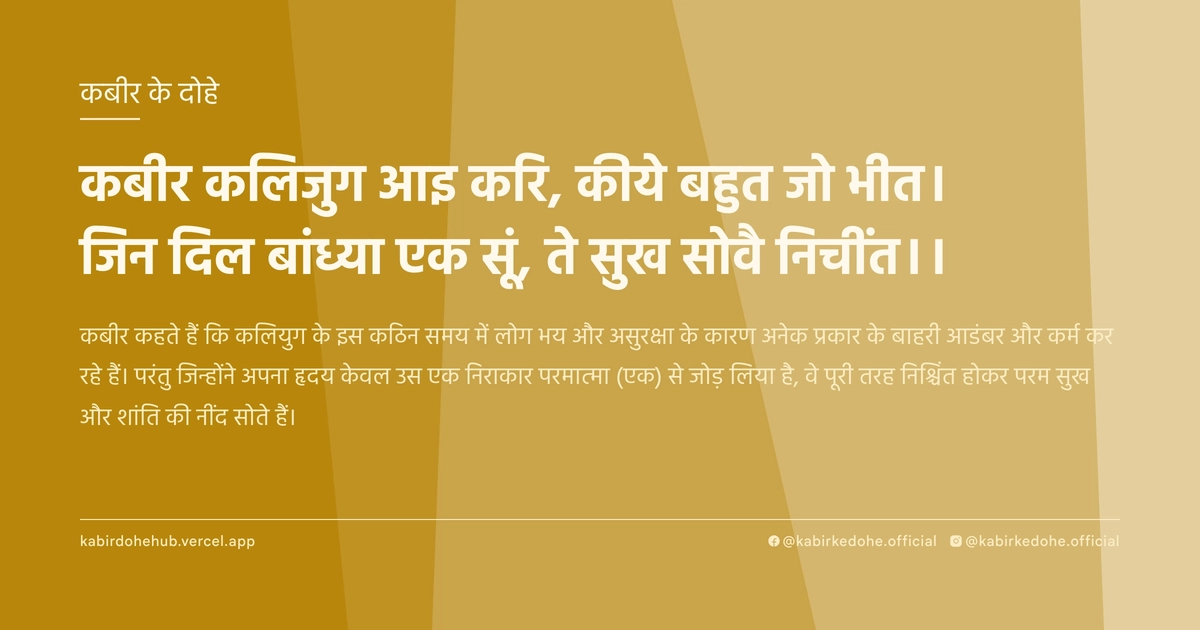
कबीर कलिजुग आइ करि, कीये बहुत जो भीत।
जिन दिल बांध्या एक सूं, ते सुख सोवै निचींत।।
Kabir kalijug aai kari, keeye bahut jo bheet. Jin dil baandhya ek sun, te sukh sovai nichiint.
इस पृष्ठ पर इस कबीर दोहे का अर्थ (meaning), हिंदी व्याख्या और अंग्रेज़ी अनुवाद, दार्शनिक विश्लेषण और व्यावहारिक जीवन सीख दी गई है। यह दोहा भक्ति (Bhakti) विषय से जुड़ा है — Kabir doha meaning and explanation in Hindi and English.
अर्थ (Meaning):
कबीर कहते हैं कि कलियुग के इस कठिन समय में लोग भय और असुरक्षा के कारण अनेक प्रकार के बाहरी आडंबर और कर्म कर रहे हैं। परंतु जिन्होंने अपना हृदय केवल उस एक निराकार परमात्मा (एक) से जोड़ लिया है, वे पूरी तरह निश्चिंत होकर परम सुख और शांति की नींद सोते हैं।
Kabir observes that in the chaotic era of Kali Yuga, people are driven by fear and anxiety, engaging in countless superficial rituals and desperate actions to find security. However, those who have anchored their hearts to the One—the singular, formless Divine—attain a state of absolute fearlessness and sleep in the lap of eternal peace.
व्याख्या (Interpretation):
यह दोहा कलियुग की मानसिक व्याकुलता और आध्यात्मिक एकाग्रता के बीच के अंतर को स्पष्ट करता है। 'भीत' का अर्थ यहाँ केवल डर नहीं, बल्कि वह आंतरिक रिक्तता है जिसे मनुष्य बाहरी शोर से भरने की कोशिश करता है। कबीर 'एक' शब्द के माध्यम से निर्गुण भक्ति और अद्वैत वेदांत की ओर संकेत करते हैं, जहाँ आत्मा और परमात्मा का मिलन ही एकमात्र सत्य है। जब साधक माया के भ्रम को त्यागकर उस एक सत्ता में लीन होता है, तो द्वैत समाप्त हो जाता है। यह अवस्था वह है जहाँ 'मैं' और 'मेरा' का अहंकार मिट जाता है, जिससे भय का कोई आधार नहीं बचता। अंततः, यह निश्चिंतता किसी बाहरी सुरक्षा से नहीं, बल्कि आंतरिक बोध से आती है।
This couplet elucidates the stark contrast between the psychological turbulence of the Kali Yuga and the stillness of spiritual singularity. The term 'bheet' refers not merely to fear, but to the existential void that humans attempt to fill with external noise and ritualistic clutter. Through the word 'Ek' (One), Kabir points toward Nirgun Bhakti and Advaita Vedanta, where the realization of non-duality between the Atman and Brahman is the ultimate truth. When a seeker transcends the illusion of Maya and anchors themselves in this singular reality, duality dissolves. This is the state where the ego—the 'I' and 'mine'—is annihilated, leaving no ground for fear to exist. Ultimately, this profound peace is not derived from external security but from the internal realization of oneness.
दार्शनिक विश्लेषण (Philosophical Analysis):
कबीर का यह दर्शन उस समय की सामाजिक और धार्मिक पृष्ठभूमि में था जहाँ कर्मकांड और जातिगत भेदभाव चरम पर थे। उन्होंने देखा कि लोग मोक्ष के लिए कठिन व्रत, तीर्थयात्रा और बाहरी दिखावे में लगे थे, जबकि उनका मन अभी भी भय और ईर्ष्या से ग्रस्त था। कबीर ने इस 'भीत' या भय को मनोवैज्ञानिक विकार माना, जो मनुष्य को उसकी वास्तविक प्रकृति से दूर रखता है।
अद्वैत वेदांत के परिप्रेक्ष्य में, यह दोहा 'अहं ब्रह्मास्मि' के बोध की बात करता है। जब तक मनुष्य स्वयं को शरीर या सामाजिक पहचान मानता है, वह मृत्यु और हानि के भय से ग्रस्त रहता है। लेकिन जब वह यह जान लेता है कि वह उस अनंत 'एक' का ही अंश है, तो भय स्वतः समाप्त हो जाता है। यह सूफी मत के 'वहदत-अल-वुजूद' (अस्तित्व की एकता) के समान है, जहाँ केवल ईश्वर का अस्तित्व है और बाकी सब उसका प्रतिबिंब है।
कबीर यहाँ ritualism (कर्मकांड) का खंडन करते हैं। वे तर्क देते हैं कि हज़ारों पूजा-पाठ भी तब तक व्यर्थ हैं जब तक हृदय में एकाग्रता और समर्पण न हो। उनके लिए 'एक' का अर्थ किसी संकीर्ण देवता से नहीं, बल्कि उस सार्वभौमिक चेतना से है जो हर कण में व्याप्त है। यह दृष्टिकोण मनुष्य को बाहरी निर्भरता से मुक्त कर आंतरिक स्वावलंबन की ओर ले जाता है।
मनोवैज्ञानिक स्तर पर, यह दोहा 'बिखराव' (fragmentation) बनाम 'एकीकरण' (integration) की बात करता है। कलियुग का मनुष्य मानसिक रूप से खंडित है—वह एक साथ कई दिशाओं में भाग रहा है। कबीर का समाधान 'एक' में केंद्रित होना है, जो आधुनिक शब्दों में 'mindfulness' और 'deep focus' का आध्यात्मिक संस्करण है।
अंततः, कबीर यह स्पष्ट करते हैं कि वास्तविक सुख भौतिक उपलब्धियों या धार्मिक श्रेष्ठता में नहीं, बल्कि अहंकार के विसर्जन में है। जब व्यक्ति अपनी व्यक्तिगत पहचान को सार्वभौमिक पहचान में विलीन कर देता है, तब वह 'निश्चिंत' हो जाता है, क्योंकि अब खोने के लिए कुछ बचा ही नहीं है।
Kabir’s philosophy emerged during a socio-religious era dominated by rigid ritualism and caste hierarchies. He observed that people were obsessed with austerity, pilgrimages, and outward displays of piety, yet their minds remained plagued by fear and insecurity. Kabir identified this 'bheet' or fear as a psychological distortion that alienates the human soul from its true nature.
From the lens of Advaita Vedanta, this doha speaks to the realization of 'Aham Brahmasmi' (I am Brahman). As long as a human identifies with the physical body or a social persona, they remain prisoners to the fear of death and loss. However, upon realizing that they are an extension of the singular, infinite 'One,' fear evaporates. This mirrors the Sufi concept of 'Wahdat-al-Wujud' (Unity of Existence), where only the Divine exists and everything else is but a reflection.
Kabir explicitly rejects ritualism. He argues that thousands of prayers are futile if the heart lacks singular devotion and concentration. For Kabir, the 'One' is not a sectarian deity but the universal consciousness permeating every atom. This perspective liberates the individual from external dependencies and steers them toward internal sovereignty.
On a psychological level, the verse addresses 'fragmentation' versus 'integration.' The modern human, much like the inhabitant of Kali Yuga, is mentally fragmented—striving in a dozen directions simultaneously. Kabir’s remedy is centering oneself in the 'One,' which is essentially a spiritual precursor to mindfulness and deep integration of the self.
Ultimately, Kabir clarifies that true bliss is found not in material accumulation or religious superiority, but in the dissolution of the ego. When an individual merges their personal identity into the universal identity, they become 'nichint' (carefree), for there is nothing left to lose when one has become everything.
मूल संदेश (Core Message):
- बाहरी शोर और कर्मकांड केवल भय के आवरण हैं।
- सच्ची शांति केवल एकत्व के बोध में निहित है।
- अहंकार का विसर्जन ही भय का एकमात्र उपचार है।
- निराकार परमात्मा से जुड़ाव ही वास्तविक सुरक्षा है।
- द्वैत से अद्वैत की ओर बढ़ना ही जीवन का लक्ष्य है।
- External rituals are often just masks for inner fear.
- True peace resides only in the realization of Oneness.
- The dissolution of ego is the only cure for anxiety.
- Connection with the Formless Divine is the only real security.
- Moving from duality to non-duality is the ultimate goal.
व्यावहारिक उदाहरण (Practical Example):
वाराणसी के घाटों पर रहने वाले एक वृद्ध विधवा, जानकी, का जीवन अत्यंत कठिन था। समाज ने उन्हें हाशिए पर धकेल दिया था और उनके पास केवल एक छोटी सी कुटिया और यादों का बोझ था। वे हर दिन मंदिर जातीं, घंटों मंत्र पढ़तीं और कई तरह के अनुष्ठान करतीं, इस उम्मीद में कि शायद उनके जीवन का दुख कम हो जाए। लेकिन उनके मन में हमेशा यह डर रहता था कि कल क्या होगा, लोग क्या कहेंगे और मृत्यु के बाद उनका क्या होगा।
एक दिन उनकी मुलाकात एक घुमक्कड़ फकीर से हुई, जिसने उन्हें कबीर का यह दोहा सुनाया। फकीर ने उनसे पूछा, "माई, तुम इतने सारे देवताओं और अनुष्ठानों के पीछे क्यों भाग रही हो? क्या तुम नहीं जानती कि जिस शांति को तुम बाहर खोज रही हो, वह तुम्हारे भीतर के उस 'एक' में है जो कभी नहीं बदलता?"
जानकी को पहले तो यह बात समझ नहीं आई। उन्होंने तर्क दिया कि बिना पूजा के मोक्ष कैसे मिलेगा? फकीर मुस्कुराया और बोला, "पूजा एक रास्ता है, लेकिन मंजिल तो वह 'एक' है। तुम रास्ते को ही मंजिल मान बैठी हो।"
जानकी ने धीरे-धीरे बाहरी दिखावों को कम किया। उन्होंने घंटों की रटंत पूजा के बजाय, केवल शांत बैठकर अपने भीतर की सांसों और उस निराकार सत्ता के साथ जुड़ना शुरू किया। उन्होंने महसूस किया कि जब वे केवल उस 'एक' पर ध्यान केंद्रित करती हैं, तो उनके जीवन की सारी परेशानियां छोटी लगने लगती हैं।
एक समय ऐसा आया जब उनके पास खाने के लिए पर्याप्त अनाज नहीं था, फिर भी उनके चेहरे पर एक ऐसी शांति थी जो पहले कभी नहीं देखी गई। उनके पड़ोसी, जो अमीर थे लेकिन तनाव में रहते थे, उनसे पूछने लगे कि वे इतनी निश्चिंत कैसे हैं।
जानकी ने बस इतना कहा, "मैंने कई दरवाजों पर दस्तक देना छोड़ दिया और अपने भीतर के उस एक दरवाजे को खोल लिया जो सीधे परमात्मा से जुड़ा है। अब मुझे किसी बाहरी सहारे की जरूरत नहीं।"
उनके व्यवहार में एक गहरा बदलाव आया। वे अब दूसरों की आलोचना नहीं करती थीं और न ही अपनी स्थिति पर विलाप करती थीं। उन्होंने अपनी छोटी सी कुटिया को उन बच्चों के लिए एक आश्रय बना दिया जो सड़कों पर अकेले थे।
उनकी मृत्यु के समय, उनके चेहरे पर कोई भय नहीं था। वे वास्तव में 'सुख सोवै निचींत' वाली अवस्था में थीं, क्योंकि उन्होंने अपनी पहचान को उस अनंत एकत्व में विलीन कर दिया था।
Janaki, an elderly widow living on the ghats of Varanasi, led a life of immense hardship. Marginalized by society, she possessed nothing but a tiny hut and a heavy burden of memories. Every day, she visited temples, chanted mantras for hours, and performed numerous rituals, hoping to alleviate her suffering. Yet, her mind was a storm of anxiety—fear of tomorrow, fear of social judgment, and fear of the afterlife.
One day, she encountered a wandering fakir who recited this specific doha of Kabir. The fakir asked her, "Mother, why do you chase so many deities and rituals? Do you not know that the peace you seek externally resides within that 'One' who never changes?"
Initially, Janaki was confused. She argued that without these rituals, how could she attain salvation? The fakir smiled and replied, "Rituals are but a path, but the destination is the 'One.' You have mistaken the path for the destination."
Slowly, Janaki began to strip away the external pretenses. Instead of hours of rote chanting, she started sitting in silence, connecting with her breath and the formless Presence within. She realized that when she focused solely on that 'One,' the chaos of her life began to seem insignificant.
There came a time when she lacked enough grain for a meal, yet her face radiated a serenity never seen before. Her neighbors, who were wealthy but chronically stressed, asked her how she could remain so carefree.
Janaki simply replied, "I stopped knocking on a thousand different doors and opened the one door within me that leads directly to the Divine. I no longer need external crutches."
A profound transformation took place in her behavior. She ceased criticizing others and stopped lamenting her fate. She turned her small hut into a sanctuary for street children who had no one to call their own.
At the moment of her passing, there was no trace of fear on her face. She had truly entered the state of 'sleeping peacefully and carefree,' having dissolved her fragile identity into the infinite Oneness.
अभ्यास मार्गदर्शन (Practice Guidance):
- प्रतिदिन 20 मिनट 'शून्य ध्यान' का अभ्यास करें, जहाँ आप किसी भी मंत्र या छवि के बजाय केवल अपनी उपस्थिति और उस निराकार 'एक' के बोध पर ध्यान केंद्रित करें।
- एक 'भय पत्रिका' (Fear Journal) बनाएँ। लिखें कि आप किन बाहरी चीजों से सुरक्षा खोज रहे हैं और फिर विचार करें कि यदि वे सब छिन जाएं, तो आपके भीतर का 'एक' कैसे स्थिर रहेगा।
- व्यवहार परिवर्तन: दिन में कम से कम एक बार किसी ऐसे व्यक्ति की मदद करें जिससे आपका कोई स्वार्थ न हो, ताकि आप 'मैं' के अहंकार को मिटाकर 'एकत्व' का अनुभव कर सकें।
- निदान चेकलिस्ट: क्या आप अभी भी अपनी शांति के लिए बाहरी परिस्थितियों (पैसा, प्रशंसा, पद) पर निर्भर हैं? क्या आप अनिश्चित भविष्य के बारे में सोचकर बेचैन होते हैं? यदि हाँ, तो आप अभी भी 'भीत' (भय) में हैं।
- Practice 20 minutes of 'Sunya Dhyana' (Void Meditation) daily, focusing not on a mantra or image, but on your pure presence and the awareness of the formless 'One.'
- Maintain a 'Fear Journal.' Document the external things you seek security from, then contemplate how the 'One' within remains steadfast even if all external supports are removed.
- Behavioral Shift: Perform one selfless act daily for someone from whom you expect nothing in return, consciously dissolving the ego of 'I' to experience the unity of 'One.'
- Diagnostic Checklist: Are you still relying on external conditions (money, praise, status) for your peace? Do you feel restless when thinking about an uncertain future? If yes, you are still operating from 'Bheet' (fear).
चिंतन प्रश्न (Reflection Questions):
- मेरे जीवन में 'एक' क्या है, या मैं कितने अलग-अलग मुखौटों के बीच बंटा हुआ हूँ?
- क्या मेरी धार्मिक या आध्यात्मिक गतिविधियाँ वास्तव में मुझे शांति दे रही हैं, या वे केवल मेरे डर को छिपाने का तरीका हैं?
- यदि मेरी सारी सामाजिक पहचान (पद, रिश्ता, प्रतिष्ठा) छीन ली जाए, तो क्या मैं तब भी निश्चिंत रह पाऊंगा?
- मैं अपनी डिजिटल पहचान (सोशल मीडिया) के माध्यम से किस तरह के 'भ्रम' को पाल रहा हूँ और यह मुझे वास्तविक शांति से कैसे दूर कर रहा है?
- मेरे भीतर का वह कौन सा डर है जिसे मैं स्वीकार करने से डरता हूँ और जिसे मैं कर्मकांडों के पीछे छिपाता हूँ?
- What is the 'One' in my life, or am I fragmented across too many different masks?
- Are my religious or spiritual activities truly bringing me peace, or are they merely tools to mask my fear?
- If all my social identities (status, relationships, reputation) were stripped away, would I still remain carefree?
- What illusions am I nurturing through my digital identity, and how is this distancing me from authentic peace?
- What is that hidden fear within me that I am afraid to acknowledge and instead hide behind rituals?