
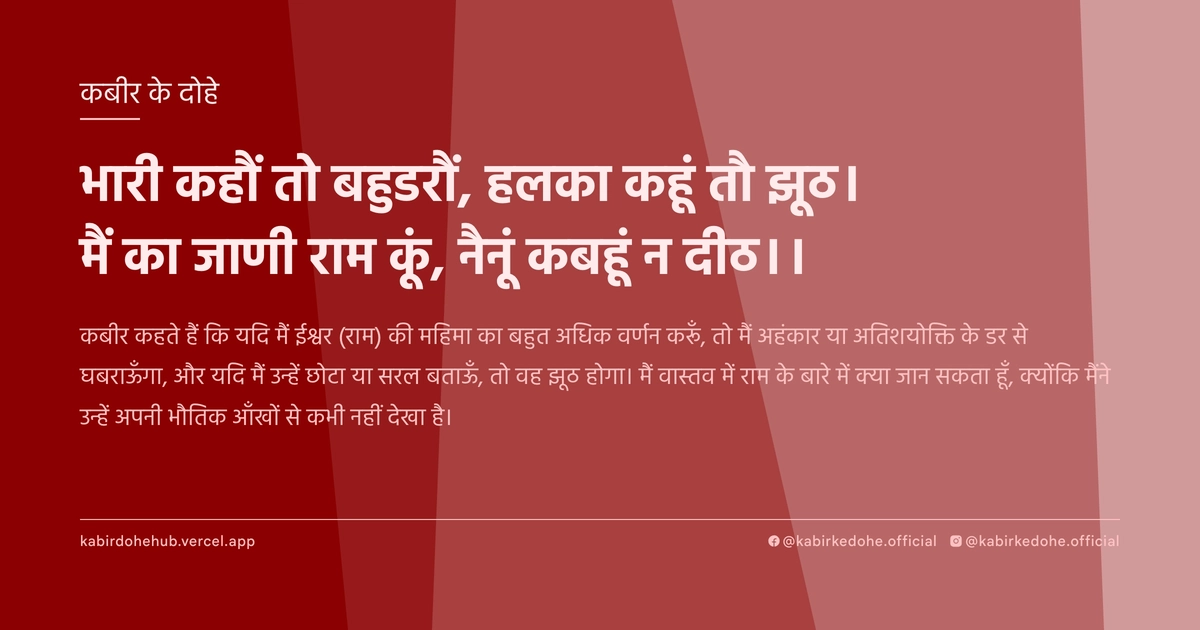
भारी कहौं तो बहुडरौं, हलका कहूं तौ झूठ।
मैं का जाणी राम कूं, नैनूं कबहूं न दीठ।।
Bhaari kahon to bahudaron, halka kahun tau jhooth. Main ka jaani Ram kun, nainun kabahun na deeth.
इस पृष्ठ पर इस कबीर दोहे का अर्थ (meaning), हिंदी व्याख्या और अंग्रेज़ी अनुवाद, दार्शनिक विश्लेषण और व्यावहारिक जीवन सीख दी गई है। यह दोहा विनम्रता (Humility) विषय से जुड़ा है — Kabir doha meaning and explanation in Hindi and English.
अर्थ (Meaning):
कबीर कहते हैं कि यदि मैं ईश्वर (राम) की महिमा का बहुत अधिक वर्णन करूँ, तो मैं अहंकार या अतिशयोक्ति के डर से घबराऊँगा, और यदि मैं उन्हें छोटा या सरल बताऊँ, तो वह झूठ होगा। मैं वास्तव में राम के बारे में क्या जान सकता हूँ, क्योंकि मैंने उन्हें अपनी भौतिक आँखों से कभी नहीं देखा है।
Kabir expresses a profound spiritual humility, stating that to describe the Divine as 'heavy' or immense would be an act of presumption and fear, yet to describe the Divine as 'light' or simple would be a falsehood. He concludes that he cannot truly claim to know Ram, for he has never perceived the Absolute with his physical eyes.
व्याख्या (Interpretation):
यह दोहा ईश्वर की अगाधता और मानवीय सीमितता के बीच के द्वंद्व को दर्शाता है। 'भारी' शब्द यहाँ परमात्मा की अनंत शक्ति और व्यापकता का प्रतीक है, जबकि 'हलका' उनकी सरलता या मानवीय धारणाओं को दर्शाता है। कबीर यहाँ 'राम' शब्द का प्रयोग दशरथ पुत्र के रूप में नहीं, बल्कि निर्गुण ब्रह्म के रूप में कर रहे हैं। वह यह स्पष्ट करते हैं कि सत्य शब्दों की सीमा से परे है। यह अद्वैत वेदांत के उस सिद्धांत की ओर इशारा करता है जहाँ ब्रह्म 'अनिर्वाचनीय' (indescribable) है। जब तक साधक माया के पर्दे को नहीं हटाता, वह केवल अनुमान लगा सकता है, अनुभव नहीं। अंततः, यह दोहा ज्ञान के अहंकार को नष्ट कर पूर्ण समर्पण की स्थिति में आने का आह्वान है।
This couplet illustrates the tension between the infinitude of the Divine and the limitations of human language. The term 'heavy' symbolizes the overwhelming vastness and power of the Absolute, while 'light' refers to the reductive nature of human conceptualization. Kabir uses 'Ram' not as a mythological figure, but as the Nirgun Brahman—the formless, attributeless Reality. He asserts that Truth is 'Anirvachaniya' (ineffable), existing beyond the reach of adjectives. This aligns with Advaita Vedanta, suggesting that as long as the veil of Maya persists, any description of God is merely a projection. The central paradox is that the only honest way to describe the Infinite is to admit one's own ignorance. It is a call to dissolve the ego's claim to knowledge in favor of direct, silent experience.
दार्शनिक विश्लेषण (Philosophical Analysis):
कबीर का यह दृष्टिकोण उनके युग के धार्मिक पाखंड और शास्त्र-ज्ञान के अहंकार पर एक तीखा प्रहार है। उस समय के पंडित और मौलवी ईश्वर को परिभाषाओं और नियमों में बांधने का प्रयास कर रहे थे। कबीर ने इस 'बौद्धिक अहंकार' को चुनौती दी। उनका दर्शन सूफीवाद के 'फना' (अहंकार का विनाश) और वेदांत के 'नेति-नेति' (यह नहीं, वह नहीं) के करीब है। वे मानते हैं कि जब तक 'मैं' (अहंकार) मौजूद है, तब तक सत्य का साक्षात्कार असंभव है।
यहाँ 'राम' का अर्थ उस सार्वभौमिक चेतना से है जो कण-कण में व्याप्त है लेकिन इंद्रियों से ओझल है। कबीर यह समझाते हैं कि ईश्वर को शब्दों में बांधना उसे सीमित करना है। यह विचार कि 'मैंने उन्हें देखा नहीं', वास्तव में एक आध्यात्मिक ईमानदारी है। वे उन लोगों का उपहास करते हैं जो केवल ग्रंथों को पढ़कर दावा करते हैं कि वे ईश्वर को जानते हैं।
यह दोहा हमें सिखाता है कि आध्यात्मिक यात्रा 'जानने' की नहीं, बल्कि 'होने' की प्रक्रिया है। ज्ञान (Knowledge) और अनुभव (Realization) के बीच का अंतर ही यहाँ मुख्य बिंदु है। जब साधक यह स्वीकार कर लेता है कि वह कुछ नहीं जानता, तभी वह वास्तव में सत्य को ग्रहण करने के योग्य बनता है।
सामाजिक स्तर पर, यह संदेश जाति और वर्ण के उन दावों को ध्वस्त करता है जो स्वयं को ईश्वर के करीब बताते थे। कबीर कहते हैं कि यदि ईश्वर निराकार है, तो कोई भी व्यक्ति अपनी सामाजिक स्थिति के आधार पर उस पर एकाधिकार नहीं जमा सकता।
अंततः, यह विश्लेषण हमें इस निष्कर्ष पर ले जाता है कि मौन ही सर्वोच्च प्रार्थना है। जब शब्द समाप्त हो जाते हैं, वहीं से वास्तविक साक्षात्कार शुरू होता है। यह बौद्धिक विफलता नहीं, बल्कि आध्यात्मिक विजय है।
Kabir’s perspective is a sharp critique of the religious hypocrisy and intellectual arrogance prevalent during his era. While the clergy of his time sought to confine the Divine within rigid definitions and scriptures, Kabir challenged this 'intellectual ego.' His philosophy mirrors the Sufi concept of 'Fana' (annihilation of the self) and the Vedantic practice of 'Neti-Neti' (not this, not that), emphasizing that Truth cannot be captured by language.
In this context, 'Ram' represents the universal consciousness that permeates every atom yet remains invisible to the sensory organs. Kabir argues that to define God is to limit Him. His admission—'I have not seen Him'—is an act of supreme spiritual honesty. He mocks those who claim divine knowledge based solely on the rote memorization of texts, distinguishing between academic knowledge and direct experiential realization.
This couplet teaches that the spiritual journey is not about 'knowing' but about 'becoming.' The gap between conceptual knowledge and actual realization is the crux of the human condition. Only when the seeker admits their total ignorance does the space for true enlightenment open up.
Socially, this message dismantles the claims of caste and class superiority. If the Divine is Nirgun (formless) and beyond description, no individual can claim a monopoly over God based on their birth or social standing. It democratizes spirituality by stripping away the intermediaries.
Ultimately, this analysis leads to the conclusion that silence is the highest form of prayer. When words fail, the actual encounter with the Absolute begins. This is not an intellectual failure, but a spiritual victory over the ego's need to categorize and control.
मूल संदेश (Core Message):
- बौद्धिक अहंकार सत्य के मार्ग में सबसे बड़ी बाधा है।
- ईश्वर को शब्दों में बांधना उसे सीमित करना है।
- सच्चा ज्ञान 'न जानने' की विनम्रता से शुरू होता है।
- अनुभव वह है जो शब्दों के समाप्त होने के बाद बचता है।
- अद्वैत का सत्य मौन और समर्पण में निहित है।
- Intellectual ego is the greatest barrier to spiritual truth.
- To define the Divine in words is to limit the Infinite.
- True wisdom begins with the humility of 'not knowing.'
- Realization is what remains after words have vanished.
- The truth of non-duality resides in silence and surrender.
व्यावहारिक उदाहरण (Practical Example):
एक समय की बात है, वाराणसी के घाटों पर माधव नाम का एक वृद्ध बुनकर रहता था। माधव अपनी पूरी जिंदगी ने केवल सूत काता और कपड़े बुने थे। उसके पड़ोस में एक बहुत बड़ा विद्वान पंडित रहता था, जो दिन भर शास्त्रों की व्याख्या करता और लोगों को बताता कि ईश्वर कैसा दिखता है और उसकी प्रकृति क्या है।
पंडित अक्सर माधव का मजाक उड़ाता कि वह अनपढ़ है और उसे ईश्वर के स्वरूप का कोई ज्ञान नहीं है। पंडित कहता, 'ईश्वर सोने के समान चमकता है, वह अनंत भुजाओं वाला है और केवल वेदों के माध्यम से जाना जा सकता है।' माधव बस मुस्कुराता और चुप रहता।
एक दिन शहर में एक महान संत आए। पंडित ने उनके सामने अपनी सारी विद्वत्ता प्रदर्शित की और पूछा, 'महाराज, क्या आप मुझे बता सकते हैं कि राम का वास्तविक स्वरूप क्या है? मैंने शास्त्रों में पढ़ा है कि वह ऐसा है, वैसा है।'
संत ने पंडित की ओर देखा और फिर माधव की ओर, जो चुपचाप किनारे खड़ा था। संत ने पूछा, 'माधव, तुम क्या सोचते हो?'
माधव ने विनम्रता से सिर झुकाया और कहा, 'महाराज, मैं तो एक साधारण बुनकर हूँ। अगर मैं कहूँ कि वह बहुत बड़ा है, तो शायद मैं झूठ बोलूँ क्योंकि मेरी बुद्धि छोटी है। और अगर मैं कहूँ कि वह छोटा है, तो मैं उस सत्य का अपमान करूँगा। सच तो यह है कि मैंने उन्हें कभी देखा नहीं, इसलिए मैं उनके बारे में कुछ नहीं जानता।'
पंडित जोर से हँसा और बोला, 'देखो, इसे कुछ नहीं पता!' लेकिन संत ने पंडित को चुप कराया और कहा, 'इस बुनकर ने वह सत्य पा लिया है जिसे तुम अपनी हजारों किताबों में नहीं ढूंढ पाए। इसने अपने अहंकार को मार दिया है। जिसने यह स्वीकार कर लिया कि वह नहीं जानता, वही वास्तव में जानने के करीब है।'
पंडित को पहली बार अपनी गलती का अहसास हुआ। उसे समझ आया कि वह ईश्वर को 'जानने' का दावा कर रहा था, जबकि माधव ईश्वर के प्रति 'समर्पण' कर रहा था।
उस दिन के बाद, पंडित ने शास्त्रों को रटना छोड़ दिया और माधव के साथ बैठकर मौन में समय बिताने लगा। उसने सीखा कि ईश्वर शब्दों में नहीं, बल्कि उस खालीपन में मिलता है जहाँ 'मैं' समाप्त हो जाता है।
Once in the ghats of Varanasi, there lived an elderly weaver named Madhav. Madhav had spent his entire life spinning yarn and weaving cloth. His neighbor was a renowned scholar, a Pandit, who spent his days interpreting scriptures and lecturing people on the nature and appearance of God.
The Pandit often mocked Madhav for being illiterate and ignorant of the Divine's form. He would boast, 'God shines like gold, possesses infinite arms, and can only be understood through the Vedas.' Madhav would simply smile and remain silent.
One day, a great saint visited the city. The Pandit showcased all his erudition before the saint and asked, 'Maharaj, can you tell me the true form of Ram? I have read in the scriptures that He is such and such.'
The saint looked at the Pandit and then at Madhav, who was standing quietly by the side. The saint asked, 'Madhav, what do you think?'
Madhav bowed humbly and replied, 'Maharaj, I am but a simple weaver. If I say He is immense, I might be lying because my intellect is small. And if I say He is simple, I would be insulting the Truth. The truth is, I have never seen Him, so I know nothing of Him.'
The Pandit laughed loudly and said, 'See, he knows nothing!' But the saint silenced the Pandit and said, 'This weaver has found the truth that you could not find in a thousand books. He has slain his ego. He who admits he knows nothing is the only one close to knowing.'
The Pandit suddenly realized his error. He saw that while he was claiming to 'know' God, Madhav was 'surrendering' to God.
From that day on, the Pandit stopped rote memorization and began spending time in silence with Madhav. He learned that God is not found in words, but in the void where the 'I' ceases to exist.
अभ्यास मार्गदर्शन (Practice Guidance):
- प्रतिदिन 20 मिनट 'मौन अभ्यास' करें। शब्दों और विचारों को पूरी तरह छोड़कर केवल अपनी श्वास पर ध्यान दें।
- एक डायरी लिखें जिसमें आप उन चीजों की सूची बनाएं जिन्हें आप 'निश्चित' रूप से सही मानते हैं, और फिर खुद से पूछें, 'क्या यह सत्य है या केवल मेरी धारणा है?'
- जब भी आप किसी विषय पर बहस करें या अपनी श्रेष्ठता सिद्ध करने की कोशिश करें, तो मन ही मन कहें: 'मैं वास्तव में कुछ नहीं जानता।'
- निदान चेकलिस्ट: यदि आप दूसरों को सही या गलत साबित करने की तीव्र इच्छा महसूस करते हैं, तो समझ लें कि आपका अहंकार (Maya) सक्रिय है। यदि आप अज्ञात के सामने सहज महसूस करते हैं, तो आप इस ज्ञान को जी रहे हैं।
- Practice 20 minutes of 'Absolute Silence' daily. Let go of all words and thoughts, focusing solely on the rhythm of your breath.
- Maintain a journal listing things you believe to be 'absolute truths,' then challenge each with the question: 'Is this the Truth, or merely my perception?'
- Whenever you feel the urge to win an argument or prove your superiority, mentally whisper: 'I truly know nothing.'
- Diagnostic Checklist: If you feel a compulsive need to prove others wrong, your ego (Maya) is active. If you feel a peaceful ease in the face of the unknown, you are living this wisdom.
चिंतन प्रश्न (Reflection Questions):
- मेरे जीवन में ऐसी कौन सी मान्यताएं हैं जिन्हें मैं बिना किसी प्रमाण के 'परम सत्य' मानकर दूसरों पर थोपता हूँ?
- क्या मेरी धार्मिक या आध्यात्मिक पहचान वास्तव में ईश्वर से जुड़ाव है, या यह केवल मेरे सामाजिक अहंकार को संतुष्टि देने का एक तरीका है?
- जब मैं कहता हूँ कि मैं 'सत्य' को जानता हूँ, तो क्या मैं वास्तव में सत्य की बात कर रहा हूँ या अपनी पसंद की धारणा की?
- मेरे भीतर का वह कौन सा हिस्सा है जो 'अज्ञात' रहने से डरता है और हर चीज को परिभाषित करना चाहता है?
- यदि आज मेरी सारी उपाधियाँ, ज्ञान और पहचान छीन ली जाएं, तो मेरे पास ईश्वर के सामने पेश करने के लिए क्या बचेगा?
- What beliefs in my life do I impose on others as 'absolute truths' without any experiential evidence?
- Is my religious or spiritual identity a genuine connection to the Divine, or merely a tool to satisfy my social ego?
- When I claim to 'know the truth,' am I referring to the Absolute Truth or simply my preferred perception?
- Which part of me fears the 'unknown' and feels a compulsive need to categorize and define everything?
- If all my titles, knowledge, and identities were stripped away today, what would remain for me to present before the Divine?