
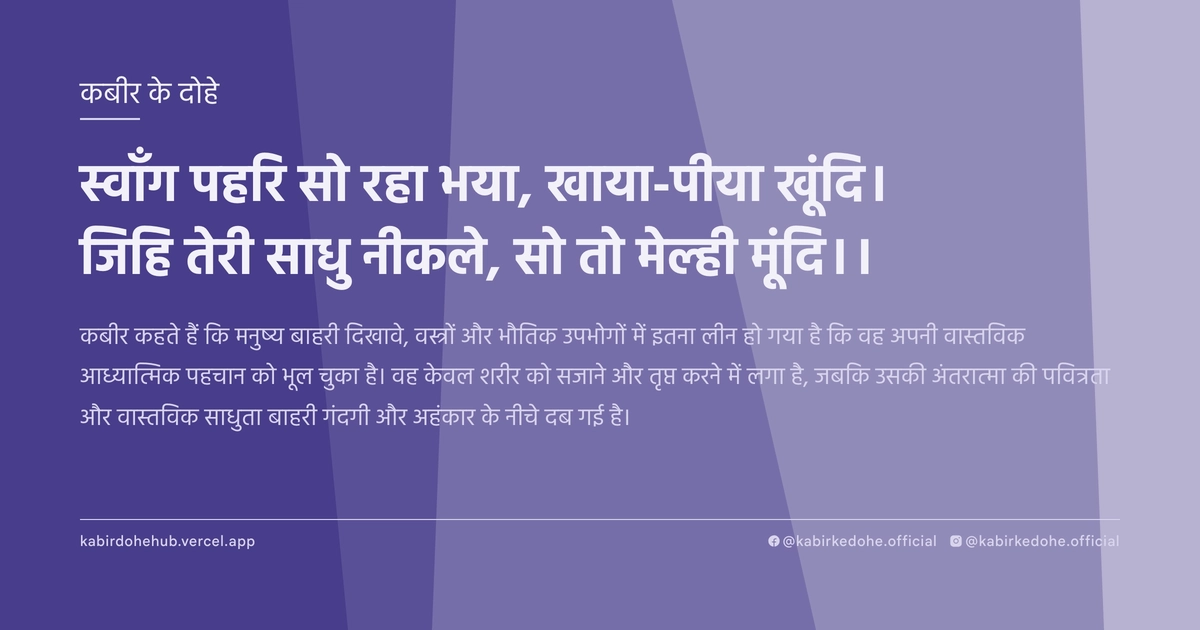
स्वाँग पहरि सो रहा भया, खाया-पीया खूंदि।
जिहि तेरी साधु नीकले, सो तो मेल्ही मूंदि।।
Swaang pahiri so raha bhaya, khaaya-piya khoondi. Jih teri sadhu neekle, so to melhi moondi.
इस पृष्ठ पर इस कबीर दोहे का अर्थ (meaning), हिंदी व्याख्या और अंग्रेज़ी अनुवाद, दार्शनिक विश्लेषण और व्यावहारिक जीवन सीख दी गई है। यह दोहा वैराग्य (Detachment) विषय से जुड़ा है — Kabir doha meaning and explanation in Hindi and English.
अर्थ (Meaning):
कबीर कहते हैं कि मनुष्य बाहरी दिखावे, वस्त्रों और भौतिक उपभोगों में इतना लीन हो गया है कि वह अपनी वास्तविक आध्यात्मिक पहचान को भूल चुका है। वह केवल शरीर को सजाने और तृप्त करने में लगा है, जबकि उसकी अंतरात्मा की पवित्रता और वास्तविक साधुता बाहरी गंदगी और अहंकार के नीचे दब गई है।
Kabir observes that humanity has become utterly consumed by external adornments, material possessions, and the indulgence of physical appetites. In the pursuit of sensory satisfaction and social prestige, the innate spiritual purity and the 'true seeker' within have been buried under the grime of ego and worldly attachment.
व्याख्या (Interpretation):
यह दोहा बाहरी आडंबर और आंतरिक रिक्तता के बीच के विरोधाभास को दर्शाता है। 'पहरि' और 'खाया-पीया' भौतिक सुखों और सामाजिक पहचान के प्रतीकों को इंगित करते हैं, जो माया के जाल हैं। कबीर यहाँ निरगुण भक्ति के सिद्धांत को प्रस्तुत करते हैं, जहाँ ईश्वर किसी विशेष वस्त्र या कर्मकांड में नहीं, बल्कि शुद्ध चेतना में बसता है। जब मनुष्य स्वयं को केवल शरीर और उसकी आवश्यकताओं तक सीमित कर लेता है, तो वह अपनी आत्मा (Atman) और ब्रह्म (Brahman) के अद्वैत संबंध को भुला देता है। 'मेल्ही मूंदि' का अर्थ है कि सत्य की दृष्टि अहंकार की धूल से ढकी हुई है। यह एक आध्यात्मिक विडंबना है कि हम जिसे 'सजावट' समझते हैं, वही वास्तव में हमारी आध्यात्मिक दृष्टि को अवरुद्ध करने वाली बाधा है।
This couplet illuminates the stark paradox between external ornamentation and internal void. The references to 'wearing' and 'consuming' symbolize the traps of Maya, where social identity and sensory gratification are mistaken for existence. Kabir invokes the essence of Nirgun Bhakti, asserting that the Divine resides not in ritualistic attire or outward piety, but in a state of formless purity. When a human reduces their identity to the physical body and its appetites, they sever the realization of non-duality between Atman and Brahman. The phrase 'melhi moondi' suggests that the vision of truth is obscured by the dust of the ego. It is a spiritual irony: the very 'decorations' we use to present ourselves to the world act as the veils that prevent us from seeing the Eternal Truth within.
दार्शनिक विश्लेषण (Philosophical Analysis):
कबीर का यह दृष्टिकोण उनके युग के धार्मिक पाखंड और जातिगत श्रेष्ठता के विरुद्ध एक सशक्त प्रहार है। उन्होंने देखा कि लोग केवल तिलक, माला या विशेष वस्त्र पहनकर स्वयं को 'साधु' घोषित कर देते थे, जबकि उनके भीतर क्रोध, लोभ और अहंकार का वास था। यह विश्लेषण अद्वैत वेदांत के उस सिद्धांत से मेल खाता है जहाँ 'अहंकार' को ही अज्ञान का मूल कारण माना गया है। कबीर का तर्क है कि जब तक व्यक्ति अपनी पहचान को बाहरी वस्तुओं से जोड़ता है, वह वास्तव में 'अविद्या' में जी रहा है।
सूफी मत के 'फना' (अहंकार का विनाश) के सिद्धांत की तरह, कबीर यहाँ भी यह संदेश देते हैं कि सत्य तक पहुँचने के लिए पहले उस झूठी पहचान को मिटाना होगा जिसे हमने समाज द्वारा निर्मित किया है। वे ritualism (कर्मकांड) को पूरी तरह नकारते हैं क्योंकि कर्मकांड अक्सर अहंकार को संतुष्ट करते हैं, उसे मिटाते नहीं।
मनोवैज्ञानिक स्तर पर, यह दोहा 'पहचान के संकट' की बात करता है। मनुष्य अपनी आंतरिक शून्यता को भरने के लिए बाहरी वस्तुओं का सहारा लेता है। वह जितना अधिक बाहरी आवरण ओढ़ता है, उसकी वास्तविक आत्मा उतनी ही संकुचित होती जाती है। कबीर इसे 'मूंदि' या बंद आँखों के समान बताते हैं।
भक्ति आंदोलन के संदर्भ में, कबीर की यह चेतावनी उन लोगों के लिए है जो धर्म को एक व्यवसाय या सामाजिक प्रतिष्ठा का साधन मानते हैं। वे स्पष्ट करते हैं कि वास्तविक साधु वह नहीं है जिसने गेरुआ वस्त्र पहना है, बल्कि वह है जिसका मन वासनाओं से मुक्त और सत्य में लीन है।
अंततः, यह विश्लेषण हमें इस निष्कर्ष पर ले जाता है कि आध्यात्मिक जागृति बाहरी संचय से नहीं, बल्कि आंतरिक विसर्जन से आती है। जब तक 'मैं' और 'मेरा' का भ्रम बना रहता है, तब तक सत्य की अनुभूति असंभव है।
Kabir’s perspective serves as a potent critique of the religious hypocrisy and caste-based superiority prevalent during his era. He observed a society where individuals claimed spiritual mastery simply by donning specific robes or wearing beads, while their hearts remained reservoirs of greed and arrogance. This analysis aligns with the Advaita Vedanta principle that 'Ahankara' (the ego) is the primary root of all ignorance and suffering.
Parallel to the Sufi concept of 'Fana' (the annihilation of the self), Kabir suggests that to encounter the Truth, one must first dismantle the artificial identity constructed by societal expectations. He rejects ritualism entirely, arguing that rituals often serve to inflate the ego rather than dissolve it, creating a false sense of spiritual achievement.
On a psychological plane, this doha addresses the 'crisis of identity.' Humans attempt to fill an internal void with external acquisitions. The more layers of social persona one adopts, the more the authentic self is suffocated. Kabir describes this as being 'blinded' or 'closed,' where the external noise drowns out the internal silence.
Within the context of the Bhakti movement, Kabir’s warning is directed at those who treat spirituality as a profession or a tool for social prestige. He clarifies that a true 'Sadhu' is not defined by saffron robes, but by a mind liberated from cravings and anchored in the formless Absolute.
Ultimately, this analysis leads to the conclusion that spiritual awakening is achieved not through accumulation, but through subtraction. As long as the illusion of 'I' and 'Mine' persists, the realization of the universal consciousness remains an impossibility.
मूल संदेश (Core Message):
- बाहरी सजावट अक्सर आंतरिक रिक्तता को छिपाने का एक प्रयास होती है।
- सच्ची आध्यात्मिकता वस्त्रों में नहीं, बल्कि अहंकार के विसर्जन में है।
- जब तक 'मैं' का भ्रम है, तब तक सत्य का अनुभव असंभव है।
- साधुता एक उपाधि नहीं, बल्कि मन की एक शुद्ध अवस्था है।
- सत्य की खोज बाहरी दुनिया में नहीं, बल्कि भीतर की धूल झाड़ने में है।
- External adornment is often a desperate attempt to mask an internal void.
- True spirituality lies not in the attire, but in the dissolution of the ego.
- As long as the illusion of 'I' persists, the experience of Truth remains impossible.
- Sainthood is not a title to be worn, but a state of mental purity to be achieved.
- The quest for Truth is not a journey outward, but a process of clearing internal dust.
व्यावहारिक उदाहरण (Practical Example):
वाराणसी के एक पुराने मोहल्ले में रामदीन नाम का एक बुनकर रहता था। वह शहर के सबसे महंगे रेशमी वस्त्र बुनता था और उसकी ख्याति दूर-दूर तक थी। रामदीन को अपनी कला और अपने वस्त्रों पर बहुत गर्व था। वह हमेशा सबसे कीमती वस्त्र पहनता ताकि लोग उसे एक समृद्ध और सम्मानित व्यक्ति मानें। वह मंदिर जाता, दान देता, लेकिन उसका मन हमेशा इस बात में रहता कि लोग उसकी पोशाक की प्रशंसा कर रहे हैं या नहीं।
एक दिन, उसकी मुलाकात एक फकीर से हुई जो फटे-पुराने कपड़ों में था लेकिन उसकी आँखों में एक अद्भुत शांति थी। फकीर ने रामदीन के कीमती वस्त्रों को देखा और मुस्कुराते हुए कहा, 'रामदीन, तूने शरीर को तो बहुत सुंदर ढक लिया, लेकिन क्या तूने उस धूल को साफ किया जो तेरी आत्मा पर जमी है?'
रामदीन को पहले तो यह बात चुभी। उसने सोचा कि यह फकीर उसकी समृद्धि से जल रहा है। लेकिन अगले कुछ दिनों तक वह फकीर की बातों पर विचार करता रहा। उसने महसूस किया कि जब वह अपने महंगे वस्त्र उतारकर साधारण कपड़ों में होता था, तो उसे डर लगता था कि लोग उसे पहचानेंगे नहीं या उसका सम्मान कम हो जाएगा।
उसे समझ आया कि उसकी पूरी पहचान उन कपड़ों पर टिकी थी, न कि उसके व्यक्तित्व या उसकी सच्चाई पर। वह वस्त्र उसके लिए एक कवच बन गए थे, जिसके पीछे वह अपने डर और असुरक्षाओं को छिपा रहा था।
एक रात, रामदीन ने अपने सबसे कीमती वस्त्रों को देखा और उसे महसूस हुआ कि ये केवल धागे हैं, जो उसे सत्य से दूर कर रहे हैं। उसने महसूस किया कि वह 'साधु' बनने का ढोंग तो कर रहा था, लेकिन उसके भीतर का लालच अभी भी जीवित था।
उसने धीरे-धीरे अपनी जीवनशैली बदली। उसने अपनी कला को अहंकार का साधन बनाने के बजाय सेवा का माध्यम बनाया। उसने गरीब बच्चों को मुफ्त में बुनाई सिखानी शुरू की।
अब वह सबसे महंगे कपड़े नहीं पहनता था, लेकिन उसके चेहरे पर एक ऐसी चमक थी जो किसी रेशमी वस्त्र से नहीं आ सकती थी। लोग अब उसकी पोशाक की नहीं, बल्कि उसकी करुणा और सरलता की प्रशंसा करने लगे।
रामदीन ने पाया कि जब उसने बाहरी आवरणों का मोह छोड़ा, तभी उसके भीतर का वास्तविक 'साधु' जागृत हुआ। वह अब वास्तव में स्वतंत्र था क्योंकि उसकी खुशी अब दूसरों की नजरों पर निर्भर नहीं थी।
In an ancient neighborhood of Varanasi lived a weaver named Ramdin. He crafted the most expensive silk garments in the city, and his fame extended far and wide. Ramdin took immense pride in his craft and his attire. He always wore the costliest fabrics so that people would perceive him as a wealthy and respected man. He visited temples and gave donations, but his mind was always preoccupied with whether people were admiring his clothing.
One day, he encountered a wandering dervish who wore tattered rags but possessed an extraordinary peace in his eyes. The dervish looked at Ramdin’s opulent clothes and smiled, saying, 'Ramdin, you have covered your body beautifully, but have you cleaned the dust that has settled upon your soul?'
Initially, Ramdin felt offended. He thought the dervish was simply jealous of his prosperity. However, over the next few days, he found himself contemplating those words. He realized that whenever he took off his expensive clothes and wore simple ones, he felt a surge of anxiety that people would not recognize him or that his status would diminish.
He understood that his entire identity was anchored in those fabrics, not in his character or his truth. The clothes had become a shield behind which he hid his fears and insecurities.
One night, looking at his finest silks, Ramdin realized they were merely threads that were distancing him from the Truth. He recognized that while he played the part of a 'pious man,' the greed within him was still very much alive.
He gradually transformed his lifestyle. Instead of using his art as a tool for ego, he turned it into a medium of service. He began teaching weaving to underprivileged children for free.
He no longer wore the most expensive clothes, but a radiance appeared on his face that no silk could provide. People began to praise his compassion and simplicity rather than his attire.
Ramdin discovered that only when he relinquished the attachment to external coverings did the true 'seeker' within him awaken. He was finally free because his happiness no longer depended on the gaze of others.
अभ्यास मार्गदर्शन (Practice Guidance):
- प्रतिदिन 20 मिनट मौन ध्यान करें, जहाँ आप अपनी सामाजिक पहचान (नाम, पद, संबंध) को पूरी तरह त्याग कर केवल एक 'साक्षी' के रूप में स्वयं को देखें।
- एक 'अहंकार डायरी' लिखें: दिन भर में उन क्षणों को नोट करें जब आपने किसी की प्रशंसा पाने के लिए या अपनी श्रेष्ठता दिखाने के लिए कोई कार्य किया।
- सप्ताह में एक दिन 'सादा जीवन' का अभ्यास करें: सबसे साधारण वस्त्र पहनें और उन स्थितियों में जाएँ जहाँ आपकी सामाजिक पहचान मायने नहीं रखती, ताकि आप अपनी आंतरिक असुरक्षाओं का सामना कर सकें।
- निदान चेकलिस्ट: क्या मैं अपनी खुशी के लिए दूसरों की राय पर निर्भर हूँ? क्या मैं अपनी उपलब्धियों का श्रेय केवल स्वयं को देता हूँ? क्या मैं बाहरी दिखावे को आंतरिक शांति से अधिक महत्व देता हूँ?
- Practice 20 minutes of silent meditation daily, consciously stripping away your social identities (name, title, relationships) and observing yourself purely as a 'Witness'.
- Maintain an 'Ego Journal': Document moments throughout the day when you acted specifically to gain admiration or to assert superiority over others.
- Practice 'Radical Simplicity' once a week: Wear your most basic clothing and place yourself in environments where your social status is irrelevant, forcing you to confront your internal insecurities.
- Diagnostic Checklist: Am I dependent on external validation for my happiness? Do I attribute all my successes solely to my own effort? Do I prioritize outward appearance over internal peace?
चिंतन प्रश्न (Reflection Questions):
- यदि मुझसे मेरी सारी उपाधियाँ, संपत्ति और सामाजिक प्रतिष्ठा छीन ली जाए, तो 'मैं' वास्तव में कौन हूँ?
- मैं अपनी सार्वजनिक छवि (Public Image) को बनाए रखने के लिए अपने भीतर के किन हिस्सों को दबा रहा हूँ?
- क्या मेरी धार्मिक या आध्यात्मिक गतिविधियाँ वास्तव में मुझे विनम्र बना रही हैं, या वे मेरे अहंकार को एक नया 'पवित्र' रूप दे रही हैं?
- मेरे जीवन में वह कौन सा 'दिखावा' है जिसे मैं सत्य मान बैठा हूँ?
- क्या मैं वास्तव में दूसरों की मदद करता हूँ, या मैं मदद करने वाले की छवि से प्रेम करता हूँ?
- If all my titles, possessions, and social prestige were stripped away, who would 'I' actually be?
- Which parts of my authentic self am I suppressing to maintain my curated public image?
- Are my religious or spiritual practices truly making me humble, or are they merely giving my ego a 'holy' new form?
- What is the specific 'pretense' in my life that I have mistaken for truth?
- Do I truly love helping others, or am I in love with the image of being a helper?