
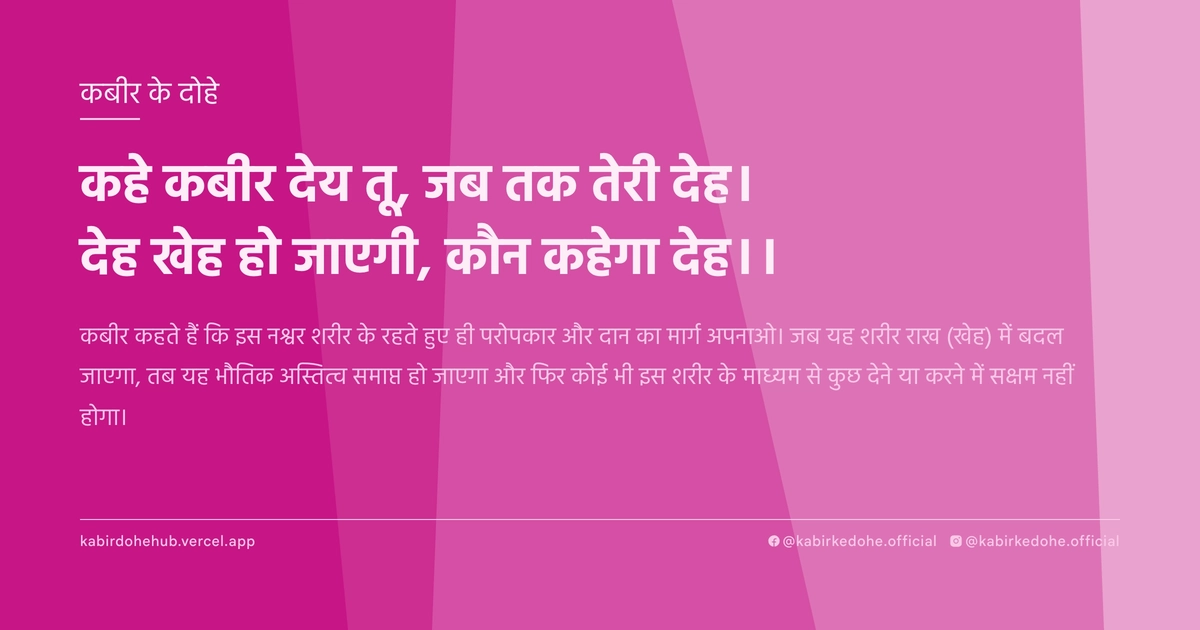
कहे कबीर देय तू, जब तक तेरी देह।
देह खेह हो जाएगी, कौन कहेगा देह।।
Kahe Kabir deya tu, jab tak teri deh. Deh kheh ho jayegi, kaun kahega deh.
इस पृष्ठ पर इस कबीर दोहे का अर्थ (meaning), हिंदी व्याख्या और अंग्रेज़ी अनुवाद, दार्शनिक विश्लेषण और व्यावहारिक जीवन सीख दी गई है। यह दोहा वैराग्य (Detachment) विषय से जुड़ा है — Kabir doha meaning and explanation in Hindi and English.
अर्थ (Meaning):
कबीर कहते हैं कि इस नश्वर शरीर के रहते हुए ही परोपकार और दान का मार्ग अपनाओ। जब यह शरीर राख (खेह) में बदल जाएगा, तब यह भौतिक अस्तित्व समाप्त हो जाएगा और फिर कोई भी इस शरीर के माध्यम से कुछ देने या करने में सक्षम नहीं होगा।
Kabir urges the seeker to practice generosity and selfless giving while the physical body still exists. Once this mortal frame turns to ash, the physical identity vanishes, and the opportunity to perform conscious acts of service or detachment through the body is lost forever.
व्याख्या (Interpretation):
शाब्दिक अर्थ यह है कि मृत्यु के बाद शरीर राख हो जाता है। आध्यात्मिक स्तर पर, 'देह' केवल मांस और हड्डियों का ढांचा नहीं है, बल्कि वह माध्यम है जिसके द्वारा आत्मा कर्म करती है। कबीर यहाँ 'माया' के मोह और शरीर के अहंकार पर प्रहार कर रहे हैं। जब तक हम जीवित हैं, हमारे पास अहंकार को गलाने का अवसर है। निर्गुण भक्ति के अनुसार, परमात्मा शरीर में नहीं बल्कि चेतना में है, लेकिन इस चेतना को शुद्ध करने के लिए शरीर का उपयोग कर सेवा करना आवश्यक है। यह दोहा अद्वैत वेदांत के उस सत्य को दर्शाता है जहाँ शरीर नश्वर है लेकिन आत्मा शाश्वत है; अतः नश्वरता का बोध ही वास्तविक जागृति का मार्ग है।
Literally, the verse warns that the body eventually becomes ash. Metaphorically, the 'body' represents the vehicle of action and the seat of the ego. Kabir attacks the illusion of permanence (Maya), suggesting that the physical form is the only tool available to dissolve the ego through selfless service. In the context of Nirgun Bhakti, while the Divine is formless, the physical existence serves as the laboratory for spiritual alchemy. The paradox lies in using the temporary (the body) to achieve the eternal (liberation). By emphasizing the inevitability of decay, Kabir aligns with Advaita Vedanta, reminding us that the identification with the 'I-body' is a delusion that must be transcended before the physical vessel collapses.
दार्शनिक विश्लेषण (Philosophical Analysis):
कबीर का यह दोहा मध्यकालीन भारत के उस सामाजिक परिवेश से उपजा है जहाँ कर्मकांड और बाहरी दिखावे का बोलबाला था। उन्होंने स्पष्ट किया कि मोक्ष केवल तीर्थयात्रा या माला जपने से नहीं, बल्कि वर्तमान क्षण में किए गए निस्वार्थ कार्यों से मिलता है। यह दृष्टिकोण सूफीवाद के 'फना' (अहंकार का विनाश) और अद्वैत वेदांत के 'अहं ब्रह्मास्मि' के बीच एक सेतु बनाता है।
यहाँ 'देय' (देना) का अर्थ केवल धन का दान नहीं है, बल्कि अपने अहंकार, क्रोध और मोह का त्याग करना है। कबीर ritualism का विरोध करते हैं क्योंकि वे मानते हैं कि ईश्वर मंदिर या मस्जिद में नहीं, बल्कि मनुष्य की करुणा में बसता है। जब व्यक्ति शरीर को केवल एक साधन मानता है, न कि अपना अंतिम गंतव्य, तब वह वास्तव में स्वतंत्र होता है।
मनोवैज्ञानिक स्तर पर, यह दोहा 'मृत्यु-बोध' (Memento Mori) का उपयोग करता है ताकि मनुष्य अपनी प्राथमिकताएं बदल सके। जब हम यह स्वीकार करते हैं कि शरीर राख हो जाएगा, तो संचय की प्रवृत्ति समाप्त हो जाती है और वितरण की प्रवृत्ति जन्म लेती है। यह मानसिक रूपांतरण ही अज्ञान से ज्ञान की ओर ले जाता है।
कबीर की निर्गुण विचारधारा यह सिखाती है कि परमात्मा किसी विशेष आकार में नहीं है, इसलिए उसकी सेवा किसी मूर्ति की नहीं बल्कि उसकी रचना (मानवता) की होनी चाहिए। यह जाति और वर्ग के भेदों को मिटाने का सबसे सशक्त तरीका है क्योंकि राख होने के बाद सभी समान हो जाते हैं।
अंततः, यह दोहा हमें चेतावनी देता है कि समय सीमित है। आध्यात्मिक यात्रा को कल पर टालना एक भ्रम है। जो व्यक्ति अपने जीवित रहते हुए स्वयं को दूसरों के लिए समर्पित कर देता है, वह मृत्यु के भय से मुक्त हो जाता है और उस अनंत सत्य में विलीन हो जाता है जहाँ न शरीर है और न ही उसकी राख।
This Doha emerges from the socio-religious turbulence of medieval India, where Kabir stood as a fierce critic of empty ritualism and caste hierarchies. He posits that liberation is not found in the performative piety of pilgrimages or beads, but in the immediate, selfless application of one's existence for the welfare of others. This philosophy bridges the Sufi concept of 'Fana' (annihilation of the self) with the Advaita Vedantic realization of the non-dual nature of reality.
The act of 'giving' (dey) mentioned by Kabir transcends material charity; it is a call for the surrender of the ego, pride, and attachment. By rejecting the sanctity of external rituals, Kabir asserts that the Divine resides not in stone idols or structured mosques, but within the compassionate heart of a human being. To treat the body as a mere instrument rather than the ultimate identity is the first step toward true spiritual freedom.
Psychologically, the verse employs the principle of 'Memento Mori'—the remembrance of death—to shift the seeker's priorities. When the inevitability of decay is internalized, the drive for accumulation is replaced by a drive for distribution. This cognitive shift is essential for dismantling the 'I-consciousness' that separates the individual from the universal.
Kabir’s Nirgun (formless) perspective suggests that since the Divine has no shape, the most authentic worship is the service of humanity. This effectively erases social stratifications, as the ultimate equality is found in the ash that follows death, rendering caste and status irrelevant.
Ultimately, the teaching warns against the spiritual procrastination of the ego. The journey toward the Truth cannot be deferred. One who dedicates their living presence to the service of others transcends the fear of death, evolving from a limited physical entity into a manifestation of the eternal, formless consciousness.
मूल संदेश (Core Message):
- देह नश्वर है, केवल कर्म शाश्वत हैं।
- संग्रह मोह है, वितरण मुक्ति है।
- अहंकार को शरीर के रहते ही विसर्जित करें।
- सेवा ही वास्तविक आध्यात्मिक साधना है।
- राख होने से पहले मनुष्य बनो।
- The body is transient; only selfless deeds are eternal.
- Accumulation is a trap; distribution is liberation.
- Dissolve the ego while the physical vessel remains.
- Service to humanity is the highest spiritual discipline.
- Become truly human before becoming ash.
व्यावहारिक उदाहरण (Practical Example):
एक समय की बात है, वाराणसी के घाटों पर माधव नाम का एक वृद्ध बुनकर रहता था। माधव अपने जीवन के अंतिम वर्षों में था और उसने अपनी पूरी जिंदगी केवल अपने परिवार के लिए कपड़े बुनने और धन संचय करने में बिता दी थी। वह बहुत कंजूस था और हमेशा इस डर में रहता था कि उसके बाद उसके बच्चों को क्या मिलेगा।
एक दिन उसने देखा कि एक छोटा बच्चा भूख से व्याकुल होकर सड़क पर पड़ा है। माधव के पास पर्याप्त भोजन था, लेकिन उसने सोचा, 'अगर मैं इसे दे दूँगा, तो मेरे पास कम हो जाएगा।' तभी उसकी नजर एक श्मशान की चिता पर पड़ी, जहाँ एक अमीर व्यक्ति का शरीर जल रहा था।
माधव ने देखा कि जिस व्यक्ति ने जीवन भर धन इकट्ठा किया था, आज वह केवल राख बन रहा था। उसके पास मौजूद सोने के गहने और रेशमी वस्त्र किसी काम नहीं आ रहे थे। उस दृश्य ने माधव के भीतर एक बिजली जैसी लहर पैदा कर दी। उसे कबीर की यह बात याद आई कि शरीर तो अंत में राख ही होना है।
उसने तुरंत उस भूखे बच्चे को भोजन कराया और अपने पास रखे पुराने कपड़ों के ढेर को पास के गरीब बस्ती के लोगों में बाँट दिया। पहली बार माधव को महसूस हुआ कि देने का सुख, संचय करने के सुख से कहीं अधिक गहरा है।
अगले कुछ महीनों में, माधव का पूरा जीवन बदल गया। उसने अपनी छोटी सी दुकान को एक सामुदायिक केंद्र बना दिया जहाँ वह गरीब बच्चों को मुफ्त में बुनाई सिखाने लगा। वह अब धन के लिए नहीं, बल्कि संतोष के लिए काम करता था।
गाँव के लोग हैरान थे कि जो माधव कभी किसी की मदद नहीं करता था, वह अब सबका सहारा बन गया है। माधव ने महसूस किया कि उसका अहंकार, जो उसे 'मालिक' होने का भ्रम देता था, अब धीरे-धीरे मिट रहा है।
जब माधव की मृत्यु आई, तो उसके पास भौतिक संपत्ति तो बहुत कम बची थी, लेकिन पूरा शहर उसके अंतिम संस्कार के लिए उमड़ पड़ा। उसके चेहरे पर एक असीम शांति थी।
उसने अपनी देह के रहते हुए ही उसे 'दे' दिया था, इसलिए वह राख होने के बाद भी लोगों की यादों में जीवित रहा। यह उसका वास्तविक रूपांतरण था।
Once, in the winding lanes of Varanasi, lived an elderly weaver named Madhav. Madhav had spent his entire life weaving fine fabrics and obsessively accumulating wealth for his children. He was known for his frugality, bordering on greed, always fearing that he would not have enough to leave behind.
One afternoon, he encountered a young child collapsed on the street, trembling from hunger. Madhav had plenty of food in his home, but he hesitated, thinking, 'If I give this away, my reserves will diminish.' As he stood there in conflict, his gaze shifted toward the cremation ghats, where a wealthy merchant was being incinerated.
Madhav watched as the flames consumed the body. The gold ornaments and silk robes that the merchant had prized in life were now useless, turning into grey ash. This sight struck Madhav with a sudden, piercing clarity: the physical body and its attachments are transient.
Recalling the essence of Kabir's wisdom—that the body eventually becomes ash—Madhav felt a surge of urgency. He immediately fed the hungry child and spent the evening distributing his hoard of old clothes to the impoverished dwellers of the nearby slums.
For the first time in his life, Madhav experienced a joy that surpassed the thrill of acquisition. He realized that the act of giving was not a loss, but a liberation from the burden of ownership.
Over the following months, Madhav transformed his small shop into a community hub. He began teaching weaving to orphaned children for free, shifting his focus from profit to purpose. The 'owner' identity he had clung to for decades began to dissolve.
Villagers were astonished by this change. The man who once counted every penny was now the pillar of the community. Madhav found that by emptying his hands, he was filling his soul.
When death finally claimed him, Madhav possessed very little material wealth, but the entire city gathered to honor him. He died with a smile of absolute serenity on his face.
Because he had 'given' while he still had a body, he transcended the tragedy of becoming ash. He had converted his temporary existence into an eternal legacy of love.
अभ्यास मार्गदर्शन (Practice Guidance):
- प्रतिदिन 15 मिनट मौन ध्यान करें और विचार करें कि आपका शरीर प्रकृति से लिया गया एक ऋण है जिसे अंततः लौटाना है।
- एक 'त्याग जर्नल' बनाएँ: हर दिन एक ऐसी चीज़ लिखें जिसे आपने भौतिक या मानसिक रूप से छोड़ा (जैसे क्रोध, कोई पुरानी वस्तु, या अहंकार)।
- सचेत सेवा: सप्ताह में एक बार किसी ऐसे व्यक्ति की मदद करें जिससे आपको बदले में कुछ मिलने की कोई उम्मीद न हो।
- निदान चेकलिस्ट: क्या मैं अभी भी चीज़ों को 'मेरा' कह रहा हूँ? क्या मुझे मृत्यु का विचार डराता है या प्रेरित करता है? क्या मेरी खुशी दूसरों की कमी पर आधारित है?
- Practice 15 minutes of silent meditation daily, contemplating that the body is a loan from nature that must eventually be returned.
- Maintain a 'Renunciation Journal': Record one thing each day that you consciously let go of, whether it is a material object, a grudge, or a piece of your ego.
- Conscious Service: Once a week, perform an act of kindness for someone from whom you expect absolutely nothing in return.
- Diagnostic Checklist: Am I still clinging to the word 'Mine'? Does the thought of death evoke fear or a sense of urgency to grow? Is my happiness dependent on possessing more than others?
चिंतन प्रश्न (Reflection Questions):
- यदि आज मेरा शरीर राख हो जाए, तो दुनिया में मेरी उपस्थिति का क्या प्रमाण बचेगा?
- मैं किन ऐसी चीज़ों को पकड़ कर बैठा हूँ जिन्हें मैं 'अपना' कहता हूँ, जबकि वे वास्तव में मेरी नहीं हैं?
- मेरा 'डिजिटल अहंकार' (सोशल मीडिया इमेज) मेरी वास्तविक आत्मा को कैसे ढक रहा है?
- क्या मेरी उदारता वास्तव में निस्वार्थ है, या यह केवल मेरी छवि सुधारने का एक तरीका है?
- मृत्यु का भय मुझे जीवन जीने से रोक रहा है या मुझे बेहतर इंसान बनने के लिए प्रेरित कर रहा है?
- If my body were to turn to ash today, what evidence of my existence would remain in the hearts of others?
- What am I clinging to as 'mine' when, in reality, I am merely a temporary custodian?
- How does my 'digital ego' (online persona) obscure the authenticity of my inner soul?
- Is my generosity truly selfless, or is it a calculated move to polish my public image?
- Does the fear of death paralyze my growth, or does it ignite a passion to live meaningfully?