
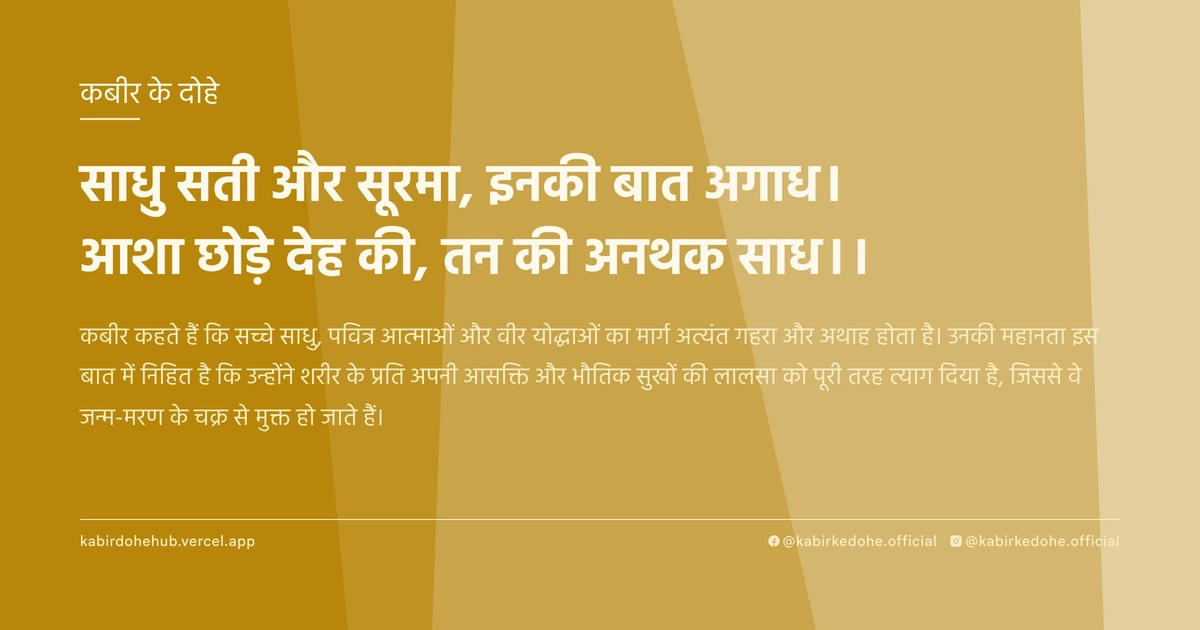
साधु सती और सूरमा, इनकी बात अगाध।
आशा छोड़े देह की, तन की अनथक साध।।
Sadhu sati aur surma, inki baat agadh. Asha chhode deh ki, tan ki anthak sadh.
इस पृष्ठ पर इस कबीर दोहे का अर्थ (meaning), हिंदी व्याख्या और अंग्रेज़ी अनुवाद, दार्शनिक विश्लेषण और व्यावहारिक जीवन सीख दी गई है। यह दोहा वैराग्य (Detachment) विषय से जुड़ा है — Kabir doha meaning and explanation in Hindi and English.
अर्थ (Meaning):
कबीर कहते हैं कि सच्चे साधु, पवित्र आत्माओं और वीर योद्धाओं का मार्ग अत्यंत गहरा और अथाह होता है। उनकी महानता इस बात में निहित है कि उन्होंने शरीर के प्रति अपनी आसक्ति और भौतिक सुखों की लालसा को पूरी तरह त्याग दिया है, जिससे वे जन्म-मरण के चक्र से मुक्त हो जाते हैं।
Kabir asserts that the path of the true seeker, the virtuous, and the spiritual warrior is unfathomable and profound. Their greatness lies in the complete relinquishment of attachment to the physical body and the cessation of endless cravings for material existence, thereby liberating themselves from the cycle of birth and death.
व्याख्या (Interpretation):
इस दोहे का शाब्दिक अर्थ है कि आध्यात्मिक योद्धा और संत शरीर की नश्वरता को पहचान कर उससे मोह छोड़ देते हैं। रूपकात्मक रूप से, 'सूरमा' यहाँ केवल युद्ध करने वाला नहीं, बल्कि वह है जो अपने भीतर के अहंकार और वासनाओं से युद्ध करता है। यह निर्गुण भक्ति का सार है, जहाँ ईश्वर को किसी मूर्ति में नहीं बल्कि स्वयं की चेतना के शुद्धिकरण में खोजा जाता है। माया वह पर्दा है जो हमें शरीर को ही 'स्व' मानने पर मजबूर करता है, जबकि वास्तव में हम शुद्ध आत्मा हैं। जब देह की आशा समाप्त होती है, तब आत्मा और ब्रह्म का अद्वैत (non-duality) प्रकट होता है। यह विरोधाभास है कि शरीर को त्यागने की इच्छा ही वास्तव में शरीर के बंधनों से मुक्ति दिलाती है। अंततः, यह संदेश देता है कि वास्तविक वीरता बाहरी विजय में नहीं, बल्कि आंतरिक विरक्ति में है।
Literally, the verse suggests that spiritual seekers and the virtuous recognize the transience of the body and abandon attachment to it. Metaphorically, the 'warrior' (surma) is not a soldier of battle, but one who wages war against their own ego and primal desires. This embodies the essence of Nirgun Bhakti, where the Divine is found not in idols, but in the purification of one's own consciousness. Maya is the veil that deceives us into identifying the 'Self' with the physical form, whereas we are essentially the eternal Atman. When the longing for the body ceases, the non-duality of Atman and Brahman is revealed. It is a profound paradox that the willingness to let go of the body is precisely what liberates the soul from its physical shackles. Ultimately, true valor is found not in external conquest, but in internal detachment.
दार्शनिक विश्लेषण (Philosophical Analysis):
कबीर का यह दोहा उस सामाजिक और धार्मिक परिवेश में लिखा गया था जहाँ कर्मकांड और बाहरी आडंबरों का बोलबाला था। उन्होंने स्पष्ट रूप से उन परंपराओं को चुनौती दी जो केवल शरीर की शुद्धि या बाहरी दिखावे को मोक्ष का मार्ग मानती थीं। कबीर का दर्शन अद्वैत वेदांत से मेल खाता है, जो यह मानता है कि जीव और ब्रह्म एक ही हैं, और केवल अज्ञानता (Avidya) ही उनके बीच अलगाव पैदा करती है।
यहाँ 'देह की आशा' का त्याग करने का अर्थ आत्महत्या नहीं, बल्कि 'देह-अभिमान' का विनाश है। यह सूफी मत के 'फना' (Fana) के सिद्धांत के समान है, जहाँ साधक अपनी व्यक्तिगत पहचान को ईश्वर की इच्छा में विलीन कर देता है। कबीर का तर्क है कि जब तक मनुष्य खुद को मांस और हड्डियों का ढांचा मानता रहेगा, वह भय और दुख से मुक्त नहीं हो सकता।
जाति और वर्ण के भेदभाव को नकारते हुए, कबीर ने 'साधु' और 'सूरमा' की परिभाषा को लोकतांत्रिक बनाया। उनके लिए वीरता वह नहीं जो तलवार से जीती जाए, बल्कि वह है जो मन के विकारों को जीत ले। यह मनोवैज्ञानिक रूपांतरण की प्रक्रिया है जहाँ व्यक्ति 'मैं' से 'तत' (वह) की ओर बढ़ता है।
ritualism के विरुद्ध उनका प्रहार इस बात पर आधारित है कि कोई भी बाहरी अनुष्ठान तब तक व्यर्थ है जब तक कि आंतरिक वैराग्य न हो। वे सिखाते हैं कि शरीर एक वस्त्र मात्र है; असली सत्य वह है जो इस वस्त्र के भीतर और बाहर व्याप्त है।
अंततः, यह विश्लेषण हमें बताता है कि मुक्ति केवल मृत्यु के बाद नहीं मिलती, बल्कि जीवित रहते हुए भी देह के मोह से मुक्त होकर 'जीवन्मुक्त' अवस्था प्राप्त की जा सकती है। यह अहंकार का पूर्ण विलोपन है, जो मनुष्य को सार्वभौमिक चेतना से जोड़ता है।
This couplet was composed during an era dominated by rigid ritualism and outward religious displays. Kabir explicitly challenged traditions that viewed physical purification or external piety as the sole path to liberation. His philosophy aligns closely with Advaita Vedanta, which posits that the individual soul (Jiva) and the Absolute (Brahman) are one, separated only by the veil of ignorance (Avidya).
Relinquishing 'hope for the body' does not imply physical suicide, but the annihilation of 'bodily identification' (Deha-Abhiman). This mirrors the Sufi concept of 'Fana', where the seeker dissolves their individual ego into the Divine Will. Kabir argues that as long as a human identifies as a mere frame of flesh and bone, they can never be free from fear and suffering.
By rejecting caste and creed, Kabir democratized the definitions of a 'saint' and a 'warrior'. For him, true valor is not won with a sword, but by conquering the impurities of the mind. This is a process of psychological transformation where the individual shifts from the 'I' (ego) to the 'That' (Universal Truth).
His critique of ritualism is based on the premise that any external rite is futile without internal detachment. He teaches that the body is merely a garment; the ultimate truth is that which pervades both the interior and exterior of this garment.
Ultimately, this analysis reveals that liberation is not solely a post-mortem event, but can be achieved while living—a state known as 'Jivanmukta'. It is the total dissolution of the ego, connecting the finite human experience to the infinite universal consciousness.
मूल संदेश (Core Message):
- देह केवल एक वस्त्र है, आत्मा शाश्वत सत्य है।
- असली वीरता बाहरी युद्ध में नहीं, आंतरिक विरक्ति में है।
- मोह का त्याग ही वास्तविक स्वतंत्रता का एकमात्र द्वार है।
- जब 'मैं' मिटता है, तब 'ब्रह्म' का अनुभव होता है।
- नश्वरता को स्वीकार करना ही अमरता की पहली सीढ़ी है।
- The body is but a garment; the soul is the eternal truth.
- True valor lies not in external wars, but in internal detachment.
- Relinquishing attachment is the only gateway to real freedom.
- When the 'I' dissolves, the experience of 'Brahman' begins.
- Accepting transience is the first step toward immortality.
व्यावहारिक उदाहरण (Practical Example):
वाराणसी के घाटों पर रहने वाले एक वृद्ध विधवा, जानकी, का जीवन अत्यंत कठिन था। वह दूसरों के घरों में सफाई करके अपना गुजारा करती थी और समाज की उपेक्षा सहती थी। वह अक्सर अपनी जवानी के दिनों और खोए हुए सम्मान को याद कर दुखी रहती थी, और अपनी शारीरिक बीमारियों और बुढ़ापे के कष्टों को अपनी नियति मानकर रोती थी।
एक दिन उसने कबीर के इस दोहे को सुना कि असली योद्धा वह है जो देह की आसक्ति छोड़ दे। पहले तो उसे लगा कि यह केवल संन्यासियों के लिए है, लेकिन फिर उसने गहराई से सोचा। उसने महसूस किया कि उसका दुख उसकी देह की बीमारी से ज्यादा, उस 'छवि' से था जो वह समाज में देखना चाहती थी।
उसने तय किया कि वह अब अपनी देह के कष्टों या अपनी सामाजिक स्थिति पर विलाप नहीं करेगी। उसने अपनी सेवा को एक आध्यात्मिक युद्ध मान लिया। जब वह झाड़ू लगाती, तो वह केवल फर्श साफ नहीं करती, बल्कि अपने भीतर के अहंकार और कड़वाहट को साफ करने का प्रयास करती।
धीरे-धीरे, जानकी के चेहरे पर एक ऐसी शांति आई जो किसी राजमहल की रानी के पास भी नहीं थी। लोग जो पहले उसे तुच्छ समझते थे, अब उसकी आंखों में एक अजीब सी चमक और स्थिरता देखने लगे।
एक बार शहर में भीषण बाढ़ आई और उसका छोटा सा बसेरा बह गया। जहाँ अन्य लोग अपनी संपत्ति और सामान के खोने पर विलाप कर रहे थे, जानकी शांत खड़ी थी। उसने महसूस किया कि जिस 'देह' और 'घर' से वह चिपकी थी, वह तो वैसे भी क्षणभंगुर था।
उसने अपनी बची हुई पोटली से कुछ अनाज निकाला और उन लोगों में बांट दिया जो उससे भी अधिक बदहाल थे। उसकी इस निस्वार्थता ने आस-पास के लोगों को झकझोर दिया।
एक धनी व्यापारी ने उससे पूछा, 'माता, आपका सब कुछ छिन गया, फिर भी आप इतनी शांत कैसे हैं?' जानकी ने मुस्कुराकर कहा, 'बेटा, मैं अब तक शरीर और सामान की आशा में जी रही थी, अब मैं उस सत्य की आशा में हूँ जो कभी नहीं मरता।'
यह 'कबीर ट्विस्ट' था—उसने अपनी शारीरिक लाचारी को अपनी आध्यात्मिक शक्ति में बदल दिया। उसने यह जान लिया कि शरीर केवल एक माध्यम है, मंजिल नहीं।
उसकी यह आंतरिक मुक्ति उसे एक ऐसी स्थिति में ले गई जहाँ वह अब किसी बाहरी मान्यता की मोहताज नहीं थी। वह वास्तव में एक 'सूरमा' बन गई थी जिसने अपने भीतर के मोह पर विजय पाई थी।
अंततः, जानकी ने अपनी अंतिम सांसें भी उसी शांति के साथ लीं, जैसे कोई पुराना वस्त्र उतारकर नया वस्त्र पहनता है, बिना किसी डर या पछतावे के।
Janaki, an elderly widow living on the ghats of Varanasi, led a life of extreme hardship. She survived by cleaning the houses of others, enduring the cold indifference of a society that marginalized her. She spent her days mourning her lost youth and the respect she once held, viewing her physical ailments and the decay of old age as a cruel destiny.
One day, she encountered Kabir's verse stating that the true warrior is one who relinquishes attachment to the body. Initially, she thought this was only for monks, but upon deeper reflection, she realized that her suffering stemmed not from her physical pain, but from the 'image' she desperately wanted the world to perceive.
She decided to stop lamenting her physical state and social standing. She transformed her menial labor into a spiritual battle. While sweeping floors, she didn't just remove dust; she attempted to sweep away the ego and bitterness within her heart.
Gradually, a serenity descended upon Janaki's face—a peace that surpassed that of any queen in a palace. People who once looked down upon her began to notice a strange brilliance and stability in her eyes.
When a devastating flood hit the city and swept away her meager shelter, others wailed over their lost possessions. Janaki stood calm. She realized that the 'body' and 'home' she had clung to were inherently transient.
She opened her remaining small bundle of grain and shared it with those who were even more destitute than herself. This selfless act shook the people around her.
A wealthy merchant asked her, 'Mother, you have lost everything; how can you remain so composed?' Janaki smiled and replied, 'Son, until now I lived in hope of the body and possessions; now I live in hope of that Truth which never dies.'
This was the 'Kabir Twist'—she converted her physical helplessness into spiritual power. She understood that the body is merely a vehicle, not the destination.
This internal liberation freed her from the need for external validation. She had become a true 'warrior' (surma) who had conquered the attachment within.
Ultimately, Janaki breathed her last with the same peace as one who simply discards an old garment to wear a new one, without fear or regret.
अभ्यास मार्गदर्शन (Practice Guidance):
- दैनिक ध्यान: प्रतिदिन 20 मिनट शांत बैठें और अपनी सांसों को देखें। यह महसूस करें कि शरीर केवल एक यंत्र है और आप उस यंत्र को चलाने वाली चेतना हैं।
- आत्म-पूछताछ जर्नल: हर रात लिखें—'आज मैंने किस शारीरिक सुख या बाहरी प्रशंसा के लिए संघर्ष किया? क्या वह वास्तव में स्थायी था?'
- व्यवहारिक परिवर्तन: दिन में कम से कम एक बार ऐसा कार्य करें जिसमें आपका कोई व्यक्तिगत लाभ न हो और जहाँ आप अपनी पहचान (नाम, पद) को पूरी तरह भुला दें।
- निदान चेकलिस्ट: यदि आप छोटी सी बीमारी या शारीरिक कमी पर अत्यधिक विलाप करते हैं, या दूसरों की शारीरिक सुंदरता से ईर्ष्या करते हैं, तो समझें कि आप अभी भी 'देह की आशा' में बंधे हैं।
- Daily Meditation: Sit in silence for 20 minutes and observe your breath. Consciously realize that the body is merely an instrument and you are the consciousness operating it.
- Self-Inquiry Journaling: Every night, record: 'What physical pleasure or external validation did I strive for today? Was it truly permanent?'
- Behavioral Shift: Perform at least one act daily that offers no personal gain and where you completely dissolve your identity (name, status, ego).
- Diagnostic Checklist: If you find yourself excessively lamenting minor physical ailments or feeling envy toward others' physical attributes, recognize that you are still bound by 'hope for the body'.
चिंतन प्रश्न (Reflection Questions):
- यदि आज आपकी सारी भौतिक पहचान (नाम, पद, संपत्ति) छीन ली जाए, तो आपके भीतर क्या बचेगा?
- आप अपनी देह की देखभाल स्वास्थ्य के लिए करते हैं या केवल सामाजिक प्रदर्शन और अहंकार की संतुष्टि के लिए?
- क्या आप वास्तव में मृत्यु से डरते हैं, या उस पहचान के खोने से जिसे आपने जीवन भर संजोया है?
- आपकी डिजिटल पहचान (सोशल मीडिया) आपकी वास्तविक आत्मा का प्रतिबिंब है या केवल एक 'देह-माया' का विस्तार?
- क्या आप किसी ऐसे व्यक्ति को प्रेम कर सकते हैं जिसकी शारीरिक स्थिति अत्यंत दयनीय हो, बिना किसी दया भाव के, केवल आत्मा से?
- If all your physical identities (name, rank, wealth) were stripped away today, what would remain within you?
- Do you care for your body for the sake of health, or merely for social display and the satisfaction of ego?
- Do you truly fear death, or do you fear the loss of the identity you have spent a lifetime constructing?
- Is your digital identity a reflection of your soul, or merely an extension of 'bodily illusion' (Deha-Maya)?
- Can you love someone whose physical condition is utterly wretched, without pity, but through a pure soul-to-soul connection?