
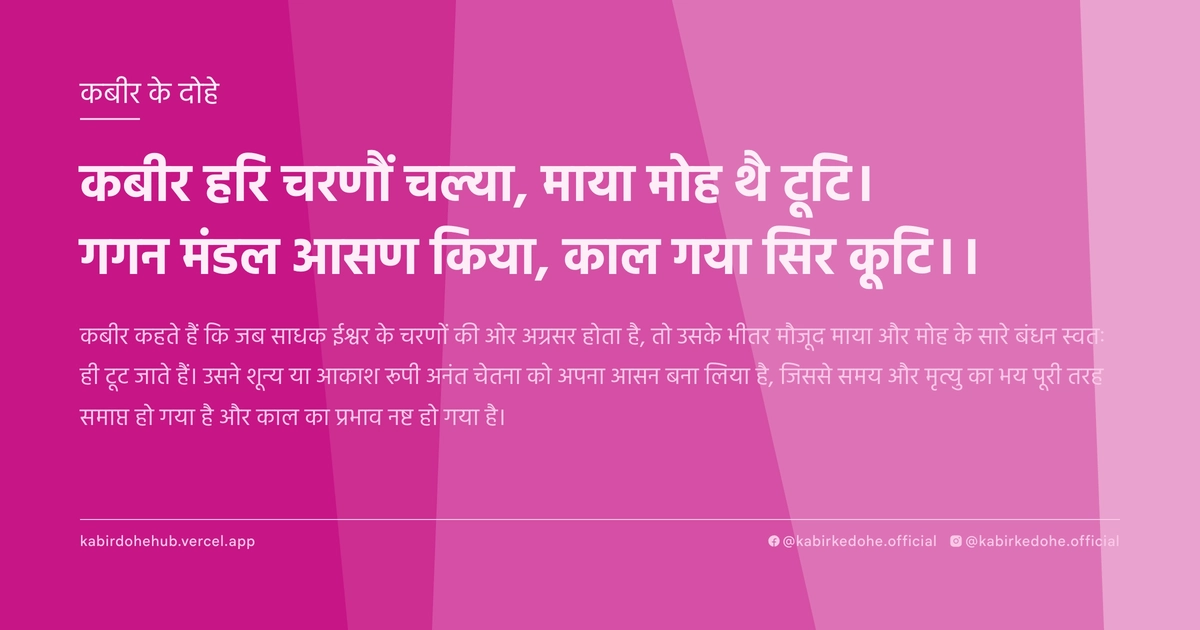
कबीर हरि चरणौं चल्या, माया मोह थै टूटि।
गगन मंडल आसण किया, काल गया सिर कूटि।।
Kabir hari charnaun chalya, maya moh thai tuti. Gagan mandal aasann kiya, kaal gaya sir kuti.
इस पृष्ठ पर इस कबीर दोहे का अर्थ (meaning), हिंदी व्याख्या और अंग्रेज़ी अनुवाद, दार्शनिक विश्लेषण और व्यावहारिक जीवन सीख दी गई है। यह दोहा प्रपत्ति (Surrender) विषय से जुड़ा है — Kabir doha meaning and explanation in Hindi and English.
अर्थ (Meaning):
कबीर कहते हैं कि जब साधक ईश्वर के चरणों की ओर अग्रसर होता है, तो उसके भीतर मौजूद माया और मोह के सारे बंधन स्वतः ही टूट जाते हैं। उसने शून्य या आकाश रूपी अनंत चेतना को अपना आसन बना लिया है, जिससे समय और मृत्यु का भय पूरी तरह समाप्त हो गया है और काल का प्रभाव नष्ट हो गया है।
Kabir proclaims that when a seeker consciously walks toward the divine feet of the Eternal, the shackles of illusion (Maya) and emotional attachment (Moh) spontaneously shatter. By establishing the vast, infinite expanse of the cosmic void as their seat of meditation, the seeker transcends the limitations of time and the dread of death, effectively crushing the power of temporal existence.
व्याख्या (Interpretation):
इस दोहे का शाब्दिक अर्थ है भौतिक संसार का त्याग और ईश्वर की शरण में जाना। गहरे स्तर पर, "हरि के चरण" किसी भौतिक स्थान नहीं, बल्कि उस परम चेतना का प्रतीक हैं जहाँ द्वैत समाप्त होता है। "माया मोह का टूटना" अहंकार के विसर्जन की प्रक्रिया है, जहाँ व्यक्ति यह समझ जाता है कि संसार एक स्वप्न है। "गगन मंडल" का अर्थ है कुण्डलिनी का जागरण या चेतना का विस्तार, जहाँ साधक स्वयं को ब्रह्मांडीय ऊर्जा के साथ एकाकार पाता है। यहाँ "काल का सिर कूटि जाना" मृत्यु पर विजय नहीं, बल्कि समय के भ्रम से मुक्ति है। यह निर्गुण भक्ति का सार है, जहाँ आत्मा (Atman) और ब्रह्म (Brahman) के बीच का पर्दा हट जाता है। यह अवस्था अद्वैत वेदांत की उस स्थिति को दर्शाती है जहाँ केवल एक ही सत्य शेष रहता है।
Literally, the verse describes the journey toward the Divine and the shedding of worldly ties. Metaphorically, "the feet of Hari" represent the ultimate state of non-duality rather than a physical destination. The "shattering of Maya and Moh" signifies the dissolution of the ego, the realization that the material world is a transient projection. "Gagan Mandal" refers to the expansion of consciousness into the Sahasrara or the cosmic void, where the seeker merges with the universal energy. The phrase "crushing the head of Kaal (Time)" does not imply physical immortality, but the transcendence of the temporal illusion. This aligns with Nirgun Bhakti, where the formless Absolute is realized. It mirrors the Advaita Vedanta pinnacle where the perceived separation between the individual soul and the Absolute vanishes, leaving only pure existence.
दार्शनिक विश्लेषण (Philosophical Analysis):
कबीर का यह दोहा उनके युग के धार्मिक पाखंड और कर्मकांडों के विरुद्ध एक सशक्त प्रहार है। उस समय समाज जातिगत श्रेष्ठता और बाहरी अनुष्ठानों में उलझा था, जबकि कबीर ने आंतरिक रूपांतरण पर बल दिया। उनका दर्शन सूफीवाद के 'फना' (अहंकार का विनाश) और वेदांत के 'अद्वैत' का एक अनूठा संगम है। वे कहते हैं कि मोक्ष किसी तीर्थ यात्रा या मंत्रोच्चार से नहीं, बल्कि मोह के त्याग से मिलता है।
यहाँ माया को एक ऐसी शक्ति के रूप में देखा गया है जो सत्य को ढक लेती है। जब साधक "हरि चरणों" की ओर चलता है, तो वह वास्तव में अपनी आंतरिक यात्रा शुरू करता है। यह यात्रा बाहर से भीतर की ओर है। कबीर के अनुसार, जब तक मनुष्य स्वयं को शरीर मानता है, वह काल (समय और मृत्यु) के अधीन रहता है। जैसे ही वह अपनी पहचान को 'शून्य' या 'गगन' से जोड़ता है, वह समय की सीमाओं से मुक्त हो जाता है।
सूफी परंपरा की तरह, कबीर यहाँ प्रेम और समर्पण की बात करते हैं। लेकिन यह प्रेम किसी व्यक्ति से नहीं, बल्कि उस निराकार तत्व से है जो कण-कण में व्याप्त है। वे ritualism को पूरी तरह नकारते हुए यह स्पष्ट करते हैं कि ईश्वर को पाने के लिए किसी मध्यस्थ या पुजारी की आवश्यकता नहीं है।
मनोवैज्ञानिक स्तर पर, यह दोहा 'संज्ञानात्मक पुनर्गठन' की बात करता है। मोह का टूटना वास्तव में उन मानसिक पैटर्न्स का टूटना है जो हमें दुख और भय से बांधते हैं। जब हम अपनी पहचान को सीमित 'मैं' से हटाकर अनंत 'ब्रह्मांड' में विलीन करते हैं, तो चिंता और भय समाप्त हो जाते हैं।
अंततः, यह दोहा हमें सिखाता है कि मुक्ति का मार्ग समर्पण और जागरूकता का है। काल का विनाश वास्तव में उस मानसिक डर का अंत है जो हमें वर्तमान क्षण में जीने से रोकता है। यह एक ऐसी अवस्था है जहाँ साधक स्वयं ही गंतव्य बन जाता है।
This couplet serves as a potent critique of the religious hypocrisy and ritualism prevalent during Kabir's era. While society was obsessed with caste hierarchies and external ceremonies, Kabir emphasized internal transformation. His philosophy is a unique synthesis of the Sufi concept of 'Fana' (annihilation of the ego) and the Vedantic principle of 'Advaita' (non-duality). He asserts that liberation is achieved not through pilgrimages or chants, but through the severance of attachment.
Maya is presented here as the veil that obscures the Ultimate Truth. Walking toward the "feet of Hari" is not a physical journey but an inward descent. This is the path from the periphery of existence to its core. According to Kabir, as long as a human identifies with the physical body, they remain subject to Kaal (Time and Death). Once the identity shifts to the 'Void' or 'Gagan', the constraints of temporal existence dissolve.
Mirroring Sufi mysticism, Kabir speaks of a love and surrender that transcends the personal. This love is directed toward the Formless Absolute that permeates every atom. He explicitly rejects the need for intermediaries or priests, arguing that the direct experience of the Divine is accessible to all, regardless of social standing.
Psychologically, this verse describes a process of 'cognitive restructuring.' The breaking of Moh (attachment) is the dismantling of mental patterns that bind the individual to suffering and fear. By shifting the locus of identity from the limited 'I' to the infinite 'Cosmic Consciousness,' the existential dread of mortality is neutralized.
Ultimately, the verse teaches that the path to liberation is paved with surrender and awareness. The 'crushing of Time' is the eradication of the mental anxiety that prevents one from inhabiting the present moment. It describes a state where the seeker ceases to be a traveler and becomes the destination itself.
मूल संदेश (Core Message):
- माया का बंधन केवल एक मानसिक भ्रम है जिसे जागरूकता से तोड़ा जा सकता है।
- ईश्वर की शरण का अर्थ है अपनी सीमित पहचान का विस्तार करना।
- जब अहंकार मिटता है, तब समय और मृत्यु का भय स्वतः समाप्त हो जाता है।
- शांति बाहरी परिस्थितियों में नहीं, बल्कि आंतरिक शून्य के अनुभव में है।
- सच्ची मुक्ति वह है जहाँ साधक स्वयं अनंत आकाश बन जाता है।
- The bonds of Maya are mere mental illusions that can be severed through awareness.
- Surrendering to the Divine means expanding one's identity beyond the limited self.
- When the ego dissolves, the fear of time and death spontaneously vanishes.
- True peace resides not in external conditions, but in the experience of the internal void.
- Ultimate liberation is the state where the seeker becomes the infinite sky.
व्यावहारिक उदाहरण (Practical Example):
वाराणसी के घाटों पर रहने वाले एक वृद्ध विधवा, जानकी, का जीवन अत्यंत कठिन था। वह दिन भर अन्य लोगों की सेवा करती और रात को अकेले अपने छोटे से कमरे में रोती। उसका मोह अपनी मृत संतान की यादों और समाज द्वारा थोपे गए 'दुखिया' के लेबल से जुड़ा था। वह मानती थी कि उसका जीवन केवल दंड है और मृत्यु ही एकमात्र छुटकारा है।
एक दिन उसने एक फकीर को सुना जो कबीर के इस दोहे का गान कर रहा था। जानकी ने पहले तो इसे साधारण कविता समझा, लेकिन धीरे-धीरे उसने विचार किया कि वह जिसे 'अपना दुख' कह रही है, वह वास्तव में उसकी अपनी बनाई हुई एक पहचान है। उसने महसूस किया कि वह अपनी यादों के मोह में कैद है, न कि वास्तव में उस ईश्वर में जो सबके भीतर है।
उसने तय किया कि वह अब अपने दुख को अपनी पहचान नहीं बनाएगी। उसने अपनी सेवा को 'कर्तव्य' के बजाय 'प्रेम' में बदलना शुरू किया। जब वह दूसरों के पैर दबाती या उन्हें भोजन कराती, तो वह यह नहीं सोचती थी कि वह एक 'बेचारी विधवा' है, बल्कि यह सोचती थी कि वह उस अनंत चेतना की सेवा कर रही है जो उसमें और सामने वाले में समान है।
धीरे-धीरे, उसकी आंतरिक स्थिति बदलने लगी। वह अब मृत्यु से नहीं डरती थी, क्योंकि उसने जान लिया था कि शरीर तो केवल एक वस्त्र है। उसने अपने मन के भीतर एक 'गगन मंडल' या एक शांत शून्य बनाना शुरू किया, जहाँ बाहरी शोर उसे विचलित नहीं करता था।
एक समय ऐसा आया जब शहर में भीषण महामारी फैली। लोग डर के मारे भाग रहे थे, लेकिन जानकी शांत थी। वह बीमारों की सेवा कर रही थी, बिना इस डर के कि वह स्वयं संक्रमित हो जाएगी। उसके चेहरे पर एक ऐसी शांति थी जो केवल उन्हें मिलती है जिन्होंने मोह के धागे तोड़ दिए हों।
उसके पड़ोसी हैरान थे कि जो महिला कभी मृत्यु की कामना करती थी, वह अब मृत्यु के सामने इतनी निडर कैसे खड़ी है। जानकी ने मुस्कुराकर कहा, "जब मैंने जान लिया कि मैं समय से परे हूँ, तो समय मेरा क्या बिगाड़ेगा?"
उसने अपनी पूरी संपत्ति और बचे हुए गहने गरीबों में बाँट दिए। उसने महसूस किया कि संचय करना ही मोह का सबसे बड़ा जाल है। अब उसके पास कुछ नहीं था, फिर भी वह दुनिया की सबसे अमीर महिला महसूस कर रही थी।
उसकी यह रूपांतरण यात्रा एक 'कबीर ट्विस्ट' थी। उसने अपनी सामाजिक त्रासदी को आध्यात्मिक अवसर में बदल दिया। उसने यह सिद्ध किया कि मुक्ति के लिए हिमालय जाने की आवश्यकता नहीं है, बल्कि अपने भीतर के मोह को तोड़ना ही पर्याप्त है।
Janaki, an elderly widow living on the ghats of Varanasi, led a life of profound hardship. She spent her days serving others and her nights weeping in a small, damp room. Her attachment (Moh) was tied to the memories of her deceased children and the societal label of the 'suffering widow.' She believed her life was a punishment and death was the only escape.
One day, she heard a wandering dervish chanting this specific Doha of Kabir. Initially, she dismissed it as mere poetry, but slowly, the words began to penetrate her consciousness. She realized that the 'sorrow' she clung to had become her primary identity. She was imprisoned not by fate, but by her own attachment to her grief.
Janaki decided she would no longer let her suffering define her. She began transforming her service from a 'burden of duty' into an 'act of love.' While massaging the feet of the elderly or feeding the hungry, she stopped seeing herself as a 'pitiful widow' and instead saw the infinite consciousness residing in both herself and the other.
Gradually, her internal landscape shifted. She ceased to fear death, recognizing the body as merely a garment. She began cultivating a 'Gagan Mandal'—a silent, expansive void within her mind where the chaos of the external world could no longer disturb her peace.
During a severe epidemic that swept through the city, panic ensued. People fled in terror, but Janaki remained steadfast. She tended to the sick without the paralyzing fear of infection. A serene glow emanated from her, the kind of peace found only by those who have severed the threads of attachment.
Her neighbors were astonished. The woman who once prayed for death was now standing fearless in its presence. Janaki smiled and said, "Once I realized I am beyond time, what power does time have over me?"
She distributed her meager savings and few remaining ornaments among the poor. She realized that accumulation was the strongest snare of Maya. With nothing left to her name, she felt like the wealthiest person in the world.
Her journey was a 'Kabir Twist.' She transformed a social tragedy into a spiritual catalyst. She proved that liberation does not require a retreat to the Himalayas; the simple act of breaking internal attachments is sufficient.
अभ्यास मार्गदर्शन (Practice Guidance):
- प्रतिदिन 20 मिनट 'शून्य ध्यान' का अभ्यास करें, जहाँ आप अपने विचारों को केवल बादलों की तरह आते-जाते देखें और स्वयं को उस अनंत आकाश (गगन मंडल) के रूप में अनुभव करें जिसमें ये विचार तैर रहे हैं।
- एक 'मोह-डायरी' लिखें। उन चीजों, रिश्तों या धारणाओं की सूची बनाएं जिनसे आप अत्यधिक चिपके हुए हैं। हर सप्ताह एक ऐसी चीज को मानसिक रूप से 'छोड़ने' का अभ्यास करें, यह समझते हुए कि वह आपकी वास्तविक पहचान नहीं है।
- व्यवहार परिवर्तन: जब भी क्रोध या भय महसूस हो, तो स्वयं से पूछें, "क्या यह भावना मेरे सीमित अहंकार की है या मेरी अनंत आत्मा की?" इस प्रश्न के माध्यम से अपनी चेतना को शरीर से हटाकर ब्रह्मांडीय विस्तार में ले जाएं।
- डायग्नोस्टिक चेकलिस्ट: यदि आप छोटी बातों पर विचलित होते हैं, भविष्य की चिंता में डूबे रहते हैं, या अपनी पहचान को केवल अपनी उपलब्धियों/दुखों से जोड़ते हैं, तो आप अभी भी माया के प्रभाव में हैं। यदि आप विपरीत परिस्थितियों में भी एक आंतरिक स्थिरता महसूस करते हैं, तो आप 'गगन मंडल' की ओर बढ़ रहे हैं।
- Practice 20 minutes of 'Void Meditation' daily. Observe your thoughts as passing clouds and experience yourself as the infinite sky (Gagan Mandal) in which these thoughts drift.
- Maintain an 'Attachment Journal.' List the objects, relationships, or beliefs you cling to most intensely. Each week, practice mentally 'releasing' one item, recognizing that it is not your true identity.
- Behavioral Shift: Whenever anger or fear arises, ask yourself, "Does this emotion belong to my limited ego or my infinite soul?" Use this inquiry to shift your awareness from the physical body to cosmic expansion.
- Diagnostic Checklist: If you are easily agitated by trivialities, consumed by future anxieties, or define yourself solely by achievements/sorrows, you are still under the influence of Maya. If you maintain an internal stillness despite external chaos, you are aligning with the Gagan Mandal.
चिंतन प्रश्न (Reflection Questions):
- मेरे जीवन का वह कौन सा 'मोह' है जिसे मैं सत्य मानकर बैठा हूँ, जबकि वह केवल एक अस्थायी भ्रम है?
- यदि मेरी सामाजिक पहचान, मेरा नाम और मेरा पेशा आज छीन लिया जाए, तो मेरे भीतर क्या बचेगा?
- मैं मृत्यु से डरता हूँ या उस 'अज्ञात' से जिसे मैंने कभी जानने की कोशिश ही नहीं की?
- क्या मेरा 'डिजिटल अहंकार' (सोशल मीडिया इमेज) मुझे उस वास्तविक आंतरिक शांति से दूर रख रहा है जिसका कबीर वर्णन करते हैं?
- मैं किन अनुष्ठानों या बाहरी दिखावों के पीछे अपनी आध्यात्मिक रिक्तता को छिपाने की कोशिश कर रहा हूँ?
- क्या मैं वास्तव में स्वतंत्र हूँ, या मैं केवल अपनी इच्छाओं के एक परिष्कृत पिंजरे में कैद हूँ?
- What is the specific 'attachment' in my life that I mistake for truth, while it is merely a transient illusion?
- If my social identity, name, and profession were stripped away today, what would actually remain within me?
- Do I fear death itself, or the 'Unknown' that I have never attempted to understand?
- Is my 'digital ego' (social media image) distancing me from the authentic internal stillness Kabir describes?
- Which rituals or external performances am I using to mask my spiritual emptiness?
- Am I truly free, or am I merely imprisoned within a sophisticated cage of my own desires?