
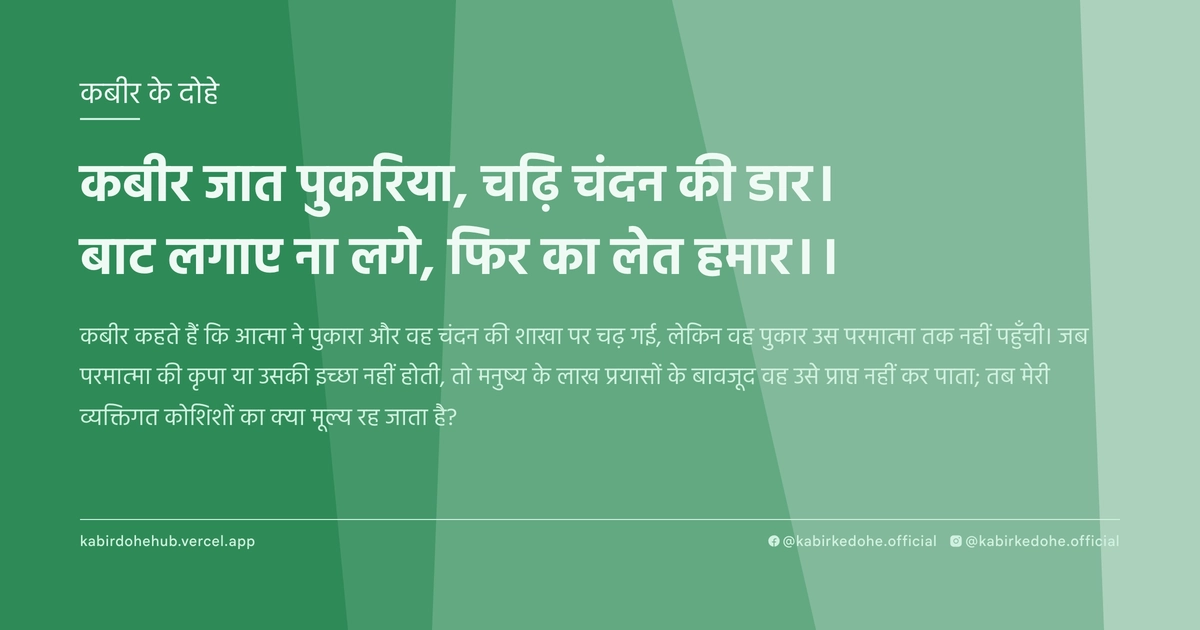
कबीर जात पुकरिया, चढ़ि चंदन की डार।
बाट लगाए ना लगे, फिर का लेत हमार।।
Kabir jaat pukariya, chadhi chandan ki daar. Baat lagaye na lage, phir ka let hamar.
इस पृष्ठ पर इस कबीर दोहे का अर्थ (meaning), हिंदी व्याख्या और अंग्रेज़ी अनुवाद, दार्शनिक विश्लेषण और व्यावहारिक जीवन सीख दी गई है। यह दोहा मोह (Attachment) विषय से जुड़ा है — Kabir doha meaning and explanation in Hindi and English.
अर्थ (Meaning):
कबीर कहते हैं कि आत्मा ने पुकारा और वह चंदन की शाखा पर चढ़ गई, लेकिन वह पुकार उस परमात्मा तक नहीं पहुँची। जब परमात्मा की कृपा या उसकी इच्छा नहीं होती, तो मनुष्य के लाख प्रयासों के बावजूद वह उसे प्राप्त नहीं कर पाता; तब मेरी व्यक्तिगत कोशिशों का क्या मूल्य रह जाता है?
Kabir suggests that the soul called out and ascended the branch of the sandalwood tree, yet the call remained unheard. When the divine grace or will is absent, no amount of human effort can bridge the gap; in such a state, what value do my individual struggles hold?
व्याख्या (Interpretation):
शाब्दिक रूप से, यह दोहा एक ऐसी स्थिति का वर्णन करता है जहाँ साधक चंदन की सुगंधित शाखा (उच्च आध्यात्मिक अवस्था) तक पहुँच तो गया है, लेकिन अंतिम मिलन नहीं हो पाया। रूपक के स्तर पर, 'चंदन की डार' उस उच्च चेतना का प्रतीक है जहाँ पहुँचकर भी अहंकार का एक सूक्ष्म अंश शेष रह जाता है। यह निर्गुण भक्ति के उस विरोधाभास को दर्शाता है जहाँ प्रयास आवश्यक हैं, लेकिन उपलब्धि केवल 'कृपा' (Grace) से संभव है। यहाँ माया का पर्दा इतना महीन है कि साधक को लगता है वह लक्ष्य के करीब है, जबकि वह अभी भी द्वैत में फँसा है। यह आत्मा और ब्रह्म के बीच के उस अंतिम अंतराल की बात करता है जिसे केवल समर्पण द्वारा भरा जा सकता है।
Literally, this couplet describes a state where the seeker has reached the fragrant branch of the sandalwood tree (a high spiritual state), yet the final union remains elusive. Metaphorically, the 'sandalwood branch' symbolizes the elevated consciousness where a subtle trace of ego still persists. It highlights the paradox of Nirgun Bhakti: while effort is necessary, attainment is possible only through 'Kripa' (Divine Grace). Here, the veil of Maya is so thin that the seeker feels close to the goal, yet remains trapped in duality. It addresses the final gap between the Atman and Brahman that can only be bridged through absolute surrender.
दार्शनिक विश्लेषण (Philosophical Analysis):
कबीर का यह दोहा उस समय के धार्मिक वातावरण पर प्रहार करता है जहाँ कर्मकांडों और बाहरी दिखावे को मोक्ष का मार्ग माना जाता था। वे स्पष्ट करते हैं कि केवल 'पुकारने' या धार्मिक क्रियाओं के प्रदर्शन से ईश्वर नहीं मिलता। यह विचार अद्वैत वेदांत के इस सिद्धांत से मेल खाता है कि जब तक 'मैं' (अहंकार) मौजूद है, तब तक 'वह' (परमात्मा) अलग प्रतीत होगा।
सूफी मत के 'फना' (अहंकार का विनाश) के सिद्धांत की तरह, कबीर यहाँ संकेत दे रहे हैं कि जब तक साधक यह सोचता है कि 'मैं' प्रयास कर रहा हूँ, तब तक वह वास्तव में परमात्मा से दूर है। प्रयास का अहंकार ही सबसे बड़ी बाधा है।
सामाजिक स्तर पर, कबीर जाति और वर्ण व्यवस्था को नकारते हुए यह बताते हैं कि आध्यात्मिक पात्रता किसी जन्म या कुल से नहीं, बल्कि आंतरिक शुद्धि और समर्पण से आती है। चंदन की डार पर चढ़ना बाहरी उपलब्धियों का प्रतीक हो सकता है, लेकिन आंतरिक मौन ही वास्तविक मिलन है।
मनोवैज्ञानिक रूप से, यह दोहा 'अपेक्षा' और 'स्वीकृति' के बीच के संघर्ष को दर्शाता है। जब हम परिणाम की अपेक्षा करते हैं, तो हम वास्तव में परमात्मा को नियंत्रित करने की कोशिश कर रहे होते हैं, जो कि असंभव है।
अंततः, यह शिक्षण हमें यह समझने के लिए प्रेरित करता है कि भक्ति कोई सौदा नहीं है जहाँ 'इतने प्रयास' के बदले 'इतना फल' मिले। यह पूर्ण विसर्जन की प्रक्रिया है, जहाँ साधक स्वयं को मिटा देता है ताकि केवल सत्य शेष रहे।
Kabir's couplet strikes at the religious atmosphere of his era, where rituals and outward displays were considered the path to liberation. He clarifies that mere 'calling out' or performing religious acts does not bring one closer to the Divine. This aligns with the Advaita Vedanta principle that as long as the 'I' (ego) exists, the 'Other' (God) will appear separate.
Similar to the Sufi concept of 'Fana' (annihilation of the self), Kabir suggests that as long as the seeker believes 'I am making the effort,' they remain distant from the Truth. The ego of effort is the greatest obstacle.
Socially, by rejecting caste and hierarchy, Kabir asserts that spiritual eligibility is not born of lineage but of inner purity and surrender. Climbing the sandalwood branch may symbolize external achievements, but internal silence is the true union.
Psychologically, this verse depicts the conflict between 'expectation' and 'acceptance.' When we expect a result, we are essentially trying to control the Divine, which is an impossibility.
Ultimately, this teaching urges us to understand that devotion is not a transaction where 'X amount of effort' yields 'Y amount of reward.' It is a process of total immersion, where the seeker erases themselves so that only the Truth remains.
मूल संदेश (Core Message):
- प्रयास आवश्यक हैं, लेकिन अहंकार मुक्त प्रयास ही फलदायी होते हैं।
- परमात्मा को पाने की इच्छा ही परमात्मा के मार्ग में सबसे बड़ी बाधा है।
- समर्पण वह कुंजी है जो प्रयास और उपलब्धि के बीच के अंतराल को भरती है।
- बाहरी उपलब्धियाँ (चंदन की डार) आंतरिक शून्यता का विकल्प नहीं हो सकतीं।
- सत्य को खोजा नहीं जाता, बल्कि खोजकर्ता के मिटने पर सत्य स्वयं प्रकट होता है।
- कृपा कोई बाहरी पुरस्कार नहीं, बल्कि अहंकार के विसर्जन का स्वाभाविक परिणाम है।
- Effort is necessary, but only effort free from ego yields fruit.
- The desire to attain the Divine is the greatest obstacle in the path to the Divine.
- Surrender is the key that bridges the gap between effort and attainment.
- External achievements (the sandalwood branch) cannot substitute for inner emptiness.
- Truth is not found; it reveals itself when the seeker vanishes.
- Grace is not an external reward, but the natural result of the ego's dissolution.
व्यावहारिक उदाहरण (Practical Example):
वाराणसी के एक पुराने घाट पर रामदीन नाम का एक वृद्ध नाविक रहता था। वह जीवन भर नाव चलाता रहा और साथ ही साथ कठिन तपस्या और शास्त्रों का अध्ययन भी किया। उसने अपने जीवन के तीस साल केवल मंत्रों के जाप और कठोर उपवासों में बिता दिए, यह सोचकर कि वह अपनी मेहनत से मोक्ष का द्वार खोल लेगा।
रामदीन को गर्व था कि वह शहर के सबसे 'धार्मिक' व्यक्ति हैं। वह अक्सर अन्य नाविकों को उपदेश देता कि कैसे सही विधि से पूजा करनी चाहिए। उसके लिए आध्यात्मिकता एक सीढ़ी थी जिसे वह अपनी इच्छाशक्ति से चढ़ रहा था।
एक दिन, एक साधारण सा फकीर उसकी नाव पर सवार हुआ। फकीर ने देखा कि रामदीन मंत्र तो पढ़ रहा है, लेकिन उसका मन इस बात की चिंता में है कि क्या उसकी प्रार्थनाएँ 'स्वीकृत' हो रही हैं या नहीं।
फकीर ने मुस्कुराते हुए कहा, 'रामदीन, तुम चंदन की डाल पर तो चढ़ गए हो, लेकिन तुम्हारी पुकार में अभी भी 'मैं' की गूँज है। तुम ईश्वर को बुला नहीं रहे, बल्कि अपनी उपलब्धि को पुकार रहे हो।'
रामदीन को पहले तो गुस्सा आया, लेकिन फिर उसने गौर किया कि उसकी पूरी भक्ति वास्तव में उसके अहंकार को पोषण दे रही थी। वह 'मोक्ष पाने वाले' की छवि में इतना खो गया था कि उसने उस परमात्मा को भुला दिया जिसे वह पाना चाहता था।
उस रात, रामदीन ने पहली बार अपनी सारी किताबों और नियमों को किनारे रखा। उसने अपनी आँखें बंद कीं और यह माँगना बंद कर दिया कि उसे क्या चाहिए। उसने बस खुद को उस अनंत शून्य में समर्पित कर दिया।
जैसे ही उसने 'पाने' की इच्छा छोड़ी, उसे एक ऐसी शांति का अनुभव हुआ जो उसने तीस साल के कठोर अनुशासन में नहीं पाया था। उसे समझ आया कि प्रयास केवल द्वार तक ले जाते हैं, लेकिन प्रवेश केवल समर्पण से होता है।
अब रामदीन नाव तो चलाता है, लेकिन वह अब 'मोक्ष का दावेदार' नहीं, बल्कि हर यात्री में उस निराकार ईश्वर का अंश देखता है। उसकी मुस्कान अब उसकी तपस्या से अधिक गहरी है।
On an old ghat in Varanasi lived an elderly boatman named Ramdin. All his life, he rowed boats and simultaneously engaged in rigorous penance and the study of scriptures. He spent thirty years of his life in mantra chanting and strict fasting, believing he could unlock the gates of liberation through his own hard work.
Ramdin took pride in being the most 'religious' man in the city. He often lectured other boatmen on the correct methods of worship. For him, spirituality was a ladder he was climbing with his sheer willpower.
One day, a simple wandering dervish boarded his boat. The dervish noticed that while Ramdin was chanting, his mind was preoccupied with whether his prayers were being 'accepted' or not.
The dervish smiled and said, 'Ramdin, you have climbed the sandalwood branch, but your call still echoes with the sound of "I". You are not calling God; you are calling out your own achievement.'
Ramdin was initially angered, but then he realized that his entire devotion was actually feeding his ego. He had become so lost in the image of being 'the one who attains liberation' that he forgot the Divine he sought.
That night, for the first time, Ramdin set aside all his books and rules. He closed his eyes and stopped asking for what he wanted. He simply surrendered himself to the infinite void.
The moment he let go of the desire to 'attain,' he experienced a peace that he had not found in thirty years of rigid discipline. He understood that effort only leads to the door, but entry is granted only through surrender.
Now Ramdin still rows his boat, but he is no longer a 'claimant of salvation'; instead, he sees a spark of the formless Divine in every passenger. His smile is now deeper than his penance ever was.
अभ्यास मार्गदर्शन (Practice Guidance):
- प्रतिदिन 20 मिनट 'साक्षी भाव' का अभ्यास करें: अपने प्रयासों को देखें और यह महसूस करें कि आप केवल एक माध्यम हैं, कर्ता नहीं।
- आत्म-पूछताछ जर्नल: लिखें कि आप आध्यात्मिक यात्रा में 'क्या पाने' की इच्छा रखते हैं और फिर विश्लेषण करें कि वह इच्छा आपके अहंकार का हिस्सा है या आत्मा का।
- व्यवहार परिवर्तन: किसी की मदद करते समय यह पूरी तरह भूल जाएँ कि आप मदद कर रहे हैं; स्वयं को केवल एक उपकरण मानें।
- निदान चेकलिस्ट: क्या मैं प्रार्थना के बाद फल की अपेक्षा करता हूँ? क्या मुझे अपनी धार्मिकता पर गर्व है? क्या मैं दूसरों की तुलना में खुद को अधिक 'जागरूक' मानता हूँ? (यदि हाँ, तो आप अभी भी 'चंदन की डार' पर अटके हैं)।
- Practice 'Witness Consciousness' for 20 minutes daily: Observe your efforts and realize that you are merely a medium, not the doer.
- Self-Inquiry Journal: Write down what you 'wish to attain' in your spiritual journey, then analyze if that desire stems from the ego or the soul.
- Behavioral Shift: When helping someone, completely forget that you are the helper; perceive yourself merely as an instrument of the Divine.
- Diagnostic Checklist: Do I expect a reward after prayer? Do I feel pride in my religiosity? Do I consider myself more 'aware' than others? (If yes, you are still stuck on the 'sandalwood branch').
चिंतन प्रश्न (Reflection Questions):
- मेरी आध्यात्मिक साधनाएँ मुझे विनम्र बना रही हैं या मुझे दूसरों से श्रेष्ठ महसूस करा रही हैं?
- यदि मुझे यह पता चले कि मेरे सभी अच्छे कर्मों का कोई आध्यात्मिक फल नहीं मिलेगा, तो क्या मैं फिर भी उन्हें करूँगा?
- मेरे जीवन में 'चंदन की डार' (वह बाहरी सफलता जिसे मैं आध्यात्मिकता समझता हूँ) क्या है?
- मैं ईश्वर से क्या माँग रहा हूँ, और क्या वह माँग वास्तव में मेरी आत्मा की है या मेरे सामाजिक व्यक्तित्व (Digital/Social Ego) की?
- क्या मैं वास्तव में मौन रह सकता हूँ, या मेरा मौन भी एक प्रदर्शन है?
- मेरे भीतर का वह कौन सा हिस्सा है जो अभी भी 'नियंत्रण' चाहता है, यहाँ तक कि ईश्वर के साथ भी?
- Are my spiritual practices making me humble, or are they making me feel superior to others?
- If I discovered that none of my good deeds would yield spiritual fruit, would I still perform them?
- What is the 'sandalwood branch' in my life (the external success I mistake for spirituality)?
- What am I asking from the Divine, and is that request truly from my soul or from my social/digital ego?
- Can I truly be silent, or is my silence also a performance?
- Which part of me still craves 'control,' even in my relationship with the Divine?