
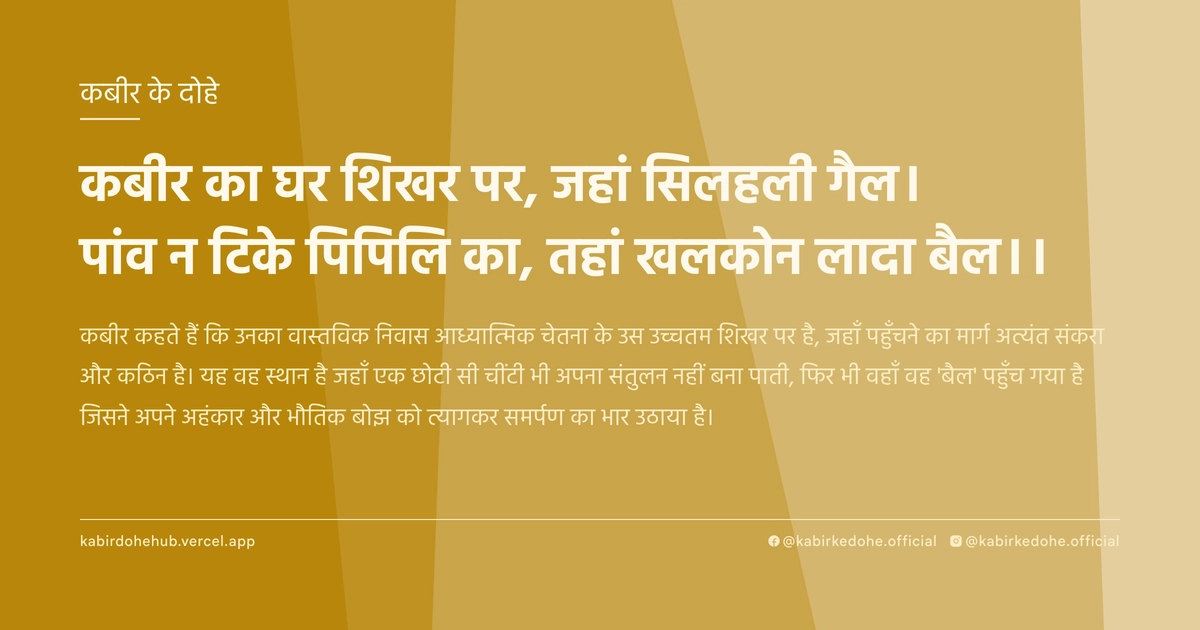
कबीर का घर शिखर पर, जहां सिलहली गैल।
पांव न टिके पिपिलि का, तहां खलकोन लादा बैल।।
Kabir ka ghar shikhar par, jahan silhali gail. Paon na tike pipili ka, tahan khalkon lada bail.
इस पृष्ठ पर इस कबीर दोहे का अर्थ (meaning), हिंदी व्याख्या और अंग्रेज़ी अनुवाद, दार्शनिक विश्लेषण और व्यावहारिक जीवन सीख दी गई है। यह दोहा पद-प्रतिष्ठा का अहंकार (The Vanity of Status) विषय से जुड़ा है — Kabir doha meaning and explanation in Hindi and English.
अर्थ (Meaning):
कबीर कहते हैं कि उनका वास्तविक निवास आध्यात्मिक चेतना के उस उच्चतम शिखर पर है, जहाँ पहुँचने का मार्ग अत्यंत संकरा और कठिन है। यह वह स्थान है जहाँ एक छोटी सी चींटी भी अपना संतुलन नहीं बना पाती, फिर भी वहाँ वह 'बैल' पहुँच गया है जिसने अपने अहंकार और भौतिक बोझ को त्यागकर समर्पण का भार उठाया है।
Kabir asserts that his true abode resides upon the highest peak of spiritual consciousness, accessible only via an impossibly narrow and treacherous path. It is a realm so ethereal and precarious that even a tiny ant cannot find a foothold, yet the 'ox'—representing the soul that has surrendered its ego and carried the burden of divine love—has managed to reach this summit.
व्याख्या (Interpretation):
यह दोहा भौतिक और आध्यात्मिक आयामों के बीच के विरोधाभास को दर्शाता है। 'शिखर' यहाँ समाधि या मोक्ष की अवस्था है, जहाँ द्वैत समाप्त हो जाता है। 'सिलहली गैल' उस सूक्ष्म मार्ग का प्रतीक है जो केवल आंतरिक यात्रा से संभव है। चींटी का पैर न टिकना इस बात का संकेत है कि केवल सूक्ष्म प्रयास या बाहरी धार्मिकता पर्याप्त नहीं है। 'खलकोन लादा बैल' एक गहरा रूपक है; बैल आमतौर पर मंदबुद्धि या बोझ ढोने वाला माना जाता है, लेकिन यहाँ वह उस साधक का प्रतीक है जिसने संसार के दुखों और ईश्वरीय प्रेम के भार को सहते हुए अहंकार का विसर्जन कर दिया है। यह निर्गुण भक्ति का सार है जहाँ बाहरी योग्यता नहीं, बल्कि आंतरिक समर्पण और शून्य होने की क्षमता व्यक्ति को परमात्मा (ब्रह्म) से मिलाती है।
This couplet illustrates the profound paradox between the material and spiritual dimensions. The 'peak' symbolizes the state of Samadhi or liberation, where duality ceases to exist. The 'narrow path' represents the subtle internal journey of the soul, inaccessible to those relying on external rituals. The inability of the ant to find footing suggests that mere superficial efforts or formal religiosity are insufficient for transcendence. The 'ox laden with a yoke' is a powerful metaphor; while an ox is typically seen as a beast of burden or slow-witted, here it represents the seeker who, by enduring the trials of existence and carrying the weight of divine longing, has annihilated the ego. This aligns with Nirgun Bhakti, where not intellectual prowess, but the capacity to become 'nothing' and surrender completely, allows the Atman to merge with the formless Brahman.
दार्शनिक विश्लेषण (Philosophical Analysis):
कबीर का यह कथन उनके युग के कर्मकांडीय आडंबरों पर एक तीखा प्रहार है। उस समय धर्म को बाहरी प्रतीकों, जैसे तीर्थयात्रा या कठिन उपवासों से जोड़ा जाता था। कबीर यहाँ स्पष्ट करते हैं कि आध्यात्मिक ऊंचाई किसी बाहरी क्रिया से नहीं, बल्कि आंतरिक रूपांतरण से प्राप्त होती है। यह अद्वैत वेदांत के उस सिद्धांत से मेल खाता है जहाँ 'अहं ब्रह्मास्मि' का अनुभव केवल तब होता है जब 'मैं' (अहंकार) पूरी तरह मिट जाता है।
सूफी मत के 'फना' (विनाश) की अवधारणा यहाँ स्पष्ट दिखती है। जैसे बैल अपना अस्तित्व अपने मालिक की इच्छा में समर्पित कर देता है, वैसे ही साधक को अपनी व्यक्तिगत इच्छाओं को ईश्वर की इच्छा में विलीन करना होता है। कबीर यह समझा रहे हैं कि जो स्वयं को 'बैल' की तरह विनम्र और समर्पित मानता है, वही उस शिखर तक पहुँच सकता है जहाँ बुद्धिमान और चतुर लोग (चींटी की तरह सूक्ष्म गणना करने वाले) असफल हो जाते हैं।
यहाँ 'बोझ' का अर्थ भौतिक संपत्ति नहीं, बल्कि वह आध्यात्मिक तपस्या और प्रेम का भार है जिसे केवल एक सच्चा प्रेमी ही उठा सकता है। यह विरोधाभास कि एक भारी बैल उस स्थान पर है जहाँ एक हल्की चींटी नहीं टिक सकती, यह दर्शाता है कि आध्यात्मिक जगत के नियम भौतिक जगत के विपरीत चलते हैं। यहाँ वजन का अर्थ है 'गहराई' और 'स्थिरता'।
कबीर जाति और वर्ग के भेदों को नकारते हुए यह संदेश देते हैं कि मोक्ष किसी विशेष कुल या विद्वता का विशेषाधिकार नहीं है। एक साधारण व्यक्ति, यदि वह पूर्ण समर्पण और सरलता को अपना ले, तो वह उन महान विद्वानों से आगे निकल सकता है जो केवल शास्त्रों के ज्ञान में उलझे हुए हैं।
अंततः, यह विश्लेषण हमें बताता है कि अहंकार का विसर्जन ही एकमात्र मार्ग है। जब तक मनुष्य स्वयं को 'विशेष' या 'योग्य' मानता रहता है, वह उस शिखर से दूर रहता है। जिस क्षण वह अपनी तुच्छता को स्वीकार कर ईश्वर की अनंतता में समर्पित होता है, वह उस असंभव शिखर पर प्रतिष्ठित हो जाता है।
Kabir's statement is a sharp critique of the ritualistic ostentation of his era. During his time, religion was often reduced to external symbols, such as pilgrimages or rigorous fasting. Kabir clarifies that spiritual altitude is achieved not through external acts, but through internal transformation. This resonates with the Advaita Vedanta principle of 'Aham Brahmasmi' (I am Brahman), which is realized only when the 'I' (the ego) is completely extinguished.
The Sufi concept of 'Fana' (annihilation of the self) is evident here. Just as an ox surrenders its existence to the will of its master, the seeker must merge their personal desires into the Divine Will. Kabir suggests that the one who considers themselves as humble and surrendered as an ox can reach a peak where the intellectually clever (those like the ant, calculating every tiny step) fail.
The 'burden' mentioned here is not material wealth, but the weight of spiritual austerity and divine love, which only a true lover can bear. The paradox—that a heavy ox stands where a light ant cannot—demonstrates that the laws of the spiritual realm operate inversely to the physical world. Here, 'weight' signifies depth, stability, and the gravity of devotion.
By rejecting caste and class distinctions, Kabir emphasizes that liberation is not the prerogative of a specific lineage or scholarly achievement. An ordinary person, by embracing absolute surrender and simplicity, can surpass great pundits who are entangled in the mere intellectual study of scriptures.
Ultimately, this analysis reveals that the dissolution of the ego is the only path. As long as a human perceives themselves as 'special' or 'qualified,' they remain distant from the peak. The moment they acknowledge their own insignificance and surrender to the infinity of the Divine, they are established upon that impossible summit.
मूल संदेश (Core Message):
- अहंकार की सूक्ष्मता भी आध्यात्मिक उन्नति में सबसे बड़ी बाधा है।
- सरलता और पूर्ण समर्पण ही कठिनतम आध्यात्मिक लक्ष्यों की कुंजी है।
- बाहरी ज्ञान का बोझ उठाने से बेहतर है कि आंतरिक प्रेम का भार उठाया जाए।
- जब 'मैं' समाप्त होता है, तभी 'वह' (परमात्मा) प्रकट होता है।
- मोक्ष योग्यता का परिणाम नहीं, बल्कि पूर्ण शरणागति का फल है।
- Even the subtlest form of ego is the greatest obstacle to spiritual ascent.
- Simplicity and absolute surrender are the keys to the most difficult spiritual goals.
- It is better to bear the weight of inner love than the burden of external knowledge.
- Only when the 'I' is extinguished does the 'Divine' manifest.
- Liberation is not a result of merit, but a fruit of total surrender.
व्यावहारिक उदाहरण (Practical Example):
वाराणसी के एक पुराने घाट पर रामदीन नाम का एक वृद्ध नाविक रहता था। वह जीवन भर नाव चलाता रहा, लेकिन उसका मन हमेशा इस बात से दुखी रहता था कि वह अनपढ़ है और बड़े पंडितों की तरह मंत्र नहीं जानता। वह खुद को एक 'बोझ ढोने वाले बैल' की तरह महसूस करता था, जिसकी कोई सामाजिक प्रतिष्ठा नहीं थी।
रामदीन हर दिन नाव चलाते समय मन ही मन एक सरल पुकार लगाता था, 'हे मालिक, मैं कुछ नहीं जानता, बस तू मुझे अपना ले।' उसने कभी यह दावा नहीं किया कि वह ज्ञानी है, बल्कि उसने अपनी अज्ञानता को ही अपना गहना बना लिया।
एक दिन एक उच्च कोटि का विद्वान पंडित उसकी नाव में बैठा। पंडित जी ने अपनी विद्वत्ता का प्रदर्शन करते हुए रामदीन को धर्म और मोक्ष के कठिन सिद्धांत समझाए। उन्होंने बताया कि कैसे कठिन तप और शास्त्रों के गहन अध्ययन से ही शिखर तक पहुँचा जा सकता है।
रामदीन चुपचाप सुनता रहा। उसने महसूस किया कि पंडित जी के शब्द ऊँचे थे, लेकिन उनका अहंकार और भी ऊँचा था। पंडित जी हर बात में 'मैं' और 'मेरा ज्ञान' जोड़ रहे थे।
तभी नाव एक तेज लहर से डगमगाई। पंडित जी घबरा गए और अपनी किताबों को बचाने लगे। लेकिन रामदीन शांत था। उसके चेहरे पर एक ऐसी स्थिरता थी जो केवल उस व्यक्ति में होती है जिसने सब कुछ खो दिया हो या सब कुछ समर्पित कर दिया हो।
पंडित जी ने रामदीन की आँखों में देखा और उन्हें एक ऐसी शांति मिली जो उनके सभी ग्रंथों में नहीं थी। उन्होंने पूछा, 'तुम इतने शांत कैसे हो? तुम्हें तो डर होना चाहिए।'
रामदीन ने सरलता से उत्तर दिया, 'महाराज, जब नाव मेरी नहीं, मालिक की है, और मैं केवल उसका एक बैल हूँ, तो डर कैसा? बोझ तो वह उठा रहा है, मैं तो बस चल रहा हूँ।'
पंडित जी को अचानक कबीर की वह बात याद आई कि शिखर पर केवल वही पहुँचता है जो खुद को शून्य कर लेता है। उन्हें समझ आया कि उनकी विद्वत्ता एक 'चींटी' की तरह सूक्ष्म गणना थी, जबकि रामदीन का समर्पण उस 'बैल' की तरह था जिसने अहंकार का बोझ उतार दिया था।
उस दिन पंडित जी ने अपनी किताबों का गर्व त्याग दिया और रामदीन के चरणों में बैठकर उस सरलता को सीखने की कोशिश की। उन्होंने महसूस किया कि ज्ञान जब तक अहंकार बनता है, वह बाधा है; लेकिन जब ज्ञान समर्पण बनता है, तो वह मोक्ष है।
रामदीन की वह साधारण नाव अब केवल नदी पार नहीं करा रही थी, बल्कि वह अहंकार से मुक्ति के उस शिखर की ओर ले जा रही थी जहाँ केवल प्रेम का वास है।
On an ancient ghat in Varanasi lived an elderly boatman named Ramdeen. He had spent his entire life rowing boats, but his heart was often heavy with the feeling that he was uneducated and lacked the knowledge of mantras possessed by the great pundits. He viewed himself as a 'burden-bearing ox,' possessing no social prestige.
Every day, while rowing, Ramdeen would offer a simple, silent plea: 'O Lord, I know nothing; just accept me as Yours.' He never claimed to be learned; instead, he wore his ignorance as a badge of humility.
One day, a high-ranking scholar, a Pundit, boarded his boat. The Pundit, displaying his erudition, began explaining complex theories of religion and liberation to Ramdeen. He asserted that only through rigorous penance and the profound study of scriptures could one reach the spiritual peak.
Ramdeen listened in silence. He noticed that while the Pundit's words were lofty, his ego was even loftier. The Pundit constantly inserted 'I' and 'my knowledge' into every sentence.
Suddenly, a strong current caused the boat to sway violently. The Pundit panicked, frantically trying to save his precious books. However, Ramdeen remained calm. His face reflected a stability found only in those who have either lost everything or surrendered everything.
Looking into Ramdeen's eyes, the Pundit saw a peace that was absent from all his texts. He asked, 'How are you so calm? Should you not be afraid?'
Ramdeen replied simply, 'Master, when the boat is not mine but the Lord's, and I am merely His ox, why should I fear? He carries the burden; I am just moving with Him.'
The Pundit suddenly recalled Kabir's wisdom—that only he who makes himself 'zero' can reach the peak. He realized his scholarship was like the 'ant's' minute calculations, whereas Ramdeen's surrender was like the 'ox' that had cast off the weight of the ego.
That day, the Pundit renounced the pride of his books and sat at Ramdeen's feet to learn the art of simplicity. He understood that knowledge, as long as it fuels the ego, is an obstacle; but when knowledge becomes surrender, it becomes liberation.
Ramdeen's simple boat was no longer just crossing a river; it was navigating toward that peak of liberation from ego, where only love resides.
अभ्यास मार्गदर्शन (Practice Guidance):
- प्रतिदिन 20 मिनट का 'शून्य ध्यान' करें, जहाँ आप अपनी सभी उपलब्धियों, पद और पहचान को एक तरफ रखकर स्वयं को ईश्वर के सामने एक साधारण सेवक या 'बैल' की तरह समर्पित करें।
- स्व-अन्वेषण जर्नल: प्रतिदिन एक ऐसी घटना लिखें जहाँ आपके अहंकार (Intellectual Ego) ने आपको दूसरों से श्रेष्ठ महसूस कराया, और फिर विश्लेषण करें कि उस समय आप 'शिखर' से कितने दूर थे।
- व्यवहार परिवर्तन: दिन में कम से कम एक बार किसी ऐसे व्यक्ति की सेवा करें जिसे समाज 'तुच्छ' मानता है, और इस प्रक्रिया में अपनी श्रेष्ठता के भाव को पूरी तरह मिटाने का प्रयास करें।
- डायग्नोस्टिक चेकलिस्ट: क्या मैं अपनी विद्वत्ता का उपयोग दूसरों को नीचा दिखाने के लिए करता हूँ? क्या मैं कठिन अनुष्ठानों में विश्वास करता हूँ लेकिन सरल प्रेम में नहीं? क्या मैं अपनी गलतियों को स्वीकार करने में असमर्थ हूँ? (यदि हाँ, तो आप अभी भी 'चींटी' की तरह सूक्ष्म गणना कर रहे हैं)।
- Practice 20 minutes of 'Zero Meditation' daily, where you set aside all your achievements, titles, and identities, surrendering yourself before the Divine as a simple servant or 'ox'.
- Self-Inquiry Journal: Record one incident daily where your intellectual ego made you feel superior to others, and analyze how far that feeling distanced you from the 'peak'.
- Behavioral Shift: Once a day, serve someone whom society deems 'insignificant,' and consciously strive to annihilate any sense of superiority during the act.
- Diagnostic Checklist: Do I use my knowledge to belittle others? Do I trust complex rituals more than simple love? Am I unable to admit my mistakes? (If yes, you are still calculating like the 'ant' rather than surrendering like the 'ox').
चिंतन प्रश्न (Reflection Questions):
- मेरी वह कौन सी 'बौद्धिक पहचान' है जिसे खोने के डर से मैं वास्तव में समर्पित नहीं हो पा रहा हूँ?
- क्या मैं धर्म का पालन इसलिए कर रहा हूँ क्योंकि मैं 'सही' होना चाहता हूँ, या इसलिए क्योंकि मैं 'मिटना' चाहता हूँ?
- मेरे जीवन का वह 'बोझ' क्या है जिसे मैं अभी भी शिकायत के साथ ढो रहा हूँ, जबकि वह मुझे शिखर की ओर ले जा सकता था?
- क्या मेरी विनम्रता वास्तविक है, या यह केवल एक 'सभ्य मुखौटा' है जिसे मैं अपनी छवि सुधारने के लिए पहनता हूँ?
- यदि आज मेरी सारी डिग्रियाँ और उपलब्धियाँ छीन ली जाएँ, तो क्या मेरे पास ईश्वर के सामने पेश करने के लिए कुछ बचेगा?
- What is that 'intellectual identity' I am so afraid to lose that it prevents me from truly surrendering?
- Am I practicing spirituality because I want to be 'right,' or because I want to be 'annihilated'?
- What is the 'burden' in my life that I am still carrying with complaint, even though it could be leading me toward the peak?
- Is my humility genuine, or is it merely a 'civilized mask' I wear to improve my public image?
- If all my degrees and achievements were stripped away today, would there be anything left of me to present before the Divine?