
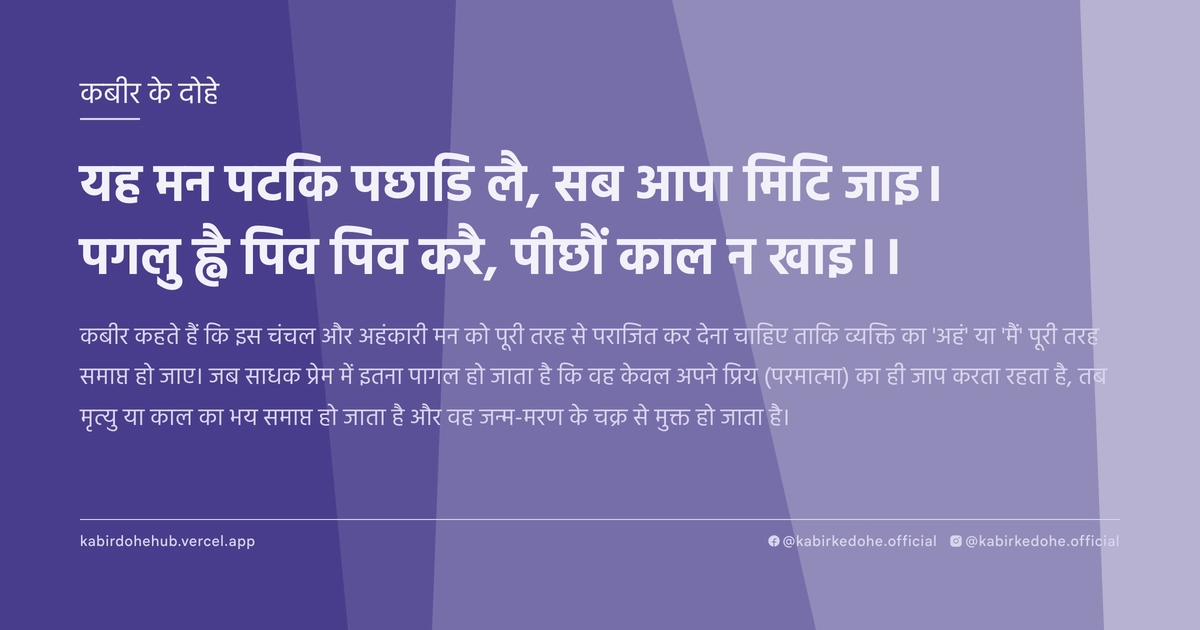
यह मन पटकि पछाडि लै, सब आपा मिटि जाइ।
पगलु ह्वै पिव पिव करै, पीछौं काल न खाइ।।
Yah man patki pachhad lai, sab aapa miti jaaye. Paglu hvai piv piv karai, pichhaun kaal na khaai.
इस पृष्ठ पर इस कबीर दोहे का अर्थ (meaning), हिंदी व्याख्या और अंग्रेज़ी अनुवाद, दार्शनिक विश्लेषण और व्यावहारिक जीवन सीख दी गई है। यह दोहा मन नियंत्रण (Mind Control) विषय से जुड़ा है — Kabir doha meaning and explanation in Hindi and English.
अर्थ (Meaning):
कबीर कहते हैं कि इस चंचल और अहंकारी मन को पूरी तरह से पराजित कर देना चाहिए ताकि व्यक्ति का 'अहं' या 'मैं' पूरी तरह समाप्त हो जाए। जब साधक प्रेम में इतना पागल हो जाता है कि वह केवल अपने प्रिय (परमात्मा) का ही जाप करता रहता है, तब मृत्यु या काल का भय समाप्त हो जाता है और वह जन्म-मरण के चक्र से मुक्त हो जाता है।
Kabir urges the seeker to decisively overthrow the restless and egoistic mind so that the sense of 'I-ness' or the individual ego is completely annihilated. When a devotee becomes so intoxicated in divine love that they chant the name of the Beloved incessantly, the fear of death or time (Kaal) vanishes, and they are liberated from the cycle of birth and rebirth.
व्याख्या (Interpretation):
इस दोहे का शाब्दिक अर्थ मन के दमन से शुरू होता है, लेकिन इसका गहरा आध्यात्मिक अर्थ 'अहंकार के विसर्जन' में है। 'मन को पटकि पछाड़ना' वास्तव में इंद्रियों और मानसिक प्रवृत्तियों पर विजय प्राप्त करना है जो हमें माया के भ्रम में उलझाए रखती हैं। जब 'आपा' यानी अहंकार मिटता है, तब द्वैत समाप्त हो जाता है और केवल शुद्ध चेतना शेष रहती है। यहाँ 'पगलु' शब्द का प्रयोग उस अवस्था के लिए किया गया है जहाँ तर्क समाप्त हो जाता है और केवल अनन्य भक्ति बचती है। यह निर्गुण भक्ति का वह शिखर है जहाँ भक्त और भगवान एक हो जाते हैं। यह अद्वैत वेदांत के उस सत्य को दर्शाता है जहाँ आत्मा और ब्रह्म के बीच का पर्दा गिर जाता है। अंततः, काल (समय/मृत्यु) केवल उसे खाता है जो शरीर और अहंकार से चिपका है; जो प्रेम में विलीन हो गया, वह अमर है।
The literal meaning begins with the suppression of the mind, but the profound spiritual essence lies in the 'dissolution of the ego.' To 'throw down the mind' actually signifies achieving mastery over the senses and mental tendencies that keep us entangled in the illusion of Maya. When 'Aapa' or the ego is erased, duality ceases, leaving only pure consciousness. The term 'Paglu' (madman) describes a state where intellectual reasoning ends and only exclusive devotion remains. This represents the pinnacle of Nirgun Bhakti, where the devotee and the Divine merge. It mirrors the truth of Advaita Vedanta, where the veil between Atman and Brahman falls. Ultimately, Kaal (Time/Death) only consumes those clinging to the body and ego; he who is dissolved in divine love becomes immortal.
दार्शनिक विश्लेषण (Philosophical Analysis):
कबीर का यह दोहा मध्यकालीन भारत के उस सामाजिक और धार्मिक परिवेश में रचा गया था जहाँ कर्मकांड और बाहरी आडंबरों का बोलबाला था। कबीर ने स्पष्ट रूप से Ritualism (कर्मकांड) को नकारते हुए आंतरिक रूपांतरण पर जोर दिया। उनके लिए मुक्ति किसी तीर्थ या मंदिर में नहीं, बल्कि मन के भीतर के युद्ध को जीतने में है। यह दृष्टिकोण सूफी मत के 'फना' (Fana) के सिद्धांत से गहराई से जुड़ा है, जहाँ साधक अपनी व्यक्तिगत पहचान को ईश्वर की इच्छा में विलीन कर देता है।
दार्शनिक स्तर पर, यह अद्वैत वेदांत के उस सिद्धांत का समर्थन करता है कि अहंकार ही वह एकमात्र बाधा है जो हमें हमारे वास्तविक स्वरूप से अलग करती है। जब कबीर 'आपा' मिटाने की बात करते हैं, तो वे मनोवैज्ञानिक स्तर पर उस 'झूठे स्व' (False Self) की बात कर रहे होते हैं जो सामाजिक पहचान, जाति और पद से निर्मित होता है। इस अहंकार का विनाश ही वास्तविक ज्ञान है।
कबीर यहाँ एक विरोधाभास प्रस्तुत करते हैं: 'पागलपन' के माध्यम से 'चेतना'। दुनिया की नजर में जो पागल है, वह वास्तव में सबसे अधिक जागृत है क्योंकि उसने तर्क की सीमाओं को पार कर लिया है। तर्क मन का गुण है, जबकि प्रेम आत्मा का। मन विभाजित करता है, प्रेम एकीकृत करता है।
यह शिक्षण हमें बताता है कि मृत्यु का भय वास्तव में शरीर के खोने का भय नहीं है, बल्कि उस 'मैं' के खोने का भय है जिसे हमने जीवन भर संजोया है। जब 'मैं' ही नहीं रहेगा, तो काल किसे खाएगा? यह शून्यता ही पूर्णता है।
अंततः, कबीर का संदेश यह है कि भक्ति कोई बाहरी क्रिया नहीं, बल्कि एक आंतरिक विस्फोट है। यह एक ऐसी प्रक्रिया है जिसमें साधक अपनी पूरी सत्ता को परमात्मा के चरणों में समर्पित कर देता है, जिससे वह समय और स्थान की सीमाओं से परे हो जाता है।
This couplet was composed during a medieval Indian era dominated by rigid rituals and external displays of piety. Kabir explicitly rejected ritualism, emphasizing internal transformation. For him, liberation is not found in pilgrimages or temples, but in winning the internal war against the mind. This perspective is deeply aligned with the Sufi concept of 'Fana' (annihilation), where the seeker dissolves their individual identity into the Divine Will.
Philosophically, this supports the Advaita Vedanta principle that the ego is the sole obstacle separating us from our true nature. When Kabir speaks of erasing 'Aapa,' he refers to the psychological 'False Self' constructed from social identity, caste, and status. The destruction of this ego is the only true knowledge.
Kabir presents a paradox: 'consciousness' through 'madness.' He who appears mad to the world is actually the most awakened, having transcended the limits of logic. Logic is a faculty of the mind, while love is a faculty of the soul. The mind divides; love integrates.
This teaching reveals that the fear of death is not actually the fear of the body perishing, but the fear of losing the 'I' that we have spent a lifetime cultivating. When the 'I' no longer exists, what is there for Time (Kaal) to consume? This emptiness is, in fact, fullness.
Ultimately, Kabir's message is that devotion is not an external act but an internal explosion. It is a process where the seeker surrenders their entire existence to the Divine, thereby transcending the boundaries of time and space.
मूल संदेश (Core Message):
- मन का अहंकार ही आत्मा और परमात्मा के बीच की सबसे बड़ी दीवार है।
- तर्क से परे जाकर प्रेम में डूबना ही वास्तविक आध्यात्मिक जागृति है।
- जब 'मैं' मिटता है, तब वह 'परम' प्रकट होता है जो कभी मरता नहीं।
- मृत्यु केवल शरीर का अंत है, अहंकार का अंत ही अमरता का द्वार है।
- भक्ति का अर्थ है स्वयं को पूरी तरह मिटाकर प्रिय में विलीन हो जाना।
- The ego of the mind is the greatest wall between the Soul and the Divine.
- True spiritual awakening lies in diving into love beyond the reach of logic.
- When the 'I' vanishes, the 'Supreme' appears, which is immortal.
- Death is only the end of the body; the end of ego is the gateway to eternity.
- Devotion means completely erasing oneself to merge into the Beloved.
व्यावहारिक उदाहरण (Practical Example):
वाराणसी के एक पुराने घाट पर रामदीन नाम का एक वृद्ध बुनकर रहता था। वह अपनी कला में निपुण था, लेकिन उसका मन हमेशा इस बात से अशांत रहता था कि लोग उसकी कला की सराहना कम और उसकी गरीबी का मज़ाक ज़्यादा उड़ाते हैं। वह अपनी श्रेष्ठता को सिद्ध करने के लिए दूसरों से ईर्ष्या करता था और अपने मन में एक सूक्ष्म अहंकार पाले हुए था कि वह 'शुद्ध' परंपरा का पालन कर रहा है।
एक दिन वह एक साधु से मिला जिसने उससे कहा, "रामदीन, तू कपड़ा नहीं बुन रहा, तू अपने अहंकार की चादर बुन रहा है। जब तक यह 'मैं' रहेगा, तू कभी शांति नहीं पाएगा।"
रामदीन ने पहले तो इसे अनसुना किया, लेकिन धीरे-धीरे उसे महसूस हुआ कि उसकी सारी मानसिक पीड़ा इसी 'मैं' से जुड़ी है। उसने तय किया कि वह अपने मन के इस शोर को शांत करेगा। उसने अपनी हर बुनाई को एक प्रार्थना बना लिया।
शुरुआत में उसका मन उसे उकसाता था, "देख, वह अमीर व्यापारी तुझे कैसे देखता है!" लेकिन रामदीन ने उस विचार को 'पछाड़' दिया। उसने मन के उस अहंकार को एक पुराने फटे कपड़े की तरह उतार फेंका।
समय बीतने के साथ, वह अपनी पहचान पूरी तरह भूल गया। अब वह यह नहीं सोचता था कि वह कौन है या लोग उसके बारे में क्या सोचते हैं। वह केवल अपने काम और उस अदृश्य शक्ति के प्रेम में डूब गया।
एक समय ऐसा आया कि वह पूरी तरह 'पगलु' हो गया। वह चलते-फिरते बस मुस्कुराता रहता और मन ही मन उस परमात्मा का नाम जपता। लोग उसे पागल समझने लगे, लेकिन उसके चेहरे पर एक ऐसी शांति थी जो किसी राजा के पास नहीं थी।
एक रात जब शहर में भीषण बाढ़ आई और कई लोग डर के मारे चिल्ला रहे थे, रामदीन शांत बैठा था। उसे अब मृत्यु का कोई भय नहीं था क्योंकि उसका 'आपा' पहले ही मिट चुका था।
उसने महसूस किया कि जब तक वह 'रामदीन' था, वह डरा हुआ था, लेकिन अब वह केवल उस अनंत प्रेम का हिस्सा था। काल उसके पास आया, लेकिन उसे खाने के लिए वहाँ कोई 'अहंकार' बचा ही नहीं था।
उसकी यह स्थिति देखकर गाँव के अन्य लोग भी प्रेरित हुए। उन्होंने सीखा कि असली जीत दूसरों को हराने में नहीं, बल्कि अपने भीतर के 'मैं' को हराने में है।
रामदीन का जीवन एक जीवित उदाहरण बन गया कि कैसे मन के समर्पण से मनुष्य काल के भय से मुक्त होकर शाश्वत आनंद को प्राप्त कर सकता है।
In the ancient ghats of Varanasi lived an elderly weaver named Ramdin. He was a master of his craft, but his mind was perpetually restless, feeling that people mocked his poverty more than they appreciated his art. He harbored a subtle ego, believing he was the sole keeper of 'pure' tradition, and often felt envy toward others.
One day, he met a wandering monk who told him, "Ramdin, you are not weaving cloth; you are weaving a shroud of ego. As long as this 'I' remains, you will never find peace."
Ramdin initially ignored the words, but gradually realized that all his mental suffering was tied to this 'I.' He decided to silence the noise of his mind. He turned every act of weaving into a prayer.
At first, his mind tempted him, whispering, "Look how that wealthy merchant looks down on you!" But Ramdin 'overthrew' that thought. He cast off the ego like a piece of old, torn fabric.
As time passed, he completely forgot his social identity. He no longer cared who he was or what others thought of him. He became immersed solely in his work and the love of the Invisible Power.
Eventually, he became 'Paglu'—divinely mad. He would walk the streets smiling, chanting the name of the Beloved within. People called him crazy, but his face radiated a peace that no king possessed.
One night, when a devastating flood hit the city and people screamed in terror, Ramdin sat calmly. He had no fear of death because his 'Aapa' had already been annihilated.
He realized that as long as he was 'Ramdin,' he was afraid; but now, he was merely a part of that infinite love. Death (Kaal) approached, but there was no 'ego' left for it to consume.
Seeing his state, other villagers were inspired. They learned that true victory is not in defeating others, but in defeating the 'I' within.
Ramdin's life became a living testament to how surrendering the mind allows a human to be freed from the fear of time and attain eternal bliss.
अभ्यास मार्गदर्शन (Practice Guidance):
- साक्षी भाव का अभ्यास: प्रतिदिन 20 मिनट मौन बैठें और अपने मन में उठने वाले विचारों को केवल देखें, उनमें शामिल न हों। जब कोई विचार 'मैं' या 'मेरा' कहे, तो उसे धीरे से 'पछाड़' दें।
- अहंकार की पहचान (Journaling): एक डायरी लिखें जिसमें उन क्षणों को दर्ज करें जब आपको अपमान महसूस हुआ या जब आपने श्रेष्ठता महसूस की। विश्लेषण करें कि वहाँ कौन सा 'आपा' सक्रिय था।
- अनन्य प्रेम का जाप: किसी भी एक शब्द या मंत्र (जैसे 'ओम' या 'प्रेम') को केवल ध्वनि के रूप में नहीं, बल्कि एक गहरे विरह और मिलन की तड़प के साथ जपना शुरू करें।
- निदान चेकलिस्ट (Diagnostic Checklist): क्या मैं अभी भी दूसरों की राय से विचलित होता हूँ? क्या मुझे अपनी उपलब्धियों पर गर्व है? क्या मृत्यु का विचार मुझे भयभीत करता है? यदि हाँ, तो 'आपा' अभी जीवित है।
- Practice of Witness Consciousness: Sit in silence for 20 minutes daily. Observe the thoughts arising in your mind without engaging with them. When a thought says 'I' or 'Mine,' gently 'overthrow' it.
- Ego Mapping (Journaling): Keep a diary of moments where you felt insulted or superior. Analyze which specific 'Aapa' (ego-identity) was active during those emotions.
- Chanting of Exclusive Love: Begin chanting a single word or mantra (like 'Om' or 'Love'), not just as a sound, but with a deep longing for union with the Divine.
- Diagnostic Checklist: Do I still get disturbed by others' opinions? Do I feel pride in my achievements? Does the thought of death frighten me? If yes, the 'Aapa' is still alive.
चिंतन प्रश्न (Reflection Questions):
- वह कौन सी सामाजिक या पेशेवर पहचान है जिसे खोने के डर से मैं अपनी सहजता का त्याग करता हूँ?
- क्या मेरा 'आध्यात्मिक अभ्यास' भी मेरे अहंकार को यह महसूस कराने का एक तरीका है कि मैं दूसरों से अधिक 'जागरूक' हूँ?
- यदि आज मेरी सारी उपलब्धियाँ और संबंध छीन लिए जाएँ, तो मेरे भीतर क्या बचेगा?
- मैं अपनी डिजिटल पहचान (Social Media Ego) को बनाए रखने के लिए कितनी मानसिक ऊर्जा व्यर्थ करता हूँ?
- क्या मैं वास्तव में ईश्वर से प्रेम करता हूँ, या मैं केवल उस प्रेम के माध्यम से मिलने वाले मानसिक सुकून से प्रेम करता हूँ?
- Which social or professional identity do I fear losing so much that I sacrifice my authenticity?
- Is my 'spiritual practice' merely another way for my ego to feel more 'aware' than others?
- If all my achievements and relationships were stripped away today, what would remain within me?
- How much mental energy do I waste maintaining my digital identity (Social Media Ego)?
- Do I truly love the Divine, or do I only love the mental comfort that comes from that love?