
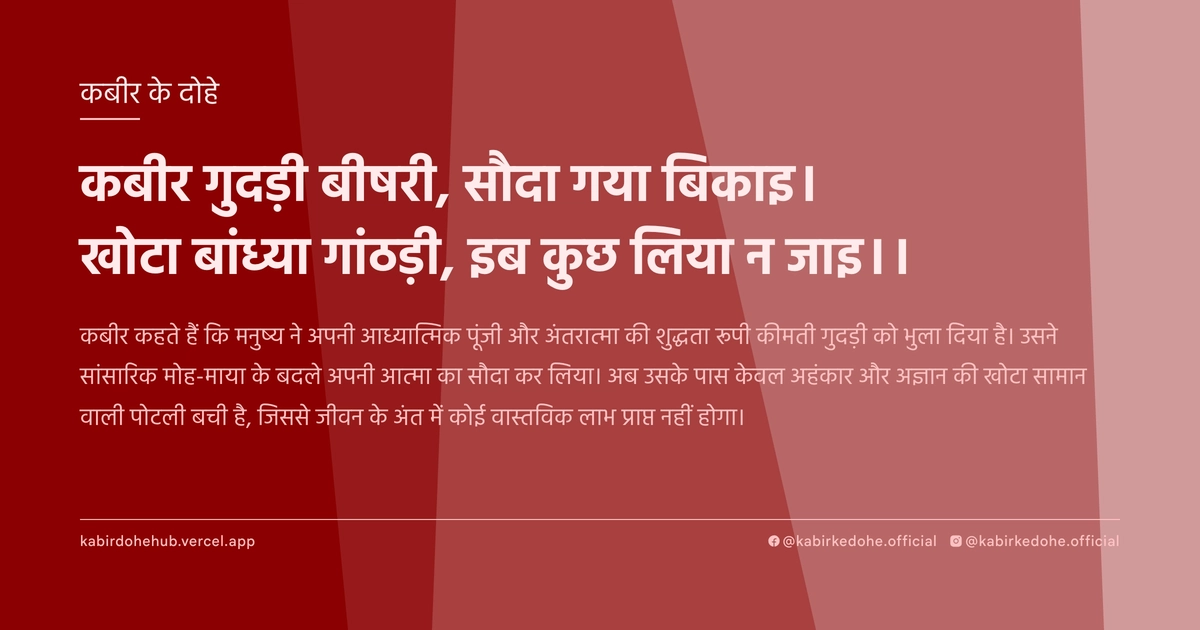
कबीर गुदड़ी बीषरी, सौदा गया बिकाइ।
खोटा बांध्या गांठड़ी, इब कुछ लिया न जाइ।।
Kabir gudri bishari, sauda gaya bikai. Khota bandhya gathdi, ib kuch liya na jai.
इस पृष्ठ पर इस कबीर दोहे का अर्थ (meaning), हिंदी व्याख्या और अंग्रेज़ी अनुवाद, दार्शनिक विश्लेषण और व्यावहारिक जीवन सीख दी गई है। यह दोहा अनित्य (Impermanence) विषय से जुड़ा है — Kabir doha meaning and explanation in Hindi and English.
अर्थ (Meaning):
कबीर कहते हैं कि मनुष्य ने अपनी आध्यात्मिक पूंजी और अंतरात्मा की शुद्धता रूपी कीमती गुदड़ी को भुला दिया है। उसने सांसारिक मोह-माया के बदले अपनी आत्मा का सौदा कर लिया। अब उसके पास केवल अहंकार और अज्ञान की खोटा सामान वाली पोटली बची है, जिससे जीवन के अंत में कोई वास्तविक लाभ प्राप्त नहीं होगा।
Kabir asserts that humans have forgotten the precious 'quilt' of spiritual awareness and inner purity. In a misguided trade, they have bartered their eternal soul for the fleeting illusions of the material world. Now, they are left with a bundle of worthless ego and ignorance, which offers no true value or liberation at the final hour of existence.
व्याख्या (Interpretation):
यहाँ 'गुदड़ी' केवल एक कपड़ा नहीं, बल्कि वह सहज ज्ञान और ईश्वरीय अंश है जो हर मनुष्य में निहित है। 'सौदा' उस मानसिक विनिमय को दर्शाता है जहाँ हम क्षणिक सुख के लिए शाश्वत शांति का त्याग करते हैं। यह दोहा निरगुण भक्ति के उस सिद्धांत पर आधारित है जहाँ माया को एक धोखेबाज व्यापारी माना गया है। जब साधक अपनी आत्मा (Atman) को भूलकर बाहरी आडंबरों में फंसता है, तो वह 'खोटा' यानी मिलावटी ज्ञान इकट्ठा करता है। यह अद्वैत वेदांत की उस स्थिति को दर्शाता है जहाँ जीव स्वयं को ब्रह्म से अलग मानकर मिथ्या पहचान को सत्य मान लेता है। अंततः, यह विडंबना है कि मनुष्य पूरी उम्र वह बटोरता रहता है जिसे वह अंत में साथ नहीं ले जा सकता।
The 'quilt' (gudari) here is not a mere rag, but a metaphor for the innate spiritual awareness and the divine spark residing within every being. The 'trade' (sauda) represents the psychological exchange where eternal peace is sacrificed for transient pleasures. This aligns with Nirgun Bhakti, viewing Maya as a deceptive merchant. When a seeker forgets the Atman and clings to external rituals, they accumulate 'khota'—counterfeit knowledge. This mirrors the Advaita Vedanta concept of Avidya, where the soul mistakenly identifies with the ego rather than the Brahman. The central paradox is that humanity spends a lifetime gathering a bundle of illusions, only to find it weightless and worthless at the threshold of death.
दार्शनिक विश्लेषण (Philosophical Analysis):
कबीर का यह दोहा उनके समय के धार्मिक पाखंड और कर्मकांडीय कट्टरता पर एक तीखा प्रहार है। उन्होंने देखा कि लोग तीर्थयात्राओं और बाहरी दिखावे में इतने व्यस्त थे कि उन्होंने अपने भीतर के 'राम' को पूरी तरह भुला दिया था। यह सूफी मत के 'फना' (अहंकार का विनाश) और अद्वैत के 'अहं ब्रह्मास्मि' के बीच का एक सेतु है, जहाँ बाहरी दुनिया का त्याग आंतरिक सत्य की प्राप्ति के लिए आवश्यक है।
ऐतिहासिक रूप से, कबीर ने जाति व्यवस्था और सामाजिक ऊंच-नीच को नकारते हुए यह संदेश दिया कि आध्यात्मिक पूंजी किसी शास्त्र या कुल से नहीं, बल्कि आत्म-साक्षात्कार से आती है। उनके लिए 'सौदा' करना वह मानसिक त्रुटि है जिसमें मनुष्य अपनी चेतना को भौतिक वस्तुओं के अधीन कर देता है। यह मनोवैज्ञानिक रूपांतरण की मांग करता है, जहाँ व्यक्ति को यह पहचानना होगा कि उसकी वर्तमान पहचान (Ego) वास्तव में एक 'खोटा' सिक्का है।
दार्शनिक स्तर पर, यह दोहा चेतावनी देता है कि समय सीमित है। यदि जागृति (Awakening) समय पर नहीं हुई, तो मनुष्य केवल पछतावे की पोटली लेकर जाएगा। यह उस स्थिति का वर्णन है जिसे बौद्ध धर्म में 'अविद्या' कहा गया है—सत्य को न देख पाने की अक्षमता।
कबीर यहाँ यह स्पष्ट करते हैं कि भक्ति कोई बाहरी क्रिया नहीं, बल्कि एक आंतरिक शुद्धि है। जो व्यक्ति केवल बाहरी नियमों का पालन करता है, वह वास्तव में एक गलत व्यापार कर रहा है। वह सत्य के बदले असत्य को चुन रहा है।
अंततः, यह विश्लेषण हमें सिखाता है कि वास्तविक समृद्धि वह नहीं है जो बैंक खातों या सामाजिक प्रतिष्ठा में है, बल्कि वह है जो आत्मा की गहराई में शांति और संतोष के रूप में विद्यमान है। अहंकार का विसर्जन ही वह एकमात्र तरीका है जिससे 'खोटी गांठड़ी' को जलाकर वास्तविक स्वर्ण प्राप्त किया जा सकता है।
This couplet is a piercing critique of the religious hypocrisy and ritualistic rigidity prevalent during Kabir's era. He observed people obsessing over pilgrimages and external displays of piety while completely neglecting the 'Ram' within. It serves as a bridge between the Sufi concept of 'Fana' (annihilation of the ego) and the Advaita realization of 'Aham Brahmasmi,' suggesting that shedding external attachments is prerequisite to internal truth.
Historically, Kabir rejected the caste hierarchy and social stratification, asserting that spiritual capital is not derived from scriptures or lineage, but from self-realization. The 'trade' he refers to is the cognitive error where a human subordinates their consciousness to material possessions. This necessitates a psychological transformation where one recognizes that their social identity (the Ego) is essentially a 'counterfeit coin.'
Philosophically, the verse warns that time is finite. If awakening does not occur in the present, the soul will carry only a bundle of regrets. This mirrors the Buddhist concept of 'Avidya'—the fundamental ignorance that prevents one from seeing the true nature of reality.
Kabir clarifies that devotion is not an external act but an internal purification. One who adheres strictly to outer rules while remaining internally void is engaging in a fraudulent transaction, choosing the illusory over the eternal.
Ultimately, this analysis reveals that true wealth is not found in bank accounts or social prestige, but in the profound peace and contentment of the soul. The dissolution of the ego is the only mechanism to burn away the 'worthless bundle' and reclaim the primordial gold of consciousness.
मूल संदेश (Core Message):
- बाहरी चमक अक्सर आंतरिक अंधकार को छिपाने का एक तरीका होती है।
- आत्मा का सौदा भौतिक सुखों के लिए करना सबसे बड़ा नुकसान है।
- अहंकार की पोटली अंततः बोझ बन जाती है, सहारा नहीं।
- सच्ची संपत्ति वह है जो मृत्यु के बाद भी साथ रहे।
- जागृति का अर्थ है अपनी खोई हुई आध्यात्मिक पहचान को पुनः प्राप्त करना।
- सादगी ही वह मार्ग है जो हमें 'खोटे' ज्ञान से मुक्त करता है।
- External glitter is often a veil used to hide internal darkness.
- Bartering the soul for material comforts is the ultimate loss.
- The bundle of ego eventually becomes a burden, not a support.
- True wealth is that which remains with you beyond death.
- Awakening means reclaiming the lost identity of the spiritual self.
- Simplicity is the only path that liberates us from counterfeit knowledge.
व्यावहारिक उदाहरण (Practical Example):
वाराणसी के एक पुराने घाट पर माधव नाम का एक वृद्ध बुनकर रहता था। माधव अपनी कला में निपुण था, लेकिन उसका मन हमेशा इस चिंता में रहता था कि वह और अधिक धन कैसे कमाए ताकि उसका बेटा शहर में बड़ा नाम कमा सके। उसने अपनी सादगी छोड़ दी और केवल महंगे रेशमी कपड़ों के व्यापार में लग गया, जिससे वह अपने गरीब पड़ोसियों और अपनी पुरानी सादगी को भूल गया।
वह अब केवल उन्हीं लोगों से बात करता था जो अमीर थे। उसने अपनी छोटी सी कुटिया को एक बड़े मकान में बदल लिया, लेकिन उसके मन की शांति गायब हो गई। वह दिन-रात हिसाब-किताब की पोटली में उलझा रहता, यह भूलकर कि उसकी असली खुशी उस करघे की लय और संतोष में थी जो उसने सालों पहले महसूस की थी।
एक दिन, एक फकीर उसके द्वार पर आया। फकीर ने माधव की महंगी पोशाक और उसके चेहरे की थकान को देखा। फकीर ने मुस्कुराते हुए कहा, "माधव, तुमने रेशम तो बहुत कमा लिया, लेकिन अपनी रूह की गुदड़ी कहीं गिर गई है। अब तुम इस सोने की पोटली को लेकर स्वर्ग नहीं जा सकोगे क्योंकि इसमें तुम्हारी अपनी सच्चाई नहीं है।"
माधव को पहले तो गुस्सा आया, लेकिन फिर उसे याद आया कि कैसे वह अपने बच्चों और पत्नी के साथ बिताए उन सरल पलों को तरस रहा था जब उसके पास पैसा कम था पर प्रेम अधिक था। उसे एहसास हुआ कि उसने अपनी आत्मा का सौदा लालच से कर लिया था।
उस रात माधव सो नहीं सका। उसने अपनी तिजोरी की ओर देखा और उसे वह 'खोटी गांठड़ी' महसूस हुई। उसे समझ आया कि उसने बाहरी चमक के लिए अपनी आंतरिक ज्योति को बुझा दिया था।
अगले दिन से माधव ने अपना जीवन बदल लिया। उसने अपने धन का एक बड़ा हिस्सा स्थानीय अनाथालय और गरीब बुनकरों की मदद के लिए दान कर दिया। उसने फिर से अपने पुराने करघे पर बैठना शुरू किया, लेकिन इस बार लाभ के लिए नहीं, बल्कि आनंद के लिए।
उसने महसूस किया कि जब वह दूसरों की सेवा करता है, तो वह खोई हुई 'गुदड़ी' यानी उसकी आंतरिक शांति वापस मिल रही है। उसका बेटा भी पिता के इस बदलाव से प्रभावित हुआ और उसने भौतिकवाद के बजाय मानवता को चुना।
माधव अब अमीर नहीं था, लेकिन वह शांत था। उसने जान लिया था कि जीवन का असली सौदा स्वयं को जानने में है, न कि वस्तुओं को इकट्ठा करने में।
On an ancient ghat in Varanasi lived an elderly weaver named Madhav. Madhav was a master of his craft, but his mind was perpetually consumed by the anxiety of earning more wealth so his son could achieve great fame in the city. He abandoned his simplicity and plunged into the trade of expensive silks, forgetting his poor neighbors and his own humble roots.
He began interacting only with the wealthy. He replaced his small cottage with a large mansion, but his inner peace vanished. He spent his days and nights entangled in the 'bundle' of accounts, forgetting that his true joy once lay in the rhythm of the loom and the contentment he felt years ago.
One day, a wandering dervish arrived at his door. The dervish observed Madhav's expensive attire and the exhaustion etched on his face. Smiling, the dervish said, "Madhav, you have gathered much silk, but you have dropped the quilt of your soul along the way. You cannot carry this golden bundle to the beyond because it contains none of your own truth."
Madhav was initially offended, but then he remembered how he longed for the simple moments spent with his children and wife, when money was scarce but love was abundant. He realized he had bartered his soul for greed.
That night, Madhav could not sleep. He looked at his vault and perceived it as a 'worthless bundle.' He understood that in pursuit of external glitter, he had extinguished his internal light.
From the next day, Madhav transformed his life. He donated a significant portion of his wealth to a local orphanage and struggling weavers. He returned to his old loom, not for profit, but for the sheer joy of creation.
He felt that as he served others, the lost 'quilt'—his inner peace—was returning. His son, moved by this transformation, also chose humanity over materialism.
Madhav was no longer wealthy by worldly standards, but he was serene. He had learned that the only trade worth making is the one where one discovers their true self, rather than accumulating objects.
अभ्यास मार्गदर्शन (Practice Guidance):
- प्रतिदिन 20 मिनट मौन बैठें और विचार करें कि आपकी कौन सी आदतें या इच्छाएं आपकी आंतरिक शांति को छीन रही हैं।
- एक 'आत्म-निरीक्षण डायरी' लिखें: प्रतिदिन एक ऐसी घटना दर्ज करें जहाँ आपने अहंकार (Ego) को सत्य से ऊपर रखा और फिर उसे सुधारने का प्रयास करें।
- साप्ताहिक त्याग: सप्ताह में एक दिन ऐसी वस्तु या सुख का त्याग करें जिससे आप अत्यधिक मोह रखते हों, ताकि आप यह जान सकें कि आप वस्तुओं के बिना भी पूर्ण हैं।
- निदान चेकलिस्ट: क्या मैं दूसरों की प्रशंसा के लिए कार्य कर रहा हूँ? क्या मेरी खुशी बाहरी उपलब्धियों पर निर्भर है? क्या मैं अपनी अंतरात्मा की आवाज़ को अनसुना कर रहा हूँ? यदि उत्तर 'हाँ' है, तो आप 'खोटी गांठड़ी' बांध रहे हैं।
- Sit in silence for 20 minutes daily, contemplating which habits or desires are stripping away your inner peace.
- Maintain a 'Self-Inquiry Journal': Record one daily instance where you prioritized the ego over truth, and then outline how to rectify it.
- Weekly Renunciation: Once a week, give up a luxury or object you are deeply attached to, proving to yourself that you are complete without external possessions.
- Diagnostic Checklist: Am I acting for the validation of others? Is my happiness dependent on external achievements? Am I ignoring the voice of my intuition? If the answer is 'Yes,' you are tying a 'worthless bundle'.
चिंतन प्रश्न (Reflection Questions):
- यदि आज आपकी सभी सामाजिक पहचान (पद, पैसा, रिश्ता) छीन ली जाएं, तो आपके पास वास्तव में क्या बचेगा?
- आप अपनी छवि को बनाए रखने के लिए अपने व्यक्तित्व के किन हिस्सों को दबा रहे हैं?
- क्या आपकी डिजिटल पहचान (Social Media) आपकी वास्तविक आत्मा का प्रतिनिधित्व करती है या यह एक 'खोटी गांठड़ी' है?
- आप किस 'सौदा' में व्यस्त हैं जहाँ आप अपनी शांति को सफलता के बदले बेच रहे हैं?
- वह कौन सी 'गुदड़ी' (मूल्य या गुण) है जिसे आपने बचपन में छोड़ा था और अब उसकी कमी महसूस करते हैं?
- क्या आप वास्तव में स्वतंत्र हैं, या आप अपनी इच्छाओं के गुलाम बन चुके हैं?
- If all your social identities (rank, money, relationships) were stripped away today, what would actually remain of you?
- Which parts of your authentic self are you suppressing to maintain a curated public image?
- Does your digital persona represent your true soul, or is it merely a 'worthless bundle' of illusions?
- What 'trade' are you currently engaged in where you are selling your peace for the sake of success?
- What 'quilt' (core value or virtue) did you abandon in childhood that you now deeply miss?
- Are you truly free, or have you become a slave to your own curated desires?