
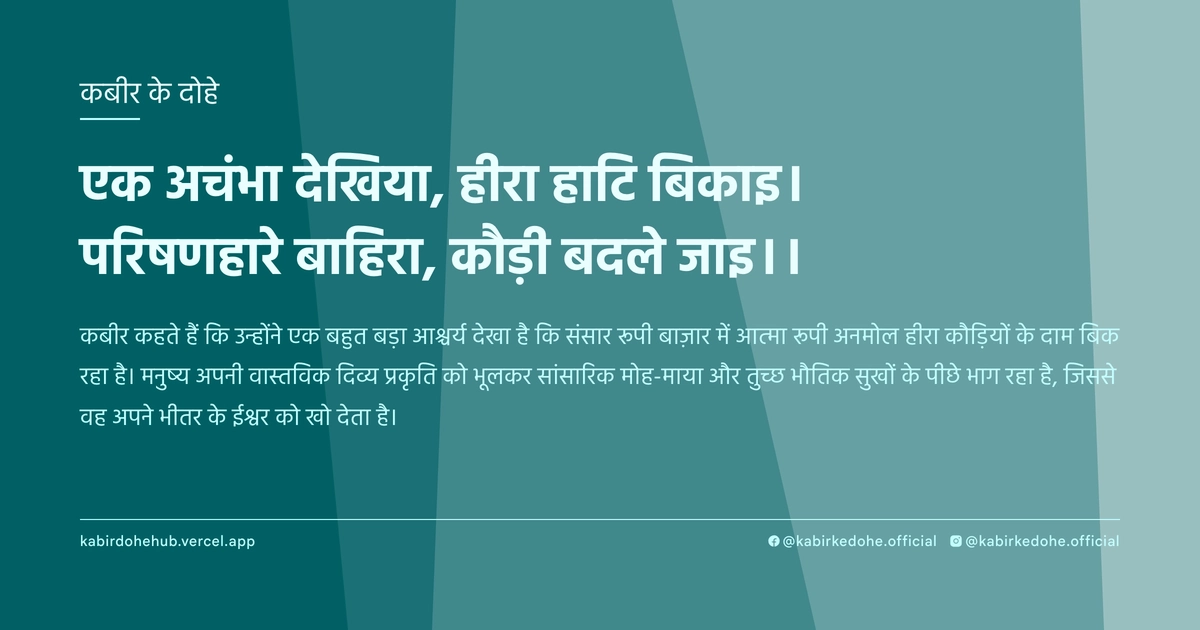
एक अचंभा देखिया, हीरा हाटि बिकाइ।
परिषणहारे बाहिरा, कौड़ी बदले जाइ।।
Ek achambha dekhiya, hira haati bikai. Parishnahare bahira, kaudi badle jaaye.
इस पृष्ठ पर इस कबीर दोहे का अर्थ (meaning), हिंदी व्याख्या और अंग्रेज़ी अनुवाद, दार्शनिक विश्लेषण और व्यावहारिक जीवन सीख दी गई है। यह दोहा माया (Maya) विषय से जुड़ा है — Kabir doha meaning and explanation in Hindi and English.
अर्थ (Meaning):
कबीर कहते हैं कि उन्होंने एक बहुत बड़ा आश्चर्य देखा है कि संसार रूपी बाज़ार में आत्मा रूपी अनमोल हीरा कौड़ियों के दाम बिक रहा है। मनुष्य अपनी वास्तविक दिव्य प्रकृति को भूलकर सांसारिक मोह-माया और तुच्छ भौतिक सुखों के पीछे भाग रहा है, जिससे वह अपने भीतर के ईश्वर को खो देता है।
Kabir observes a profound paradox: in the marketplace of worldly existence, the priceless diamond of the soul is being traded for mere shells. Human beings, blinded by ignorance, exchange their eternal spiritual essence for fleeting, trivial material pleasures and ego-driven desires, failing to recognize the divine spark within.
व्याख्या (Interpretation):
इस दोहे में 'हीरा' आत्मा का प्रतीक है और 'हाट' यह भौतिक संसार है। कबीर यहाँ उस विडंबना पर प्रहार कर रहे हैं जहाँ मनुष्य बाहरी दुनिया की चमक-धमक में इतना खो गया है कि वह अपने भीतर के अनंत खजाने को पहचान नहीं पाता। यह निर्गुण भक्ति का सार है, जहाँ ईश्वर किसी मंदिर या मस्जिद में नहीं, बल्कि स्वयं के भीतर है। माया वह पर्दा है जो हमें यह विश्वास दिलाता है कि बाहरी वस्तुएं मूल्यवान हैं, जबकि आंतरिक शांति और आत्म-साक्षात्कार ही वास्तविक धन है। यह अद्वैत वेदांत के उस सिद्धांत को दर्शाता है जहाँ जीव और ब्रह्म एक ही हैं, परंतु अज्ञानता के कारण अलगाव महसूस होता है। अंततः, यह दोहा मनुष्य को उसकी आत्मिक गरिमा को पुनः प्राप्त करने का आह्वान करता है।
In this couplet, the 'diamond' symbolizes the Atman (soul) and the 'marketplace' represents the material world. Kabir highlights the irony of human existence where the eternal spirit is undervalued in favor of transient illusions. This aligns with Nirgun Bhakti, emphasizing that the Divine is formless and resides within, not in external rituals. Maya acts as the veil of ignorance, tricking the individual into believing that external acquisitions are the path to fulfillment. From the perspective of Advaita Vedanta, the perceived separation between the self and the Absolute is the primary error. The 'shells' represent the ego and sensory gratifications which are worthless in the face of eternity. The central paradox is that the most valuable treasure is available to all, yet ignored by most.
दार्शनिक विश्लेषण (Philosophical Analysis):
कबीर का यह दोहा उनके समय के सामाजिक और धार्मिक पाखंडों पर एक गहरा प्रहार है। 15वीं शताब्दी में, जब लोग कर्मकांडों, तीर्थयात्राओं और बाहरी दिखावे में डूबे थे, कबीर ने 'सहज मार्ग' का प्रस्ताव रखा। उन्होंने तर्क दिया कि यदि ईश्वर सर्वव्यापी है, तो उसे बाहर खोजना व्यर्थ है। यह दृष्टिकोण सूफी मत के 'फना' (अहंकार का विनाश) और वेदांत के 'अहं ब्रह्मास्मि' के करीब है।
यहाँ 'हीरा' केवल एक वस्तु नहीं, बल्कि चेतना की उच्चतम अवस्था है। कबीर यह समझाते हैं कि मनुष्य अपनी पहचान को जाति, धर्म और पद से जोड़ लेता है, जो कि 'कौड़ियों' के समान तुच्छ हैं। जब व्यक्ति इन कृत्रिम पहचानों को त्याग देता है, तभी वह अपनी वास्तविक दिव्यता को देख पाता है। यह मनोवैज्ञानिक रूपांतरण की प्रक्रिया है जहाँ 'मैं' (अहंकार) का विसर्जन होता है।
ritualism या कर्मकांडों के प्रति उनकी अस्वीकृति इस बात पर आधारित है कि बाहरी क्रियाएं आंतरिक परिवर्तन के बिना निरर्थक हैं। वे कहते हैं कि माला फेरने या माथा टेकने से अधिक महत्वपूर्ण है अपने भीतर की सच्चाई को पहचानना। यह एक क्रांतिकारी विचार था जिसने तत्कालीन समाज में व्याप्त ऊंच-नीच के भेदभाव को चुनौती दी।
दार्शनिक स्तर पर, यह दोहा 'मूल्य' (Value) की अवधारणा को पुनर्परिभाषित करता है। संसार जिसे मूल्यवान मानता है (धन, प्रसिद्धि, सत्ता), कबीर उसे तुच्छ बताते हैं। वास्तविक मूल्य केवल उस ज्ञान में है जो आत्मा को परमात्मा से मिला दे। यह द्वैत से अद्वैत की ओर संक्रमण की यात्रा है।
अंततः, कबीर हमें चेतावनी देते हैं कि समय सीमित है और यदि हम इस 'बाज़ार' के प्रलोभनों में फंसे रहे, तो हम अपने जीवन के वास्तविक उद्देश्य को खो देंगे। यह केवल एक आध्यात्मिक उपदेश नहीं, बल्कि एक अस्तित्वगत चेतावनी है कि हम अपनी आत्मा का सौदा न करें।
Kabir's couplet serves as a scathing critique of the socio-religious hypocrisy of the 15th century. During an era dominated by rigid caste hierarchies and elaborate rituals, Kabir advocated for the 'Sahaja Marg' (the natural path). He posited that if the Divine is omnipresent, seeking God in external shrines or through pilgrimages is a futile exercise. This philosophy converges with the Sufi concept of 'Fana' (annihilation of the ego) and the Vedantic realization of 'Aham Brahmasmi' (I am Brahman).
The 'diamond' is not a physical gem but a metaphor for the highest state of consciousness. Kabir argues that humans tether their identity to caste, creed, and social status—all of which are as worthless as 'shells' compared to the eternal soul. The process of spiritual awakening requires the shedding of these artificial identities to reveal the inherent divinity within. This is a psychological shift from the limited 'I' to the universal 'Self'.
His rejection of ritualism stems from the belief that external piety is a mask for internal ignorance. He suggests that chanting beads or performing prostrations is meaningless if the heart remains clouded by ego. By stripping away these layers, Kabir challenges the structural inequalities of his time, suggesting that the soul has no caste and no creed.
Philosophically, the poem redefines the concept of 'Value'. The world prizes material accumulation and social prestige, but Kabir identifies these as distractions. True value lies in 'Gnosis' or experiential knowledge of the Self. This is the transition from duality (the feeling of being separate from God) to non-duality (the realization of oneness).
Ultimately, Kabir warns that the human lifespan is a fleeting opportunity. To spend it chasing the illusions of the 'marketplace' is a cosmic tragedy. It is an existential call to stop trading the eternal for the ephemeral, urging the seeker to reclaim their spiritual sovereignty before the opportunity vanishes.
मूल संदेश (Core Message):
- बाहरी चमक अक्सर आंतरिक अंधकार को छिपाने का एक माध्यम होती है।
- सच्ची संपत्ति वह है जिसे कोई चोर चुरा नहीं सकता और कोई बाज़ार बेच नहीं सकता।
- अहंकार वह भ्रम है जो हमें अपनी ही दिव्यता से दूर करता है।
- सांसारिक इच्छाएं समुद्र के पानी की तरह हैं, जितना पियो प्यास उतनी बढ़ती है।
- आत्म-साक्षात्कार ही जीवन का एकमात्र वास्तविक लाभ और उपलब्धि है।
- External brilliance is often a veil used to hide internal darkness.
- True wealth is that which no thief can steal and no market can sell.
- The ego is the illusion that separates us from our own divinity.
- Worldly desires are like salt water; the more you drink, the thirstier you become.
- Self-realization is the only genuine profit and achievement in human life.
व्यावहारिक उदाहरण (Practical Example):
वाराणसी के एक पुराने घाट पर माधव नाम का एक वृद्ध बुनकर रहता था। माधव अपनी कला में निपुण था, लेकिन उसका मन हमेशा इस बात की चिंता में रहता था कि उसके पास पर्याप्त धन नहीं है। वह दिन-रात मेहनत करता, लेकिन उसकी आँखों में कभी संतोष नहीं था। वह अक्सर अमीर व्यापारियों को देखता और सोचता कि काश उसके पास भी वैसा ही वैभव होता।
एक दिन, माधव की मुलाकात एक घुमक्कड़ फकीर से हुई। फकीर ने माधव को एक पुराना, धूल से भरा पत्थर दिया और कहा, "इसे संभाल कर रखो, यह तुम्हारी असली पूंजी है।" माधव ने उस पत्थर को देखा और हँसते हुए कहा, "बाबा, यह तो मामूली पत्थर है, मुझे सोना चाहिए, हीरा चाहिए!"
फकीर मुस्कुराया और बोला, "तुम हीरा मांग रहे हो, जबकि वह तुम्हारे पास पहले से है। बस तुमने उसे धूल समझकर उपेक्षित कर दिया है।"
माधव को पहले तो यह बात समझ नहीं आई। वह अपनी गरीबी और अभावों के बारे में सोचने लगा। लेकिन फकीर की बात उसके दिमाग में घर कर गई। उसने गौर करना शुरू किया कि वह किन चीजों के पीछे भाग रहा है। उसने महसूस किया कि वह अपनी शांति, अपने परिवार के साथ बिताए सुखद क्षणों और अपनी कला की शुद्धता को केवल इसलिए खो रहा था क्योंकि वह दूसरों की नजरों में 'सफल' दिखना चाहता था।
उसने महसूस किया कि उसकी 'कौड़ियाँ' वे सामाजिक मान्यताएं और भौतिक इच्छाएं थीं, जिनके बदले में वह अपनी आंतरिक शांति रूपी 'हीरे' को बेच रहा था। वह जितना अधिक धन कमाने की कोशिश करता, उतना ही वह अपने भीतर के खालीपन को बढ़ाता जा रहा था।
एक शाम, जब वह गंगा किनारे बैठा था, उसे अचानक बोध हुआ। उसने अपनी आँखें बंद कीं और महसूस किया कि जिस पूर्णता को वह बाहर खोज रहा था, वह उसके भीतर ही मौजूद है। उसे अपनी सांसों की लय और अपने अस्तित्व की गहराई का अनुभव हुआ।
उस पल माधव का पूरा नजरिया बदल गया। उसने अब अधिक पैसे कमाने की होड़ छोड़ दी। उसने अपनी बुनाई को केवल जीविका का साधन नहीं, बल्कि एक साधना बना लिया। वह अब हर धागे में प्रेम और ध्यान पिरोने लगा।
गाँव के लोग हैरान थे कि माधव अब पहले से ज्यादा खुश था, जबकि उसकी आर्थिक स्थिति में कोई बड़ा बदलाव नहीं आया था। वह अब एक ऐसा व्यक्ति बन गया था जिसने बाज़ार के प्रलोभनों को पहचान लिया था और अपने भीतर के हीरे को तराश लिया था।
On the ancient ghats of Varanasi lived an elderly weaver named Madhav. Madhav was a master of his craft, yet his mind was perpetually plagued by the anxiety of insufficiency. He worked tirelessly day and night, but contentment remained elusive. He often gazed at the wealthy merchants, longing for a similar level of opulence.
One day, Madhav encountered a wandering fakir. The fakir handed him an old, dust-covered stone and said, "Keep this safe; it is your true capital." Madhav looked at the stone and laughed, "Baba, this is just a common pebble! I want gold, I want diamonds!"
The fakir smiled and replied, "You ask for a diamond, yet you already possess it. You have simply mistaken it for dust and ignored it."
Initially, Madhav did not grasp the meaning. He continued to dwell on his poverty and lack. However, the fakir's words took root in his mind. He began to observe the nature of his desires. He realized that he was sacrificing his peace, the joy of his family, and the purity of his art simply to appear 'successful' in the eyes of others.
He recognized that his 'shells' were the social validations and material cravings for which he was trading his inner peace—the true 'diamond'. The harder he strove for wealth, the deeper the void within him grew.
One evening, sitting by the banks of the Ganges, a sudden realization dawned upon him. He closed his eyes and felt that the wholeness he had been seeking externally was already present within. He experienced the rhythm of his breath and the profound depth of his own existence.
In that moment, Madhav's entire perspective shifted. He ceased the frantic race for accumulation. He transformed his weaving from a mere means of livelihood into a spiritual practice. He began to weave love and mindfulness into every thread.
The villagers were astonished to find Madhav significantly happier, despite no major change in his financial status. He had become a man who recognized the traps of the marketplace and had finally polished the diamond within.
Madhav's life became a testament to the fact that true wealth is not what we gather, but what we realize we already are. He lived the rest of his days in a state of effortless grace, free from the hunger of the ego.
अभ्यास मार्गदर्शन (Practice Guidance):
- प्रतिदिन 20 मिनट मौन ध्यान करें, जहाँ आप बाहरी दुनिया के शोर को छोड़कर केवल अपनी आंतरिक उपस्थिति (Presence) का अनुभव करें।
- एक 'मूल्य डायरी' (Value Journal) बनाएँ। लिखें कि आप किन बाहरी चीजों (प्रशंसा, पद, वस्तुएं) के लिए अपनी मानसिक शांति का त्याग कर रहे हैं।
- सचेत उपभोग का अभ्यास करें: जब भी कुछ खरीदने की तीव्र इच्छा हो, स्वयं से पूछें, "क्या यह मेरी आत्मा की आवश्यकता है या अहंकार की मांग?"
- निदान चेकलिस्ट: यदि आप दूसरों की सफलता देखकर ईर्ष्या महसूस करते हैं या अपनी खुशी को भविष्य की किसी उपलब्धि से जोड़ते हैं, तो समझें कि आप 'हीरे' को 'कौड़ियों' से बदल रहे हैं।
- Practice 20 minutes of silent meditation daily, shifting focus from external noise to the sheer experience of your internal presence.
- Maintain a 'Value Journal'. Document the external validations (praise, status, objects) for which you are sacrificing your mental peace.
- Practice conscious consumption: whenever a strong urge to acquire arises, ask yourself, "Is this a need of my soul or a demand of my ego?"
- Diagnostic Checklist: If you feel envy toward others' success or tie your happiness to a future achievement, recognize that you are trading your 'diamond' for 'shells'.
चिंतन प्रश्न (Reflection Questions):
- मेरे जीवन में वे कौन सी 'कौड़ियाँ' हैं जिन्हें मैं सबसे अधिक मूल्यवान मानता हूँ?
- यदि मेरी सारी सामाजिक पहचान (पद, डिग्री, रिश्ता) छीन ली जाए, तो मेरे पास क्या बचेगा?
- मैं अपनी डिजिटल छवि (Social Media Ego) को बनाए रखने के लिए अपनी वास्तविक शांति का कितना हिस्सा कुर्बान कर रहा हूँ?
- क्या मेरी प्रार्थनाएं ईश्वर को पाने के लिए हैं, या ईश्वर से कुछ मांगने के लिए?
- मेरे भीतर का वह 'हीरा' क्या है जिसे मैंने डर या शर्म के कारण दुनिया से छिपा रखा है?
- What are the 'shells' in my life that I mistakenly perceive as most valuable?
- If all my social identities (status, degrees, relationships) were stripped away, what would remain of me?
- How much of my authentic peace am I sacrificing to maintain my digital persona (Social Media Ego)?
- Are my prayers intended to realize the Divine, or merely to negotiate for favors from the Divine?
- What is the 'diamond' within me that I have kept hidden from the world due to fear or shame?