
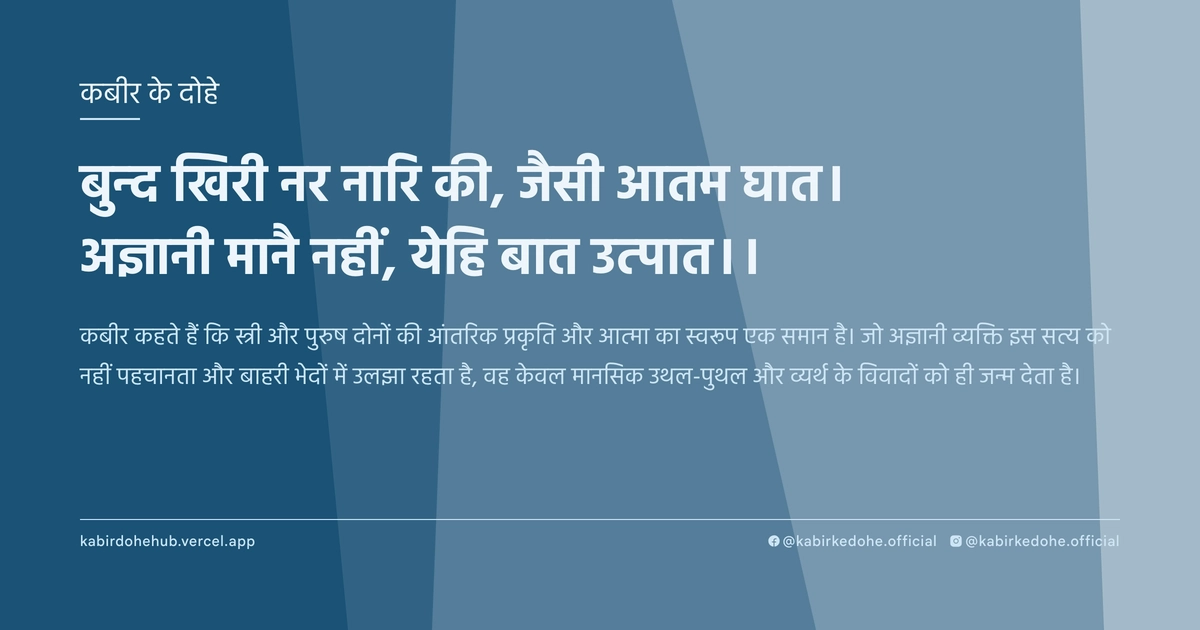
बुन्द खिरी नर नारि की, जैसी आतम घात।
अज्ञानी मानै नहीं, येहि बात उत्पात।।
Bund khiri nar nari ki, jaisi aatam ghat. Agyani manai nahin, yehi baat utpat.
इस पृष्ठ पर इस कबीर दोहे का अर्थ (meaning), हिंदी व्याख्या और अंग्रेज़ी अनुवाद, दार्शनिक विश्लेषण और व्यावहारिक जीवन सीख दी गई है। यह दोहा आत्मा और शरीर (Soul and Body) विषय से जुड़ा है — Kabir doha meaning and explanation in Hindi and English.
अर्थ (Meaning):
कबीर कहते हैं कि स्त्री और पुरुष दोनों की आंतरिक प्रकृति और आत्मा का स्वरूप एक समान है। जो अज्ञानी व्यक्ति इस सत्य को नहीं पहचानता और बाहरी भेदों में उलझा रहता है, वह केवल मानसिक उथल-पुथल और व्यर्थ के विवादों को ही जन्म देता है।
Kabir asserts that the inner essence and the spiritual nature of both men and women are identical. Those who remain ignorant of this fundamental truth and cling to external distinctions only create mental turmoil and engage in futile, disruptive conflicts.
व्याख्या (Interpretation):
इस दोहे का शाब्दिक अर्थ है कि नर और नारी के भीतर की चेतना एक ही है। गहराई में, कबीर 'आतम घात' के माध्यम से उस बिंदु की ओर संकेत कर रहे हैं जहाँ लिंग, जाति और शरीर का कोई अस्तित्व नहीं रहता। यह निर्गुण भक्ति का सार है, जहाँ ईश्वर किसी एक रूप में नहीं बल्कि एक निराकार तत्व के रूप में सबके भीतर व्याप्त है। माया हमें बाहरी आवरणों में उलझाकर सत्य से दूर रखती है, जिससे द्वैत पैदा होता है। जब तक मनुष्य इस अद्वैत भाव को नहीं समझता, वह समाज में भेदभाव और अपने मन में अशांति का अनुभव करता रहता है। यह विरोधाभास है कि हम जिसे अलग समझते हैं, वही वास्तव में हमारी अपनी आत्मा का प्रतिबिंब है।
Literally, the verse states that the consciousness within men and women is one. Metaphorically, Kabir uses 'aatam ghaat' to point toward the singularity of the soul where gender, caste, and physical form cease to exist. This is the essence of Nirgun Bhakti, where the Divine is not a personified entity but a formless element permeating all existence. Maya lures the individual into external distinctions, creating a perceived duality. Until one realizes this non-duality (Advaita), they continue to experience social fragmentation and internal unrest. The central paradox lies in the fact that the 'other' we strive to differentiate from is actually a reflection of our own universal Atman.
दार्शनिक विश्लेषण (Philosophical Analysis):
कबीर का यह दोहा उस युग की सामाजिक संरचना पर प्रहार करता है जहाँ पितृसत्ता और धार्मिक कट्टरता चरम पर थी। उन्होंने स्पष्ट किया कि आध्यात्मिक मार्ग पर कोई भी लिंग बाधा नहीं है, जो उस समय के रूढ़िवादी ब्राह्मणवादी और सूफी परंपराओं के कुछ हिस्सों के विपरीत था। यह विचार सीधे तौर पर अद्वैत वेदांत से जुड़ता है, जो कहता है कि 'अहं ब्रह्मास्मि'—मैं ही ब्रह्म हूँ, और यह ब्रह्म लिंग-विहीन है।
सूफी मत के 'वहदत-अल-वजूद' (अस्तित्व की एकता) के समान, कबीर तर्क देते हैं कि आत्मा का कोई जेंडर नहीं होता। जब हम किसी को 'पुरुष' या 'स्त्री' के रूप में देखते हैं, तो हम केवल शरीर को देख रहे होते हैं, आत्मा को नहीं। यह शरीर केवल एक वस्त्र है, जबकि उसके भीतर की ज्योति एक ही स्रोत से निकली है।
कबीर ritualism (कर्मकांड) का विरोध करते हैं क्योंकि कर्मकांड अक्सर भेदभाव को पुख्ता करते हैं। यदि कोई व्यक्ति केवल बाहरी पूजा करता है लेकिन मन में स्त्री-पुरुष का भेद रखता है, तो उसकी भक्ति व्यर्थ है। उनके लिए वास्तविक धर्म वह है जो अहंकार को मिटाकर एकता का अनुभव कराए।
मनोवैज्ञानिक स्तर पर, यह दोहा 'प्रोजेक्शन' की प्रक्रिया को समझाता है। अज्ञानी व्यक्ति अपनी आंतरिक कमियों या इच्छाओं को दूसरे लिंग पर थोपता है, जिससे 'उत्पात' या संघर्ष पैदा होता है। जब हम दूसरे में स्वयं को देखते हैं, तो संघर्ष समाप्त हो जाता है और करुणा का जन्म होता है।
अंततः, कबीर का संदेश यह है कि मुक्ति केवल तभी संभव है जब हम द्वैत (Duality) को त्यागकर अद्वैत (Non-duality) को अपनाएं। अहंकार ही वह पर्दा है जो हमें यह देखने से रोकता है कि हम सब एक ही चेतना के विभिन्न रूप हैं। इस पर्दे का गिरना ही वास्तविक ज्ञान है।
This couplet is a direct assault on the social structures of Kabir's era, characterized by rigid patriarchy and religious dogmatism. He clarifies that gender is no barrier to spiritual attainment, challenging the orthodoxies of both the Brahmanical and certain Sufi traditions of his time. This aligns seamlessly with Advaita Vedanta, which posits 'Aham Brahmasmi'—I am Brahman—and that this ultimate reality is genderless.
Parallel to the Sufi concept of 'Wahdat-al-Wujud' (Unity of Existence), Kabir argues that the soul possesses no gender. When we perceive someone as 'male' or 'female,' we are merely observing the physical vessel, not the essence. The body is but a garment; the light within is derived from a single, universal source.
Kabir rejects ritualism because rituals often reinforce social hierarchies and distinctions. If a practitioner engages in external worship but maintains a mental divide between genders, their devotion is superficial. For Kabir, true religion is the annihilation of the ego to experience primordial unity.
Psychologically, the verse addresses the mechanism of 'projection.' The ignorant person projects their internal conflicts or desires onto the opposite gender, leading to 'utpaat' or turmoil. When one recognizes the self in the other, conflict dissolves into compassion.
Ultimately, Kabir suggests that liberation is only possible by transcending duality in favor of non-duality. The ego is the veil that prevents us from seeing that we are all diverse expressions of a single consciousness. The falling of this veil constitutes true enlightenment.
मूल संदेश (Core Message):
- बाहरी भेद केवल माया का खेल हैं, सत्य अद्वैत है।
- आत्मा का कोई लिंग नहीं होता, वह निराकार और अनंत है।
- अहंकार ही वह दीवार है जो हमें एकता देखने से रोकती है।
- सच्ची भक्ति वह है जो भेदभाव को पूरी तरह मिटा दे।
- मानसिक शांति केवल तब मिलती है जब द्वैत समाप्त हो जाता है।
- External distinctions are mere plays of Maya; Truth is non-dual.
- The soul has no gender; it is formless and infinite.
- Ego is the only wall preventing us from seeing unity.
- True devotion is that which completely erases discrimination.
- Mental peace arrives only when duality is extinguished.
व्यावहारिक उदाहरण (Practical Example):
वाराणसी के एक पुराने घाट पर रहने वाली सुमित्रा नाम की एक वृद्ध विधवा थी, जिसे समाज ने 'अशुभ' मानकर हाशिए पर धकेल दिया था। वह दिन भर घाट की सीढ़ियाँ साफ करती और लोगों के तिरस्कार को चुपचाप सहती। उसी घाट पर एक युवा पंडित, राघव, रहता था जो शास्त्रों का ज्ञाता था और मानता था कि आध्यात्मिक ज्ञान केवल पुरुषों के लिए है।
राघव अक्सर सुमित्रा को देखता और सोचता कि यह स्त्री केवल सेवा के लिए बनी है, ज्ञान के लिए नहीं। वह अपनी श्रेष्ठता के अहंकार में डूबा रहता और सुमित्रा की चुप्पी को उसकी अज्ञानता समझता।
एक दिन, राघव एक कठिन श्लोक के अर्थ को लेकर गहरे मानसिक द्वंद्व में था। वह घंटों तक ग्रंथों में उलझा रहा, लेकिन उसे शांति नहीं मिली। उसने देखा कि सुमित्रा एक कोने में बैठकर शांत भाव से गंगा को निहार रही थी, उसके चेहरे पर एक ऐसी स्थिरता थी जो राघव ने अपनी सारी किताबों में नहीं पाई थी।
जिज्ञासावश, राघव ने उससे पूछा, "माता, आप इतनी शांत कैसे हैं? क्या आपको इस समाज के दुखों का अहसास नहीं होता?"
सुमित्रा ने मंद मुस्कान के साथ उत्तर दिया, "बेटा, जब मैं यह भूल गई कि मैं एक 'विधवा' हूँ या एक 'स्त्री' हूँ, तब मुझे वह मिला जो कभी खोता नहीं। तुम किताबों में जिसे ढूंढ रहे हो, वह शब्दों में नहीं, उस मौन में है जहाँ तुम और मैं अलग नहीं रहते।"
यह सुनकर राघव स्तब्ध रह गया। उसे अहसास हुआ कि वह जिसे 'अज्ञानी' समझ रहा था, वह वास्तव में उससे कहीं अधिक जागृत थी। उसने महसूस किया कि उसका ज्ञान केवल बौद्धिक था, जबकि सुमित्रा का ज्ञान अनुभवात्मक था।
राघव के भीतर का अहंकार टूट गया। उसने महसूस किया कि उसने अब तक केवल शरीर और सामाजिक भूमिकाओं को देखा था, आत्मा को नहीं। उसने सुमित्रा के चरणों में सिर झुकाया और स्वीकार किया कि आत्मा का कोई लिंग या सामाजिक दर्जा नहीं होता।
इस 'कबीर ट्विस्ट' ने राघव के जीवन को बदल दिया। उसने शास्त्रों का उपयोग भेदभाव करने के बजाय सबको जोड़ने के लिए करना शुरू किया। उसने समाज में स्त्रियों के प्रति अपने नजरिए को पूरी तरह बदल लिया और उन्हें आध्यात्मिक रूप से समान मानना शुरू किया।
अब राघव केवल एक पंडित नहीं था, वह एक सच्चा साधक बन गया था। उसने सीखा कि जब तक हम दूसरे को अपने से अलग या कमतर देखते हैं, हम सत्य से दूर रहते हैं। सुमित्रा की मौन शिक्षा ने उसे अद्वैत का वास्तविक अनुभव कराया।
राघव और सुमित्रा की यह अनकही मित्रता घाट पर अन्य लोगों के लिए भी एक मिसाल बन गई, जहाँ ज्ञान की कसौटी अब डिग्री या जेंडर नहीं, बल्कि हृदय की करुणा और आंतरिक शांति बन गई थी।
In the ancient ghats of Varanasi lived Sumitra, an elderly widow who had been pushed to the margins of society, labeled as 'inauspicious.' She spent her days cleaning the stone steps, silently enduring the disdain of passersby.
On the same ghat lived Raghav, a young priest and scholar of the scriptures. Raghav believed that profound spiritual knowledge was the exclusive domain of men. He viewed Sumitra with a mixture of pity and condescension, assuming her silence was a sign of ignorance.
One day, Raghav found himself in a state of intense mental turmoil over the interpretation of a complex verse. Despite hours of study, he could not find peace. He noticed Sumitra sitting in a corner, gazing at the Ganges with a profound stillness that Raghav had never encountered in any text.
Driven by curiosity, Raghav asked, "Mother, how are you so peaceful? Do you not feel the weight of the sorrows this society imposes on you?"
Sumitra replied with a gentle smile, "Son, when I forgot that I was a 'widow' or a 'woman,' I found that which can never be lost. What you seek in books is not in words, but in the silence where you and I cease to be separate."
Raghav was stunned. He realized that the person he had dismissed as 'ignorant' was far more awakened than he was. His knowledge was merely intellectual, while hers was experiential.
His ego shattered. He recognized that he had been perceiving only bodies and social roles, completely missing the soul. He bowed before Sumitra, acknowledging that the Atman knows no gender or social rank.
This 'Kabir Twist' transformed Raghav's life. He stopped using scriptures to justify hierarchy and began using them to foster unity. His entire perception of women shifted from one of inferiority to one of spiritual equality.
Raghav ceased to be just a priest; he became a true seeker. He learned that as long as we perceive another as separate or lesser, we remain distant from the Truth.
The unspoken bond between Raghav and Sumitra became a beacon for others on the ghat. Knowledge was no longer measured by degrees or gender, but by the depth of one's compassion and inner silence.
अभ्यास मार्गदर्शन (Practice Guidance):
- दैनिक ध्यान: प्रतिदिन 20 मिनट मौन बैठें और यह विचार करें कि आपके भीतर की चेतना और दूसरे व्यक्ति की चेतना में कोई मौलिक अंतर नहीं है।
- आत्म-पूछताछ जर्नल: लिखें कि दिन भर में आपने कितनी बार किसी व्यक्ति को उसके लिंग, पद या जाति के आधार पर जज किया। उस निर्णय के पीछे के अहंकार को पहचानें।
- व्यवहार परिवर्तन: जानबूझकर उन लोगों के साथ समय बिताएं जिन्हें समाज 'कमतर' मानता है, और उनमें अपनी ही आत्मा का प्रतिबिंब खोजने का प्रयास करें।
- निदान चेकलिस्ट: क्या आप अभी भी 'मैं' और 'वह' के बीच अंतर महसूस करते हैं? क्या आप किसी की क्षमता को उसके जेंडर से जोड़ते हैं? यदि हाँ, तो आप अभी भी 'अज्ञानी' की श्रेणी में हैं।
- Daily Meditation: Spend 20 minutes in silence, contemplating that the consciousness within you and the consciousness within another are fundamentally identical.
- Self-Inquiry Journaling: Record instances where you judged someone based on gender, status, or caste. Identify the specific ego-driver behind that judgment.
- Behavioral Shift: Consciously spend time with those marginalized by society, attempting to recognize your own soul's reflection in them.
- Diagnostic Checklist: Do you still feel a fundamental gap between 'I' and 'the other'? Do you subconsciously link capability to gender? If yes, you are still operating from a place of ignorance.
चिंतन प्रश्न (Reflection Questions):
- यदि आपका शरीर और सामाजिक पहचान छीन ली जाए, तो आपकी 'पहचान' में क्या बचेगा?
- आपकी डिजिटल पहचान (सोशल मीडिया) आपके वास्तविक आंतरिक स्वरूप को कितना छिपाती या बढ़ा-चढ़ाकर दिखाती है?
- क्या आप वास्तव में समानता में विश्वास करते हैं, या आप केवल 'समानता' का ढोंग करते हैं जबकि मन में श्रेष्ठता का भाव रहता है?
- आपके जीवन का वह कौन सा गुप्त पूर्वाग्रह है जो आपको दूसरों को पूरी तरह इंसान समझने से रोकता है?
- क्या आपकी शांति दूसरों की स्थिति पर निर्भर है, या वह आपके भीतर के अद्वैत से उपजी है?
- If your body and social identity were stripped away, what would remain of your 'identity'?
- To what extent does your digital persona hide or exaggerate your true internal nature?
- Do you truly believe in equality, or do you merely perform equality while harboring a sense of superiority?
- What is the hidden bias in your life that prevents you from seeing others as fully human?
- Is your peace dependent on external circumstances, or does it arise from the non-duality within you?