
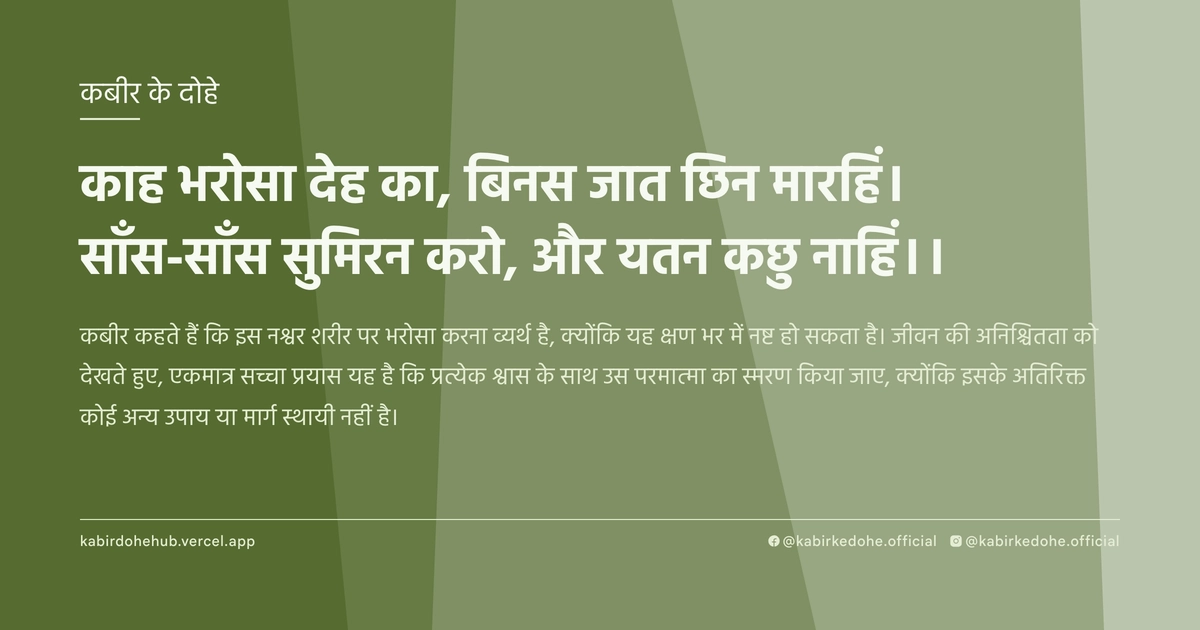
काह भरोसा देह का, बिनस जात छिन मारहिं।
साँस-साँस सुमिरन करो, और यतन कछु नाहिं।।
Kaah bharosa deh ka, binas jaat chhin maarihin. Saans-saans sumiran karo, aur yatan kachu naahin.
इस पृष्ठ पर इस कबीर दोहे का अर्थ (meaning), हिंदी व्याख्या और अंग्रेज़ी अनुवाद, दार्शनिक विश्लेषण और व्यावहारिक जीवन सीख दी गई है। यह दोहा मृतुक्यता (Mortality) विषय से जुड़ा है — Kabir doha meaning and explanation in Hindi and English.
अर्थ (Meaning):
कबीर कहते हैं कि इस नश्वर शरीर पर भरोसा करना व्यर्थ है, क्योंकि यह क्षण भर में नष्ट हो सकता है। जीवन की अनिश्चितता को देखते हुए, एकमात्र सच्चा प्रयास यह है कि प्रत्येक श्वास के साथ उस परमात्मा का स्मरण किया जाए, क्योंकि इसके अतिरिक्त कोई अन्य उपाय या मार्ग स्थायी नहीं है।
Kabir asserts that relying on the physical body is futile, as it can be extinguished in a mere instant. Given the profound fragility and uncertainty of existence, the only meaningful endeavor is to maintain a constant remembrance of the Divine with every single breath, for no other effort or ritual offers a lasting sanctuary.
व्याख्या (Interpretation):
इस दोहे का शाब्दिक अर्थ शरीर की क्षणभंगुरता की चेतावनी है। आध्यात्मिक स्तर पर, 'देह' केवल मांस और हड्डियों का ढांचा नहीं, बल्कि उस 'अहंकार' का प्रतीक है जिसे हम अपनी पहचान मानते हैं। कबीर यहाँ निरगुण भक्ति का संदेश दे रहे हैं, जहाँ साधक को यह समझना होता है कि मायावी जगत और भौतिक शरीर केवल एक भ्रम हैं। 'सुमिरन' का अर्थ केवल मंत्र जाप नहीं, बल्कि आत्मा का परमात्मा (ब्रह्म) के साथ एकाकार होना है। यह अद्वैत वेदांत के उस सत्य को दर्शाता है जहाँ जीव और शिव के बीच का भेद मिट जाता है। जब हम श्वास-श्वास सुमिरन करते हैं, तो हम समय और स्थान की सीमाओं से ऊपर उठकर उस अनंत शून्य में विलीन हो जाते हैं। यह विरोधाभास है कि शरीर के नष्ट होने के भय से ही हम उस अविनाशी तत्व की खोज की ओर प्रेरित होते हैं।
Literally, the couplet warns of the body's transience. Metaphorically, the 'body' represents not just the physical form, but the 'ego'—the false identity we cling to. Kabir invokes Nirgun Bhakti, urging the seeker to realize that the material world and the physical vessel are mere projections of Maya (illusion). 'Sumiran' (remembrance) transcends rote chanting; it is the conscious alignment of the Atman with the formless Brahman. This mirrors Advaita Vedanta, where the perceived duality between the individual soul and the Universal Consciousness is dissolved. By anchoring awareness in every breath, the practitioner transcends the limitations of time and space, merging into the infinite void. The central paradox lies in the fact that only by acknowledging the certainty of death can one truly awaken to the permanence of the Eternal Spirit.
दार्शनिक विश्लेषण (Philosophical Analysis):
कबीर का यह विचार उनके युग के उस सामाजिक और धार्मिक परिवेश की प्रतिक्रिया है जहाँ लोग बाहरी कर्मकांडों, तीर्थयात्राओं और शारीरिक शुद्धि में उलझे थे। उन्होंने स्पष्ट किया कि मोक्ष किसी बाहरी क्रिया से नहीं, बल्कि आंतरिक जागरूकता से मिलता है। यह दृष्टिकोण सूफी मत के 'ज़िक्र' (निरंतर स्मरण) से गहराई से मेल खाता है, जहाँ हृदय की धड़कन और श्वास को ईश्वर की याद से जोड़ा जाता है।
दार्शनिक रूप से, कबीर यहाँ 'देह-अभिमान' पर प्रहार कर रहे हैं। जब मनुष्य शरीर को ही सत्य मान लेता है, तो वह मोह और भय के जाल में फंस जाता है। अद्वैत वेदांत के अनुसार, शरीर 'अधिष्ठान' है, लेकिन सत्य 'चेतना' है। कबीर का 'सुमिरन' इसी चेतना को जाग्रत करने की प्रक्रिया है।
वे जाति और धर्म के भेदों को नकारते हुए यह बताते हैं कि श्वास लेना एक सार्वभौमिक सत्य है। चाहे कोई राजा हो या रंक, श्वास की यह लय सबको एक समान करती है। यह समानता ही वास्तविक सामाजिक न्याय का आधार है, क्योंकि मृत्यु सबको एक ही धरातल पर ला खड़ा करती है।
मनोवैज्ञानिक स्तर पर, यह दोहा 'मृत्यु-बोध' (Memento Mori) के माध्यम से वर्तमान क्षण में जीने की कला सिखाता है। जब हम यह स्वीकार कर लेते हैं कि शरीर क्षणभंगुर है, तो हमारी आसक्तियाँ कम होने लगती हैं और हम मानसिक शांति की ओर बढ़ते हैं।
अंततः, कबीर यह समझाते हैं कि 'यतन' या प्रयास केवल बाहरी दिखावे के लिए नहीं होना चाहिए। वास्तविक प्रयास वह है जो अहंकार का विसर्जन करे और साधक को उस स्थिति में ले जाए जहाँ 'मैं' समाप्त हो जाए और केवल 'वह' (परमात्मा) शेष रहे।
Kabir’s insight is a direct critique of the ritualistic landscape of his era, where spiritual liberation was erroneously sought through external ceremonies, pilgrimages, and physical purifications. He posits that salvation is an internal awakening rather than a result of external performance. This philosophy resonates deeply with the Sufi practice of 'Zikr' (constant remembrance), where the rhythm of the breath and heartbeat is synchronized with the Divine presence.
Philosophically, Kabir attacks 'Deh-Abhiman' or bodily identification. When a human perceives the physical form as the ultimate reality, they become imprisoned by attachment and fear. According to Advaita Vedanta, while the body is the 'Adhishthana' (substratum), the only truth is 'Chaitanya' (Pure Consciousness). Kabir’s 'Sumiran' is the method of awakening this latent consciousness.
By emphasizing the breath, Kabir bypasses caste and creed. Breathing is a universal biological truth; whether one is a king or a pauper, the rhythm of breath is identical. This universality serves as the foundation for a radical social equality, reminding us that death is the ultimate equalizer that strips away all societal constructs.
Psychologically, this couplet employs the concept of 'Memento Mori' to anchor the practitioner in the present moment. By accepting the fragility of the body, the grip of worldly attachments loosens, facilitating a transition from anxiety to equanimity.
Ultimately, Kabir argues that 'Yatan' (effort) must not be performative. True effort is the systematic annihilation of the ego. The goal is to reach a state of 'Fana' (extinction of self), where the individual 'I' vanishes, leaving only the Universal Truth to exist.
मूल संदेश (Core Message):
- शरीर एक अस्थायी वस्त्र है, इसे स्थायी घर न समझें।
- अहंकार का आधार भौतिकता है, जो अंततः ढह जाता है।
- सांसों की लय ही परमात्मा से जुड़ने का सबसे सरल सेतु है।
- बाहरी कर्मकांडों से श्रेष्ठ आंतरिक निरंतर जागरूकता है।
- मृत्यु का भय केवल तभी मिटता है जब हम अविनाशी तत्व को पहचानते हैं।
- सच्चा प्रयास वह है जो हमें 'स्व' से 'सर्व' की ओर ले जाए।
- The body is a temporary garment; do not mistake it for a permanent home.
- Ego is rooted in materiality, which is destined to crumble.
- The rhythm of breath is the simplest bridge to the Divine.
- Internal constant awareness outweighs all external ritualistic performances.
- Fear of death vanishes only when the indestructible element is recognized.
- True effort is that which transitions the seeker from the 'self' to the 'all'.
व्यावहारिक उदाहरण (Practical Example):
वाराणसी के एक पुराने घाट पर रहने वाले माधव नाम के एक वृद्ध बुनकर थे। माधव अपनी कला में निपुण थे और उन्हें अपनी शारीरिक शक्ति और अपनी बनाई साड़ियों की श्रेष्ठता पर बहुत गर्व था। वे मानते थे कि उनकी कुशलता ही उनकी असली पहचान है और वे अपनी सेहत के प्रति अति-आत्मविश्वासी थे।
एक दिन, अचानक एक तीव्र ज्वर ने उन्हें बिस्तर पर डाल दिया। जिस शरीर पर उन्हें इतना नाज़ था, वह अब एक मामूली बुखार के सामने बेबस था। उनके हाथ कांपने लगे और वे करघे को छू भी नहीं पा रहे थे।
बीमारी के उन कठिन दिनों में, माधव ने महसूस किया कि उनकी सारी उपलब्धियाँ, उनका अहंकार और उनकी शारीरिक क्षमताएँ रेत की तरह फिसल रही हैं। उन्हें डर लगने लगा कि यदि वे अब कुछ कर नहीं पाए, तो उनकी पहचान क्या रह जाएगी?
तभी उनकी मुलाकात एक फकीर से हुई, जिसने उन्हें कबीर का यही दोहा सुनाया। फकीर ने कहा, 'माधव, तुम उस धागे पर भरोसा कर रहे हो जो कभी भी टूट सकता है, जबकि तुम्हें उस बुनकर को याद करना चाहिए जिसने यह सारा संसार बुना है।'
माधव ने अपनी आँखें बंद कीं और अपनी श्वासों पर ध्यान केंद्रित करना शुरू किया। उन्होंने महसूस किया कि जब वे सांस लेते हैं, तो वे केवल एक बुनकर नहीं, बल्कि उस अनंत ब्रह्मांड का हिस्सा हैं।
धीरे-धीरे, उनका डर गायब हो गया। उन्होंने पाया कि जब वे अपनी हर सांस के साथ उस निराकार परमात्मा का स्मरण करते हैं, तो उन्हें एक ऐसी शांति मिलती है जो उनके स्वास्थ्य या उनकी कला से परे थी।
जब वे अंततः स्वस्थ हुए, तो माधव बदल चुके थे। अब वे साड़ियाँ तो बुनते थे, लेकिन उनमें अब अहंकार नहीं था। वे हर ताने-बाने को परमात्मा की एक भेंट मानते थे।
उन्होंने अपने जीवन का शेष समय दूसरों की सेवा में लगा दिया, यह जानते हुए कि शरीर केवल एक माध्यम है, मंजिल नहीं। उनकी पहचान अब 'कुशल बुनकर' से बदलकर 'एक शांत साधक' की हो गई थी।
In the ancient ghats of Varanasi lived an elderly weaver named Madhav. Madhav was a master of his craft and took immense pride in his physical vigor and the unmatched quality of his silk sarees. He believed his skill was his ultimate identity and remained overconfident in his health.
One day, a sudden and severe fever struck him, confining him to his bed. The body he had so blindly trusted was now helpless against a simple ailment. His hands trembled, and he could no longer touch his loom.
During those grueling days of illness, Madhav realized that his achievements, his ego, and his physical capabilities were slipping away like sand through fingers. He was gripped by the fear that if he could no longer produce, his identity would vanish.
It was then that he met a wandering Sufi dervish who recited this very doha by Kabir. The dervish told him, 'Madhav, you are trusting the thread that can snap at any moment; instead, remember the Weaver who wove the entire universe.'
Madhav closed his eyes and began to focus on his breath. He realized that as he breathed, he was not merely a weaver of cloth, but a part of an infinite, cosmic tapestry.
Slowly, his fear evaporated. He discovered that by anchoring every breath in the remembrance of the Formless Divine, he accessed a peace that transcended his health or his professional status.
When he eventually recovered, Madhav was a transformed man. He continued to weave sarees, but the arrogance was gone. He viewed every warp and weft as an offering to the Divine.
He spent the remainder of his life serving others, knowing that the body is merely a vehicle, not the destination. His identity shifted from being a 'skilled weaver' to a 'peaceful seeker.'
अभ्यास मार्गदर्शन (Practice Guidance):
- प्राणायाम और सजगता: प्रतिदिन 20 मिनट केवल अपनी श्वास के आने और जाने पर ध्यान दें। जब भी मन भटककर शरीर या बाहरी दुनिया की चिंताओं में जाए, धीरे से कहें 'मैं यह शरीर नहीं हूँ, मैं वह शाश्वत चेतना हूँ' और पुनः श्वास पर लौट आएं।
- आत्म-पूछताछ जर्नल: प्रतिदिन रात को लिखें—'आज मैंने किन शारीरिक या भौतिक चीजों पर अत्यधिक निर्भरता दिखाई? यदि ये आज मुझसे छिन जातीं, तो मेरी मानसिक स्थिति क्या होती?'
- व्यवहारिक परिवर्तन: दिन में तीन बार (सुबह, दोपहर, शाम) एक मिनट का मौन धारण करें। इस दौरान अपनी हर सांस को परमात्मा का उपहार मानकर कृतज्ञता व्यक्त करें, न कि अधिकार।
- निदान चेकलिस्ट: यदि आप छोटी बीमारियों या उम्र बढ़ने के संकेतों पर अत्यधिक घबरा रहे हैं, या अपनी भौतिक उपलब्धियों को अपनी पहचान मान रहे हैं, तो समझें कि आप 'देह-भरोसे' के जाल में हैं। यदि आप विपरीत परिस्थितियों में भी आंतरिक शांति महसूस करते हैं, तो आप 'सुमिरन' के मार्ग पर हैं।
- Pranayama and Mindfulness: Spend 20 minutes daily focusing solely on the inhalation and exhalation of breath. Whenever the mind wanders toward bodily concerns or external anxieties, gently affirm, 'I am not this body; I am the eternal consciousness,' and return to the breath.
- Self-Inquiry Journaling: Each night, record—'In what ways did I rely excessively on physical or material attributes today? If these were stripped away, how would my internal state be affected?'
- Behavioral Shift: Practice one minute of absolute silence three times a day (morning, noon, evening). During this time, view every breath as a gift from the Divine rather than a biological right, cultivating deep gratitude.
- Diagnostic Checklist: You are trapped in 'bodily reliance' if you experience disproportionate anxiety over minor illnesses or signs of aging, or if you equate your self-worth with physical appearance. You are on the path of 'Sumiran' if you maintain internal equanimity despite physical decline or external chaos.
चिंतन प्रश्न (Reflection Questions):
- यदि आज आपकी सभी भौतिक पहचानें (पद, रूप, संपत्ति) छीन ली जाएं, तो आपके भीतर क्या शेष बचेगा?
- आप अपनी सेहत और सुंदरता के प्रति कितने आश्रित हैं? क्या यह निर्भरता आपके भीतर एक सूक्ष्म भय पैदा करती है?
- क्या आपका 'डिजिटल व्यक्तित्व' (सोशल मीडिया इमेज) आपके शरीर के मोह का एक आधुनिक विस्तार है?
- आप श्वास लेते तो हैं, लेकिन क्या आप कभी श्वास के 'होने' के प्रति जागरूक रहे हैं?
- वह कौन सा हिस्सा है आपके व्यक्तित्व का जिसे आप कभी खोना नहीं चाहते? क्या वह वास्तव में आपका है?
- क्या आप मृत्यु को एक अंत के रूप में देखते हैं या एक रूपांतरण के रूप में?
- If all your material identities (status, appearance, wealth) were stripped away today, what would remain within you?
- To what extent are you dependent on your health and beauty? Does this dependence create a subtle, underlying fear?
- Is your 'digital persona' (social media image) merely a modern extension of your attachment to the physical body?
- You breathe constantly, but have you ever been consciously aware of the act of 'being' a breath?
- Which part of your identity are you most terrified of losing? Does that part truly belong to you?
- Do you perceive death as a final termination or as a profound transformation?