
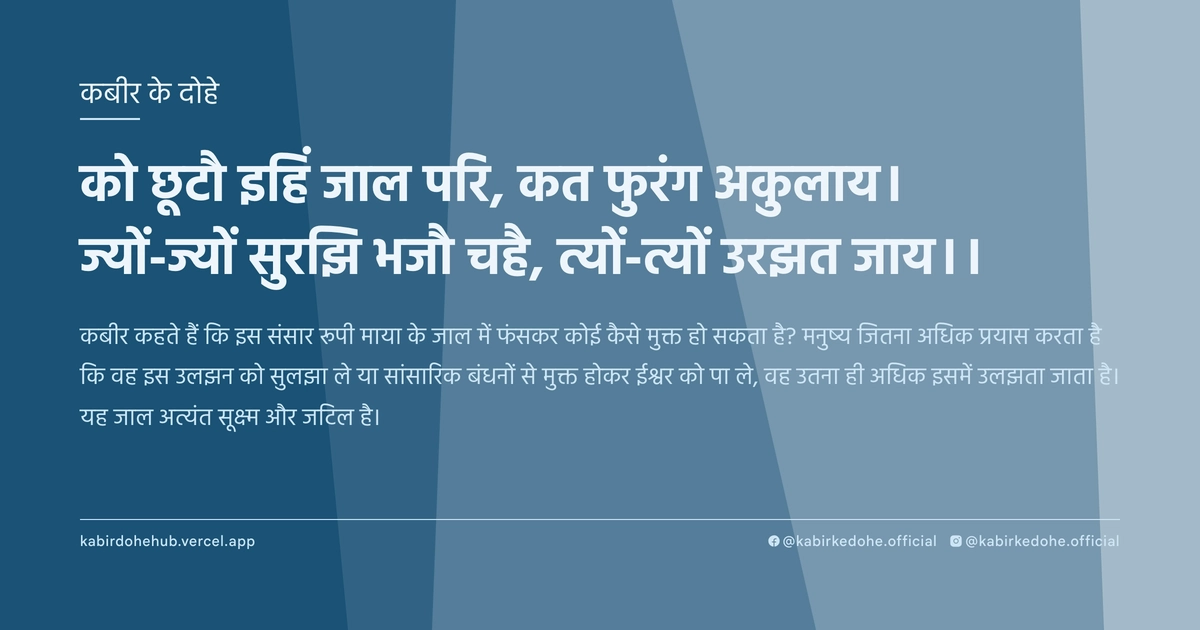
को छूटौ इहिं जाल परि, कत फुरंग अकुलाय।
ज्यों-ज्यों सुरझि भजौ चहै, त्यों-त्यों उरझत जाय।।
Ko chhootau ihin jaal pari, kat phurang akulaaye. Jyon-jyon surajhi bhajau chahaye, tyon-tyon urjhat jaaye.
इस पृष्ठ पर इस कबीर दोहे का अर्थ (meaning), हिंदी व्याख्या और अंग्रेज़ी अनुवाद, दार्शनिक विश्लेषण और व्यावहारिक जीवन सीख दी गई है। यह दोहा माया (Maya) विषय से जुड़ा है — Kabir doha meaning and explanation in Hindi and English.
अर्थ (Meaning):
कबीर कहते हैं कि इस संसार रूपी माया के जाल में फंसकर कोई कैसे मुक्त हो सकता है? मनुष्य जितना अधिक प्रयास करता है कि वह इस उलझन को सुलझा ले या सांसारिक बंधनों से मुक्त होकर ईश्वर को पा ले, वह उतना ही अधिक इसमें उलझता जाता है। यह जाल अत्यंत सूक्ष्म और जटिल है।
Kabir questions who can truly escape the intricate web of Maya (worldly illusion). He observes that the more a person consciously struggles to untangle themselves from the complexities of existence or attempts to force a spiritual liberation through intellectual effort, the more deeply they become entwined in the entanglement.
व्याख्या (Interpretation):
यहाँ 'जाल' माया और अहंकार का प्रतीक है। कबीर का संकेत है कि जब तक हम 'मैं' के भाव से मुक्ति चाहते हैं, वह 'मैं' ही हमें और अधिक बांधता है। यह निरगुण भक्ति का सार है: ईश्वर को बाहरी कर्मकांडों या मानसिक कुश्ती से नहीं, बल्कि पूर्ण समर्पण से पाया जा सकता है। अद्वैत वेदांत के अनुसार, द्वैत का भाव ही बंधन है। जब साधक यह सोचता है कि 'मैं' मुक्त होना चाहता हूँ, तो वह अपनी पृथकता को और पुष्ट करता है, जिससे माया का प्रभाव बढ़ जाता है। यह एक आध्यात्मिक विरोधाभास है जहाँ प्रयास ही बाधा बन जाता है।
The 'web' symbolizes the intricate construct of Maya and the ego. Kabir suggests that as long as the 'I' seeks liberation, that very sense of agency reinforces the bondage. This aligns with Nirgun Bhakti, where the Divine is formless and cannot be captured by ritualistic or intellectual striving. In the lens of Advaita Vedanta, the belief in separation (duality) is the root of the trap. When a seeker thinks, 'I want to be free,' they are inadvertently strengthening the ego-identity, thereby tightening the knot of illusion. It is a spiritual paradox: the effort to escape the ego using the ego only deepens the entanglement.
दार्शनिक विश्लेषण (Philosophical Analysis):
कबीर का यह दोहा उनके समय के धार्मिक पाखंड और बाहरी आडंबरों पर एक गहरा प्रहार है। वे उस समय के समाज को देखते हैं जहाँ लोग तीर्थयात्रा, व्रत और कठोर तपस्या के माध्यम से मोक्ष पाने की कोशिश कर रहे थे। कबीर तर्क देते हैं कि ये सभी बाहरी प्रयास वास्तव में अहंकार की सूक्ष्म खुराक हैं। वे सूफी मत के 'फना' (अहंकार का विनाश) और वेदांत के 'अहं ब्रह्मास्मि' के बीच एक सेतु बनाते हैं।
यहाँ 'जाल' केवल भौतिक सुख नहीं, बल्कि मानसिक धारणाएँ और सामाजिक पहचानें हैं। जाति, धर्म और पद की पहचान मनुष्य को एक ऐसे मानसिक पिंजरे में डाल देती है जिसे वह 'सत्य' समझने लगता है। कबीर के अनुसार, जब तक साधक यह मानता है कि वह कुछ 'कर' रहा है, वह माया के प्रभाव में है। वास्तविक मुक्ति 'करने' में नहीं, बल्कि 'होने' में है।
यह विश्लेषण मनोवैज्ञानिक स्तर पर भी सटीक है। आधुनिक शब्दावली में इसे 'प्रतिगामी प्रयास' (backwards law) कह सकते हैं। जितना अधिक हम किसी चीज़ को नियंत्रित करने की कोशिश करते हैं, वह उतनी ही अधिक हमें नियंत्रित करती है। कबीर इस मानसिक संघर्ष को पहचानते हैं और चेतावनी देते हैं कि बौद्धिक विश्लेषण आध्यात्मिक प्रगति का मार्ग नहीं है।
वे इस बात पर जोर देते हैं कि मुक्ति का मार्ग 'अहं' का विसर्जन है। जब तक 'मैं' मौजूद है, तब तक 'बंधन' भी मौजूद रहेगा क्योंकि बंधन और बंधनमुक्त होने वाला, दोनों एक ही सिक्के के दो पहलू हैं। बिना इस सत्य को समझे, मनुष्य केवल एक जाल से निकलकर दूसरे जाल में प्रवेश करता है।
अंततः, कबीर यह संदेश देते हैं कि ईश्वर या सत्य कोई ऐसी वस्तु नहीं है जिसे 'प्राप्त' किया जाए, बल्कि यह वह है जो तब प्रकट होता है जब खोजने वाला स्वयं मिट जाता है। यह शून्य की अवस्था है, जहाँ न कोई जाल है और न ही कोई फँसा हुआ जीव।
This couplet is a profound critique of the religious hypocrisy and external ritualism prevalent during Kabir's era. He observed a society obsessed with pilgrimages, fasting, and rigorous penance as shortcuts to salvation. Kabir argues that these external efforts are merely subtle nourishments for the ego, creating a false sense of spiritual superiority.
The 'web' refers not just to material desires, but to the mental constructs and social identities we inhabit. Caste, creed, and status create a psychological cage that the individual mistakes for reality. Drawing from Sufi concepts of 'Fana' (annihilation of the self) and the Advaita realization of non-duality, Kabir posits that as long as the seeker believes they are 'doing' something to achieve liberation, they remain trapped in the illusion of agency.
Psychologically, this mirrors the 'backwards law'—the idea that the pursuit of a feeling often precludes the experience of it. The more one consciously struggles to be 'free' from the world, the more they focus on the world, thereby strengthening their attachment to it. Intellectualization is not spiritualization; it is often just another layer of the web.
Kabir emphasizes that liberation is not an acquisition but a subtraction. It is the process of stripping away the false identities. If the 'I' persists in seeking freedom, the duality of 'seeker' and 'goal' persists, and thus the bondage remains. True liberation occurs when the seeker dissolves into the sought.
Ultimately, Kabir suggests that Truth is not a destination to be reached through effort, but a presence that reveals itself when the effort ceases. It is the state of 'Shunya' (void), where the distinction between the trapped and the liberator vanishes entirely, leaving only the eternal, formless reality.
मूल संदेश (Core Message):
- मुक्ति प्रयास से नहीं, बल्कि प्रयास के विसर्जन से आती है।
- अहंकार द्वारा किया गया आध्यात्मिक प्रयास केवल एक नया बंधन है।
- सत्य को पकड़ने की कोशिश उसे और दूर धकेलती है।
- जब 'मैं' मिटता है, तब जाल अपने आप गायब हो जाता है।
- समर्पण ही वह एकमात्र कुंजी है जो माया के ताले खोलती है।
- Liberation comes not from effort, but from the dissolution of effort.
- Spiritual striving fueled by the ego is merely a more sophisticated bondage.
- The attempt to grasp the Truth only pushes it further away.
- When the 'I' vanishes, the web disappears of its own accord.
- Surrender is the only key that unlocks the gates of Maya.
व्यावहारिक उदाहरण (Practical Example):
वाराणसी के घाटों पर रहने वाली एक वृद्ध विधवा, जानकी, का जीवन इस दोहे का जीवंत उदाहरण है। जानकी ने अपने जीवन के तीस वर्ष केवल कठोर नियमों, उपवासों और निरंतर मंत्र जाप में बिता दिए। उनका एकमात्र लक्ष्य था—मोक्ष।
वह हर दिन यह सोचकर जागती कि आज वह अपने मन के विकारों को पूरी तरह जीत लेगी। वह जितना अधिक प्रयास करती, उसका मन उतना ही अधिक विचलित होता।
जब वह मौन व्रत रखती, तो उसके भीतर के विचार और अधिक शोर मचाने लगते। वह जितना अधिक 'पवित्र' बनने की कोशिश करती, उसे अपने भीतर का क्रोध और असंतोष उतना ही अधिक स्पष्ट दिखने लगता।
उसे लगा कि शायद उसकी भक्ति में कमी है, इसलिए उसने और अधिक कठिन तपस्या शुरू कर दी। वह अब घंटों तक एक ही मुद्रा में बैठती, लेकिन उसका मन केवल इस बात पर केंद्रित रहता कि 'मैं अब मुक्त होने के करीब हूँ'।
यह 'मैं' ही उसका सबसे बड़ा बंधन बन गया था। वह मोक्ष को एक पुरस्कार की तरह देख रही थी जिसे वह अपनी मेहनत से हासिल करेगी।
एक दिन, घाट पर एक छोटा बच्चा गिर गया और जोर-जोर से रोने लगा। जानकी ने बिना सोचे, बिना किसी 'मोक्ष' के विचार के, उसे गोद में उठाया और उसे चुप कराया।
उस क्षण, जानकी पूरी तरह भूल गई कि वह एक 'साधिका' है या उसे 'मुक्त' होना है। वह केवल उस बच्चे की करुणा में विलीन हो गई।
जैसे ही उसने 'स्वयं को मुक्त करने' का प्रयास छोड़ा, उसे महसूस हुआ कि वह पहले से ही मुक्त थी। वह जाल जिसे वह सुलझाने की कोशिश कर रही थी, वास्तव में उसकी अपनी इच्छा थी।
उसने समझा कि मोक्ष कोई मंजिल नहीं, बल्कि वह सहजता है जो तब आती है जब हम स्वयं को पाने की जिद छोड़ देते हैं।
जानकी ने अब कठिन तपस्या छोड़ दी और केवल प्रेम और सेवा में लीन हो गई, और आश्चर्यजनक रूप से, वही शांति उसे मिली जो वह तीस वर्षों के संघर्ष में नहीं पा सकी थी।
Janki, an elderly widow living on the ghats of Varanasi, embodies the struggle described in this Doha. For thirty years, Janki's life was a rigid schedule of strict rules, fasting, and incessant mantra chanting. Her sole objective was Moksha (liberation).
Every morning, she woke up with the resolve to completely conquer the fluctuations of her mind. However, the harder she pushed, the more her mind rebelled and wandered.
When she observed a vow of silence, the internal chatter in her head grew deafening. The more she strove to be 'pure,' the more clearly she perceived the simmering anger and dissatisfaction within her.
Believing her devotion was insufficient, she escalated to even harsher austerities. She would sit motionless for hours, but her internal focus remained fixed on the thought: 'I am now closer to liberation.'
This 'I' became her greatest shackle. She viewed liberation as a trophy to be earned through sheer willpower and effort.
One afternoon, a small child tripped on the stone steps of the ghat and began to cry hysterically. Without a second thought, and without any conscious thought of her spiritual status, Janki rushed to pick him up and soothe him.
In that fleeting moment, Janki completely forgot that she was a 'seeker' or that she needed to be 'freed.' She was entirely absorbed in the act of compassion for the child.
As soon as she abandoned the effort to 'free herself,' she realized that she was already free. The web she had been trying to untangle was, in fact, her own desire for liberation.
She understood that Moksha is not a destination to be reached, but a natural state of being that emerges when the stubbornness of the ego vanishes.
Janki abandoned her rigid austerities and lived simply in service and love. Paradoxically, she found the peace in a few moments of selfless love that she had failed to find in thirty years of disciplined struggle.
अभ्यास मार्गदर्शन (Practice Guidance):
- प्रतिदिन 20 मिनट 'साक्षी भाव' का अभ्यास करें। अपने विचारों को सुलझाने या बदलने की कोशिश न करें, बस उन्हें एक दर्शक की तरह देखें।
- एक जर्नल लिखें जिसमें आप उन क्षेत्रों को चिह्नित करें जहाँ आप 'परिणाम' पाने के लिए बहुत अधिक प्रयास कर रहे हैं और यह देखें कि वह प्रयास कैसे तनाव पैदा कर रहा है।
- जब भी आप आध्यात्मिक रूप से 'अकुलाय' (बेचैन) महसूस करें, तो रुकें और स्वयं से पूछें: 'यह कौन है जो मुक्त होना चाहता है?'
- निदान चेकलिस्ट: क्या आप अपनी आध्यात्मिक प्रगति को मापना चाहते हैं? क्या आप दूसरों की तुलना में खुद को अधिक 'जागरूक' मानते हैं? यदि हाँ, तो आप अभी भी जाल में हैं।
- Practice 'Witness Consciousness' (Sakshi Bhava) for 20 minutes daily. Do not attempt to untangle or change your thoughts; simply observe them as a detached spectator.
- Maintain a journal to identify areas in your life where you are striving too hard for a specific 'result' and observe how that effort creates more resistance.
- Whenever you feel spiritual restlessness or anxiety (Akulaay), pause and ask yourself: 'Who is the one who desires liberation?'
- Diagnostic Checklist: Do you find yourself measuring your spiritual progress? Do you feel more 'awakened' than others? If yes, you are still operating within the web of ego.
चिंतन प्रश्न (Reflection Questions):
- क्या मेरी आध्यात्मिक खोज वास्तव में सत्य के लिए है, या यह मेरी अपनी श्रेष्ठता की भावना को संतुष्ट करने का एक तरीका है?
- मेरे जीवन का वह कौन सा 'जाल' है जिसे मैं सुलझाने की जितनी कोशिश करता हूँ, वह उतना ही उलझता जाता है?
- यदि मैं अपनी सभी धार्मिक और सामाजिक पहचानें अभी त्याग दूँ, तो मेरे भीतर क्या बचेगा?
- क्या मैं वास्तव में मुक्त होना चाहता हूँ, या मैं केवल 'मुक्त होने वाले व्यक्ति' की छवि का आनंद लेना चाहता हूँ?
- मेरे डिजिटल व्यक्तित्व (सोशल मीडिया ईगो) में मैं किस तरह के 'आध्यात्मिक मुखौटे' पहनता हूँ?
- Is my spiritual quest truly for Truth, or is it a sophisticated way to satisfy my need for superiority?
- What is the specific 'web' in my life that becomes more tangled the more I try to consciously resolve it?
- If I were to strip away all my religious and social identities right now, what would actually remain within me?
- Do I truly desire liberation, or am I merely enamored with the image of being 'one who is liberated'?
- What spiritual masks do I wear within my digital persona to project an image of enlightenment?