
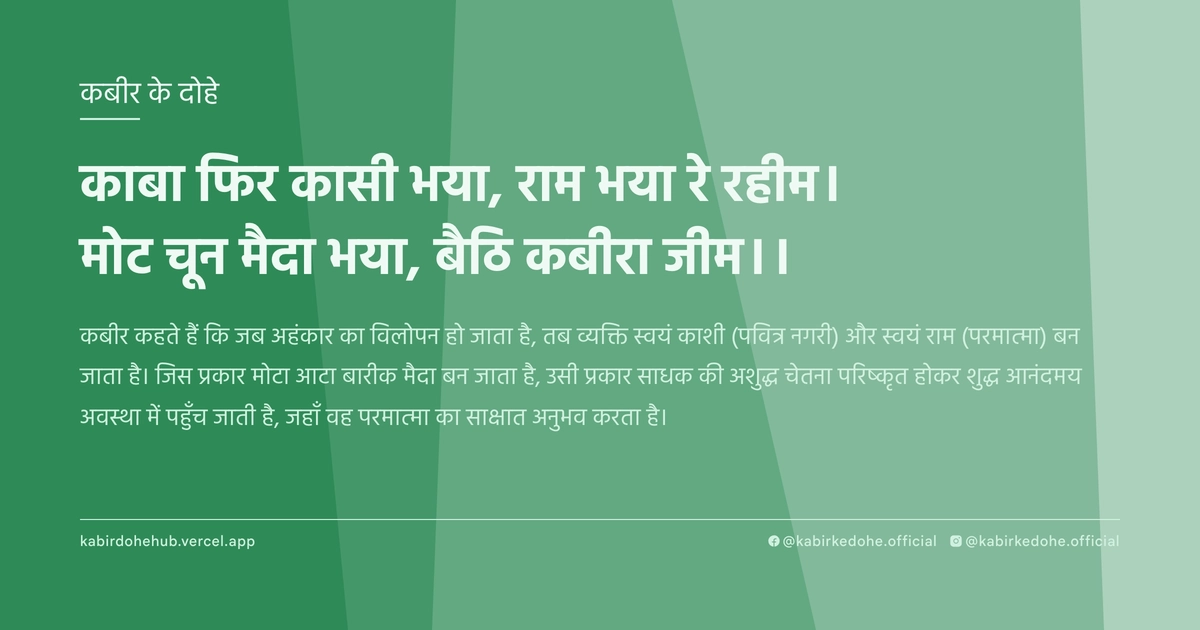
काबा फिर कासी भया, राम भया रे रहीम।
मोट चून मैदा भया, बैठि कबीरा जीम।।
Kaaba phir kaasi bhaya, ram bhaya re rahim. Mot choon maida bhaya, baithi kabira jeem.
इस पृष्ठ पर इस कबीर दोहे का अर्थ (meaning), हिंदी व्याख्या और अंग्रेज़ी अनुवाद, दार्शनिक विश्लेषण और व्यावहारिक जीवन सीख दी गई है। यह दोहा मुक्ति (Liberation) विषय से जुड़ा है — Kabir doha meaning and explanation in Hindi and English.
अर्थ (Meaning):
कबीर कहते हैं कि जब अहंकार का विलोपन हो जाता है, तब व्यक्ति स्वयं काशी (पवित्र नगरी) और स्वयं राम (परमात्मा) बन जाता है। जिस प्रकार मोटा आटा बारीक मैदा बन जाता है, उसी प्रकार साधक की अशुद्ध चेतना परिष्कृत होकर शुद्ध आनंदमय अवस्था में पहुँच जाती है, जहाँ वह परमात्मा का साक्षात अनुभव करता है।
Kabir proclaims that when the ego is completely annihilated, the seeker becomes Kashi (the sacred city) and Ram (the Divine) themselves. Just as coarse flour is refined into fine maida, the seeker's crude consciousness is purified into a subtle, blissful state, allowing them to feast upon the direct experience of the Absolute.
व्याख्या (Interpretation):
यहाँ 'काशी' केवल एक भौगोलिक स्थान नहीं, बल्कि मोक्ष की अवस्था का प्रतीक है। 'राम' यहाँ सगुण मूर्ति नहीं, बल्कि निर्गुण ब्रह्म है जो हर कण में व्याप्त है। कबीर एक अद्भुत विरोधाभास प्रस्तुत करते हैं: बाहरी तीर्थयात्रा व्यर्थ है क्योंकि वास्तविक तीर्थ आत्मा के भीतर है। 'मोटे चून' का 'मैदा' बनना आध्यात्मिक रूपांतरण की प्रक्रिया है, जहाँ अज्ञान की खुरदरी परतें हटती हैं और आत्मा की सूक्ष्मता प्रकट होती है। यह अद्वैत वेदांत के उस सत्य को दर्शाता है जहाँ ज्ञाता, ज्ञान और ज्ञेय का भेद समाप्त हो जाता है। अंततः, 'जीम' (भोजन करना) का अर्थ है उस परम सत्य का आस्वादन करना, जो अब बाहर नहीं बल्कि स्वयं के भीतर उपलब्ध है।
In this verse, 'Kashi' is not a geographical location but a symbol of the state of liberation. 'Ram' does not refer to a deity with form, but to the Nirgun Brahman—the formless Absolute pervading every atom. Kabir presents a profound paradox: external pilgrimages are futile because the true pilgrimage occurs within the soul. The transformation of 'coarse flour' into 'fine maida' represents the process of spiritual alchemy, where the rough edges of ignorance are worn away to reveal the subtlety of the spirit. This aligns with Advaita Vedanta, where the distinction between the knower, the known, and the knowledge dissolves. Ultimately, 'jeem' (to eat) signifies the tasting of the Absolute Truth, which is no longer sought externally but is realized as one's own essence.
दार्शनिक विश्लेषण (Philosophical Analysis):
कबीर का यह दोहा उनके युग के कर्मकांडीय पाखंड पर एक तीखा प्रहार है। उस समय समाज में यह मान्यता थी कि केवल काशी जाकर मरने से ही मोक्ष मिलता है। कबीर इस बाहरी ढांचे को ध्वस्त करते हुए घोषणा करते हैं कि पवित्रता स्थान में नहीं, बल्कि चेतना की अवस्था में है। यह दृष्टिकोण सूफी मत के 'फना' (अहंकार का विनाश) और अद्वैत वेदांत के 'अहं ब्रह्मास्मि' (मैं ही ब्रह्म हूँ) के करीब है।
यहाँ 'मोटा चून' मानव की आदिम, वासना-युक्त और अहंकार-ग्रस्त स्थिति का प्रतिनिधित्व करता है। मैदा बनना उस मानसिक और आध्यात्मिक शोधन की प्रक्रिया है जिसे 'साधना' कहा जाता है। जब तक मनुष्य स्वयं को शरीर या नाम मानकर अलग समझता है, वह 'मोटा' रहता है। जैसे ही वह अपनी पहचान को सार्वभौमिक चेतना में विलीन करता है, वह परिष्कृत हो जाता है।
यह विश्लेषण दर्शाता है कि कबीर के लिए ईश्वर कोई बाहरी सत्ता नहीं है जिसे प्रार्थनाओं या अनुष्ठानों से प्रसन्न किया जाए। उनके अनुसार, ईश्वर एक 'अवस्था' है जिसे प्राप्त किया जाता है। यह मनोवैज्ञानिक रूपांतरण है जहाँ 'मैं' का विलोपन 'वह' के उदय में होता है।
कबीर की यह शिक्षा जाति और धर्म की सीमाओं को तोड़ती है। यदि हर व्यक्ति अपने भीतर की काशी को खोज ले, तो उसे किसी मंदिर, मस्जिद या विशेष तीर्थ की आवश्यकता नहीं रहती। यह सामाजिक समानता का आध्यात्मिक आधार है।
अंततः, यह दोहा हमें सिखाता है कि आध्यात्मिक प्रगति का अर्थ कुछ नया जोड़ना नहीं, बल्कि अनावश्यक को हटाना है। जैसे मैदा बनाने के लिए आटे की अशुद्धियों को दूर किया जाता है, वैसे ही आत्म-साक्षात्कार के लिए अहंकार की परतों को हटाना अनिवार्य है।
This doha is a sharp critique of the ritualistic hypocrisy prevalent during Kabir's era. At the time, there was a widespread belief that salvation could only be achieved by dying in the city of Kashi. Kabir dismantles this external framework, asserting that sanctity resides not in a location, but in a state of consciousness. This perspective closely aligns with the Sufi concept of 'Fana' (annihilation of the self) and the Advaita Vedanta realization of 'Aham Brahmasmi' (I am Brahman).
The 'coarse flour' represents the primal human condition—driven by desire, ego, and fragmented identity. The transformation into 'fine maida' symbolizes the process of spiritual refinement known as 'Sadhana.' As long as a human identifies with the body or a social label, they remain 'coarse.' Once they merge their identity into the universal consciousness, they become refined.
This analysis reveals that for Kabir, God is not an external entity to be appeased through prayers or rituals. Instead, Divinity is a 'state of being' to be attained. It is a psychological transmutation where the 'I' dissolves into the 'All.'
Kabir's teaching transcends the boundaries of caste and creed. If every individual discovers the 'Kashi' within, the need for temples, mosques, or specific pilgrimage sites vanishes. This provides a spiritual foundation for absolute social equality.
Ultimately, the verse teaches that spiritual progress is not about adding something new, but about subtracting the unnecessary. Just as flour is refined by removing impurities, self-realization requires the stripping away of the layers of the ego.
मूल संदेश (Core Message):
- बाहरी तीर्थ केवल भ्रम हैं; वास्तविक मोक्ष आंतरिक रूपांतरण में है।
- अहंकार की खुरदरी परतें ही सत्य और साधक के बीच की दीवार हैं।
- जब 'मैं' का विलोपन होता है, तब सार्वभौमिक चेतना का उदय होता है।
- पवित्रता किसी स्थान का गुण नहीं, बल्कि आत्मा की एक अवस्था है।
- परमात्मा को पाना नहीं है, बल्कि स्वयं को परमात्मा के रूप में पहचानना है।
- External pilgrimages are illusions; true liberation lies in internal transformation.
- The coarse layers of ego are the only walls between the seeker and the Truth.
- When the individual 'I' dissolves, the universal consciousness awakens.
- Holiness is not a quality of a place, but a state of the soul.
- God is not to be attained, but to be recognized as one's own essence.
व्यावहारिक उदाहरण (Practical Example):
एक समय की बात है, बनारस के घाटों पर रहने वाला एक वृद्ध बुनकर था जिसका नाम माधव था। माधव जीवन भर इस विश्वास में रहा कि यदि वह अपनी सारी जमा पूँजी से गंगा की सात परिक्रमाएँ करे और काशी के सबसे बड़े मंदिर में दान दे, तो उसे मोक्ष मिल जाएगा। वह दिन-रात मेहनत करता, लेकिन उसका मन हमेशा अशांत रहता था क्योंकि उसे लगता था कि वह अभी भी 'अशुद्ध' है।
माधव अक्सर अपने पड़ोस में रहने वाले एक शांत साधु के पास जाता और पूछता, 'महाराज, मैं और कितनी पूजा करूँ कि मैं राममय हो जाऊँ?' साधु केवल मुस्कुराते और कहते, 'माधव, तुम आटे को छानने की कोशिश कर रहे हो, लेकिन तुमने अभी तक यह नहीं देखा कि तुम खुद आटा हो।'
एक दिन माधव एक भीषण विवाद में पड़ गया। उसका एक साथी बुनकर उसके कपड़ों की चोरी का झूठा आरोप लगा रहा था। माधव क्रोध से भर गया और चिल्लाने लगा। तभी उसे साधु की बात याद आई। उसने अचानक महसूस किया कि उसका क्रोध, उसका अहंकार और उसकी 'पवित्र' होने की इच्छा ही वह 'मोटा चून' (मोटा आटा) है जो उसे सत्य देखने से रोक रहा है।
उस क्षण माधव ने अपनी आँखें बंद कीं और महसूस किया कि जिस शांति को वह काशी के मंदिरों में खोज रहा था, वह उसके भीतर के मौन में छिपी है। उसने अपने शत्रु को क्षमा कर दिया, न इसलिए कि वह महान बनना चाहता था, बल्कि इसलिए क्योंकि उसने देखा कि वह शत्रु भी उसी एक चेतना का हिस्सा है।
जैसे ही माधव का अहंकार टूटा, उसका हृदय हल्का हो गया। उसे अब किसी तीर्थयात्रा की आवश्यकता महसूस नहीं हुई। वह अपने करघे पर बैठता और बुनाई करते समय उसे वही आनंद मिलता जो किसी को गहन ध्यान में मिलता है।
उसका जीवन अब एक निरंतर उत्सव बन गया था। वह अब केवल कपड़े नहीं बुन रहा था, बल्कि वह प्रेम और करुणा का ताना-बाना बुन रहा था।
गाँव के लोग हैरान थे कि जो माधव पहले चिड़चिड़ा और नियमों का पाबंद था, वह अब इतना शांत और आनंदित कैसे हो गया। माधव बस मुस्कुराता और कहता, 'मैं अब काशी गया नहीं, मैं काशी हो गया हूँ।'
यह 'कबीर ट्विस्ट' था—बाहरी खोज का आंतरिक रूपांतरण में बदलना। माधव ने सीखा कि जब तक 'मैं' मौजूद है, तब तक 'राम' नहीं मिल सकते। जैसे ही 'मैं' मिटा, केवल 'राम' शेष रह गए।
Once, on the ghats of Varanasi, lived an elderly weaver named Madhav. For his entire life, Madhav believed that if he spent all his savings on seven circumambulations of the Ganges and donated generously to Kashi's largest temple, he would attain salvation. He worked tirelessly, yet his mind remained restless, feeling that he was still 'impure.'
Madhav often visited a serene monk living nearby, asking, 'Maharaj, how much more prayer must I perform to become one with Ram?' The monk would only smile and say, 'Madhav, you are trying to sift the flour, but you haven't yet realized that you are the flour itself.'
One day, Madhav became embroiled in a fierce dispute. A fellow weaver falsely accused him of stealing fabric. Madhav was consumed by rage and began to shout. Suddenly, he remembered the monk's words. He realized that his anger, his ego, and his desperate desire to be 'holy' were the 'coarse flour' preventing him from seeing the truth.
In that moment, Madhav closed his eyes and felt that the peace he sought in Kashi's temples was hidden within his own silence. He forgave his enemy—not because he wanted to be seen as great, but because he saw that the enemy was also a part of the same single consciousness.
As Madhav's ego shattered, his heart became light. He no longer felt the need for any pilgrimage. He would sit at his loom, and the act of weaving brought him the same bliss that others found in deep meditation.
His life became a continuous celebration. He was no longer just weaving cloth; he was weaving a tapestry of love and compassion.
The villagers were astonished that Madhav, once irritable and rigid with rules, had become so calm and joyful. Madhav would simply smile and say, 'I no longer go to Kashi; I have become Kashi.'
This was the 'Kabir Twist'—the shift from external seeking to internal transformation. Madhav learned that as long as the 'I' exists, 'Ram' cannot be found. Once the 'I' vanished, only 'Ram' remained.
अभ्यास मार्गदर्शन (Practice Guidance):
- प्रतिदिन 20 मिनट 'साक्षी भाव' का अभ्यास करें: अपने विचारों को बिना किसी निर्णय के देखें, जैसे वे किसी और के हों।
- आत्म-पूछताछ जर्नल: प्रतिदिन लिखें कि आज किस क्षण में मेरा 'अहंकार' (मोटा चून) सक्रिय हुआ और मैंने उसे कैसे परिष्कृत किया।
- व्यवहारिक परिवर्तन: किसी ऐसे व्यक्ति की मदद करें जिससे आप घृणा करते हैं, यह महसूस करते हुए कि वह आपकी ही आत्मा का विस्तार है।
- डायग्नोस्टिक चेकलिस्ट: क्या मैं अभी भी अपनी शांति के लिए बाहरी परिस्थितियों या स्थानों पर निर्भर हूँ? यदि हाँ, तो मैं अभी भी 'मोटे चून' की अवस्था में हूँ।
- Practice 'Witness Consciousness' for 20 minutes daily: Observe your thoughts without judgment, as if they belong to someone else.
- Self-Inquiry Journaling: Record daily instances where your 'ego' (coarse flour) was triggered and how you refined that reaction.
- Behavioral Shift: Perform an act of service for someone you dislike, consciously feeling that they are an extension of your own soul.
- Diagnostic Checklist: Am I still relying on external circumstances or locations for my peace? If yes, I am still in the state of 'coarse flour'.
चिंतन प्रश्न (Reflection Questions):
- मेरी वह कौन सी 'पवित्र' पहचान है जिसे मैं पकड़े हुए हूँ और जो वास्तव में मेरे अहंकार को बढ़ा रही है?
- यदि मैं अपने सभी सामाजिक पदकों और धार्मिक पहचानों को हटा दूँ, तो मेरे भीतर क्या शेष बचेगा?
- मैं अपनी शांति के लिए किन बाहरी 'काशी' (स्थानों या लोगों) पर निर्भर हूँ?
- मेरे जीवन का वह कौन सा 'मोटा चून' (कठोर स्वभाव) है जिसे मैं स्वीकार करने से डरता हूँ?
- क्या मेरी भक्ति वास्तव में समर्पण है, या यह केवल एक आध्यात्मिक श्रेष्ठता का मुखौटा है?
- What 'holy' identity am I clinging to that is actually inflating my ego?
- If I stripped away all my social titles and religious identities, what would remain within me?
- Which external 'Kashis' (places or people) am I relying on for my inner peace?
- What is the 'coarse flour' (rigid trait) in my personality that I am afraid to acknowledge?
- Is my devotion truly a surrender, or is it merely a mask for spiritual superiority?