
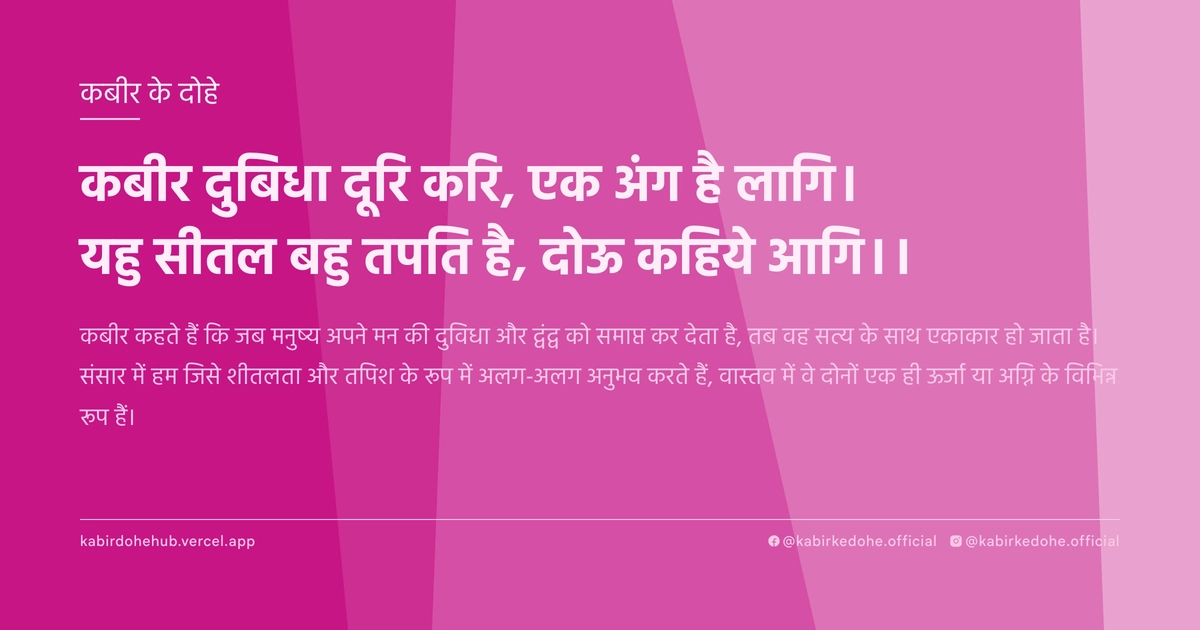
कबीर दुबिधा दूरि करि, एक अंग है लागि।
यहु सीतल बहु तपति है, दोऊ कहिये आगि।।
Kabir dubidha doori kari, ek ang hai laagi. Yahu seetal bahu tapati hai, dou kahiye aagi.
इस पृष्ठ पर इस कबीर दोहे का अर्थ (meaning), हिंदी व्याख्या और अंग्रेज़ी अनुवाद, दार्शनिक विश्लेषण और व्यावहारिक जीवन सीख दी गई है। यह दोहा सहज योग (Sahaja Yoga) विषय से जुड़ा है — Kabir doha meaning and explanation in Hindi and English.
अर्थ (Meaning):
कबीर कहते हैं कि जब मनुष्य अपने मन की दुविधा और द्वंद्व को समाप्त कर देता है, तब वह सत्य के साथ एकाकार हो जाता है। संसार में हम जिसे शीतलता और तपिश के रूप में अलग-अलग अनुभव करते हैं, वास्तव में वे दोनों एक ही ऊर्जा या अग्नि के विभिन्न रूप हैं।
Kabir asserts that once a seeker eradicates the duality and inner conflict of the mind, they merge into a singular essence. He suggests that what we perceive as contrasting forces—such as coolness and intense heat—are actually manifestations of the same primordial fire or energy.
व्याख्या (Interpretation):
शाब्दिक अर्थ में, कबीर तापमान के विरोधाभास की बात कर रहे हैं, लेकिन आध्यात्मिक स्तर पर यह 'द्वैत' (Duality) पर प्रहार है। 'दुबिधा' वह मानसिक भ्रम है जो हमें यह विश्वास दिलाता है कि सुख-दुख, लाभ-हानि या शिव-शक्ति अलग हैं। जब साधक इस भ्रम को मिटाता है, तो वह 'अद्वैत' की स्थिति में पहुँचता है जहाँ विपरीतताएँ समाप्त हो जाती हैं। यहाँ 'आगि' (अग्नि) केवल विनाश का प्रतीक नहीं, बल्कि उस परम चेतना का प्रतीक है जो अशुद्धियों को जलाकर केवल शुद्ध सत्य को शेष रखती है। यह निर्गुण भक्ति का सार है, जहाँ ईश्वर किसी रूप में नहीं, बल्कि एक सर्वव्यापी ऊर्जा के रूप में देखा जाता है। अंततः, यह दोहा बताता है कि विपरीत अनुभव भी एक ही ब्रह्म की अभिव्यक्ति हैं।
Literally, Kabir speaks of the paradox of temperature, but spiritually, this is a profound strike against 'Dvaita' or duality. 'Dubidha' represents the mental fog that convinces us that joy and sorrow, gain and loss, or the creator and creation are separate entities. When the seeker dissolves this illusion, they enter the state of 'Advaita' (non-duality), where opposites cease to exist. Here, 'Aagi' (Fire) is not merely a symbol of destruction, but of the supreme consciousness that incinerates impurities to leave only the absolute truth. This is the essence of Nirgun Bhakti, where the Divine is perceived not as a form, but as an all-pervading energy. Ultimately, the couplet reveals that contrasting experiences are but different ripples on the same ocean of Brahman.
दार्शनिक विश्लेषण (Philosophical Analysis):
कबीर का यह दोहा उनके समय के धार्मिक कट्टरवाद और कर्मकांडीय विभाजन के विरुद्ध एक सशक्त प्रतिक्रिया है। उस युग में हिंदू और मुस्लिम समुदायों के बीच गहरा विभाजन था, जिसे कबीर ने 'दुबिधा' कहा। उन्होंने तर्क दिया कि बाहरी अनुष्ठान केवल अहंकार को बढ़ाते हैं, जबकि वास्तविक सत्य आंतरिक एकता में निहित है।
अद्वैत वेदांत के परिप्रेक्ष्य में, यह दोहा 'माया' के पर्दे को हटाने की बात करता है। माया वह शक्ति है जो एक ही सत्य को अनेक रूपों में दिखाती है। कबीर कहते हैं कि जिसे हम 'शीतल' (शांति) और 'तपति' (पीड़ा) मानते हैं, वे वास्तव में एक ही सिक्के के दो पहलू हैं। जब तक हम इन विरोधाभासों से लड़ते हैं, हम बंधन में रहते हैं; जब हम इन्हें एक ही ऊर्जा के रूप में स्वीकार करते हैं, तब मुक्ति मिलती है।
सूफी मत के 'वहदत-अल-वुजूद' (अस्तित्व की एकता) के साथ इसका गहरा संबंध है। सूफी संत भी मानते हैं कि ईश्वर और सृष्टि अलग नहीं हैं। कबीर की 'अग्नि' उस ईश्वरीय प्रेम (Ishq) की तरह है जो प्रेमी के अस्तित्व को मिटाकर उसे परमात्मा में विलीन कर देती है। यह अहंकार का पूर्ण विलोपन है।
मनोवैज्ञानिक स्तर पर, यह दोहा संज्ञानात्मक सामंजस्य (Cognitive Harmony) की बात करता है। मनुष्य अक्सर अपनी इच्छाओं और वास्तविकता के बीच संघर्ष करता है। यह संघर्ष ही 'दुबिधा' है। जब व्यक्ति यह स्वीकार कर लेता है कि जीवन के उतार-चढ़ाव एक ही दैवीय नाटक का हिस्सा हैं, तो मानसिक तनाव समाप्त हो जाता है।
अंततः, कबीर ritualism (कर्मकांड) को नकारते हुए 'सहज' मार्ग की वकालत करते हैं। वे कहते हैं कि सत्य किसी मंदिर या मस्जिद में नहीं, बल्कि उस बोध में है जहाँ विपरीतताएँ समाप्त हो जाती हैं और केवल एक अखंड चेतना शेष रहती है।
This couplet serves as a potent reaction against the religious bigotry and ritualistic divisions of Kabir's era. During a time of deep fracture between Hindu and Muslim communities, Kabir identified these sectarian walls as 'Dubidha'—the great duality. He argued that external rituals only inflate the ego, while true reality resides in an internal, unifying oneness.
From the lens of Advaita Vedanta, this verse speaks of lifting the veil of 'Maya'. Maya is the cosmic illusion that presents the singular Truth as a multitude of fragmented forms. Kabir suggests that what we categorize as 'coolness' (peace) and 'heat' (suffering) are actually two facets of the same singular energy. As long as we struggle against these opposites, we remain bound; once we recognize them as manifestations of the same fire, liberation ensues.
There is a profound resonance here with the Sufi concept of 'Wahdat-al-Wujud' (The Unity of Existence). Sufi mystics similarly believe that the Creator and the creation are not distinct. Kabir's 'Fire' is akin to the Divine Love (Ishq) that consumes the lover's separate identity, merging them into the Beloved. This is the total annihilation of the 'I'.
Psychologically, the verse addresses cognitive harmony. Human suffering often stems from the friction between desire and reality. This friction is the 'Dubidha'. When an individual accepts that the peaks and valleys of life are part of the same divine play, the internal conflict dissolves into a state of equanimity.
Ultimately, Kabir rejects ritualism in favor of the 'Sahaj' (natural/spontaneous) path. He posits that Truth is not found in temples or mosques, but in the realization where all contradictions vanish, leaving behind only a single, unbroken consciousness.
मूल संदेश (Core Message):
- द्वंद्व ही बंधन है, एकता ही मुक्ति है।
- सुख और दुख एक ही सिक्के के दो पहलू हैं।
- अहंकार की अग्नि ही आत्मा को शुद्ध करती है।
- बाहरी विरोधाभासों से ऊपर उठकर आंतरिक सत्य को पहचानें।
- परमात्मा निर्गुण है, वह हर विपरीत अनुभव में व्याप्त है।
- Conflict is bondage; unity is liberation.
- Joy and sorrow are but two sides of the same coin.
- The fire of ego is what ultimately purifies the soul.
- Rise above external contradictions to recognize the internal Truth.
- The Divine is formless and permeates every opposing experience.
व्यावहारिक उदाहरण (Practical Example):
वाराणसी के एक पुराने घाट पर माधव नाम का एक वृद्ध बुनकर रहता था। माधव अपनी पूरी जिंदगी रेशमी साड़ियाँ बुनने में बिता चुका था, लेकिन उसका मन हमेशा अशांत रहता था। वह अपनी गरीबी के लिए भाग्य को कोसता और अमीरों की विलासिता को देखकर ईर्ष्या करता। उसके लिए जीवन 'शीतलता' (सुख) और 'तपिश' (दुख) के बीच एक अंतहीन युद्ध था।
एक दिन, माधव की मुलाकात एक घुमक्कड़ फकीर से हुई। फकीर ने देखा कि माधव अपनी करघे पर काम करते हुए भी गुस्से में था। फकीर ने उससे पूछा, "तुम इस धागे को खींच रहे हो या यह धागा तुम्हें खींच रहा है?"
माधव हैरान हुआ और बोला, "मैं इसे बुन रहा हूँ, लेकिन यह गरीबी मुझे जला रही है।"
फकीर मुस्कुराया और बोला, "जिस आग में तुम जल रहे हो, वही आग तुम्हें सोने जैसा शुद्ध भी कर सकती है। तुम सुख को शीतल और दुख को तपिश मान रहे हो, जबकि दोनों एक ही जीवन-ऊर्जा हैं। यदि तुम इस द्वंद्व को छोड़कर केवल 'बुनने' की क्रिया में लीन हो जाओ, तो तुम्हें पता चलेगा कि शांति और संघर्ष एक ही हैं।"
माधव को यह बात समझ नहीं आई, लेकिन उसने प्रयोग करने का निर्णय लिया। उसने तय किया कि वह अब परिणामों (गरीबी या अमीरी) के बारे में नहीं सोचेगा, बल्कि केवल अपने काम की पवित्रता पर ध्यान देगा।
धीरे-धीरे, माधव ने महसूस किया कि जब वह अपनी ईर्ष्या और शिकायतें छोड़कर केवल वर्तमान क्षण में जीता है, तो उसकी गरीबी उसे अब 'तपाती' नहीं थी, बल्कि उसे और अधिक धैर्यवान और विनम्र बना रही थी।
एक दिन, एक बड़ा व्यापारी उसकी साड़ी की बारीकी देखकर दंग रह गया और उसे बहुत ऊंचे दाम दिए। लेकिन माधव अब उस धन से विचलित नहीं हुआ। उसने महसूस किया कि वह धन भी और उसकी पुरानी गरीबी भी, दोनों ही उसके जीवन के अनुभव थे, जो उसे एक ही सत्य की ओर ले जा रहे थे।
उसकी 'दुबिधा' समाप्त हो गई थी। अब वह न तो सुख में पागल होता था और न दुख में टूटता था।
उसने पाया कि जिस अग्नि को वह अपना शत्रु समझता था, उसी ने उसके भीतर के अहंकार को जला दिया था।
अब माधव के लिए उसका करघा केवल कपड़ा बनाने की मशीन नहीं, बल्कि परमात्मा से जुड़ने का एक माध्यम बन गया था।
On an ancient ghat in Varanasi lived an elderly weaver named Madhav. Madhav had spent his entire life weaving silk sarees, yet his mind remained a storm of unrest. He cursed his fate for his poverty and felt a searing jealousy toward the luxury of the wealthy. To him, life was an endless war between 'coolness' (comfort) and 'heat' (suffering).
One day, Madhav encountered a wandering fakir. The fakir noticed that even while working at his loom, Madhav's face was etched with anger. The fakir asked, "Are you pulling the thread, or is the thread pulling you?"
Startled, Madhav replied, "I am weaving, but this poverty is burning me alive."
The fakir smiled and said, "The very fire you feel as a torment can also refine you like gold. You perceive happiness as cool and sorrow as heat, but both are manifestations of the same life-energy. If you abandon this duality and merge completely into the act of weaving, you will realize that peace and struggle are one and the same."
Madhav did not fully grasp the words, but he decided to experiment. He resolved to stop obsessing over outcomes—poverty or wealth—and instead focus solely on the sanctity of his craft.
Gradually, Madhav noticed that when he let go of his grievances and lived entirely in the present moment, his poverty no longer 'burned' him. Instead, it made him more patient and humble.
One day, a wealthy merchant was mesmerized by the intricacy of his weave and offered him a vast sum of money. But Madhav was no longer swayed by the wealth. He realized that the money and his previous poverty were both merely experiences leading him toward the same truth.
His 'Dubidha'—his inner conflict—had vanished. He was no longer intoxicated by joy nor shattered by grief.
He discovered that the fire he had once considered his enemy had actually incinerated his ego.
Now, for Madhav, his loom was no longer just a tool for making cloth, but a medium for communion with the Divine.
अभ्यास मार्गदर्शन (Practice Guidance):
- साक्षी भाव का अभ्यास: दिन भर में जब भी आप सुख या दुख महसूस करें, तो रुकें और सोचें—'यह केवल ऊर्जा का एक रूप है।' इसे न तो पकड़ें, न ही इससे भागें।
- द्वंद्व-लेखन (Journaling): एक डायरी में उन दो विपरीत चीजों को लिखें जिनसे आप जूझ रहे हैं (जैसे: करियर बनाम शौक)। फिर विश्लेषण करें कि ये दोनों आपको एक ही लक्ष्य (विकास) की ओर कैसे ले जा रहे हैं।
- मौन चिंतन: प्रतिदिन 20 मिनट के लिए शांत बैठें। अपने भीतर उठने वाले विचारों को 'शीतल' या 'तप्त' श्रेणियों में बांटने के बजाय, उन्हें केवल 'होने' दें।
- डायग्नोस्टिक चेकलिस्ट: क्या मैं अभी भी परिस्थितियों को 'अच्छा' या 'बुरा' कह रहा हूँ? क्या मैं विपरीत परिस्थितियों में विचलित होता हूँ? यदि हाँ, तो इसका अर्थ है कि 'दुबिधा' अभी शेष है।
- Practice of Witness Consciousness: Whenever you feel joy or sorrow during the day, pause and reflect—'This is merely a form of energy.' Neither cling to it nor flee from it.
- Duality Journaling: List two opposing forces you are struggling with (e.g., career vs. passion). Analyze how both are actually driving you toward the same goal of growth.
- Silent Contemplation: Sit in silence for 20 minutes daily. Instead of categorizing arising thoughts as 'cool' or 'hot', simply allow them to exist without judgment.
- Diagnostic Checklist: Am I still labeling situations as 'good' or 'bad'? Do I lose my center during contradictions? If yes, it indicates that 'Dubidha' still persists.
चिंतन प्रश्न (Reflection Questions):
- मेरे जीवन का वह कौन सा 'द्वंद्व' है जिसे मैं सुलझाने की कोशिश कर रहा हूँ, जबकि उसे स्वीकार करना ही समाधान है?
- क्या मेरी 'शांति' केवल इसलिए है क्योंकि अभी जीवन में कोई 'तपिश' नहीं है, या यह वास्तविक स्थिरता है?
- मैं अपनी सार्वजनिक छवि (Ideal Self) और अपनी गुप्त कमियों (Shadow Self) के बीच के संघर्ष को कैसे देख रहा हूँ?
- यदि मेरा सबसे बड़ा डर और मेरी सबसे बड़ी इच्छा एक ही स्रोत से उपजी हैं, तो मैं उनसे कैसे अलग हो सकता हूँ?
- क्या मैं धर्म या विचारधारा के नाम पर दूसरों को 'पराया' मानकर अपनी आंतरिक एकता को खंडित कर रहा हूँ?
- What is the primary 'conflict' in my life that I am trying to solve, when acceptance is actually the only solution?
- Is my 'peace' merely a result of the absence of 'heat' in my life, or is it a genuine, unshakable stability?
- How do I perceive the struggle between my public persona (Ideal Self) and my hidden flaws (Shadow Self)?
- If my greatest fear and my greatest desire spring from the same source, how can I detach myself from them?
- Am I fracturing my own internal unity by labeling others as 'alien' in the name of religion or ideology?