
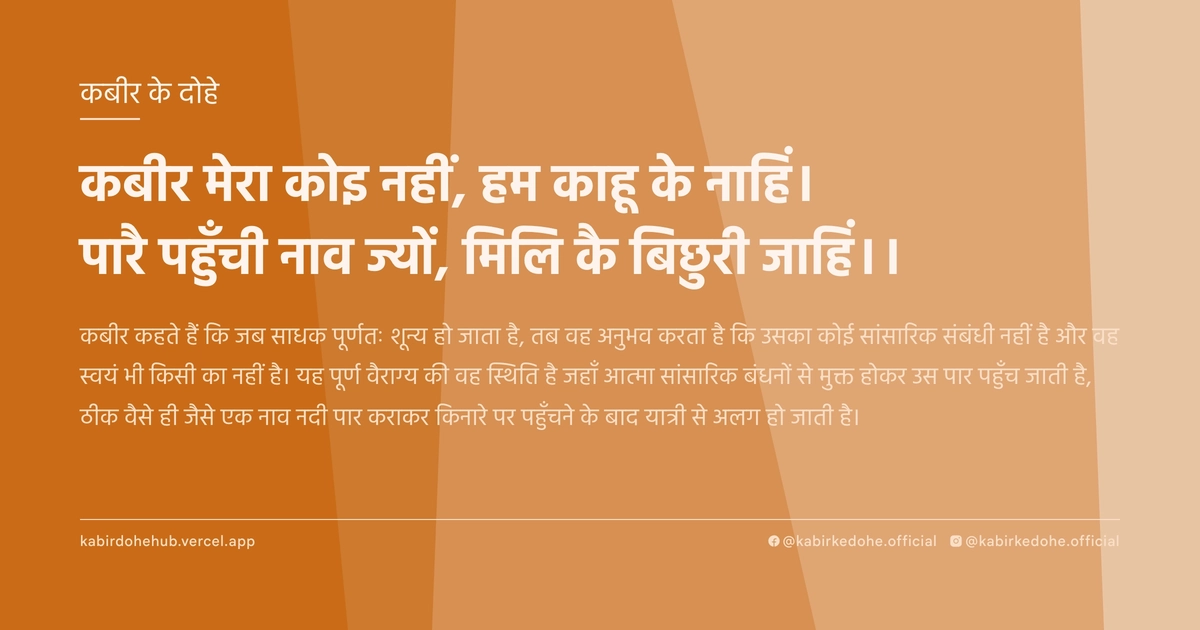
कबीर मेरा कोइ नहीं, हम काहू के नाहिं।
पारै पहुँची नाव ज्यों, मिलि कै बिछुरी जाहिं।।
Kabir mera koi nahi, hum kahu ke nahin. Paarai pahunchi naav jyon, mili kai bichhuri jahin.
इस पृष्ठ पर इस कबीर दोहे का अर्थ (meaning), हिंदी व्याख्या और अंग्रेज़ी अनुवाद, दार्शनिक विश्लेषण और व्यावहारिक जीवन सीख दी गई है। यह दोहा वैराग्य (Detachment) विषय से जुड़ा है — Kabir doha meaning and explanation in Hindi and English.
अर्थ (Meaning):
कबीर कहते हैं कि जब साधक पूर्णतः शून्य हो जाता है, तब वह अनुभव करता है कि उसका कोई सांसारिक संबंधी नहीं है और वह स्वयं भी किसी का नहीं है। यह पूर्ण वैराग्य की वह स्थिति है जहाँ आत्मा सांसारिक बंधनों से मुक्त होकर उस पार पहुँच जाती है, ठीक वैसे ही जैसे एक नाव नदी पार कराकर किनारे पर पहुँचने के बाद यात्री से अलग हो जाती है।
Kabir asserts that when a seeker reaches a state of absolute void, they realize they belong to no one, and no one belongs to them. This is the pinnacle of detachment where the soul, freed from all worldly ties, crosses the ocean of existence. Like a boat that carries a passenger to the distant shore and then departs, the soul transcends all dualistic relationships to merge with the Infinite.
व्याख्या (Interpretation):
इस दोहे का शाब्दिक अर्थ सांसारिक अकेलेपन से लग सकता है, परंतु यह वास्तव में 'अद्वैत' की उच्चतम अवस्था का वर्णन है। 'मेरा कोई नहीं' का अर्थ अलगाव नहीं, बल्कि अहंकार का विसर्जन है। यहाँ 'नाव' गुरु या साधना का प्रतीक है जो जीव को माया के सागर से पार कराती है। जब आत्मा ब्रह्म में विलीन होती है, तो 'मैं' और 'मेरा' का भ्रम समाप्त हो जाता है। यह निर्गुण भक्ति का सार है जहाँ ईश्वर किसी व्यक्ति या रूप में नहीं, बल्कि शून्य और पूर्ण के मिलन में है। यह विरोधाभास है कि पूर्ण अलगाव ही वास्तव में परमात्मा के साथ पूर्ण मिलन है। इस अवस्था में साधक माया के मोह से मुक्त होकर आत्म-साक्षात्कार करता है।
While the literal meaning suggests a state of loneliness, this verse describes the zenith of Advaita (non-duality). 'I have no one' does not signify isolation, but the dissolution of the ego. The 'boat' symbolizes the Guru or the spiritual practice (Sadhana) that carries the seeker across the turbulent ocean of Maya. When the Atman merges with Brahman, the illusion of 'mine' and 'thine' vanishes. This is the essence of Nirgun Bhakti, where the Divine is found not in a form, but in the union of the Void and the Absolute. It presents the central paradox: that absolute detachment from the finite is the only path to absolute union with the Infinite. In this state, the seeker transcends the human condition of longing and possession.
दार्शनिक विश्लेषण (Philosophical Analysis):
कबीर का यह दृष्टिकोण उनके युग के कट्टरपंथी धार्मिक ढांचों और जातिगत भेदभाव के विरुद्ध एक सशक्त प्रहार था। उन्होंने सिखाया कि मोक्ष किसी विशेष कुल, कर्मकांड या मंदिर-मस्जिद में नहीं, बल्कि आंतरिक शून्यता में है। यह दर्शन सूफीवाद के 'फना' (अहंकार का विनाश) और वेदांत के 'अहं ब्रह्मास्मि' के करीब है। कबीर यहाँ यह स्पष्ट करते हैं कि जब तक मनुष्य 'मेरा' और 'तेरा' के मानसिक पिंजरे में कैद है, वह सत्य को नहीं देख सकता।
ritualism (कर्मकांड) का विरोध करते हुए कबीर बताते हैं कि बाहरी दिखावे केवल माया के पर्दे हैं। वास्तविक भक्ति वह है जहाँ साधक अपनी पहचान को पूरी तरह मिटा दे। यह मनोवैज्ञानिक रूपांतरण की प्रक्रिया है जहाँ व्यक्ति अपनी सामाजिक पहचान (नाम, पद, संबंध) को त्याग कर अपनी मूल चेतना को पहचानता है।
अद्वैत वेदांत के अनुसार, जगत एक मिथ्या है और केवल ब्रह्म सत्य है। कबीर इसी सत्य को सरल भाषा में समझाते हैं कि संबंध केवल बंधन हैं। जब नाव (साधना) किनारे (मोक्ष) पर पहुँचती है, तो नाव का उपयोग समाप्त हो जाता है। इसी तरह, जब ज्ञान प्राप्त हो जाता है, तो माध्यम की आवश्यकता नहीं रहती।
सूफी मत में भी 'इश्क-ए-हकीकी' (ईश्वरीय प्रेम) के लिए 'इश्क-ए-मजाजी' (सांसारिक प्रेम) का त्याग आवश्यक है। कबीर का 'कोई नहीं' होना वास्तव में उस परम प्रेम की तैयारी है जहाँ कोई दूसरा बचता ही नहीं।
अतः, यह दोहा केवल वैराग्य का गीत नहीं है, बल्कि चेतना के विकास का एक मानचित्र है। यह हमें सिखाता है कि मुक्ति का मार्ग 'संग्रह' से नहीं, बल्कि 'त्याग' से होकर गुजरता है। अहंकार का विसर्जन ही वह एकमात्र द्वार है जिससे पार जाना संभव है।
Kabir’s perspective serves as a profound critique of the rigid religious structures and caste hierarchies of his era. He posits that liberation is found not in specific lineages, rituals, or shrines, but in the internal experience of emptiness. This philosophy aligns closely with the Sufi concept of 'Fana' (annihilation of the self) and the Vedantic realization of 'Aham Brahmasmi' (I am Brahman).
By rejecting ritualism, Kabir argues that external observances are merely veils of Maya. True devotion requires the complete erasure of the individual ego. This is a psychological transformation where the seeker sheds their social identity—name, status, and kinship—to rediscover their primordial consciousness.
According to Advaita Vedanta, the perceived world is an illusion (Mithya), and only Brahman is the ultimate reality. Kabir simplifies this by explaining that relationships are essentially bonds. Just as a boat is discarded once the shore is reached, the means of spiritual practice (Sadhana) are relinquished once the goal of enlightenment is achieved.
In Sufism, the transition from 'Ishq-e-Majazi' (metaphorical/worldly love) to 'Ishq-e-Haqiqi' (Divine love) is essential. Kabir's state of 'having no one' is the necessary vacuum required to be filled by the Absolute. There is no room for the 'other' in the presence of the One.
Therefore, this couplet is not merely a song of renunciation but a blueprint for the evolution of consciousness. It teaches that the path to liberation is not through accumulation, but through subtraction. The annihilation of the ego is the only gateway through which one can cross the ocean of existence.
मूल संदेश (Core Message):
- अहंकार का अंत ही वास्तविक मिलन की शुरुआत है।
- सांसारिक संबंध नाव की तरह हैं, जो केवल पार कराने के लिए हैं।
- शून्यता ही वह स्थान है जहाँ परमात्मा का वास होता है।
- मोह का त्याग ही आत्मा की वास्तविक स्वतंत्रता है।
- जब 'मैं' मिटता है, तब 'वह' प्रकट होता है।
- The end of ego is the beginning of true union.
- Worldly bonds are like boats, meant only for crossing.
- Emptiness is the only space where the Divine resides.
- Renunciation of attachment is the soul's true liberation.
- When the 'I' vanishes, the 'Absolute' manifests.
व्यावहारिक उदाहरण (Practical Example):
वाराणसी के एक पुराने घाट पर रहने वाली एक वृद्ध विधवा, जानकी, का जीवन अत्यंत एकाकी था। उनके पति और पुत्र वर्षों पहले गुजर चुके थे। समाज उन्हें 'अशुभ' मानकर दूर रखता था, और उनके पास केवल एक छोटा सा कमरा और कुछ फटे हुए वस्त्र थे।
शुरुआत में, जानकी इस अकेलेपन से तड़पती थीं। वह हर रात ईश्वर से प्रार्थना करती थीं कि उन्हें कोई ऐसा मिल जाए जो उन्हें प्यार करे, जो उन्हें अपना कहे। वह अपनी स्मृतियों के बोझ तले दबी रहती थीं और पुराने रिश्तों के दुख में डूबी रहती थीं।
एक दिन उन्होंने कबीर के इस दोहे को सुना। उन्होंने महसूस किया कि उनका दुख इस बात में नहीं था कि उनका कोई नहीं है, बल्कि इस बात में था कि वह अभी भी 'किसी का' होना चाहती थीं।
उन्होंने धीरे-धीरे अपनी पहचान को 'विधवा' या 'बेसहारा' के रूप में देखना बंद कर दिया। उन्होंने महसूस किया कि जिस 'मैं' को वह बचाने की कोशिश कर रही थीं, वह केवल यादों का एक ढेर था।
उन्होंने अपना समय घाट की सफाई और अन्य बेसहारा लोगों की मदद करने में लगाना शुरू किया। अब वह किसी से उम्मीद नहीं करती थीं कि कोई उन्हें अपना कहे।
एक दिन, एक युवा यात्री ने उनसे पूछा, 'माता, आप इतनी अकेली होकर भी इतनी शांत कैसे हैं?' जानकी मुस्कुराईं और कहा, 'बेटा, मैं अकेली नहीं हूँ, मैं बस अब किसी की मोहताज नहीं हूँ।'
वह समझ गई थीं कि जब उन्होंने 'मेरा' और 'तेरा' का मोह छोड़ा, तो पूरा ब्रह्मांड उनका अपना हो गया। उनकी नाव अब किनारे पर पहुँच चुकी थी।
अब वह किसी भी व्यक्ति के आने या जाने से विचलित नहीं होती थीं। उनके भीतर एक ऐसा मौन छा गया था जिसे दुनिया का कोई भी शोर भंग नहीं कर सकता था।
जानकी का जीवन अब एक जीवित उदाहरण था कि कैसे पूर्ण वैराग्य वास्तव में पूर्ण स्वतंत्रता है। उन्होंने अकेलेपन को एकांत (Solitude) में बदल दिया था।
उनकी मृत्यु के समय, उनके चेहरे पर एक ऐसी शांति थी जो केवल उन लोगों के पास होती है जिन्होंने स्वयं को पूरी तरह शून्य कर लिया होता है।
Janaki, an elderly widow living on an ancient ghat in Varanasi, led a life of profound isolation. Her husband and son had passed away years ago. Society shunned her as 'inauspicious,' and her only possessions were a tiny room and a few tattered clothes.
Initially, Janaki suffered deeply from this loneliness. Every night, she prayed to the Divine for someone to love her, someone to call her their own. She remained burdened by memories and drowned in the grief of lost relationships.
One day, she encountered Kabir’s couplet. She realized that her suffering did not stem from the fact that she had no one, but from her desperate desire to 'belong' to someone.
Slowly, she stopped identifying herself as a 'widow' or 'destitute.' She realized that the 'I' she was trying to protect was merely a heap of fading memories.
She began spending her time cleaning the ghats and helping other homeless souls. She no longer expected anyone to claim her or offer her affection.
One day, a young traveler asked her, 'Mother, how are you so peaceful despite being so alone?' Janaki smiled and replied, 'Child, I am not alone; I have simply ceased to be dependent on anyone.'
She understood that once she let go of the attachment to 'mine' and 'thine,' the entire universe became her own. Her boat had finally reached the shore.
She was no longer disturbed by the arrival or departure of people in her life. A silence descended within her that no worldly noise could disrupt.
Janaki's life became a living testament that absolute renunciation is, in fact, absolute freedom. She had transformed loneliness into sacred solitude.
At the moment of her passing, her face bore a serenity known only to those who have successfully reduced themselves to zero.
अभ्यास मार्गदर्शन (Practice Guidance):
- प्रतिदिन 20 मिनट मौन ध्यान करें, जहाँ आप अपनी सभी सामाजिक पहचानों (नाम, रिश्ता, पेशा) को मानसिक रूप से उतार दें और केवल एक 'साक्षी' बनें।
- एक डायरी लिखें जिसमें उन सभी चीजों की सूची बनाएं जिन्हें आप 'मेरा' कहते हैं, और फिर विचार करें कि यदि ये सब कल छिन जाएं, तो आपके भीतर क्या शेष रहेगा।
- व्यवहार परिवर्तन: दिन में कम से कम एक बार किसी ऐसे व्यक्ति की निस्वार्थ मदद करें जिससे आपका कोई संबंध न हो, यह अनुभव करते हुए कि आप और वह एक ही चेतना के अंश हैं।
- निदान चेकलिस्ट: क्या आप किसी के व्यवहार से जल्दी आहत होते हैं? क्या आप अपनी उपलब्धियों का श्रेय स्वयं लेते हैं? यदि हाँ, तो आप अभी भी 'अहंकार' के बंधन में हैं।
- Practice 20 minutes of silent meditation daily, mentally stripping away all social identities (name, relationship, profession) and remaining only as a 'Witness'.
- Maintain a journal listing everything you call 'mine,' then contemplate what would remain of your essence if all these were stripped away tomorrow.
- Behavioral Shift: Perform one act of selfless service daily for a complete stranger, experiencing the realization that you and they are fragments of the same consciousness.
- Diagnostic Checklist: Do you feel easily hurt by others' behavior? Do you take personal credit for your achievements? If yes, you are still bound by the ego's 'mine'.
चिंतन प्रश्न (Reflection Questions):
- यदि आपसे आपकी सारी उपाधियाँ और रिश्ते छीन लिए जाएं, तो आपकी वास्तविक पहचान क्या होगी?
- क्या आपका 'अकेलापन' वास्तव में बाहरी है, या यह आपके भीतर के अहंकार की पुकार है जो ध्यान आकर्षित करना चाहता है?
- आप किन लोगों या वस्तुओं को 'मेरा' कहकर अपनी मानसिक शांति को बंधक बना रहे हैं?
- क्या आप अपनी डिजिटल पहचान (सोशल मीडिया इमेज) को अपना वास्तविक स्वरूप मान बैठे हैं?
- क्या आप वास्तव में स्वतंत्र हैं, या आप केवल अपनी पसंद के बंधनों में खुश हैं?
- If all your titles and relationships were stripped away, what would remain as your true identity?
- Is your 'loneliness' truly external, or is it the cry of an ego seeking validation and attention?
- Which people or possessions are you holding onto as 'mine,' thereby imprisoning your own peace?
- Have you mistaken your digital persona (social media image) for your actual essence?
- Are you truly free, or are you simply comfortable within the bonds you have chosen?