
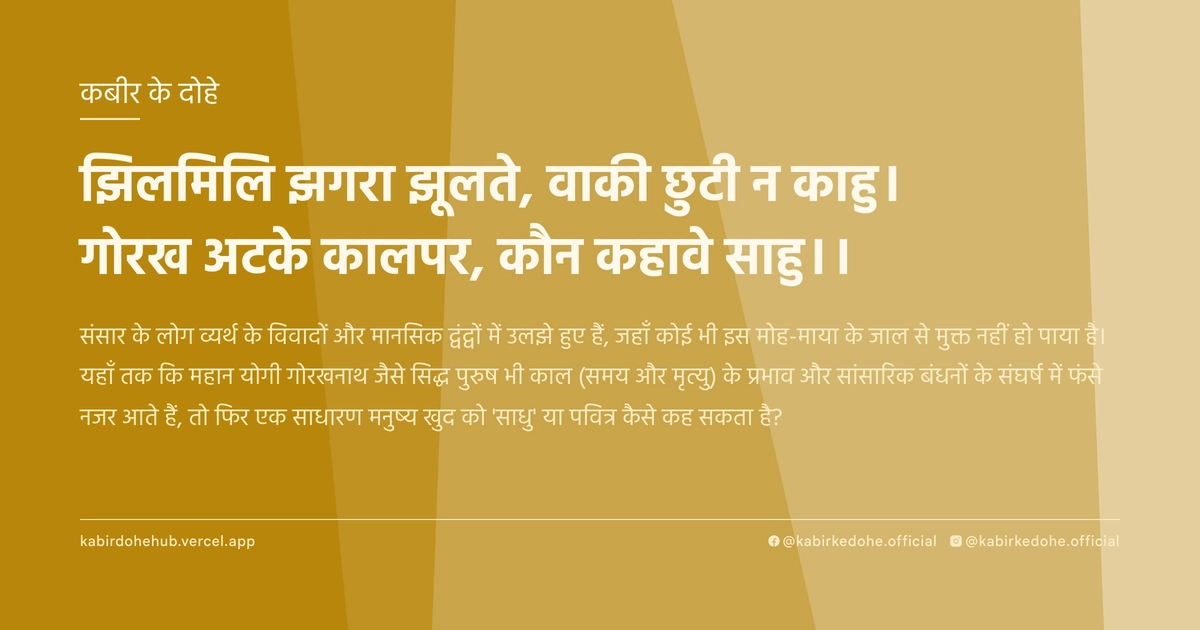
झिलमिलि झगरा झूलते, वाकी छुटी न काहु।
गोरख अटके कालपर, कौन कहावे साहु।।
Jhilmili jhagra jhoolte, vaaki chuti na kaahu. Gorakh atke kaalpar, kaun kahaave saahu.
इस पृष्ठ पर इस कबीर दोहे का अर्थ (meaning), हिंदी व्याख्या और अंग्रेज़ी अनुवाद, दार्शनिक विश्लेषण और व्यावहारिक जीवन सीख दी गई है। यह दोहा मोह (Attachment) विषय से जुड़ा है — Kabir doha meaning and explanation in Hindi and English.
अर्थ (Meaning):
संसार के लोग व्यर्थ के विवादों और मानसिक द्वंद्वों में उलझे हुए हैं, जहाँ कोई भी इस मोह-माया के जाल से मुक्त नहीं हो पाया है। यहाँ तक कि महान योगी गोरखनाथ जैसे सिद्ध पुरुष भी काल (समय और मृत्यु) के प्रभाव और सांसारिक बंधनों के संघर्ष में फंसे नजर आते हैं, तो फिर एक साधारण मनुष्य खुद को 'साधु' या पवित्र कैसे कह सकता है?
The people of this world are suspended in a shimmering web of endless conflicts and mental turmoil, where no one has truly managed to break free from the grip of illusion. Even a great yogi like Gorakhnath appears entangled in the struggle against Time and mortality; if such a powerhouse of spiritual energy is caught in the cosmic play, who among ordinary men can dare to claim the title of a 'Sādhu' or a truly realized soul?
व्याख्या (Interpretation):
यह दोहा मानवीय अहंकार और आध्यात्मिक पाखंड पर एक तीखा प्रहार है। 'झिलमिलि झगरा' उस मायावी चमक को दर्शाता है जो सांसारिक विवादों को आकर्षक बनाती है, जिससे मनुष्य अपनी वास्तविक प्रकृति को भूल जाता है। कबीर यहाँ यह स्पष्ट करते हैं कि जब तक 'अहंकार' जीवित है, तब तक मुक्ति असंभव है। 'गोरख' का संदर्भ यहाँ केवल एक व्यक्ति से नहीं, बल्कि उस कठिन हठयोग और बाहरी साधना से है जो अक्सर साधक को 'मैं' के सूक्ष्म जाल में फंसा देती है। यह निर्गुण भक्ति का सार है कि ईश्वर बाहरी कर्मकांडों या कठिन तपस्या में नहीं, बल्कि पूर्ण समर्पण और अहंकार के विसर्जन में है। जब तक व्यक्ति स्वयं को दूसरों से श्रेष्ठ या 'साधु' मानता है, वह वास्तव में काल के चक्र में फंसा हुआ है, क्योंकि द्वैत (Duality) ही बंधन का मूल कारण है।
This couplet serves as a sharp critique of human ego and spiritual pretension. The phrase 'shimmering conflicts' refers to the deceptive allure of Maya, which masks the void of worldly disputes and keeps the soul tethered to the material plane. Kabir suggests that as long as the 'I-consciousness' persists, liberation remains a distant dream. The mention of 'Gorakh' is not merely a reference to the historical yogi, but a metaphor for the rigorous, external paths of Hatha Yoga and asceticism that can inadvertently trap a seeker in the subtle ego of 'spiritual achievement.' This aligns with Nirgun Bhakti, emphasizing that the Formless Divine is not reached through ritualistic rigor but through the annihilation of the self. The central paradox is that the moment one claims to be a 'Sādhu' (holy person), they reinforce the duality of 'self' versus 'other,' thereby remaining imprisoned by Kaal (Time/Death).
दार्शनिक विश्लेषण (Philosophical Analysis):
कबीर का यह दोहा उस युग की प्रतिक्रिया है जहाँ धर्म केवल बाहरी प्रतीकों, जातिगत श्रेष्ठता और कठिन शारीरिक तपस्या तक सीमित हो गया था। वे यहाँ 'साधु' की पारंपरिक परिभाषा को चुनौती देते हैं। उनके अनुसार, साधु वह नहीं है जिसने गेरुआ वस्त्र पहना है, बल्कि वह है जिसने अपने भीतर के द्वंद्व को समाप्त कर लिया है। यह विचार अद्वैत वेदांत के करीब है, जहाँ आत्मा और ब्रह्म की एकता ही अंतिम सत्य है। जब तक व्यक्ति स्वयं को अलग मानकर 'साधु' होने का दावा करता है, वह अद्वैत के मार्ग से भटक रहा होता है।
सूफीवाद के 'फना' (अहंकार का विनाश) के सिद्धांत की तरह, कबीर यहाँ मानसिक शोर और विवादों के अंत की बात कर रहे हैं। वे तर्क देते हैं कि यदि महानतम योगी भी काल के प्रभाव से पूरी तरह मुक्त नहीं दिखते, तो साधारण मनुष्य का अपनी पवित्रता पर गर्व करना हास्यास्पद है। यह एक मनोवैज्ञानिक विश्लेषण है कि कैसे मनुष्य अपनी आध्यात्मिक उपलब्धियों को एक नया 'अहंकार' बना लेता है, जिसे 'आध्यात्मिक अहंकार' कहा जाता है।
कबीर का प्रहार उन लोगों पर है जो धर्म को एक सामाजिक पहचान या पदवी के रूप में उपयोग करते हैं। उनके लिए, वास्तविक धर्म आंतरिक रूपांतरण है, न कि बाहरी प्रदर्शन। वे ritualism (कर्मकांड) को एक बाधा मानते हैं क्योंकि यह व्यक्ति को बाहरी दुनिया में खोज की ओर ले जाता है, जबकि सत्य भीतर है।
ऐतिहासिक रूप से, कबीर ने नाथ पंथ और बौद्ध धर्म के प्रभावों को आत्मसात किया, लेकिन उन्होंने उन सीमाओं को भी तोड़ा जो केवल शारीरिक नियंत्रण (जैसे कुंभक या मुद्रा) पर जोर देती थीं। वे प्रेम और सहजता (Sahaja) को सर्वोच्च मार्ग मानते थे।
अंततः, यह विश्लेषण हमें यह सिखाता है कि मुक्ति का मार्ग 'पाने' में नहीं, बल्कि 'खोने' में है—अपने अहंकार को खोने में। जब तक 'मैं' मौजूद है, तब तक 'वह' (परमात्मा) नहीं मिल सकता। यह शून्य की अवस्था है जहाँ कोई झगड़ा नहीं, कोई दावा नहीं, और कोई द्वैत नहीं बचता।
Kabir’s couplet is a visceral reaction to an era where spirituality had devolved into external symbols, caste-based superiority, and grueling physical austerities. He challenges the conventional definition of a 'Sādhu.' To Kabir, holiness is not a garment or a title but the total cessation of internal conflict. This mirrors the core of Advaita Vedanta, which posits that the realization of non-duality between Atman and Brahman is the only path to liberation. Any claim to be a 'Sādhu' implies a separation between the self and the divine, which is the very illusion (Maya) that prevents liberation.
Drawing parallels with the Sufi concept of 'Fana' (the annihilation of the self), Kabir addresses the mental noise and disputes that cloud human consciousness. He argues that if even the most formidable yogis, like Gorakhnath, appear entangled in the cosmic struggle against Time (Kaal), then the ordinary man's pride in his own piety is an absurdity. This is a profound psychological observation on 'spiritual ego'—the tendency to transform spiritual progress into a new, more subtle form of pride.
Kabir attacks the use of religion as a social identity or a status symbol. For him, true religion is an internal alchemy, not a public performance. He views ritualism as a barrier because it directs the seeker's gaze outward, whereas the Truth resides within the silence of the heart.
Historically, while Kabir was influenced by the Nath tradition and Buddhism, he transcended their emphasis on mere physical control (such as breath-work or postures). He advocated for 'Sahaja' (the natural way) and divine love as the supreme vehicles for transcendence.
Ultimately, this analysis reveals that the path to liberation is not about 'acquisition' but 'relinquishment'—the shedding of the ego. As long as the 'I' exists, the 'Divine' remains hidden. It is in the state of Shunya (void), where there is no conflict, no claim, and no duality, that the soul truly merges with the Infinite.
मूल संदेश (Core Message):
- बाहरी पवित्रता एक भ्रम है; वास्तविक शुद्धि अहंकार के अंत में है।
- जब तक 'मैं' है, तब तक द्वंद्व है; जब 'मैं' मिटता है, तब सत्य प्रकट होता है।
- साधु वह नहीं जो दावा करे, बल्कि वह है जो स्वयं को शून्य कर ले।
- मानसिक विवाद आत्मा की प्रगति में सबसे बड़ी बाधा हैं।
- परमात्मा तक पहुँचने का मार्ग 'होने' में नहीं, बल्कि 'मिटने' में है।
- External piety is an illusion; true purity lies in the dissolution of the ego.
- Where the 'I' persists, conflict remains; when the 'I' vanishes, Truth emerges.
- A true Sādhu is not one who claims holiness, but one who becomes a void.
- Mental disputes and intellectual pride are the greatest hurdles to spiritual evolution.
- The path to the Divine is not through 'becoming' something, but through 'unbecoming' the self.
व्यावहारिक उदाहरण (Practical Example):
एक समय की बात है, बनारस के घाटों पर एक वृद्ध विधवा, जानकी रहती थी। वह दिन भर गंगा आरती में शामिल होती और शहर के सबसे बड़े पंडितों के साथ धार्मिक चर्चा करती। जानकी को इस बात का बहुत गर्व था कि वह शहर की सबसे 'शुद्ध' और 'सात्विक' महिला है। वह अक्सर अन्य महिलाओं को उनके गलत रीति-रिवाजों के लिए टोकती और उन्हें उपदेश देती कि कैसे एक आदर्श साध्वी का जीवन जीना चाहिए।
उसी घाट के पास एक साधारण नाविक रहता था, जिसका नाम माधव था। माधव अनपढ़ था, लेकिन वह अपनी नाव चलाने के साथ-साथ चुपचाप लोगों की मदद करता था। वह कभी किसी को उपदेश नहीं देता था, बस मुस्कुराकर अपना काम करता था। जानकी अक्सर माधव को 'अज्ञानी' समझकर उसकी उपेक्षा करती थी।
एक दिन, शहर में एक बहुत बड़ा धार्मिक विवाद छिड़ गया। दो बड़े संप्रदायों के बीच इस बात पर झगड़ा था कि मोक्ष का सही मार्ग कौन सा है। जानकी इस विवाद के केंद्र में थी, वह अपनी विद्वत्ता और शुद्धता का प्रमाण देने के लिए घंटों तर्क-वितर्क करती रही। वह इतनी उलझ गई कि उसका मानसिक सुकून पूरी तरह खत्म हो गया। वह रात-रात भर जागकर यह सोचती कि वह दूसरों को कैसे गलत साबित करे।
तभी एक शाम, जानकी ने देखा कि माधव एक बीमार वृद्ध व्यक्ति को अपनी नाव में मुफ्त में ले जा रहा था, जबकि वह खुद बहुत थका हुआ था। जब जानकी ने उससे पूछा कि वह बिना किसी लाभ के यह क्यों कर रहा है, तो माधव ने बस इतना कहा, 'माँ, जब मैं नाव चलाता हूँ, तो मैं भूल जाता हूँ कि मैं कौन हूँ और वह कौन है। बस एक लहर होती है।'
यह सरल वाक्य जानकी के भीतर बिजली की तरह कौंधा। उसे अहसास हुआ कि वह जिसे 'साधुता' समझ रही थी, वह वास्तव में उसका अहंकार था जो दूसरों को छोटा दिखाकर खुद को बड़ा महसूस करना चाहता था। वह 'झिलमिलि झगरा' (दिखावटी विवादों) में फंसी थी, जबकि माधव बिना किसी दावे के उस शांति में जी रहा था।
जानकी का हृदय परिवर्तन हुआ। उसने उपदेश देना छोड़ दिया और चुपचाप सेवा करना शुरू किया। उसने महसूस किया कि जब तक वह खुद को 'शुद्ध' मानती रही, वह वास्तव में बंधन में थी। जिस दिन उसने अपनी 'साधु' होने की पहचान छोड़ी, उसे पहली बार वास्तविक शांति का अनुभव हुआ।
उसने सीखा कि सच्ची आध्यात्मिकता दूसरों को सुधारने में नहीं, बल्कि स्वयं के अहंकार को मिटाने में है। अब वह घाट पर केवल आरती नहीं करती थी, बल्कि चुपचाप उन लोगों की मदद करती जिन्हें समाज अनदेखा कर देता था।
उसका जीवन अब एक प्रदर्शन नहीं, बल्कि एक प्रार्थना बन गया था। वह अब किसी से श्रेष्ठ नहीं थी, और इसी 'अश्रेष्ठता' में उसे वह आनंद मिला जो उसे वर्षों के शास्त्रों के अध्ययन से नहीं मिला था।
In the ancient lanes of Varanasi, there lived an elderly widow named Janaki. She spent her days attending the grand Ganga Aarti and engaging in theological debates with the city's most renowned priests. Janaki took immense pride in being the 'purest' and most 'Sattvic' woman in the neighborhood. She frequently corrected other women on their rituals, lecturing them on how a true devotee should conduct herself.
Nearby lived a simple boatman named Madhav. Madhav was illiterate, but he possessed a quiet kindness, helping strangers cross the river without expecting anything in return. He never preached; he simply smiled and performed his duties. Janaki often dismissed Madhav as 'ignorant,' viewing his simplicity as a lack of spiritual depth.
One day, a fierce religious conflict erupted in the city. Two major sects were locked in a bitter dispute over which path to salvation was superior. Janaki found herself at the heart of this turmoil, spending hours arguing and using her knowledge to prove her sect's superiority. She became so consumed by the need to be 'right' that her inner peace vanished. She spent sleepless nights strategizing how to dismantle the arguments of others.
One evening, Janaki observed Madhav carrying a frail, sick elderly man across the river for free, despite being exhausted from a long day's work. When Janaki asked him why he did this without any reward, Madhav simply replied, 'Mother, when I row the boat, I forget who I am and who he is. There is only the flow of the river.'
This simple sentence struck Janaki like a bolt of lightning. She realized that what she had termed 'holiness' was actually a sophisticated ego, seeking validation by making others feel inferior. She had been caught in the 'shimmering conflict' of intellectual pride, while Madhav lived in the silence of selfless action, without any claim to status.
Janaki underwent a profound transformation. She stopped lecturing and began serving in silence. She realized that as long as she identified as 'pure' or 'holy,' she was merely reinforcing her own bondage. The moment she relinquished the identity of being a 'Sādhu,' she experienced a peace that had eluded her for decades.
She learned that true spirituality is not about correcting the world, but about erasing the 'I' that feels the need to correct. She stopped trying to be the most pious woman on the ghats and started being a humble servant to those the society ignored.
Her life ceased to be a performance and became a prayer. By accepting her 'unimportance,' she found a joy that no amount of scriptural study could ever provide.
अभ्यास मार्गदर्शन (Practice Guidance):
- दैनिक आत्म-अवलोकन: दिन के अंत में यह लिखें कि आज आपने कितनी बार खुद को दूसरों से श्रेष्ठ या 'सही' महसूस किया।
- मौन साधना: प्रतिदिन 30 मिनट पूर्ण मौन रहें, जहाँ आप न केवल शब्दों से, बल्कि मानसिक तर्कों और विवादों से भी दूर रहें।
- अहंकार विसर्जन अभ्यास: किसी ऐसे व्यक्ति की निस्वार्थ सेवा करें जिसे आप सामान्यतः 'निम्न' या 'अयोग्य' समझते हैं, बिना उन्हें यह बताए कि आप उनकी मदद कर रहे हैं।
- डायग्नोस्टिक चेकलिस्ट: क्या आप अभी भी अपनी आध्यात्मिक उपलब्धियों पर गर्व करते हैं? क्या आप दूसरों की गलतियों पर तुरंत प्रतिक्रिया देते हैं? यदि हाँ, तो आप अभी भी 'झिलमिलि झगरा' में हैं।
- Daily Self-Observation: At the end of each day, journal every instance where you felt superior to others or felt a compulsive need to be 'right.'
- Silence Practice: Spend 30 minutes in absolute silence daily, abstaining not only from speech but from internal mental arguments and debates.
- Ego-Dissolution Exercise: Perform a selfless act of service for someone you subconsciously perceive as 'inferior' or 'unworthy,' ensuring the act remains completely anonymous.
- Diagnostic Checklist: Do you still take pride in your spiritual achievements? Do you react instantly to others' flaws? If yes, you are still entangled in the 'shimmering conflict' of the ego.
चिंतन प्रश्न (Reflection Questions):
- मेरी वह कौन सी 'आध्यात्मिक पहचान' है जिसे मैं खोने से डरता हूँ?
- क्या मेरी करुणा वास्तव में निस्वार्थ है, या यह मेरे भीतर के 'मसीहा' को संतुष्ट कर रही है?
- जब मैं दूसरों को उपदेश देता हूँ, तो क्या मैं उन्हें सुधारना चाहता हूँ या अपनी श्रेष्ठता सिद्ध करना चाहता हूँ?
- मेरे जीवन का वह कौन सा 'झिलमिलि झगरा' है जो मुझे शांति से दूर रखता है?
- यदि मेरी सारी उपाधियाँ और धार्मिक पहचान छीन ली जाएँ, तो मेरे भीतर क्या बचेगा?
- क्या मैं वास्तव में सत्य की खोज कर रहा हूँ, या केवल सत्य के बारे में बात करने का आनंद ले रहा हूँ?
- What is the specific 'spiritual identity' I am most afraid of losing?
- Is my compassion truly selfless, or is it merely feeding a hidden 'messiah complex' within me?
- When I offer advice to others, am I seeking their growth or confirming my own superiority?
- What is the 'shimmering conflict' in my life that keeps me tethered to restlessness?
- If all my titles and religious identities were stripped away, what would actually remain of me?
- Am I genuinely seeking the Truth, or am I simply enamored with the act of talking about the Truth?