
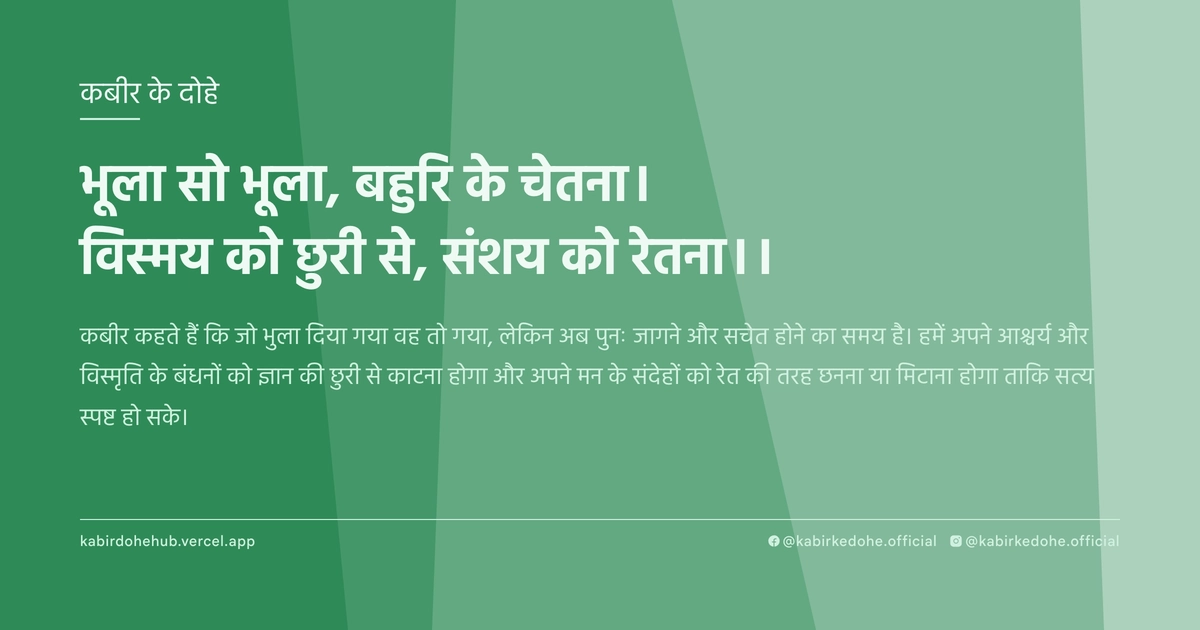
भूला सो भूला, बहुरि के चेतना।
विस्मय को छुरी से, संशय को रेतना।।
Bhoola so bhoola, bahuri ke chetna. Vismay ko churi se, sanshay ko retna.
इस पृष्ठ पर इस कबीर दोहे का अर्थ (meaning), हिंदी व्याख्या और अंग्रेज़ी अनुवाद, दार्शनिक विश्लेषण और व्यावहारिक जीवन सीख दी गई है। यह दोहा जागृति (The Wake-up Call) विषय से जुड़ा है — Kabir doha meaning and explanation in Hindi and English.
अर्थ (Meaning):
कबीर कहते हैं कि जो भुला दिया गया वह तो गया, लेकिन अब पुनः जागने और सचेत होने का समय है। हमें अपने आश्चर्य और विस्मृति के बंधनों को ज्ञान की छुरी से काटना होगा और अपने मन के संदेहों को रेत की तरह छनना या मिटाना होगा ताकि सत्य स्पष्ट हो सके।
Kabir suggests that what is forgotten is gone, but now is the time to awaken and regain consciousness. We must sever the bonds of bewilderment and oblivion with the knife of wisdom and sift through or erase our doubts like sand, allowing the pure truth to emerge clearly.
व्याख्या (Interpretation):
इस दोहे का शाब्दिक अर्थ है कि अतीत की अज्ञानता को पीछे छोड़कर वर्तमान में जागना। रूपक के तौर पर, 'विस्मय' यहाँ उस आध्यात्मिक विस्मृति (Maya) को दर्शाता है जहाँ आत्मा स्वयं को शरीर मान बैठती है। 'छुरी' विवेक और प्रज्ञा का प्रतीक है जो मोह के धागों को काटती है। 'संशय' वह मानसिक शोर है जो साधक को सत्य से दूर रखता है। यह निरगुण भक्ति का मार्ग है जहाँ बाहरी कर्मकांडों के बजाय आंतरिक शुद्धि पर बल दिया गया है। अद्वैत वेदांत के अनुसार, जब संशय का पर्दा हटता है, तब आत्मा और ब्रह्म की एकता का अनुभव होता है। यह विरोधाभास है कि हम जिसे खोज रहे हैं, वह हमारे भीतर ही है, बस विस्मृति की धूल जमी है।
Literally, this couplet urges the seeker to leave past ignorance behind and awaken in the present. Metaphorically, 'Vismay' represents the spiritual oblivion or Maya, where the soul mistakenly identifies itself with the physical body. The 'knife' symbolizes Viveka (discernment) and Prajna (wisdom) that severs the threads of attachment. 'Sanshay' is the mental noise and doubt that distances the seeker from the Truth. This aligns with Nirgun Bhakti, emphasizing internal purification over external rituals. According to Advaita Vedanta, once the veil of doubt is lifted, the non-duality of Atman and Brahman is realized. The central paradox is that the Truth we seek is already within us, merely obscured by the dust of forgetfulness.
दार्शनिक विश्लेषण (Philosophical Analysis):
कबीर का यह काल मध्यकालीन भारत का था, जहाँ धर्म कर्मकांडों, जातिगत भेदभाव और बाहरी आडंबरों में जकड़ा हुआ था। कबीर ने इस व्यवस्था को चुनौती देते हुए 'सहज' मार्ग की बात की। उनका दर्शन सूफीवाद के 'फना' (अहंकार का विनाश) और वेदांत के 'अद्वैत' का एक अनूठा संगम है। वे कहते हैं कि ईश्वर मंदिर या मस्जिद में नहीं, बल्कि चेतना के जागरण में है।
यहाँ 'विस्मय' का अर्थ केवल आश्चर्य नहीं, बल्कि वह मानसिक अवस्था है जिसमें मनुष्य संसार की नश्वरता को भूलकर उसे स्थायी मान लेता है। यह मनोवैज्ञानिक भ्रम है जिसे कबीर 'माया' कहते हैं। जब तक मनुष्य इस भ्रम में है, वह सत्य को नहीं देख सकता।
संदेह (संशय) को 'रेतना' यानी छानने की प्रक्रिया का उल्लेख करना यह दर्शाता है कि सत्य को पाने के लिए विश्लेषण और आत्म-निरीक्षण आवश्यक है। यह केवल विश्वास का मामला नहीं है, बल्कि अनुभवजन्य सत्य की खोज है।
कबीर का दृष्टिकोण कट्टरपंथी नहीं, बल्कि क्रांतिकारी है। वे व्यक्ति को उसकी सामाजिक पहचान (जाति, धर्म) से ऊपर उठाकर एक सार्वभौमिक चेतना की ओर ले जाते हैं। उनके लिए मोक्ष का अर्थ मृत्यु के बाद स्वर्ग पाना नहीं, बल्कि जीवित रहते हुए अज्ञानता से मुक्ति पाना है।
अंततः, यह दोहा अहंकार के विसर्जन की बात करता है। जब 'मैं' और 'मेरा' का संशय समाप्त होता है, तब केवल वह 'एक' बचता है जो सर्वव्यापी है। यह मनोवैज्ञानिक रूपांतरण ही वास्तविक आध्यात्मिक प्रगति है।
Kabir lived in medieval India, a time when religion was stifled by rigid rituals, caste discrimination, and external ostentation. Challenging this system, Kabir advocated for the 'Sahaj' (natural/spontaneous) path. His philosophy is a unique synthesis of the Sufi concept of 'Fana' (annihilation of the ego) and the Vedantic principle of 'Advaita' (non-duality).
In this context, 'Vismay' does not merely mean surprise, but the state of spiritual oblivion where a human forgets the transience of the world and perceives it as permanent. This is the psychological illusion Kabir identifies as 'Maya'. As long as one remains in this trance, the Truth remains invisible.
The mention of 'sifting' (retna) the doubts (sanshay) indicates that the path to truth requires rigorous analysis and self-introspection. It is not a matter of blind faith but an empirical quest for experiential truth.
Kabir's approach is not dogmatic but revolutionary. He elevates the individual above social identities—caste or creed—toward a universal consciousness. For him, liberation (Moksha) is not attaining heaven after death, but achieving freedom from ignorance while alive.
Ultimately, this doha speaks of the dissolution of the ego. When the doubts of 'I' and 'Mine' are sifted away, only the 'One' remains, which is omnipresent. This psychological transformation is the essence of true spiritual progress.
मूल संदेश (Core Message):
- अतीत की भूलों को पकड़कर रखना केवल दुख का कारण है।
- जागरूकता ही वह एकमात्र उपकरण है जो भ्रम को नष्ट कर सकता है।
- संदेह सत्य के मार्ग में सबसे बड़ी बाधा है, इसे विवेक से छानें।
- आंतरिक शांति बाहरी परिस्थितियों पर नहीं, आंतरिक स्पष्टता पर निर्भर है।
- जब अहंकार का पर्दा हटता है, तब आत्मा का परमात्मा से मिलन होता है।
- Clinging to past errors only perpetuates suffering.
- Awareness is the only tool capable of destroying illusion.
- Doubt is the greatest obstacle to Truth; sift it with discernment.
- Inner peace depends on internal clarity, not external circumstances.
- When the veil of ego is lifted, the soul merges with the Divine.
व्यावहारिक उदाहरण (Practical Example):
वाराणसी के एक पुराने घाट पर रहने वाले माधव नाम के एक वृद्ध बुनकर थे। माधव अपनी कला में निपुण थे, लेकिन उनके मन में एक गहरा संशय था कि क्या उनके जैसा साधारण व्यक्ति कभी ईश्वर को पा सकता है। वे घंटों मंदिर की सीढ़ियों पर बैठकर पंडितों को सुनते, लेकिन उनके भीतर का द्वंद्व शांत नहीं होता था।
माधव को लगता था कि आध्यात्मिक ज्ञान केवल शास्त्रों के ज्ञाताओं के लिए है। वे अपनी गरीबी और अनपढ़ होने के कारण खुद को अयोग्य मानते थे। यह 'विस्मय' था—एक ऐसा भ्रम जिसने उन्हें अपनी आंतरिक दिव्यता से दूर रखा था।
एक दिन उन्होंने एक फकीर को देखा जो केवल मौन रहकर मुस्कुरा रहा था। माधव ने उनसे पूछा, 'बाबा, मैं सत्य को कैसे पहचानूँ? मेरे संशय मुझे सोने नहीं देते।' फकीर ने उन्हें एक पुराने कपड़े का टुकड़ा दिया जिसमें रेत और कीमती मोती मिले हुए थे।
फकीर ने कहा, 'माधव, जैसे तुम कपड़े को हिलाकर रेत अलग करते हो और मोती बचाते हो, वैसे ही अपने विचारों को छानो। जो विचार तुम्हें छोटा महसूस कराते हैं, वे रेत हैं; जो तुम्हें प्रेम और करुणा से जोड़ते हैं, वे मोती हैं।'
माधव ने इस बात पर गहराई से विचार किया। उन्होंने महसूस किया कि उनकी 'अयोग्यता' का विचार केवल एक मानसिक रेत थी। उन्होंने अपनी बुनाई को ही अपनी प्रार्थना बना लिया।
अब वे केवल कपड़ा नहीं बुनते थे, बल्कि हर धागे में उस निराकार ईश्वर का ध्यान करते थे। उनके मन का संशय धीरे-धीरे मिटने लगा।
उन्होंने पाया कि जिस ईश्वर को वे शास्त्रों में खोज रहे थे, वह उनके अपने हाथों की कुशलता और हृदय की सरलता में मौजूद था।
एक दिन जब एक अहंकारी विद्वान उनके पास आया और उन्हें नीचा दिखाने की कोशिश की, तो माधव विचलित नहीं हुए। उन्होंने केवल मुस्कुराकर कहा, 'मैंने रेत छान ली है, अब केवल मोती बचे हैं।'
विद्वान चकित रह गया। माधव की शांति और स्पष्टता ने उसे यह अहसास कराया कि वास्तविक ज्ञान किताबों में नहीं, बल्कि अहंकार के विसर्जन में है।
माधव का जीवन अब एक जीवित ध्यान बन गया था। उन्होंने साबित किया कि जागृति के लिए किसी विशेष कुल या शिक्षा की आवश्यकता नहीं, केवल विवेक की छुरी और संशय को छानने के साहस की जरूरत है।
In the ancient ghats of Varanasi lived an elderly weaver named Madhav. Madhav was a master of his craft, yet he carried a deep-seated doubt: could a simple man like him ever attain the Divine? He spent hours on the temple steps listening to scholars, but the conflict within him remained unresolved.
Madhav believed that spiritual knowledge was reserved for those versed in scriptures. Due to his poverty and lack of formal education, he felt unworthy. This was his 'Vismay'—an illusion that kept him distanced from his own inner divinity.
One day, he encountered a wandering dervish who sat in profound silence with a gentle smile. Madhav asked, 'Baba, how do I recognize the Truth? My doubts keep me awake at night.' The dervish handed him a piece of old cloth containing a mixture of sand and precious pearls.
The dervish said, 'Madhav, just as you shake the cloth to separate the sand and keep the pearls, sift through your thoughts. The thoughts that make you feel small are sand; those that connect you to love and compassion are pearls.'
Madhav contemplated this deeply. He realized that his feeling of 'unworthiness' was merely mental sand. He decided to turn his weaving into his prayer.
He no longer just wove fabric; in every thread, he meditated on the Formless Divine. Slowly, the doubts in his mind began to dissipate.
He discovered that the God he sought in scriptures was present in the skill of his own hands and the simplicity of his heart.
One day, an arrogant scholar approached him and tried to belittle him. Madhav remained undisturbed. He simply smiled and said, 'I have sifted the sand; now only the pearls remain.'
The scholar was stunned. Madhav's peace and clarity made him realize that true knowledge is not found in books, but in the dissolution of the ego.
Madhav's life became a living meditation. He proved that awakening requires no specific lineage or degree, only the knife of discernment and the courage to sift through doubt.
अभ्यास मार्गदर्शन (Practice Guidance):
- दैनिक मौन अभ्यास: प्रतिदिन 20 मिनट पूर्ण मौन में बैठें। जब भी कोई विचार या संशय आए, उसे एक 'रेत के कण' की तरह देखें और उसे बिना किसी निर्णय के बह जाने दें।
- विवेकपूर्ण विश्लेषण (Journaling): एक डायरी में उन विश्वासों को लिखें जो आपको सीमित करते हैं। पूछें, 'क्या यह सत्य है या केवल एक धारणा?' इसे 'विवेक की छुरी' से काटें।
- चेतना का जागरण: दिन में तीन बार अलार्म लगाएं। जब अलार्म बजे, तो रुकें और स्वयं से पूछें, 'क्या मैं अभी इस क्षण में जागृत हूँ या मैं अपनी पुरानी आदतों के विस्मय में खोया हूँ?'
- निदान चेकलिस्ट (Diagnostic Checklist): 1. क्या मैं छोटी बातों पर विचलित होता हूँ? (संशय की उपस्थिति) 2. क्या मैं अपनी पहचान बाहरी उपलब्धियों से जोड़ता हूँ? (विस्मय/माया) 3. क्या मैं दूसरों के प्रति करुणा महसूस करता हूँ बिना किसी अपेक्षा के? (जागृति का संकेत)।
- Daily Silence Practice: Sit in complete silence for 20 minutes daily. Whenever a thought or doubt arises, view it as a 'grain of sand' and let it flow away without judgment.
- Discernment Journaling: List the beliefs that limit you in a diary. Ask, 'Is this an absolute truth or merely a conditioned perception?' Use the 'knife of wisdom' to sever these attachments.
- Consciousness Alerts: Set three alarms during the day. When they ring, stop and ask yourself, 'Am I awake in this moment, or am I lost in the oblivion of my old habits?'
- Diagnostic Checklist: 1. Do I get easily agitated by trivialities? (Presence of doubt) 2. Do I tie my identity to external achievements? (Presence of Vismay/Maya) 3. Do I feel compassion for others without expectation? (Sign of awakening).
चिंतन प्रश्न (Reflection Questions):
- मेरे जीवन का वह कौन सा 'संशय' है जिसे मैं सत्य मानकर जी रहा हूँ?
- मैं अपनी सार्वजनिक छवि (Digital/Social Ego) को बनाए रखने के लिए अपनी आत्मा की कितनी सच्चाई की बलि देता हूँ?
- यदि मेरी सारी उपलब्धियाँ और पद छीन लिए जाएँ, तो मेरे भीतर क्या शेष बचेगा?
- क्या मेरा आध्यात्मिक झुकाव वास्तव में सत्य की खोज है, या केवल मानसिक शांति की एक इच्छा?
- मैं किन पूर्वाग्रहों (Biases) को 'विवेक' का नाम देकर सही ठहरा रहा हूँ?
- What is the specific 'doubt' in my life that I have mistaken for an absolute truth?
- How much of my inner truth do I sacrifice to maintain my public image (Digital/Social Ego)?
- If all my achievements and titles were stripped away, what would remain within me?
- Is my spiritual inclination a genuine quest for Truth, or merely a desire for psychological comfort?
- Which biases am I justifying by labeling them as 'discernment'?