
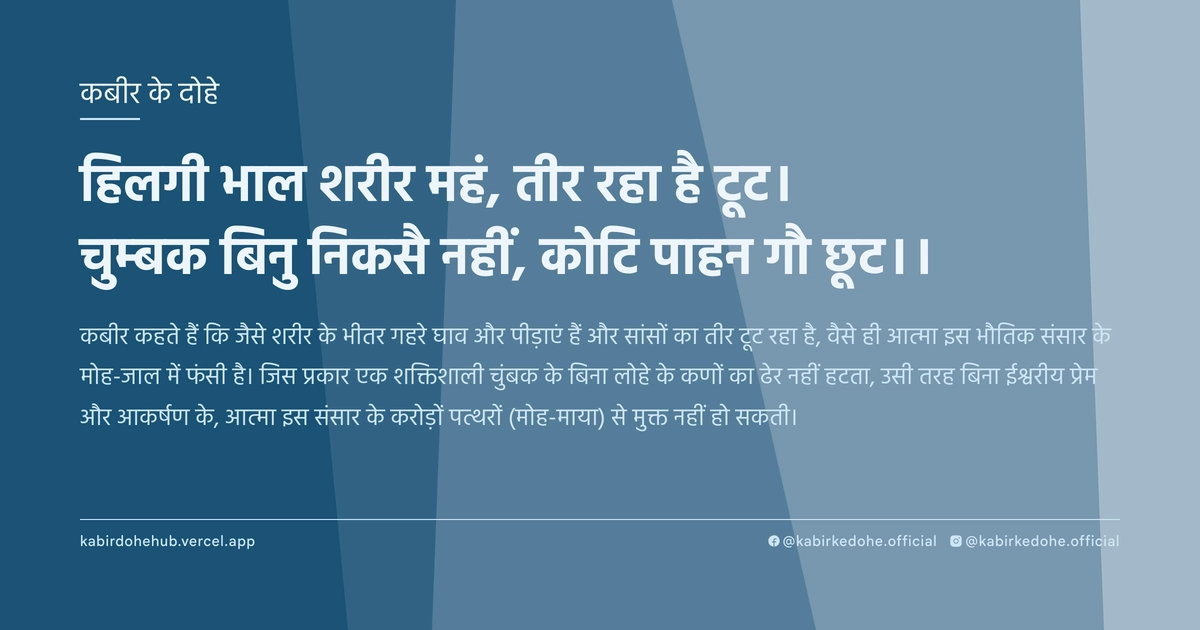
हिलगी भाल शरीर महं, तीर रहा है टूट।
चुम्बक बिनु निकसै नहीं, कोटि पाहन गौ छूट।।
Hilgi bhaal shareer mahn, teer raha hai toot. Chumbak binu niksai nahin, koti pahan gau choot.
इस पृष्ठ पर इस कबीर दोहे का अर्थ (meaning), हिंदी व्याख्या और अंग्रेज़ी अनुवाद, दार्शनिक विश्लेषण और व्यावहारिक जीवन सीख दी गई है। यह दोहा आत्मा और शरीर (Soul and Body) विषय से जुड़ा है — Kabir doha meaning and explanation in Hindi and English.
अर्थ (Meaning):
कबीर कहते हैं कि जैसे शरीर के भीतर गहरे घाव और पीड़ाएं हैं और सांसों का तीर टूट रहा है, वैसे ही आत्मा इस भौतिक संसार के मोह-जाल में फंसी है। जिस प्रकार एक शक्तिशाली चुंबक के बिना लोहे के कणों का ढेर नहीं हटता, उसी तरह बिना ईश्वरीय प्रेम और आकर्षण के, आत्मा इस संसार के करोड़ों पत्थरों (मोह-माया) से मुक्त नहीं हो सकती।
Kabir suggests that the physical body is riddled with wounds and the arrow of life is breaking. The soul is trapped within the dense materiality of existence. Just as a powerful magnet is required to extract iron filings from a mountain of stone, the soul cannot liberate itself from the millions of attachments of this world without the magnetic pull of Divine Love and spiritual longing.
व्याख्या (Interpretation):
इस दोहे का शाब्दिक अर्थ शरीर की नश्वरता और सांसों के अंत की ओर संकेत करता है। रूपकात्मक स्तर पर, 'तीर' जीवन की ऊर्जा और समय का प्रतीक है जो निरंतर क्षय हो रहा है। 'कोटि पाहन' (करोड़ों पत्थर) संसार की उन जड़ताओं और भौतिक इच्छाओं को दर्शाते हैं जिन्होंने आत्मा को जकड़ रखा है। यहाँ 'चुंबक' निर्गुण भक्ति और परमात्मा के प्रति तीव्र विरह-वेदना का प्रतीक है। यह अद्वैत वेदांत के उस सिद्धांत को पुष्ट करता है जहाँ माया को एक भारी बोझ माना गया है, जिसे केवल आत्म-ज्ञान और ईश्वर के प्रति अनन्य आकर्षण से ही हटाया जा सकता है। यह मानव स्थिति के उस विरोधाभास को उजागर करता है जहाँ हम मुक्ति चाहते हैं, परंतु हमारी इच्छाएं ही हमें बांधे रखती हैं।
Literally, the verse speaks of the fragility of the body and the inevitable breaking of the life-breath. Metaphorically, the 'arrow' represents the finite span of human existence and the vital energy that is steadily depleting. The 'millions of stones' symbolize the dense, inert attachments and worldly delusions (Maya) that weigh down the spirit. The 'magnet' serves as a profound metaphor for Nirgun Bhakti—the intense, magnetic longing for the Formless Divine. This aligns with Advaita Vedanta, where the world is seen as a superimposition that can only be dissolved through the realization of the Atman's unity with Brahman. It highlights the central paradox: the soul yearns for liberation while remaining clung to the very illusions that imprison it.
दार्शनिक विश्लेषण (Philosophical Analysis):
कबीर का यह दोहा उनके युग के उस सामाजिक और धार्मिक परिवेश की प्रतिक्रिया है जहाँ कर्मकांड और बाहरी आडंबरों को मोक्ष का साधन माना जाता था। कबीर ने स्पष्ट किया कि न तो तीर्थयात्रा और न ही कठोर व्रत आत्मा को मुक्त कर सकते हैं। उनका दृष्टिकोण सूफी मत के 'इश्क-ए-हकीकी' (दिव्य प्रेम) से मेल खाता है, जहाँ प्रेमी (आत्मा) और प्रिय (परमात्मा) का मिलन ही एकमात्र लक्ष्य है।
दार्शनिक रूप से, यह दोहा 'अहंकार' के विलीनीकरण की बात करता है। जब तक मनुष्य स्वयं को शरीर मानता है, वह 'पत्थरों' के बोझ तले दबा रहता है। जैसे ही वह अपनी पहचान को शरीर से हटाकर शुद्ध चेतना (Suddha Chaitanya) पर केंद्रित करता है, वह चुंबक की तरह आकर्षित होकर ऊपर उठ जाता है। यह प्रक्रिया मनोवैज्ञानिक रूपांतरण की है, जहाँ भय और मोह का स्थान पूर्ण समर्पण ले लेता है।
कबीर यहाँ जाति और धर्म के भेदों को निरर्थक बताते हैं क्योंकि आत्मा का बंधन किसी सामाजिक व्यवस्था से नहीं, बल्कि अज्ञान (Avidya) से है। वे सिखाते हैं कि मुक्ति बाहरी क्रियाओं से नहीं, बल्कि आंतरिक तीव्रता से आती है। यदि हृदय में परमात्मा के लिए तड़प नहीं है, तो ज्ञान की पुस्तकें भी केवल पत्थर के समान भारी बोझ हैं।
अद्वैत वेदांत के संदर्भ में, यह दोहा माया के आवरण को हटाने की प्रक्रिया है। माया वह चुंबकीय बल है जो हमें संसार की ओर खींचता है, लेकिन भक्ति वह 'उच्चतर चुंबक' है जो हमें माया से खींचकर सत्य की ओर ले जाती है। यह द्वैत से अद्वैत की यात्रा है।
अंततः, कबीर यह चेतावनी देते हैं कि समय (तीर) सीमित है। जीवन का हर क्षण हमें मृत्यु के करीब ले जा रहा है, इसलिए इस क्षणिक शरीर के मोह को त्यागकर उस शाश्वत तत्व को खोजने की आवश्यकता है जो इस भौतिक जगत से परे है।
This couplet is a direct response to the ritualistic and dogmatic environment of Kabir's era, where external ceremonies were mistaken for paths to salvation. Kabir asserts that neither pilgrimages nor ascetic rituals can liberate the soul. His perspective mirrors the Sufi concept of 'Ishq-e-Haqiqi' (Divine Love), where the union of the lover (soul) and the Beloved (God) is the ultimate destination.
Philosophically, the verse addresses the annihilation of the ego. As long as a human identifies with the physical body, they remain buried under the 'stones' of materiality. Only when the identity shifts from the transient body to Pure Consciousness (Suddha Chaitanya) does the soul experience the magnetic pull toward the Divine. This is a psychological transformation where fear and attachment are replaced by total surrender.
Kabir dismisses caste and religious divisions as irrelevant, as the soul's bondage is not created by social structures but by ignorance (Avidya). He teaches that liberation comes not from external actions, but from internal intensity. Without a burning longing for the Divine, scholarly knowledge is merely another heavy stone adding to the burden of the ego.
In the context of Advaita Vedanta, this is the process of piercing the veil of Maya. While Maya is the magnetic force pulling us toward the illusory world, Bhakti is the 'superior magnet' that extracts the soul from this delusion. It is the journey from duality (the feeling of separation) to non-duality (the realization of oneness).
Ultimately, Kabir warns that time—the 'arrow'—is finite. Every passing moment brings us closer to the end of the physical vessel. Therefore, it is imperative to transcend the attachment to the ephemeral body and seek the eternal essence that exists beyond the physical realm.
मूल संदेश (Core Message):
- शरीर नश्वर है, केवल आत्मा शाश्वत है।
- भौतिक आसक्तियाँ आत्मा के लिए भारी पत्थर हैं।
- ईश्वरीय प्रेम ही वह चुंबक है जो मुक्ति दिलाता है।
- अहंकार का विसर्जन ही वास्तविक स्वतंत्रता है।
- समय सीमित है, इसलिए जागृति अभी आवश्यक है।
- The body is ephemeral; only the soul is eternal.
- Material attachments are heavy stones for the spirit.
- Divine Love is the only magnet that grants liberation.
- The dissolution of ego is the only true freedom.
- Time is finite; awakening is an immediate necessity.
व्यावहारिक उदाहरण (Practical Example):
वाराणसी के एक पुराने घाट पर माधव नाम का एक वृद्ध बुनकर रहता था। माधव ने अपना पूरा जीवन रेशमी कपड़ों की बारीकियों में बिताया, लेकिन उसका मन हमेशा एक बेचैनी से भरा रहता था। वह जितना अधिक धन कमाता, उतना ही वह अपनी संपत्ति और सामाजिक प्रतिष्ठा के 'पत्थरों' के बोझ तले दबता गया। उसे लगता था कि उसकी पहचान उसके बेहतरीन कपड़ों और उसके पुश्तैनी घर से है।
एक दिन माधव ने देखा कि उसका शरीर अब उसका साथ नहीं दे रहा था। जोड़ों का दर्द और सांसों की तकलीफ ने उसे यह अहसास दिला दिया कि जीवन का 'तीर' अब टूटने वाला है। वह घबरा गया। उसने अपने धन से बड़े-बड़े पंडितों को बुलाया, महंगे अनुष्ठान करवाए, लेकिन उसकी आंतरिक शांति नहीं लौटी। उसे महसूस हुआ कि वह केवल बाहरी दिखावे की कोशिश कर रहा था।
तभी उसकी मुलाकात एक फकीर से हुई जो घाट की सीढ़ियों पर चुपचाप बैठा रहता था। फकीर ने माधव की व्याकुलता देखी और बस इतना कहा, "तू पत्थरों को हटाने की कोशिश कर रहा है, जबकि तुझे एक चुंबक की तलाश है।" माधव ने पूछा, "वह चुंबक क्या है?"
फकीर ने उत्तर दिया, "वह चुंबक है—निस्वार्थ प्रेम और पूर्ण समर्पण। जब तक तू 'मैं' और 'मेरा' के बोझ को ढोएगा, तू मुक्त नहीं होगा। जिस दिन तू इस शरीर को एक किराए का घर मानकर इसे ईश्वर को सौंप देगा, तू हल्का हो जाएगा।"
माधव ने इस बात पर गहरा चिंतन किया। उसने धीरे-धीरे अपनी संपत्ति का मोह छोड़ना शुरू किया। उसने अपने कौशल का उपयोग गरीबों के लिए मुफ्त कपड़े बनाने में किया। उसने पाया कि जब वह दूसरों की सेवा में डूब गया, तो उसके भीतर एक ऐसी तड़प पैदा हुई जो उसे भौतिक सुखों से ऊपर ले गई।
उसका अहंकार, जो अब तक एक भारी पत्थर की तरह था, धीरे-धीरे पिघलने लगा। उसने महसूस किया कि वह अब केवल एक बुनकर नहीं था, बल्कि उस अनंत चेतना का एक छोटा सा हिस्सा था। उसकी बीमारी अब उसे डराती नहीं थी, क्योंकि उसने शरीर से अपना नाता तोड़ लिया था।
एक शाम, जब वह गंगा की लहरों को देख रहा था, उसे अनुभव हुआ कि वह 'चुंबक' उसके अपने हृदय में ही था। वह प्रेम, जो उसने अब तक केवल अपनों के लिए संजोया था, अब संपूर्ण ब्रह्मांड के लिए फैल गया था।
माधव की मृत्यु शांत थी। उसके चेहरे पर एक ऐसी मुस्कान थी जैसे कोई बहुत भारी बोझ उतारकर अंततः विश्राम पा रहा हो। उसके जीवन का रूपांतरण यह सिखा गया कि मुक्ति बाहरी कर्मकांडों में नहीं, बल्कि हृदय के उस चुंबकीय प्रेम में है जो हमें स्वयं से ऊपर उठा देता है।
In the ancient ghats of Varanasi lived an elderly weaver named Madhav. Madhav had spent his entire life perfecting the intricate art of silk weaving, yet his mind was always plagued by a restless void. The more wealth he accumulated, the more he felt burdened by the 'stones' of material possessions and social prestige. He believed his identity was defined by his exquisite fabrics and his ancestral home.
One day, Madhav realized his body was failing him. Chronic joint pain and shortness of breath made him acutely aware that the 'arrow' of his life was nearing its breaking point. Panic seized him. He spent his riches inviting renowned priests and performing expensive rituals, but inner peace remained elusive. He realized he was merely polishing the exterior of a crumbling wall.
During this time, he encountered a wandering Sufi ascetic who sat silently on the stone steps of the ghat. The ascetic observed Madhav's distress and remarked, "You are trying to push the stones away with your hands, while you actually need a magnet."
Confused, Madhav asked, "What is this magnet?"
The ascetic replied, "The magnet is selfless love and total surrender. As long as you carry the burden of 'I' and 'Mine,' you will remain trapped. The moment you view this body as a rented house and surrender it to the Divine, you will become weightless."
Madhav pondered these words deeply. He began to consciously detach from his wealth. He started using his weaving skills to create free clothing for the destitute. He discovered that as he immersed himself in the service of others, a profound longing awoke within him—a longing that transcended material pleasures.
His ego, which had been a heavy stone for decades, began to dissolve. He realized he was not merely a weaver, but a tiny spark of the infinite consciousness. His illness no longer terrified him because he had severed his emotional dependence on the physical vessel.
One evening, while watching the ripples of the Ganges, he felt the 'magnet' activate within his own heart. The love he had once reserved only for his kin now expanded to encompass the entire universe.
Madhav's passing was serene. A smile lingered on his face, as if someone had finally set down a crushing load after a long journey. His transformation proved that liberation is not found in external rites, but in the magnetic love of the heart that lifts the soul above the self.
अभ्यास मार्गदर्शन (Practice Guidance):
- दैनिक चिंतन: प्रतिदिन 20 मिनट मौन बैठें और विचार करें कि आपके जीवन में वे कौन से 'पत्थर' (मोह, क्रोध, ईर्ष्या) हैं जो आपको मानसिक रूप से भारी बना रहे हैं।
- आत्म-पूछताछ जर्नल: एक डायरी लिखें जिसमें आप उन क्षणों को दर्ज करें जब आपका 'अहंकार' आपको सत्य देखने से रोकता है। पूछें: "यदि यह शरीर और पद मेरा नहीं है, तो मैं वास्तव में कौन हूँ?"
- व्यवहारिक परिवर्तन: सप्ताह में एक बार ऐसा कार्य करें जिसमें आपका कोई व्यक्तिगत लाभ न हो और आप अपनी पहचान (पद/जाति/धर्म) को पूरी तरह भुलाकर केवल एक 'मानव' के रूप में सेवा करें।
- निदान चेकलिस्ट: यदि आप छोटी बातों पर विचलित होते हैं, दूसरों की सफलता से जलते हैं, या मृत्यु के विचार से भयभीत हैं, तो समझें कि आप अभी भी 'पत्थरों' के बोझ तले हैं। यदि आप विपरीत परिस्थितियों में भी आंतरिक स्थिरता महसूस करते हैं, तो 'चुंबक' कार्य कर रहा है।
- Daily Contemplation: Spend 20 minutes in silence daily, identifying the 'stones' (attachments, anger, jealousy) in your life that make you feel mentally burdened.
- Self-Inquiry Journal: Keep a record of moments where your 'ego' blocked you from seeing the truth. Ask: "If this body and status are not mine, who am I truly?"
- Behavioral Shift: Once a week, perform an act of service with zero personal gain, consciously stripping away your identity (rank, caste, religion) to act simply as a 'human being'.
- Diagnostic Checklist: If you are easily triggered by trivialities, feel envy toward others' success, or fear the thought of death, you are still burdened by 'stones'. If you maintain inner stillness amidst chaos, the 'magnet' is functioning.
चिंतन प्रश्न (Reflection Questions):
- मेरी वह कौन सी सामाजिक पहचान है जिसे मैं अपनी आत्मा से ज्यादा महत्व देता हूँ?
- यदि आज मेरा सारा धन और सम्मान छीन लिया जाए, तो मेरे भीतर क्या बचेगा?
- मैं किन 'पत्थरों' (पुरानी यादों या शिकायतों) को ढो रहा हूँ जो मुझे वर्तमान में जीने नहीं दे रहे?
- क्या मेरा धर्म और मेरी पूजा मुझे विनम्र बना रही है या मेरे अहंकार को और बढ़ा रही है?
- मेरे जीवन का 'तीर' टूट रहा है—क्या मैं वास्तव में उस सत्य की खोज कर रहा हूँ जो मृत्यु के बाद भी रहता है?
- Which social identity do I value more than my own soul's growth?
- If all my wealth and honors were stripped away today, what would remain within me?
- What 'stones' (old grudges or memories) am I carrying that prevent me from living in the present?
- Is my religious practice making me humble, or is it inflating my spiritual ego?
- As the 'arrow' of my life breaks, am I truly seeking the truth that persists beyond death?