
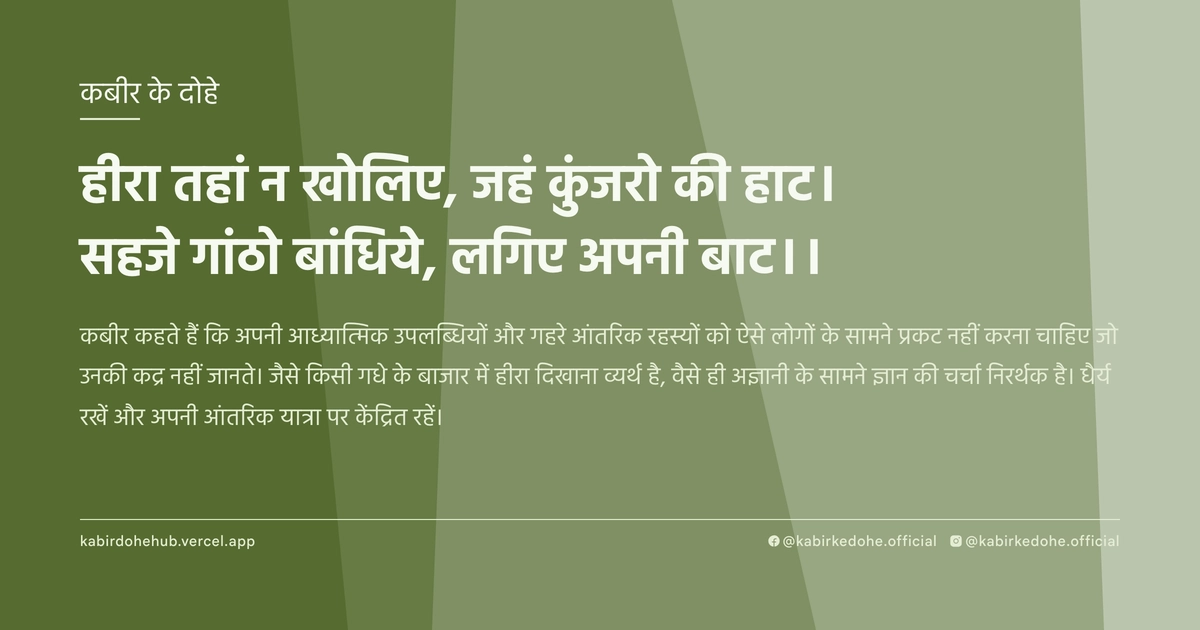
हीरा तहां न खोलिए, जहं कुंजरो की हाट।
सहजे गांठो बांधिये, लगिए अपनी बाट।।
Heera taha na kholiye, jahan kunjaro ki haat. Sahje gantho bandhiye, lagiye apni baat.
इस पृष्ठ पर इस कबीर दोहे का अर्थ (meaning), हिंदी व्याख्या और अंग्रेज़ी अनुवाद, दार्शनिक विश्लेषण और व्यावहारिक जीवन सीख दी गई है। यह दोहा सहज योग (Sahaja Yoga) विषय से जुड़ा है — Kabir doha meaning and explanation in Hindi and English.
अर्थ (Meaning):
कबीर कहते हैं कि अपनी आध्यात्मिक उपलब्धियों और गहरे आंतरिक रहस्यों को ऐसे लोगों के सामने प्रकट नहीं करना चाहिए जो उनकी कद्र नहीं जानते। जैसे किसी गधे के बाजार में हीरा दिखाना व्यर्थ है, वैसे ही अज्ञानी के सामने ज्ञान की चर्चा निरर्थक है। धैर्य रखें और अपनी आंतरिक यात्रा पर केंद्रित रहें।
Kabir advises against revealing one's spiritual treasures or profound inner realizations in the company of those who lack the capacity to understand them. Just as showcasing a diamond in a market of donkeys is futile, sharing sacred truths with the ignorant is pointless. One should maintain inner silence and patiently await the divine timing of their own journey.
व्याख्या (Interpretation):
इस दोहे का शाब्दिक अर्थ है कि मूल्यवान वस्तु को वहां न दिखाएं जहां उसकी कीमत समझने वाला कोई न हो। आध्यात्मिक स्तर पर, 'हीरा' वह आत्म-साक्षात्कार या 'अनुभूति' है जिसे साधक ने कठिन तपस्या से पाया है। 'कुंजरो की हाट' उन लोगों का प्रतीक है जो केवल भौतिकता, अहंकार और बाहरी आडंबरों में विश्वास रखते हैं। कबीर यहाँ 'सहज' अवस्था की बात कर रहे हैं, जहाँ साधक बिना किसी दिखावे के अपनी साधना को सुरक्षित रखता है। यह निरगुण भक्ति का वह पहलू है जहाँ सत्य मौन में निवास करता है। जब हम अपने अनुभव को दूसरों के अनुमोदन (validation) के लिए साझा करते हैं, तो हम माया के जाल में फंस जाते हैं और अपनी ऊर्जा खो देते हैं। यह अद्वैत वेदांत के उस सिद्धांत से जुड़ा है जहाँ ब्रह्म का अनुभव व्यक्तिगत होता है और शब्दों से परे होता है।
Literally, the verse warns against displaying a precious gem in a marketplace of donkeys. Metaphorically, the 'diamond' represents the 'Anubhuti' or the spiritual realization attained through rigorous inner discipline. The 'market of donkeys' symbolizes a society obsessed with materialism, ego, and superficial rituals. Kabir emphasizes the state of 'Sahaj'—a natural, effortless alignment with the Divine—where the seeker guards their realization from the corrosive influence of external judgment. This aligns with Nirgun Bhakti, where the formless truth is found in silence rather than discourse. By seeking validation from the ignorant, the seeker risks falling back into the illusion of Maya. It echoes Advaita Vedanta's premise that the ultimate truth (Brahman) is an experiential reality that transcends linguistic description and social approval.
दार्शनिक विश्लेषण (Philosophical Analysis):
कबीर का यह दृष्टिकोण उनके युग के सामाजिक और धार्मिक पाखंड के प्रति एक तीखी प्रतिक्रिया है। उस समय धर्म केवल बाहरी कर्मकांडों और शास्त्रार्थों तक सीमित था, जहाँ पंडित और मुल्ला केवल शब्दों की लड़ाई लड़ते थे, जबकि वास्तविक अनुभव (Experience) गायब था। कबीर ने ritualism को पूरी तरह नकार दिया क्योंकि उनका मानना था कि सत्य किसी किताब या बहस में नहीं, बल्कि हृदय की गहराई में है।
दार्शनिक रूप से, यह दोहा 'गुह्य' (Secret) ज्ञान की परंपरा को दर्शाता है, जो सूफीवाद के 'सर' (Secret) के समान है। सूफी मत में भी माना जाता है कि आध्यात्मिक अनुभव को केवल उन्हीं के साथ साझा किया जाना चाहिए जो उस स्तर तक पहुँच चुके हों। यदि कोई अपरिपक्व व्यक्ति उच्च ज्ञान सुनता है, तो वह उसे अपने अहंकार के चश्मे से देखता है, जिससे सत्य विकृत हो जाता है।
अद्वैत वेदांत के संदर्भ में, यह 'अहंकार' के विसर्जन की बात है। जब कोई व्यक्ति कहता है, "देखो मुझे यह ज्ञान प्राप्त है," तो वह वास्तव में अपने अहंकार को पुष्ट कर रहा होता है, न कि सत्य को। वास्तविक ज्ञान वह है जो व्यक्ति को विनम्र बनाता है और उसे मौन में ले जाता है। कबीर यहाँ चेतावनी दे रहे हैं कि बाहरी प्रशंसा की भूख साधक की प्रगति को रोक देती है।
मनोवैज्ञानिक स्तर पर, यह 'संज्ञानात्मक विसंगति' (Cognitive Dissonance) को संबोधित करता है। एक जागृत व्यक्ति और एक अज्ञानी व्यक्ति के बीच संवाद अक्सर संघर्ष पैदा करता है। कबीर सुझाव देते हैं कि इस संघर्ष से बचने का सबसे अच्छा तरीका 'सहज' रहना है—अर्थात अपनी आंतरिक शांति को बाहरी शोर से अलग रखना।
अंततः, यह दोहा हमें सिखाता है कि आध्यात्मिक यात्रा एक व्यक्तिगत यात्रा है। यह भीड़ के साथ चलने का नाम नहीं है, बल्कि अपनी 'बाट' (रास्ते) पर अडिग रहने का नाम है। यह बाहरी दुनिया के शोर और आंतरिक शांति के बीच एक स्पष्ट विभाजन रेखा खींचता है, जिससे साधक अपनी ऊर्जा को संरक्षित कर सके।
Kabir's perspective is a sharp reaction to the social and religious hypocrisy of his era. During his time, religion was confined to external rituals and scholastic debates, where pundits and mullahs fought over semantics while the actual 'Anubhuti' (Experience) was absent. Kabir rejected ritualism entirely, believing that truth resides not in books or arguments, but in the depths of the heart.
Philosophically, this verse reflects the tradition of 'Gupt' or secret knowledge, mirroring the Sufi concept of 'Sirr' (The Secret). In Sufism, spiritual realizations are shared only with those who have attained a corresponding level of maturity. If an immature mind encounters high spiritual truth, it filters it through the lens of ego, thereby distorting the essence of the truth.
In the context of Advaita Vedanta, this is about the annihilation of the 'Ahamkara' (Ego). When a person claims, "Look, I have attained this knowledge," they are reinforcing their ego rather than the Truth. Genuine realization renders a person humble and draws them into silence. Kabir warns that the hunger for external validation halts the seeker's progress.
Psychologically, this addresses 'Cognitive Dissonance.' Dialogue between an awakened soul and an ignorant mind often leads to conflict. Kabir suggests the path of 'Sahaj'—maintaining internal equilibrium regardless of external noise, thereby preserving spiritual energy from being drained by futile arguments.
Ultimately, the verse teaches that the spiritual journey is profoundly solitary. It is not about following the crowd but about remaining steadfast on one's own 'Baat' (Path). It draws a clear boundary between the clamor of the world and the stillness of the soul, ensuring the seeker's inner light is not extinguished by the winds of skepticism.
मूल संदेश (Core Message):
- अहंकार की भूख आध्यात्मिक प्रगति की सबसे बड़ी बाधा है।
- सत्य शब्दों का मोहताज नहीं, वह अनुभव की गहराई में है।
- मौन केवल शब्दों का अभाव नहीं, बल्कि पूर्णता की उपस्थिति है।
- अपनी ऊर्जा को व्यर्थ की बहसों में नष्ट न करें।
- सही समय और सही पात्रता का इंतज़ार करना ही धैर्य है।
- आंतरिक संपदा को बाहरी शोर से बचाकर रखना ही बुद्धिमत्ता है।
- The hunger for ego-validation is the greatest obstacle to spiritual growth.
- Truth does not depend on words; it resides in the depth of experience.
- Silence is not the absence of words, but the presence of wholeness.
- Do not deplete your spiritual energy in futile arguments.
- Patience is waiting for the right time and the right receptivity.
- Wisdom lies in shielding inner treasures from external noise.
व्यावहारिक उदाहरण (Practical Example):
एक समय की बात है, बनारस के एक पुराने मोहल्ले में माधव नाम का एक बुनकर रहता था। माधव ने वर्षों तक मौन साधना और आत्म-चिंतन किया था, जिससे उसे जीवन की नश्वरता और ईश्वर की सर्वव्यापकता का गहरा अनुभव हुआ। उसके चेहरे पर एक अलौकिक शांति थी, जिसे देखकर मोहल्ले के लोग उसे 'पागल' या 'अजीब' समझने लगे।
एक दिन, मोहल्ले के कुछ अहंकारी लोग, जो खुद को शास्त्रों का ज्ञाता मानते थे, माधव के पास आए। उन्होंने उसका मज़ाक उड़ाते हुए पूछा, "तुम दिन भर चुप क्यों रहते हो? क्या तुम्हें लगता है कि तुम हमसे ज़्यादा जानते हो? हमें बताओ कि तुम्हारी इस 'शांति' का राज क्या है, ताकि हम तुम्हारी अज्ञानता को उजागर कर सकें।"
माधव ने पहले तो उन्हें अनदेखा किया, लेकिन जब वे लोग उसके काम में बाधा डालने लगे, तो उसने अपनी अनुभूति का एक छोटा सा हिस्सा साझा करने की कोशिश की। उसने उन्हें बताया कि कैसे बाहरी दुनिया एक सपना है और केवल आत्मा ही सत्य है।
लेकिन उन लोगों ने उसकी बात को गंभीरता से लेने के बजाय उसका उपहास किया। उन्होंने कहा, "एक मामूली बुनकर हमें वेदांत सिखाएगा? तुम तो बस धागे बुनना जानते हो, सत्य क्या होता है, यह हमें पता है।"
माधव को तुरंत एहसास हुआ कि वह 'कुंजरो की हाट' में अपना हीरा खोल रहा था। उसने देखा कि वे लोग सत्य को खोजने नहीं, बल्कि अपनी श्रेष्ठता सिद्ध करने आए थे। उसने महसूस किया कि उसकी शांति को शब्दों में ढालना उन लोगों के लिए केवल एक मनोरंजन था।
उस क्षण माधव ने एक 'कबीर ट्विस्ट' का अनुभव किया। उसने बहस करना बंद कर दिया और एक मंद मुस्कान के साथ वापस अपने करघे पर लग गया। उसने तय किया कि वह अब अपनी आंतरिक संपदा का प्रदर्शन किसी ऐसे व्यक्ति से नहीं करेगा जो उसे समझने की क्षमता नहीं रखता।
उसने अपनी 'गाँठ' बाँध ली—अर्थात उसने अपने ज्ञान को अपने भीतर समेट लिया। उसने बाहरी दुनिया की प्रतिक्रियाओं से खुद को पूरी तरह अलग कर लिया और अपनी साधना में लीन हो गया।
धीरे-धीरे, उसकी चुप्पी उन लोगों के लिए एक चुनौती बन गई। जो लोग उसका मज़ाक उड़ाते थे, वे अब उसकी शांति से डरने लगे। वे सोचने लगे कि आखिर माधव के पास ऐसा क्या है जिसे वह साझा नहीं कर रहा।
अंत में, उन्हीं में से एक व्यक्ति, जिसका अहंकार टूट चुका था, माधव के पास आया और विनम्रता से पूछा, "मुझे अब समझ आया कि शब्दों से ज़्यादा मौन शक्तिशाली है। क्या आप मुझे रास्ता दिखाएंगे?"
माधव ने तब उसे सिखाया, क्योंकि अब वह व्यक्ति 'गधे का बाज़ार' छोड़कर एक 'साधक' बन चुका था। माधव ने सीखा कि सही समय और सही व्यक्ति का इंतज़ार करना ही वास्तविक बुद्धिमत्ता है।
Once in an ancient neighborhood of Varanasi, there lived a weaver named Madhav. Through years of silent meditation and self-inquiry, Madhav had attained a profound realization of the impermanence of life and the omnipresence of the Divine. A celestial peace radiated from him, which led the locals to perceive him as either 'mad' or 'eccentric.'
One day, a group of arrogant men, who considered themselves scholars of the scriptures, approached Madhav. Mocking him, they asked, "Why do you remain silent all day? Do you believe you know more than we do? Tell us the secret of your 'peace' so we can expose your ignorance."
Madhav initially ignored them, but when they began disrupting his work, he attempted to share a glimpse of his realization. He spoke of how the external world is a dream and only the Atman is the ultimate reality.
Instead of listening with openness, the men ridiculed him. They sneered, "A mere weaver will teach us Vedanta? You only know how to weave threads; we are the ones who know what Truth is."
Madhav instantly realized he was opening his 'diamond' in a 'market of donkeys.' He saw that these men had come not to seek truth, but to validate their own superiority. He understood that translating his peace into words was merely entertainment for them.
In that moment, Madhav experienced a 'Kabir Twist.' He ceased all arguments and, with a gentle smile, returned to his loom. He decided he would never again display his inner wealth to those lacking the capacity to value it.
He 'tied the knot'—meaning he withdrew his knowledge back into the sanctuary of his heart. He detached himself completely from the reactions of the external world and immersed himself in his practice.
Gradually, his silence became a challenge to those very people. Those who once mocked him began to fear his stillness. They wondered what Madhav possessed that he refused to share.
Eventually, one of those men, whose ego had finally crumbled, approached Madhav with humility and asked, "I now realize that silence is more powerful than words. Will you show me the way?"
Only then did Madhav teach him, for the man had left the 'market of donkeys' and become a 'seeker.' Madhav learned that waiting for the right time and the right person is the pinnacle of wisdom.
अभ्यास मार्गदर्शन (Practice Guidance):
- प्रतिदिन 20 मिनट 'मौन साधना' करें, जहाँ आप अपने विचारों को बिना किसी निर्णय के देखें और उन्हें किसी के साथ साझा करने की इच्छा को त्याग दें।
- एक 'निरीक्षण डायरी' लिखें: जब भी आपको अपनी उपलब्धियों या आध्यात्मिक अनुभवों को दूसरों को बताने की तीव्र इच्छा हो, तो रुकें और पूछें—"क्या मैं सत्य साझा करना चाहता हूँ या अपने अहंकार को संतुष्ट करना चाहता हूँ?"
- व्यवहार परिवर्तन: किसी भी विवाद या बहस में जीतने की कोशिश करने के बजाय, मौन रहकर सामने वाले की ऊर्जा को महसूस करें और अपनी आंतरिक शांति को प्राथमिकता दें।
- डायग्नोस्टिक चेकलिस्ट: क्या आप दूसरों की प्रशंसा के बिना भी अपने ज्ञान में संतुष्ट हैं? क्या आप अज्ञानियों के उपहास से विचलित होते हैं? यदि हाँ, तो आप अभी भी 'बाज़ार' के प्रभाव में हैं।
- Practice 20 minutes of 'Silent Contemplation' daily, observing your thoughts without judgment and consciously relinquishing the urge to share them with others.
- Maintain an 'Observation Journal': Whenever you feel a strong impulse to broadcast your achievements or spiritual insights, pause and ask—"Am I seeking to share the Truth, or am I seeking to feed my ego?"
- Behavioral Shift: Instead of trying to win an argument or debate, remain silent and observe the other person's energy, prioritizing your internal equilibrium over external victory.
- Diagnostic Checklist: Are you content with your knowledge without external validation? Do you feel disturbed by the mockery of the ignorant? If yes, you are still influenced by the 'Marketplace' of ego.
चिंतन प्रश्न (Reflection Questions):
- आप अपनी आध्यात्मिक या बौद्धिक पहचान को सोशल मीडिया या सार्वजनिक मंचों पर कैसे प्रदर्शित करते हैं, और इसके पीछे का वास्तविक उद्देश्य क्या है?
- जब कोई आपकी मान्यताओं का उपहास करता है, तो आपके भीतर उठने वाली प्रतिक्रिया क्या है? क्या वह आपकी शांति को भंग करती है?
- क्या आप वास्तव में सत्य की खोज कर रहे हैं, या आप केवल 'सत्य जानने वाले' के रूप में पहचाने जाना चाहते हैं?
- आपके जीवन में वे कौन से 'गधे के बाज़ार' हैं जहाँ आप अपनी ऊर्जा व्यर्थ करते हैं?
- यदि दुनिया आपकी किसी भी उपलब्धि को स्वीकार न करे, तो क्या आपकी आंतरिक शांति बनी रहेगी?
- क्या आप मौन में रहने की क्षमता रखते हैं, या आपको निरंतर बाहरी शोर और संवाद की आवश्यकता होती है?
- How do you project your spiritual or intellectual identity on social media or public platforms, and what is the hidden motive behind it?
- What is the internal reaction when someone mocks your beliefs? Does it shatter your inner peace?
- Are you truly seeking the Truth, or are you merely seeking to be recognized as 'one who knows the Truth'?
- What are the 'markets of donkeys' in your own life where you waste your precious energy?
- If the world refused to acknowledge any of your achievements, would your inner peace remain intact?
- Do you possess the capacity for absolute silence, or do you constantly require external noise and dialogue to feel existent?