
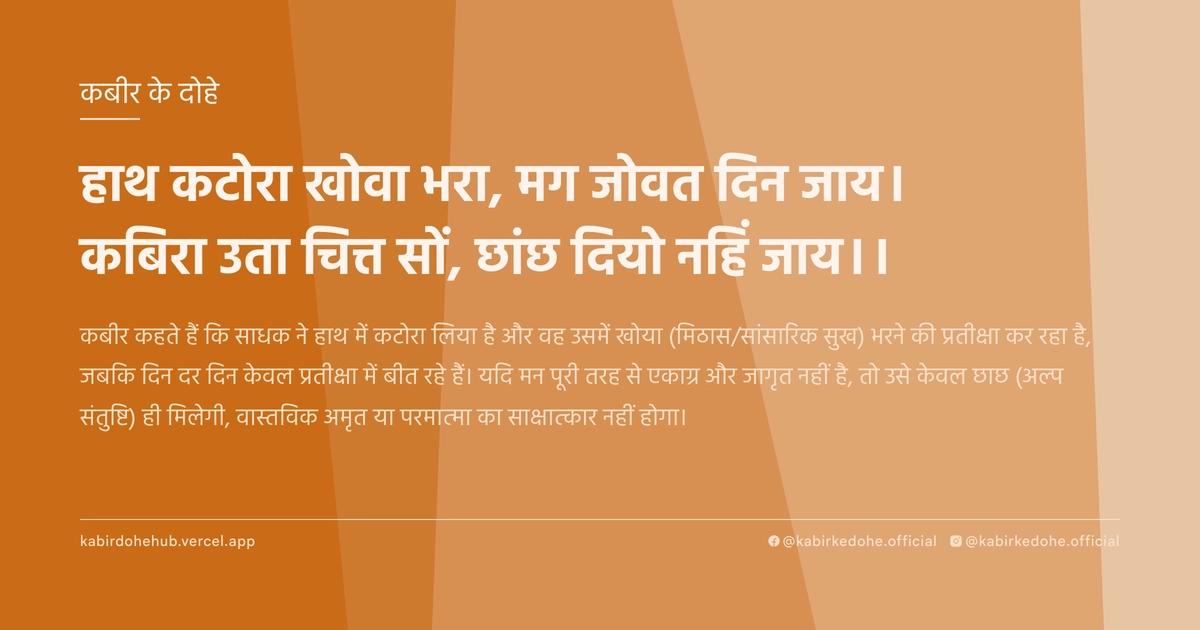
हाथ कटोरा खोवा भरा, मग जोवत दिन जाय।
कबिरा उता चित्त सों, छांछ दियो नहिं जाय।।
Hath katora khova bhara, mag jovat din jaaye. Kabira uta chitt son, chhanchh diyo nahin jaaye.
इस पृष्ठ पर इस कबीर दोहे का अर्थ (meaning), हिंदी व्याख्या और अंग्रेज़ी अनुवाद, दार्शनिक विश्लेषण और व्यावहारिक जीवन सीख दी गई है। यह दोहा भक्ति (Bhakti) विषय से जुड़ा है — Kabir doha meaning and explanation in Hindi and English.
अर्थ (Meaning):
कबीर कहते हैं कि साधक ने हाथ में कटोरा लिया है और वह उसमें खोया (मिठास/सांसारिक सुख) भरने की प्रतीक्षा कर रहा है, जबकि दिन दर दिन केवल प्रतीक्षा में बीत रहे हैं। यदि मन पूरी तरह से एकाग्र और जागृत नहीं है, तो उसे केवल छाछ (अल्प संतुष्टि) ही मिलेगी, वास्तविक अमृत या परमात्मा का साक्षात्कार नहीं होगा।
Kabir describes a seeker holding a bowl, waiting for it to be filled with 'khoya' (rich sweetness/divine bliss), while days waste away in mere anticipation. He warns that if the mind is not intensely focused and awakened, the seeker will receive only 'buttermilk' (trivial, superficial satisfaction) instead of the true nectar of spiritual liberation.
व्याख्या (Interpretation):
इस दोहे का शाब्दिक अर्थ एक भिक्षु की स्थिति है, लेकिन आध्यात्मिक रूप से यह 'अधूरी साधना' का प्रतीक है। 'कटोरा' मानव अहंकार और इच्छाओं का पात्र है। 'खोवा' उस परम आनंद या मोक्ष का प्रतीक है जिसकी लालसा हर आत्मा करती है। कबीर यहाँ एक गहरे विरोधाभास को दर्शाते हैं: हम ईश्वर को खोजते तो हैं, लेकिन हमारी खोज केवल बाहरी प्रतीकों और उम्मीदों तक सीमित है। यह निरगुण भक्ति का मार्ग है जहाँ बाहरी आडंबरों के बजाय आंतरिक तीव्रता (उता चित्त) अनिवार्य है। जब तक साधक माया के मोह और आलस्य से मुक्त नहीं होता, वह केवल 'छाछ' जैसे तुच्छ सांसारिक सुखों में उलझा रहता है, जिसे वह गलती से आध्यात्मिक प्रगति मान लेता है। यह अद्वैत वेदांत के उस सत्य को उजागर करता है कि जब तक 'मैं' (अहंकार) का कटोरा मौजूद है, तब तक पूर्णता का अनुभव असंभव है।
Literally, the verse depicts a mendicant waiting for alms, but metaphorically, it represents the state of 'incomplete spiritual practice.' The 'bowl' symbolizes the human ego and its endless desires. 'Khoya' represents the supreme bliss or liberation that every soul longs for. Kabir highlights a profound paradox: we seek the Divine, yet our search is often confined to external symbols and passive expectations. This aligns with Nirgun Bhakti, where internal intensity (uta chitt) is prioritized over outward rituals. As long as the seeker is entangled in the illusions of Maya and spiritual lethargy, they receive only 'buttermilk'—trivial, superficial gratifications mistaken for progress. It echoes Advaita Vedanta's truth that as long as the 'I' (the bowl of ego) exists, the experience of non-dual oneness remains elusive.
दार्शनिक विश्लेषण (Philosophical Analysis):
कबीर का यह दोहा उनके युग के उस सामाजिक और धार्मिक परिवेश पर प्रहार करता है जहाँ धर्म केवल एक यांत्रिक प्रक्रिया बन गया था। उस समय के कई साधु और मुनि केवल भिक्षाटन और बाहरी दिखावे को ही साधना मान बैठे थे। कबीर इस 'कर्मकांडीय भक्ति' का खंडन करते हैं। वे तर्क देते हैं कि परमात्मा किसी बाहरी कटोरे में नहीं, बल्कि चित्त की एकाग्रता में बसता है।
दार्शनिक स्तर पर, यह सूफी मत के 'फना' (अहंकार का विनाश) और अद्वैत वेदांत के 'अहं ब्रह्मास्मि' के बीच एक सेतु है। जब तक साधक यह सोचता है कि उसे कुछ 'प्राप्त' करना है (कटोरा लेकर इंतज़ार करना), तब तक वह द्वैत में फँसा रहता है। वास्तविक ज्ञान तब आता है जब कटोरा (अहंकार) ही टूट जाए।
कबीर यहाँ 'छाछ' और 'खोवा' के माध्यम से मनोवैज्ञानिक स्तर पर सूक्ष्म अंतर स्पष्ट करते हैं। 'छाछ' वह मानसिक संतोष है जो हमें छोटे-छोटे सांसारिक लाभों या धार्मिक पहचानों से मिलता है। यह एक भ्रम है जो हमें वास्तविक खोज से रोकता है।
यह विश्लेषण दर्शाता है कि कबीर केवल एक कवि नहीं, बल्कि एक मनोवैज्ञानिक थे। वे जानते थे कि मनुष्य अक्सर 'प्रतीक्षा' को 'साधना' समझ लेता है। केवल मार्ग पर चलना पर्याप्त नहीं है; उस मार्ग पर चलने की तीव्रता और ईमानदारी (उता चित्त) ही परिणाम तय करती है।
अंततः, यह दोहा जाति, धर्म और संप्रदाय से ऊपर उठकर केवल 'चेतना की शुद्धता' की बात करता है। यह संदेश देता है कि ईश्वर की प्राप्ति किसी बाहरी अनुग्रह से नहीं, बल्कि आंतरिक रूपांतरण और अहंकार के पूर्ण विसर्जन से संभव है।
This Doha strikes at the social and religious fabric of Kabir's era, where spirituality had devolved into mechanical rituals. Many ascetics of the time equated mendicancy and outward appearances with spiritual attainment. Kabir vehemently rejects this 'ritualistic devotion,' arguing that the Divine does not reside in an external bowl but in the absolute concentration of the consciousness.
Philosophically, this verse bridges the Sufi concept of 'Fana' (annihilation of the ego) and the Advaita Vedanta realization of 'Aham Brahmasmi.' As long as the seeker believes there is something to 'acquire' (waiting with a bowl), they remain trapped in duality. True gnosis occurs only when the bowl—the ego itself—is shattered.
Through the metaphors of 'buttermilk' and 'khoya,' Kabir delineates a psychological distinction. 'Buttermilk' represents the superficial contentment derived from minor worldly gains or religious identities. This is a deceptive plateau that prevents the seeker from pursuing the ultimate truth.
This analysis reveals Kabir as a spiritual psychologist. He understood that humans often mistake 'waiting' for 'practicing.' Simply being on the path is insufficient; it is the intensity and integrity of the intent (uta chitt) that determines the outcome.
Ultimately, the verse transcends caste, creed, and sect, focusing solely on the 'purity of consciousness.' It asserts that liberation is not a gift of external grace but a result of internal transformation and the complete dissolution of the self.
मूल संदेश (Core Message):
- प्रतीक्षा साधना नहीं है; सक्रिय जागरूकता ही वास्तविक मार्ग है।
- अहंकार का कटोरा खाली किए बिना ईश्वरीय प्रेम नहीं भरा जा सकता।
- बाहरी प्रतीकों का मोह केवल आध्यात्मिक भ्रम (छाछ) पैदा करता है।
- चित्त की तीव्रता ही साधारण जीवन को असाधारण बनाती है।
- मोक्ष कोई भविष्य का लक्ष्य नहीं, बल्कि वर्तमान की पूर्णता है।
- Waiting is not practice; active awareness is the only true path.
- The bowl of ego must be emptied before divine love can fill it.
- Attachment to external symbols creates only spiritual illusion (buttermilk).
- Intensity of consciousness transforms an ordinary life into an extraordinary one.
- Liberation is not a future destination, but the fullness of the present.
व्यावहारिक उदाहरण (Practical Example):
एक समय की बात है, वाराणसी के घाटों पर माधव नाम का एक वृद्ध बुनकर रहता था। माधव ने अपना पूरा जीवन केवल इस उम्मीद में बिता दिया कि एक दिन कोई महान गुरु आएगा और उसे 'मोक्ष का गुप्त मंत्र' दे देगा। वह रोज़ सुबह उठकर घाट पर बैठता, अपनी आँखें बंद करता और प्रार्थना करता कि उसे वह दिव्य ज्ञान प्राप्त हो जाए। वह खुद को एक महान साधक मानता था क्योंकि वह घंटों मौन रहता था, लेकिन उसके मन के भीतर अभी भी यह अहंकार था कि वह दूसरों से अधिक पवित्र है।
उसकी दिनचर्या एक यांत्रिक प्रक्रिया बन गई थी। वह मंत्रों का जाप करता, लेकिन उसका ध्यान इस बात पर रहता कि लोग उसे 'ज्ञानी' कहें। वह उस 'खोवे' (परम ज्ञान) की प्रतीक्षा कर रहा था, जबकि उसका जीवन केवल बाहरी दिखावे की 'छाछ' से भरा था।
एक दिन, एक फकीर उसके पास आया। फकीर ने देखा कि माधव की आँखें बंद हैं, लेकिन उसका चेहरा तनावपूर्ण है। फकीर ने उसके पास रखे पानी के लोटे को उलट दिया। माधव चौंक कर उठा और क्रोध में चिल्लाया, "तुमने मेरा पवित्र जल क्यों गिराया?"
फकीर मुस्कुराया और बोला, "तुम जिस जल की रक्षा कर रहे थे, वह तो केवल मिट्टी का था। तुम उस अमृत की प्रतीक्षा कर रहे हो जो तुम्हारे भीतर है, लेकिन तुम्हारा कटोरा अभी भी 'मैं' और 'मेरा' के अहंकार से भरा है। जब तक यह कटोरा खाली नहीं होगा, इसमें कुछ भी नया नहीं भरा जा सकता।"
माधव को अचानक अपनी गलती का अहसास हुआ। उसने महसूस किया कि उसकी वर्षों की प्रतीक्षा वास्तव में साधना नहीं, बल्कि एक मानसिक आलस्य था। वह केवल एक 'परिणाम' चाहता था, बिना उस 'प्रक्रिया' (चित्त की एकाग्रता) से गुज़रे जो आवश्यक थी।
उस दिन के बाद, माधव ने बाहरी गुरुओं की प्रतीक्षा करना छोड़ दिया। उसने अपने बुनकर के काम को ही अपनी प्रार्थना बना लिया। वह हर धागे को पूरी जागरूकता और प्रेम के साथ बुनने लगा।
अब वह घाट पर बैठकर यह नहीं माँगता था कि उसे कुछ दिया जाए, बल्कि उसने खुद को देना शुरू किया। उसने गरीब बच्चों को मुफ्त में पढ़ाना शुरू किया और बिना किसी अपेक्षा के दूसरों की सेवा की।
उसका 'उता चित्त' (जागृत मन) अब सक्रिय था। उसने पाया कि जिस मोक्ष को वह बाहर खोज रहा था, वह तो उसके वर्तमान क्षण की पूर्णता में ही छिपा था। उसका जीवन अब 'छाछ' से बदलकर 'खोवे' जैसी मिठास से भर गया था।
Once, in the ghats of Varanasi, lived an elderly weaver named Madhav. Madhav spent his entire life in the hope that one day a great guru would arrive and grant him the 'secret mantra of liberation.' Every morning, he would sit by the river, close his eyes, and pray for divine knowledge. He considered himself a great seeker because he remained silent for hours, yet within him resided the ego that he was holier than others.
His routine had become a mechanical process. He chanted mantras, but his focus was on whether people perceived him as 'wise.' He was waiting for the 'khoya' (supreme knowledge), while his life was filled only with the 'buttermilk' of outward appearances.
One day, a wandering fakir approached him. The fakir noticed that while Madhav's eyes were closed, his face was tense. Without warning, the fakir overturned the water pot sitting beside him. Madhav jumped up, startled and angry, shouting, "Why did you spill my holy water?"
The fakir smiled and said, "The water you were protecting was merely earthly. You wait for the nectar that lies within, but your bowl is still full of the ego of 'I' and 'mine.' Until this bowl is emptied, nothing new can be filled into it."
Madhav suddenly realized his error. He understood that his years of waiting were not spiritual practice, but a form of mental lethargy. He wanted the 'result' without undergoing the 'process' (concentration of consciousness) that was necessary.
From that day on, Madhav stopped waiting for external gurus. He turned his weaving into his prayer. He began to weave every thread with absolute awareness and love.
He no longer sat on the ghats asking to be given something; instead, he began to give of himself. He started teaching poor children for free and served others without expectation.
His 'uta chitt' (awakened mind) was now active. He discovered that the liberation he sought externally was hidden in the fullness of the present moment. His life, once thin like buttermilk, was now rich and sweet like khoya.
अभ्यास मार्गदर्शन (Practice Guidance):
- प्रतिदिन 20 मिनट 'साक्षी भाव' का अभ्यास करें: अपने विचारों को बिना किसी निर्णय के देखें, जैसे आप किसी और के विचार देख रहे हों।
- आत्म-पूछताछ जर्नल: प्रतिदिन लिखें कि आज आपने कितनी बार 'मैं' या 'मेरा' शब्द का प्रयोग किया और वह किस अहंकार से प्रेरित था।
- व्यवहारिक परिवर्तन: किसी ऐसे व्यक्ति की निस्वार्थ सेवा करें जिससे आपका कोई व्यक्तिगत लाभ न हो, और इस प्रक्रिया में अपनी पहचान को पूरी तरह मिटा दें।
- डायग्नोस्टिक चेकलिस्ट: क्या मैं केवल परिणाम की प्रतीक्षा कर रहा हूँ? क्या मेरी साधना केवल एक आदत बन गई है? क्या मैं अपनी आध्यात्मिक पहचान का उपयोग दूसरों से श्रेष्ठ दिखने के लिए कर रहा हूँ?
- Practice 'Witness Consciousness' for 20 minutes daily: Observe your thoughts without judgment, as if you are watching someone else's mind.
- Self-Inquiry Journaling: Record every instance today where you used 'I' or 'Mine' and analyze which specific ego-drive prompted it.
- Behavioral Shift: Perform a selfless act of service for someone from whom you can gain nothing, consciously erasing your identity during the act.
- Diagnostic Checklist: Am I merely waiting for a result? Has my practice become a mechanical habit? Am I using my spiritual identity to feel superior to others?
चिंतन प्रश्न (Reflection Questions):
- क्या मेरी आध्यात्मिक खोज वास्तव में सत्य के लिए है, या मैं केवल एक 'विशेष' पहचान पाना चाहता हूँ?
- मेरे जीवन में वह कौन सा 'कटोरा' है जिसे मैं पकड़े हुए हूँ और खाली होने से डरता हूँ?
- मैं अपनी डिजिटल पहचान (सोशल मीडिया) पर जिस 'आदर्श' छवि को प्रस्तुत करता हूँ, वह मेरे वास्तविक आंतरिक संघर्षों से कितनी अलग है?
- क्या मैं अपनी प्रार्थनाओं में ईश्वर से कुछ माँग रहा हूँ, या मैं स्वयं को ईश्वर के प्रति समर्पित कर रहा हूँ?
- मेरे जीवन की 'छाछ' (सतही सुख) क्या है जो मुझे 'खोवे' (परम सत्य) की खोज से रोक रही है?
- Is my spiritual quest truly for Truth, or am I merely seeking a 'special' identity?
- What is the 'bowl' in my life that I am clinging to and afraid to empty?
- How different is the 'ideal' image I project on my digital identity from my actual internal struggles?
- In my prayers, am I asking God for something, or am I surrendering myself to the Divine?
- What is the 'buttermilk' (superficial satisfaction) in my life that prevents me from seeking the 'khoya' (ultimate truth)?