
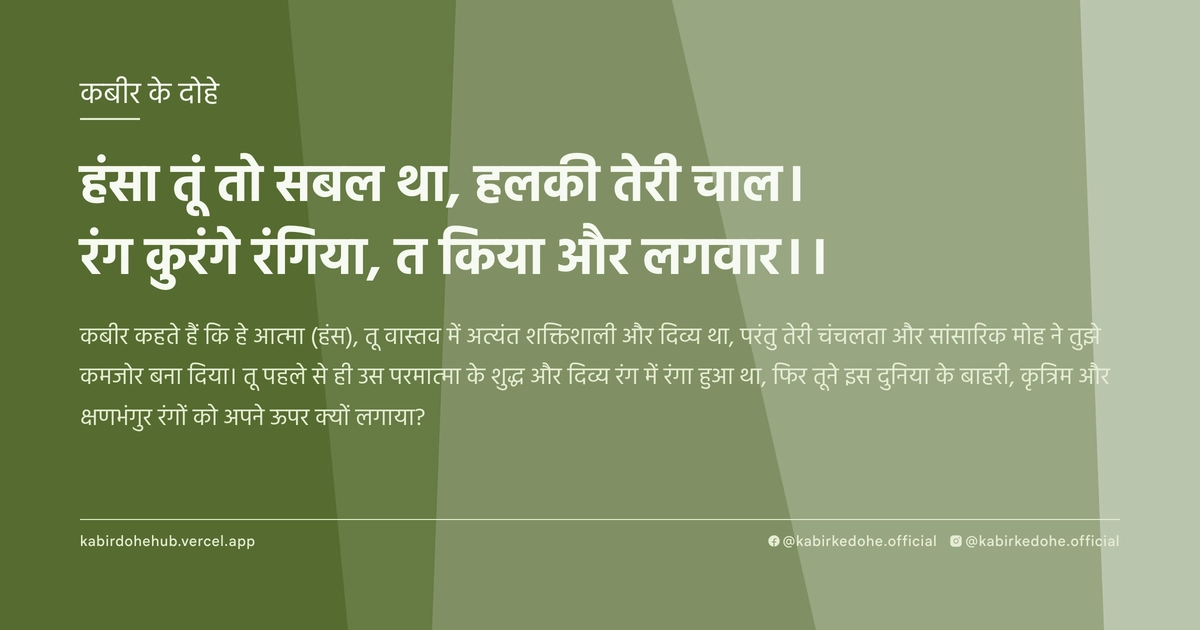
हंसा तूं तो सबल था, हलकी तेरी चाल।
रंग कुरंगे रंगिया, त किया और लगवार।।
Hansa tun to sabal tha, halki teri chaal. Rang kurange rangiya, ta kiya aur lagvaar.
इस पृष्ठ पर इस कबीर दोहे का अर्थ (meaning), हिंदी व्याख्या और अंग्रेज़ी अनुवाद, दार्शनिक विश्लेषण और व्यावहारिक जीवन सीख दी गई है। यह दोहा मोह (Attachment) विषय से जुड़ा है — Kabir doha meaning and explanation in Hindi and English.
अर्थ (Meaning):
कबीर कहते हैं कि हे आत्मा (हंस), तू वास्तव में अत्यंत शक्तिशाली और दिव्य था, परंतु तेरी चंचलता और सांसारिक मोह ने तुझे कमजोर बना दिया। तू पहले से ही उस परमात्मा के शुद्ध और दिव्य रंग में रंगा हुआ था, फिर तूने इस दुनिया के बाहरी, कृत्रिम और क्षणभंगुर रंगों को अपने ऊपर क्यों लगाया?
Kabir addresses the soul as a 'Hansa' (swan), reminding it that it was inherently powerful and divine. However, the soul's restlessness and attachment to worldly illusions made its gait unsteady. Though already imbued with the pure, eternal color of the Divine, the soul chose to stain itself with the artificial and fleeting colors of material existence.
व्याख्या (Interpretation):
यहाँ 'हंस' आत्मा का प्रतीक है, जो अपनी शुद्धता और विवेक के लिए जाना जाता है। 'सबल' होने का अर्थ है कि आत्मा मूलतः पूर्ण और ब्रह्म स्वरूप है। 'हलकी चाल' उस मानसिक अस्थिरता को दर्शाता है जो माया के प्रभाव से आती है। यह दोहा निर्गुण भक्ति के उस सिद्धांत पर आधारित है जहाँ आत्मा और परमात्मा एक ही हैं, लेकिन अज्ञानता के कारण आत्मा स्वयं को शरीर और सामाजिक पहचान के साथ जोड़ लेती है। 'रंग कुरंगे' का अर्थ है वे सांसारिक वासनाएँ और अहंकार जो आत्मा की मौलिक चमक को ढक लेते हैं। यह एक विरोधाभास है कि जो अनंत है, वह सीमित होने का ढोंग कर रहा है।
The 'Hansa' (swan) serves as a metaphor for the soul, renowned for its purity and ability to discern essence from waste. Being 'sabal' implies that the soul is fundamentally complete and non-dual with Brahman. The 'halki chaal' (light/unsteady gait) represents the spiritual instability induced by Maya. This verse aligns with Nirgun Bhakti, suggesting that the soul is inherently divine but forgets its nature through identification with the ego. The 'kurange rang' (dull/artificial colors) symbolize worldly attachments and social masks. It highlights the central paradox: the Infinite pretending to be finite, and the Eternal chasing the ephemeral.
दार्शनिक विश्लेषण (Philosophical Analysis):
कबीर का यह दोहा मध्यकालीन भारत के उस सामाजिक परिवेश में लिखा गया जहाँ धर्म बाहरी कर्मकांडों और जातिगत पहचानों में सिमट गया था। कबीर ने 'रंग' के माध्यम से यह प्रहार किया है कि मनुष्य अपनी वास्तविक पहचान (आत्मा) को छोड़कर बाहरी पहचानों (जाति, धर्म, पद) को अपनाने में समय व्यर्थ करता है। यह विचार अद्वैत वेदांत के 'अहं ब्रह्मास्मि' के करीब है, जहाँ यह माना जाता है कि अज्ञान (Avidya) ही वह पर्दा है जो हमें हमारी दिव्यता से अलग करता है।
सूफी मत के 'फना' (अहंकार का विनाश) की अवधारणा यहाँ स्पष्ट है; जब तक बाहरी रंगों (माया) का त्याग नहीं होगा, तब तक आंतरिक सत्य का अनुभव संभव नहीं है। कबीर ritualism का विरोध करते हुए कहते हैं कि ईश्वर मंदिर या मस्जिद में नहीं, बल्कि स्वयं के भीतर है। वे चेतावनी देते हैं कि बाहरी आडंबर केवल भ्रम पैदा करते हैं।
मनोवैज्ञानिक स्तर पर, यह दोहा 'पहचान के संकट' की बात करता है। मनुष्य अक्सर दूसरों की नजरों में अपनी कीमत ढूंढता है, जिससे उसकी 'चाल' हलकी हो जाती है, अर्थात उसका आत्मविश्वास और आंतरिक स्थिरता समाप्त हो जाती है। वह अपनी मौलिक शक्ति को भूलकर दूसरों के द्वारा थोपे गए साँचों में फिट होने की कोशिश करता है।
भक्ति आंदोलन के संदर्भ में, यह 'आत्म-साक्षात्कार' की पुकार है। कबीर यह स्पष्ट करते हैं कि मोक्ष कहीं बाहर से प्राप्त नहीं करना है, बल्कि जो पहले से मौजूद है, उसे पुनः पहचानना है। यह 'प्राप्ति' नहीं, बल्कि 'स्मरण' की प्रक्रिया है।
अंततः, यह दोहा हमें सिखाता है कि संसार के रंग आकर्षक हो सकते हैं, लेकिन वे स्थायी नहीं हैं। केवल परमात्मा का रंग (प्रेम और सत्य) ही शाश्वत है। जब साधक इस सत्य को जान लेता है, तो वह बाहरी दुनिया के द्वंद्वों से ऊपर उठकर अपनी मूल शक्ति को पुनः प्राप्त कर लेता है।
Written during a period of rigid ritualism and caste hierarchies in medieval India, Kabir uses the metaphor of 'color' to critique the human tendency to prioritize external identity over internal essence. This aligns closely with Advaita Vedanta's concept of 'Maya', where the illusion of duality obscures the truth of non-duality (Atman-Brahman). The 'artificial colors' represent the social masks and religious labels that humans wear to feel significant.
Connecting this to Sufism, the verse echoes the concept of 'Fana'—the annihilation of the false self. Kabir suggests that the ego is a borrowed garment, a temporary stain on the pristine canvas of the soul. By rejecting the 'kurange rang' (dull colors), the seeker strips away the layers of conditioning to reveal the primordial light within.
From a psychological perspective, the 'unsteady gait' describes the anxiety and instability that arise when an individual seeks validation from external sources. The loss of spiritual 'strength' (sabal) occurs when one trades their authentic self for a socially constructed persona, leading to a fragmented existence.
In the context of the Bhakti movement, Kabir emphasizes that liberation is not an acquisition of something new, but a recovery of something lost. It is a process of 'unlearning' rather than learning. He challenges the notion that God is found in distant heavens or complex rituals, asserting instead that the Divine is the very fabric of our being.
Ultimately, the philosophical core is the transition from the 'Many' to the 'One'. The world offers a kaleidoscope of distractions, but these are mere shadows. The realization that one was always 'colored' in the Divine hue leads to the cessation of longing and the beginning of true spiritual sovereignty.
मूल संदेश (Core Message):
- बाहरी पहचान एक भ्रम है, आंतरिक दिव्यता ही एकमात्र सत्य है।
- अहंकार की अस्थिरता को त्यागकर आत्मा की मूल शक्ति को पहचानें।
- संसार के कृत्रिम रंगों से ऊपर उठकर प्रेम के शाश्वत रंग में रंगें।
- सादगी और सत्य ही वह मार्ग हैं जो आत्मा को पुनः 'सबल' बनाते हैं।
- स्वयं को खोजने का अर्थ है उन सब चीजों को छोड़ना जो आप वास्तव में नहीं हैं।
- External identity is an illusion; internal divinity is the only truth.
- Shed the instability of ego to reclaim the soul's primal power.
- Rise above the artificial hues of the world to embrace the eternal color of Love.
- Simplicity and truth are the only paths that restore the soul's strength.
- Finding yourself means letting go of everything that you are not.
व्यावहारिक उदाहरण (Practical Example):
वाराणसी के एक पुराने घाट पर माधव नाम का एक वृद्ध बुनकर रहता था। माधव अपनी रेशमी साड़ियों की बारीक बुनाई के लिए प्रसिद्ध था, लेकिन उसका मन हमेशा अशांत रहता था। वह अपनी कला के माध्यम से धन कमाता था, पर उसे लगता था कि उसकी असली पहचान उसकी अमीरी और समाज में उसके ऊँचे पद से है। वह हर समय इस चिंता में रहता कि लोग उसके बारे में क्या सोचेंगे और वह अपनी प्रतिष्ठा कैसे बचाए रखेगा।
एक दिन माधव की मुलाकात एक फकीर से हुई, जिसने उसकी बेचैनी को भांप लिया। फकीर ने माधव को एक सफेद सूती कपड़ा दिया और कहा, "इसे देखो, यह अपनी शुद्धता में पूर्ण है। लेकिन अगर मैं इस पर अलग-अलग रंगों के धब्बे लगा दूँ, तो क्या यह कपड़ा बदल जाएगा?"
माधव ने कहा, "नहीं, कपड़ा तो वही रहेगा, बस उसके ऊपर रंग चढ़े होंगे।"
फकीर मुस्कुराया और बोला, "ठीक वैसे ही तुम हो, माधव। तुम मूलतः शांत और शक्तिशाली आत्मा हो, लेकिन तुमने प्रतिष्ठा, अहंकार और सामाजिक डर के रंग अपने ऊपर इतने गहरे चढ़ा लिए हैं कि तुम भूल गए हो कि तुम वास्तव में कौन हो। तुम्हारी यह बेचैनी तुम्हारी 'हलकी चाल' है, क्योंकि तुम उस बोझ को ढो रहे हो जो तुम्हारा है ही नहीं।"
माधव को यह बात गहराई से चुभ गई। उसने महसूस किया कि वह अपनी पूरी जिंदगी दूसरों को प्रभावित करने के रंगों को संवारने में बिता रहा था, जबकि उसकी अपनी आंतरिक शांति कहीं खो गई थी। उसने अपनी पहचान को अपनी साड़ियों की चमक या समाज की वाहवाही से जोड़ना बंद कर दिया।
उसने अपनी कार्यशाला को एक साझा स्थान बना दिया जहाँ वह गरीब बच्चों को मुफ्त में बुनाई सिखाने लगा। अब वह केवल लाभ के लिए नहीं, बल्कि सेवा के लिए बुनता था। उसने पाया कि जब उसने 'प्रतिष्ठा' का रंग उतारा, तो उसे एक ऐसी शक्ति मिली जो पहले कभी महसूस नहीं हुई थी।
उसका मन अब स्थिर था। वह अब घाट पर बैठकर घंटों मौन रहता, और उसकी आँखों में एक ऐसी चमक थी जो किसी बाहरी रंग से नहीं आई थी। वह अब वास्तव में 'सबल' महसूस कर रहा था क्योंकि उसने बाहरी मुखौटों का त्याग कर दिया था।
गाँव के लोग हैरान थे कि माधव अब पहले से कहीं अधिक खुश और शांत था, जबकि उसके पास अब पहले जैसी विलासिता नहीं थी। माधव ने जान लिया था कि असली रंग वह है जो भीतर से फूटता है, न कि वह जो बाहर से लगाया जाता है।
इस प्रकार, माधव ने कबीर के शब्दों को अपने जीवन में उतारा। उसने समझा कि आत्मा की शक्ति उसकी सादगी और सत्य में है, न कि उन कृत्रिम रंगों में जिन्हें दुनिया 'सफलता' कहती है।
On an ancient ghat in Varanasi lived an elderly weaver named Madhav. He was renowned for the intricate weave of his silk sarees, yet his mind was a storm of unrest. Madhav believed his true identity lay in his wealth and the high social status he had acquired. He spent his days in constant anxiety, obsessing over how the world perceived him and how to maintain his prestige.
One day, Madhav encountered a wandering Sufi mystic who sensed his inner turmoil. The mystic handed him a piece of pure white cotton cloth and asked, "Look at this; it is complete in its purity. But if I splash various colors upon it, does the essence of the cloth change?"
Madhav replied, "No, the cloth remains the same; only the surface is altered."
The mystic smiled and said, "Exactly so, Madhav. You are fundamentally a powerful and serene soul, but you have layered yourself with the colors of prestige, ego, and social fear. This restlessness is your 'unsteady gait,' for you are carrying a burden that does not belong to you."
These words pierced Madhav's heart. He realized he had spent his entire life polishing the colors of external validation while his inner peace had withered away. He decided to stop linking his identity to the luster of his silks or the applause of the town.
He transformed his workshop into a community space, teaching weaving to underprivileged children for free. He no longer wove for profit alone, but for the joy of service. He discovered that by shedding the 'color' of prestige, he accessed a strength he had never known.
His mind became a still lake. He would spend hours in silence by the river, his eyes reflecting a light that no external dye could produce. He finally felt 'sabal' (powerful) because he had discarded the heavy masks of social expectation.
The villagers were amazed that Madhav was happier and more composed than ever, despite possessing fewer luxuries than before. He had learned that the only true color is the one that emanates from within, not the one applied from without.
Thus, Madhav lived the essence of Kabir's wisdom. He understood that the soul's power lies in its simplicity and truth, not in the artificial hues that the world labels as 'success'.
अभ्यास मार्गदर्शन (Practice Guidance):
- प्रतिदिन 20 मिनट मौन ध्यान करें, जहाँ आप स्वयं को एक 'श्वेत हंस' के रूप में देखें और मानसिक रूप से अपने सामाजिक मुखौटों (पद, नाम, अहंकार) को एक-एक कर उतारते हुए महसूस करें।
- एक 'पहचान पत्रिका' (Identity Journal) बनाएँ। लिखें कि आप दुनिया को क्या दिखाते हैं और वास्तव में आप भीतर से क्या महसूस करते हैं। इस अंतर को पहचानना ही जागरूकता की शुरुआत है।
- व्यवहार परिवर्तन: दिन में कम से कम एक बार ऐसा कार्य करें जिसमें आपको कोई श्रेय (Credit) न मिले। यह आपके 'अहंकार के रंग' को हल्का करने का अभ्यास है।
- डायग्नोस्टिक चेकलिस्ट: यदि आप किसी की आलोचना से विचलित होते हैं या प्रशंसा से अत्यधिक उत्साहित होते हैं, तो समझ लें कि आप अभी भी बाहरी रंगों के प्रभाव में हैं। स्थिरता ही आपकी वास्तविक शक्ति की पहचान है।
- Practice 20 minutes of silent meditation daily, visualizing yourself as a 'White Swan' and mentally stripping away your social masks (title, name, ego) one by one.
- Maintain an 'Identity Journal'. Document the contrast between the persona you project to the world and the truth of your internal feelings. Recognizing this gap is the start of awakening.
- Behavioral Shift: Perform at least one act of service daily where you receive no credit or recognition. This is a practice in fading the 'colors of ego'.
- Diagnostic Checklist: If you feel deeply unsettled by criticism or overly elated by praise, recognize that you are still clinging to external colors. True strength is marked by equanimity.
चिंतन प्रश्न (Reflection Questions):
- यदि आपकी वर्तमान सामाजिक स्थिति, पद और संपत्ति छीन ली जाए, तो आपके पास 'स्वयं' के रूप में क्या बचेगा?
- आप अपनी छवि को बनाए रखने के लिए प्रतिदिन कितनी मानसिक ऊर्जा व्यर्थ करते हैं?
- वे कौन से 'कृत्रिम रंग' हैं जिन्हें आप दुनिया के सामने सबसे अधिक गर्व से प्रदर्शित करते हैं?
- क्या आपकी शांति बाहरी परिस्थितियों पर निर्भर है, या वह आपके भीतर एक स्वतंत्र स्रोत है?
- आपकी 'हलकी चाल' (अस्थिरता) का मूल कारण कौन सी अधूरी इच्छा या डर है?
- क्या आप वास्तव में वह हैं जो आप दर्पण में देखते हैं, या वह जो आप दूसरों को दिखाना चाहते हैं?
- If your current social status, title, and possessions were stripped away, what would remain of 'you'?
- How much mental energy do you waste daily simply to maintain a specific image of yourself?
- Which 'artificial colors' do you display with the most pride in your public life?
- Is your peace dependent on external circumstances, or is it an independent spring within you?
- What specific unfulfilled desire or fear is the root cause of your 'unsteady gait' (instability)?
- Are you truly the person you see in the mirror, or the person you wish others to perceive?