
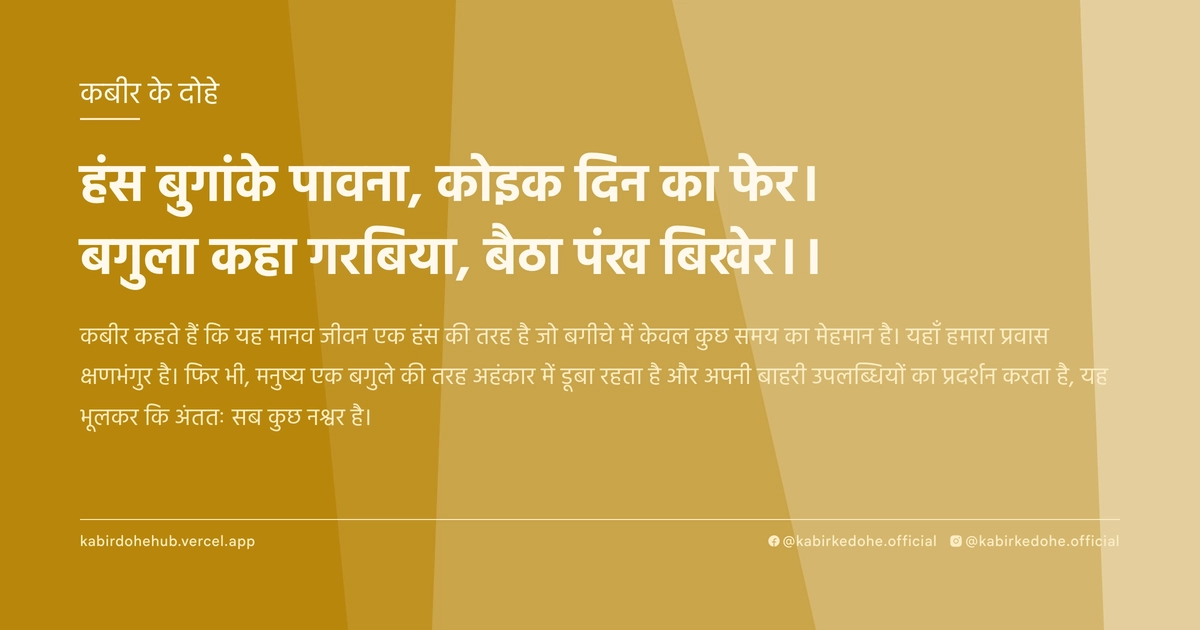
हंस बुगांके पावना, कोइक दिन का फेर।
बगुला कहा गरबिया, बैठा पंख बिखेर।।
Hans buganke pavna, koik din ka pher. Bagula kaha garbiya, baitha pankh bikher.
इस पृष्ठ पर इस कबीर दोहे का अर्थ (meaning), हिंदी व्याख्या और अंग्रेज़ी अनुवाद, दार्शनिक विश्लेषण और व्यावहारिक जीवन सीख दी गई है। यह दोहा अनित्य (Impermanence) विषय से जुड़ा है — Kabir doha meaning and explanation in Hindi and English.
अर्थ (Meaning):
कबीर कहते हैं कि यह मानव जीवन एक हंस की तरह है जो बगीचे में केवल कुछ समय का मेहमान है। यहाँ हमारा प्रवास क्षणभंगुर है। फिर भी, मनुष्य एक बगुले की तरह अहंकार में डूबा रहता है और अपनी बाहरी उपलब्धियों का प्रदर्शन करता है, यह भूलकर कि अंततः सब कुछ नश्वर है।
Kabir explains that human existence is like a swan visiting a garden—a guest for only a fleeting moment. Our stay in this physical realm is temporary. Yet, man behaves like a heron, consumed by pride and flaunting his superficial attributes, forgetting that all worldly possessions and status are transient.
व्याख्या (Interpretation):
इस दोहे में 'हंस' शुद्ध आत्मा का प्रतीक है और 'बगुल' अहंकार से ग्रस्त मन का। शाब्दिक अर्थ यह है कि जीवन छोटा है, लेकिन आध्यात्मिक अर्थ यह है कि हम माया के मोह में फंसकर अपनी वास्तविक प्रकृति को भूल गए हैं। निर्गुण भक्ति के अनुसार, आत्मा (हंस) इस संसार में केवल आत्म-साक्षात्कार के लिए आई है। जब हम 'बगुला' बनते हैं, तो हम द्वैत में जीते हैं, जहाँ हम स्वयं को दूसरों से श्रेष्ठ मानते हैं। यह विरोधाभास है कि जो आत्मा अनंत है, वह क्षणभंगुर शरीर के अहंकार में कैद है। अद्वैत वेदांत के नजरिए से, यह अहंकार ही वह पर्दा है जो हमें ब्रह्म से अलग करता है।
In this couplet, the 'Swan' symbolizes the pure soul, while the 'Heron' represents the ego-driven mind. Literally, it speaks of life's brevity, but metaphorically, it addresses how we are trapped in Maya (illusion). According to Nirgun Bhakti, the soul (Swan) is a guest in this world, visiting only to realize its divine source. When we act as the 'Heron,' we exist in duality, mistakenly believing our social status or physical form makes us superior. The central paradox lies in the infinite Atman being imprisoned by the finite ego of the body. From the lens of Advaita Vedanta, this pride is the veil that obscures the non-duality of the self and the Absolute.
दार्शनिक विश्लेषण (Philosophical Analysis):
कबीर का यह दोहा उस समय के सामाजिक और धार्मिक पाखंड पर कड़ा प्रहार है जहाँ लोग केवल बाहरी वेशभूषा और कर्मकांडों से अपनी श्रेष्ठता सिद्ध करते थे। कबीर ने देखा कि कैसे लोग धर्म के नाम पर अहंकार पालते हैं, जबकि वास्तविक आध्यात्मिकता 'शून्य' होने में है।
यह विचार सूफी मत के 'फना' (अहंकार का विनाश) के करीब है। जब तक मनुष्य स्वयं को एक अलग इकाई मानता है, वह बगुले की तरह अपनी पंख फैलाकर गर्व करता है। लेकिन जब वह यह समझ जाता है कि वह केवल एक 'पावना' (अतिथि) है, तब उसका अहंकार पिघल जाता है।
अद्वैत वेदांत के अनुसार, यह संसार एक स्वप्न की तरह है। बगुले का गर्व उस व्यक्ति की तरह है जो सपने में राजा बनकर गर्व करता है, जबकि जागने पर वह पाता है कि वह केवल एक साधारण मनुष्य था। कबीर यहाँ चेतावनी दे रहे हैं कि भौतिक उपलब्धियाँ केवल भ्रम हैं।
निर्गुण भक्ति का मार्ग हमें सिखाता है कि ईश्वर किसी मंदिर या मस्जिद में नहीं, बल्कि अहंकार के विसर्जन में मिलता है। बगुला अपनी चंचलता और चालाकी के लिए जाना जाता है, जो माया के खेल का प्रतीक है। हंस की शांति और पवित्रता ही वह लक्ष्य है जिसे साधक को प्राप्त करना है।
अंततः, कबीर यह समझाते हैं कि मृत्यु अटल है। जब समय समाप्त होगा, तो न तो पद काम आएगा और न ही प्रतिष्ठा। केवल वह प्रेम और सत्य बचेगा जो हमने निस्वार्थ भाव से जिया। अहंकार का त्याग ही वास्तविक मुक्ति का द्वार है।
Kabir's verse is a sharp critique of the social and religious hypocrisy of his era, where individuals sought superiority through outward appearances and rigid rituals. He observed how people cultivated spiritual pride, whereas true spirituality lies in becoming 'nothing'—the void of ego.
This philosophy aligns closely with the Sufi concept of 'Fana' (the annihilation of the self). As long as a human perceives themselves as a separate, superior entity, they are like the heron, flaunting their wings. However, once they realize they are merely a 'guest' (Pavna), the ego dissolves into the universal consciousness.
According to Advaita Vedanta, the material world is an illusion (Maya). The heron's pride is akin to a person dreaming they are a king, only to wake up and realize their true, humble nature. Kabir warns that material achievements are merely transient shadows.
The path of Nirgun Bhakti teaches that the Formless Divine is found not in temples or mosques, but in the dissolution of the 'I'. The heron, known for its cunning and restlessness, symbolizes the distractions of the mind, while the swan represents the purity and stillness of the realized soul.
Ultimately, Kabir emphasizes the inevitability of death. When the tenure ends, neither rank nor reputation will accompany the soul. Only the truth and love lived selflessly will remain. The surrender of the ego is the only gateway to liberation.
मूल संदेश (Core Message):
- अहंकार एक भ्रम है जो आत्मा को सत्य से दूर करता है।
- जीवन एक अल्पकालिक यात्रा है, इसे गर्व में नहीं, प्रेम में बिताएं।
- बाहरी चमक-धमक केवल माया का पर्दा है।
- विनम्रता ही वह कुंजी है जो ईश्वर के द्वार खोलती है।
- स्वयं को एक अतिथि मानें, मालिक नहीं।
- Ego is a delusion that severs the soul from the Truth.
- Life is a brief transit; spend it in love, not in pride.
- External brilliance is merely a veil of Maya.
- Humility is the only key that unlocks the gates of the Divine.
- View yourself as a guest in this world, not as its owner.
व्यावहारिक उदाहरण (Practical Example):
वाराणसी के एक पुराने घाट पर माधव नाम का एक वृद्ध बुनकर रहता था। वह अपनी महीन रेशमी साड़ियों के लिए पूरे शहर में प्रसिद्ध था। उसकी कला इतनी बेजोड़ थी कि बड़े-बड़े सेठ उसके सामने झुकते थे। धीरे-धीरे माधव के मन में यह अहंकार बैठ गया कि उसके बिना शहर की शान अधूरी है। वह अब अन्य बुनकरों को तुच्छ समझने लगा और अपनी श्रेष्ठता का प्रदर्शन करने लगा।
एक दिन माधव की मुलाकात एक घुमक्कड़ साधु से हुई। साधु ने माधव की सबसे महंगी साड़ी देखी और मुस्कुराते हुए पूछा, "इस कपड़े की उम्र कितनी है?" माधव ने गर्व से कहा, "यह सालों साल चलेगी!"
साधु ने शांति से जवाब दिया, "कपड़ा तो चलेगा, लेकिन इसे पहनने वाला शरीर तो एक दिन मिट्टी में मिल जाएगा। फिर इस रेशम की चमक का क्या मोल?"
माधव को लगा जैसे किसी ने उसके अहंकार पर चोट की हो। उसने महसूस किया कि वह पिछले कई वर्षों से केवल एक 'बगुला' बना हुआ था, जो अपनी कला के पंख फैलाकर दूसरों को छोटा दिखा रहा था।
उस रात माधव सो नहीं सका। उसने सोचा कि वह जिसे अपनी उपलब्धि मान रहा था, वह वास्तव में केवल एक साधन था, साध्य नहीं। उसने महसूस किया कि उसकी पहचान उसकी साड़ियों से नहीं, बल्कि उसके भीतर की करुणा से होनी चाहिए।
अगले दिन से माधव का व्यवहार बदल गया। उसने अपनी कला का उपयोग केवल धन कमाने के लिए नहीं, बल्कि गरीब बच्चों को बुनाई सिखाने के लिए करना शुरू किया।
उसने अपने अहंकार के पंखों को समेट लिया और एक विनम्र सेवक बन गया। उसने पाया कि जब उसने दूसरों को छोटा समझना बंद किया, तो उसे एक ऐसी आंतरिक शांति मिली जो उसकी महंगी साड़ियों से कहीं अधिक मूल्यवान थी।
माधव अब जान चुका था कि वह इस दुनिया में एक मेहमान है। उसने अपनी कला को ईश्वर की सेवा माना और जीवन के अंतिम समय तक विनम्रता के साथ जीता रहा।
On an ancient ghat in Varanasi lived an elderly weaver named Madhav. He was renowned throughout the city for his exquisite silk sarees. His craft was so peerless that wealthy merchants bowed before him. Gradually, an ego took root in Madhav's heart; he believed the city's prestige depended on him. He began to look down upon other weavers, flaunting his superiority.
One day, Madhav met a wandering monk. The monk looked at Madhav's most expensive saree and asked with a smile, "What is the lifespan of this cloth?"
Madhav replied proudly, "It will last for years!"
The monk calmly responded, "The cloth may last, but the body wearing it will one day return to dust. Then, what value does the shimmer of this silk hold?"
Madhav felt as if a blow had been struck to his ego. He realized he had been acting like a 'heron' for years, spreading the wings of his skill only to make others feel small.
Madhav could not sleep that night. He contemplated that what he considered his achievement was merely a tool, not the ultimate destination. He realized his identity should be defined by compassion, not by his creations.
From the next day, Madhav's behavior transformed. He stopped using his art solely for profit and began teaching weaving to underprivileged children for free.
He folded the wings of his pride and became a humble servant of his craft. He discovered that once he stopped belittling others, he attained an inner peace far more valuable than any silk saree.
Madhav now understood that he was merely a guest in this world. He viewed his art as a service to the Divine and lived the remainder of his days in profound humility.
अभ्यास मार्गदर्शन (Practice Guidance):
- प्रतिदिन 15 मिनट मौन रहकर यह चिंतन करें कि आपका शरीर और आपकी उपलब्धियाँ अस्थायी हैं।
- एक डायरी लिखें जिसमें उन क्षणों को दर्ज करें जब आपने अपनी श्रेष्ठता सिद्ध करने के लिए दूसरों को नीचा दिखाया, और फिर उसे क्षमा करें।
- व्यवहार परिवर्तन: दिन में कम से कम एक बार किसी ऐसे व्यक्ति की मदद करें जिससे आपको कोई लाभ न मिले, बिना उसे बताए।
- निदान चेकलिस्ट: क्या आप अपनी प्रशंसा सुनकर उत्साहित होते हैं? क्या आप दूसरों की सफलता से ईर्ष्या करते हैं? यदि हाँ, तो आप 'बगुला' मोड में हैं।
- Spend 15 minutes in silence daily, contemplating the transience of your physical body and worldly achievements.
- Maintain a journal to record moments where you sought to prove your superiority over others, and then consciously practice forgiveness.
- Behavioral Shift: At least once a day, perform a selfless act of service for someone from whom you can gain nothing, without announcing it.
- Diagnostic Checklist: Do you feel an adrenaline rush when praised? Do you feel a sting of jealousy at another's success? If yes, you are currently in 'Heron' mode.
चिंतन प्रश्न (Reflection Questions):
- यदि आज आपकी सारी उपाधियाँ और संपत्ति छीन ली जाए, तो आपकी पहचान क्या रह जाएगी?
- आपकी कौन सी 'उपलब्धियाँ' वास्तव में आपके अहंकार को पोषण दे रही हैं?
- क्या आप अपनी डिजिटल पहचान (सोशल मीडिया) के माध्यम से एक 'बगुला' बन रहे हैं?
- वह कौन सा डर है जो आपको विनम्र होने से रोकता है?
- क्या आप वास्तव में दूसरों की मदद करते हैं, या मदद करके अपनी श्रेष्ठता का अनुभव करना चाहते हैं?
- If all your titles and possessions were stripped away today, what would remain of your identity?
- Which of your 'achievements' are actually feeding your ego rather than your soul?
- Are you becoming a 'heron' through your digital persona and social media validation?
- What is the underlying fear that prevents you from being truly humble?
- Do you help others for their benefit, or to experience the feeling of being a benefactor?