
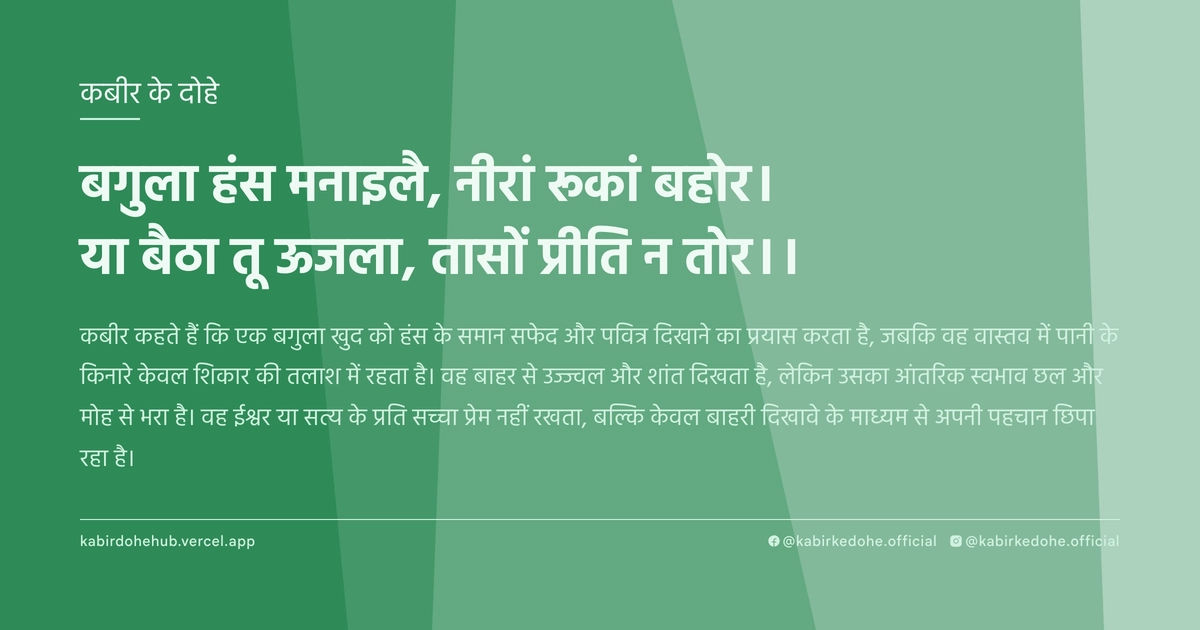
बगुला हंस मनाइलै, नीरां रूकां बहोर।
या बैठा तू ऊजला, तासों प्रीति न तोर।।
Bagula hans manailai, neeran rukan bahor. Ya baitha tu ujla, tason preeti na tor.
इस पृष्ठ पर इस कबीर दोहे का अर्थ (meaning), हिंदी व्याख्या और अंग्रेज़ी अनुवाद, दार्शनिक विश्लेषण और व्यावहारिक जीवन सीख दी गई है। यह दोहा भक्ति (Bhakti) विषय से जुड़ा है — Kabir doha meaning and explanation in Hindi and English.
अर्थ (Meaning):
कबीर कहते हैं कि एक बगुला खुद को हंस के समान सफेद और पवित्र दिखाने का प्रयास करता है, जबकि वह वास्तव में पानी के किनारे केवल शिकार की तलाश में रहता है। वह बाहर से उज्ज्वल और शांत दिखता है, लेकिन उसका आंतरिक स्वभाव छल और मोह से भरा है। वह ईश्वर या सत्य के प्रति सच्चा प्रेम नहीं रखता, बल्कि केवल बाहरी दिखावे के माध्यम से अपनी पहचान छिपा रहा है।
Kabir observes that a heron attempts to masquerade as a swan, appearing white and pure, while it actually waits by the water's edge solely to hunt. Though it looks luminous and serene from the outside, its inner nature is driven by deceit and craving. It possesses no genuine love for the Divine or Truth, using external purity as a veil to hide its predatory instincts.
व्याख्या (Interpretation):
यह दोहा पाखंड और आध्यात्मिक दिखावे पर एक तीखा प्रहार है। बगुला यहाँ उस साधक का प्रतीक है जो बाहरी कर्मकांडों, सफेद वस्त्रों या धार्मिक शब्दावली का उपयोग करके स्वयं को 'हंस' (शुद्ध आत्मा) सिद्ध करता है, जबकि उसका मन अभी भी सांसारिक वासनाओं और अहंकार में लिप्त है। 'नीरां रूकां' उस स्थिति को दर्शाता है जहाँ व्यक्ति सत्य के करीब तो है, लेकिन उसका उद्देश्य केवल स्वार्थ है। निर्गुण भक्ति के संदर्भ में, यह आत्मा और माया के बीच के द्वंद्व को दर्शाता है; जहाँ माया व्यक्ति को भ्रमित करती है कि वह पवित्र है, जबकि वास्तव में वह केवल अपनी छवि को संवार रहा है। अद्वैत वेदांत के अनुसार, जब तक 'मैं' और 'मेरा' का भाव बना रहता है, तब तक बाहरी उज्ज्वलता केवल एक भ्रम है। वास्तविक पवित्रता आंतरिक रूपांतरण से आती है, न कि बाहरी अनुकरण से।
This couplet is a sharp critique of hypocrisy and spiritual pretension. The heron symbolizes the seeker who employs external rituals, white garments, or religious jargon to project the image of a 'swan' (the pure soul), while the mind remains entangled in worldly desires and ego. 'Neeran rukan' represents the state of being near the Truth but motivated solely by self-interest. In the context of Nirgun Bhakti, this illustrates the conflict between the Soul and Maya; Maya deceives the individual into believing they are pure, while they are merely polishing their public image. According to Advaita Vedanta, as long as the sense of 'I' and 'mine' persists, external luminosity is a mere illusion. True purity emerges from internal transformation, not from external imitation.
दार्शनिक विश्लेषण (Philosophical Analysis):
कबीर का यह दोहा उनके युग के धार्मिक पाखंड के विरुद्ध एक विद्रोह है। उस समय, कई लोग केवल तिलक लगाकर या विशेष वस्त्र पहनकर स्वयं को उच्च आध्यात्मिक श्रेणी में रखते थे, जबकि उनके आचरण में करुणा और सत्य का अभाव था। कबीर यहाँ 'बगुला' और 'हंस' के माध्यम से एक गहरा मनोवैज्ञानिक अंतर स्पष्ट करते हैं। बगुला अवसरवादी है, जबकि हंस विवेक का प्रतीक है जो दूध और पानी को अलग कर सकता है।
दार्शनिक स्तर पर, यह सूफी मत के 'नफ्स' (अहंकार/इच्छा) के विचार से मेल खाता है, जहाँ साधक को अपने निचले स्वभाव को पहचानकर उसे नष्ट करना होता है। यदि कोई व्यक्ति अपनी बुराइयों को स्वीकार किए बिना पवित्रता का ढोंग करता है, तो वह आध्यात्मिक प्रगति के मार्ग को अवरुद्ध कर देता है। यह अद्वैत वेदांत के उस सिद्धांत की पुष्टि करता है कि अज्ञान (Avidya) ही वह पर्दा है जो हमें सत्य देखने से रोकता है।
कबीर का विरोध केवल व्यक्तियों से नहीं, बल्कि उस व्यवस्था से था जो बाहरी प्रतीकों को आंतरिक बोध से ऊपर रखती थी। वे तर्क देते हैं कि ईश्वर किसी विशेष रंग, वस्त्र या जाति में नहीं, बल्कि शुद्ध हृदय में निवास करता है। ritualism (कर्मकांड) जब केवल प्रदर्शन बन जाता है, तो वह आध्यात्मिक विकास के बजाय अहंकार को पुष्ट करता है।
मनोवैज्ञानिक रूप से, यह 'कॉग्निटिव डिसोनेंस' की स्थिति है, जहाँ व्यक्ति अपनी वास्तविक पहचान और अपनी आदर्श छवि के बीच संघर्ष करता है। जब तक यह आंतरिक द्वंद्व समाप्त नहीं होता, तब तक 'प्रीति' (दिव्य प्रेम) संभव नहीं है। प्रेम वह है जो बंधन तोड़ दे, जबकि बगुले का प्रेम केवल अपनी भूख मिटाने का एक साधन है।
अंततः, कबीर यह संदेश देते हैं कि सत्य की खोज के लिए सबसे पहले स्वयं के प्रति ईमानदार होना आवश्यक है। बिना आत्म-साक्षात्कार के, कोई भी साधना केवल एक सामाजिक मुखौटा है। वास्तविक मुक्ति तब मिलती है जब हम बगुले की चालाकी को त्यागकर हंस की सहजता और विवेक को अपनाते हैं।
This couplet is a rebellion against the religious hypocrisy of Kabir's era. At the time, many individuals claimed high spiritual status simply by wearing specific marks or garments, while their conduct lacked compassion and truth. Kabir uses the 'heron' and the 'swan' to clarify a profound psychological distinction: the heron is opportunistic, whereas the swan symbolizes discernment (Viveka), capable of separating milk from water.
Philosophically, this aligns with the Sufi concept of 'Nafs' (the ego/lower self), where the seeker must recognize and annihilate their lower nature. If a person pretends to be pure without acknowledging their flaws, they block their own spiritual progress. This confirms the Advaita Vedanta principle that ignorance (Avidya) is the veil preventing the realization of Truth.
Kabir's opposition was not merely toward individuals, but toward a system that prioritized external symbols over internal realization. He argues that the Divine resides not in a specific color, garment, or caste, but in a pure heart. When ritualism becomes a performance, it reinforces the ego rather than fostering spiritual growth.
Psychologically, this represents a state of cognitive dissonance, where an individual struggles between their actual identity and their idealized self-image. Until this internal conflict is resolved, 'Preeti' (Divine Love) remains impossible. True love is that which breaks bonds, whereas the heron's 'love' is merely a tool to satisfy its hunger.
Ultimately, Kabir conveys that honesty with oneself is the prerequisite for the search for Truth. Without self-realization, any spiritual practice is merely a social mask. True liberation occurs when we discard the cunning of the heron and embrace the naturalness and discernment of the swan.
मूल संदेश (Core Message):
- बाहरी पवित्रता केवल एक आवरण है, आंतरिक सत्य ही वास्तविक है।
- अहंकार का मुखौटा उतारना ही आध्यात्मिक यात्रा की पहली सीढ़ी है।
- दिखावे की भक्ति ईश्वर को नहीं, बल्कि केवल स्वयं के अहंकार को संतुष्ट करती है।
- विवेक वह शक्ति है जो हमें बगुले की चालाकी से हंस की सरलता की ओर ले जाती है।
- सच्चा प्रेम वह है जिसमें 'मैं' का विलोपन हो, न कि 'मैं' का प्रदर्शन।
- External purity is but a veil; internal truth is the only reality.
- Shedding the mask of ego is the first step on the spiritual path.
- Performative devotion satisfies the ego, not the Divine.
- Discernment is the power that leads us from the cunning of the heron to the simplicity of the swan.
- True love is the dissolution of the 'I', not the exhibition of the 'I'.
व्यावहारिक उदाहरण (Practical Example):
एक समय की बात है, बनारस के घाटों पर एक वृद्ध विधवा रहती थी, जिसका नाम जानकी था। जानकी पूरे शहर में अपनी अत्यधिक धार्मिकता के लिए जानी जाती थी। वह सुबह चार बजे उठती, गंगा में स्नान करती, घंटों जप करती और हमेशा सफेद सूती साड़ी पहनती। लोग उसे 'पवित्र आत्मा' कहते थे और उससे आशीर्वाद लेने आते थे।
लेकिन जानकी के भीतर एक गहरा अंधेरा था। वह अपने मोहल्ले की अन्य गरीब महिलाओं के प्रति अत्यंत कठोर थी। यदि कोई गलती से उसके घर के सामने कचरा डाल देता, तो वह उन्हें नीची जाति का कहकर अपमानित करती और उनके चरित्र पर कीचड़ उछालती। उसकी बाहरी 'उज्ज्वलता' केवल दूसरों को नीचा दिखाने का एक हथियार थी।
एक दिन, एक घुमक्कड़ फकीर उसके पास आया। उसने देखा कि जानकी एक छोटी बच्ची को इसलिए डाँट रही थी क्योंकि उसने गलती से उसके आंगन में पैर रख दिया था। फकीर ने मुस्कुराते हुए कहा, "माता, आपका सफेद वस्त्र तो बहुत चमक रहा है, लेकिन क्या आपके भीतर का बगुला सो गया है? या वह अभी भी शिकार की तलाश में है?"
जानकी को पहले तो यह बात चुभी, लेकिन फिर उसने गौर किया कि वह वास्तव में क्या कर रही थी। वह धर्म का उपयोग अपनी श्रेष्ठता सिद्ध करने के लिए कर रही थी, न कि प्रेम फैलाने के लिए। उसे एहसास हुआ कि उसकी भक्ति केवल एक मुखौटा थी, ठीक उसी बगुले की तरह जो हंस होने का ढोंग करता है।
उस रात जानकी सो नहीं सकी। उसने महसूस किया कि उसकी सारी पूजा व्यर्थ थी क्योंकि उसके हृदय में करुणा नहीं थी। उसने अपनी बंद आँखों से देखा कि वह कैसे अपनी 'पवित्रता' के अहंकार में दूसरों को चोट पहुँचा रही थी।
अगली सुबह, जानकी ने अपनी दिनचर्या नहीं बदली, लेकिन अपना दृष्टिकोण बदल लिया। उसने सबसे पहले उस बच्ची को बुलाया और उसे मिठाई खिलाई। उसने उन महिलाओं से माफी मांगी जिन्हें उसने अपमानित किया था।
धीरे-धीरे, उसकी धार्मिकता प्रदर्शन से हटकर सेवा में बदल गई। अब वह केवल जप नहीं करती थी, बल्कि बीमारों की सेवा करती और भूखों को भोजन कराती। उसने सीखा कि असली 'हंस' वह नहीं है जो सफेद दिखता है, बल्कि वह है जिसका मन निर्मल है।
उसका जीवन अब एक प्रदर्शन नहीं, बल्कि एक प्रार्थना बन गया था। उसने पाया कि जब अहंकार का बगुला मर जाता है, तब प्रेम का हंस स्वतः प्रकट हो जाता है।
Once, on the ghats of Varanasi, lived an elderly widow named Janaki. She was renowned throughout the city for her extreme piety. She woke at four in the morning, bathed in the Ganges, chanted for hours, and always wore a pristine white cotton saree. People called her a 'pure soul' and came to seek her blessings.
However, within Janaki lay a deep darkness. She was incredibly harsh toward the other poor women in her neighborhood. If someone accidentally dropped litter near her house, she would insult them, citing their lower caste, and slander their character. Her external 'luminosity' was merely a weapon to belittle others.
One day, a wandering fakir arrived. He observed Janaki scolding a small child simply because the child had accidentally stepped into her courtyard. The fakir smiled and said, "Mother, your white garment shines brightly, but has the heron within you fallen asleep? Or is it still searching for prey?"
Initially, Janaki felt stung, but then she reflected on her actions. She realized she was using religion to prove her superiority rather than to spread love. She understood that her devotion was merely a mask, just like the heron pretending to be a swan.
Janaki could not sleep that night. She felt that all her prayers were futile because her heart lacked compassion. With closed eyes, she saw how she had been hurting others through the ego of her 'purity'.
The next morning, Janaki did not change her routine, but she changed her perspective. She first called the child and gave her sweets. She apologized to the women she had insulted.
Gradually, her religiosity shifted from performance to service. She no longer just chanted; she tended to the sick and fed the hungry. She learned that a true 'swan' is not one who appears white, but one whose mind is stainless.
Her life ceased to be a performance and became a prayer. She discovered that when the heron of ego dies, the swan of love manifests spontaneously.
अभ्यास मार्गदर्शन (Practice Guidance):
- प्रतिदिन 15 मिनट मौन आत्म-अवलोकन करें। विचार करें कि आप दुनिया को क्या दिखाना चाहते हैं और वास्तव में आप क्या हैं।
- एक 'ईमानदारी जर्नल' लिखें। उन क्षणों को दर्ज करें जब आपने अपनी छवि बचाने के लिए झूठ बोला या किसी को नीचा दिखाया।
- व्यवहार परिवर्तन: जब भी आप किसी की आलोचना करें, रुकें और पूछें, "क्या यह मेरी करुणा बोल रही है या मेरा आंतरिक बगुला?"
- डायग्नोस्टिक चेकलिस्ट: क्या मैं दूसरों की प्रशंसा के बिना भी धर्म का पालन करता हूँ? क्या मेरी पवित्रता दूसरों के लिए भय या सम्मान का कारण बनती है या प्रेम का? क्या मैं अपनी गलतियों को स्वीकार करने में सहज हूँ?
- Practice 15 minutes of silent self-observation daily. Contemplate what you wish to project to the world versus who you actually are.
- Maintain an 'Honesty Journal'. Record moments where you lied or belittled someone simply to protect your public image.
- Behavioral Shift: Whenever you criticize someone, pause and ask, "Is this my compassion speaking, or my inner heron?"
- Diagnostic Checklist: Do I practice my faith even without external validation? Does my purity evoke fear/respect or genuine love in others? Am I comfortable admitting my flaws?
चिंतन प्रश्न (Reflection Questions):
- मेरे जीवन का वह कौन सा 'सफेद वस्त्र' है जिसे मैं दुनिया को दिखाने के लिए पहनता हूँ, जबकि अंदर मैं अशांत हूँ?
- क्या मेरी धार्मिक या नैतिक पहचान मुझे वास्तव में विनम्र बना रही है, या यह मुझे दूसरों से श्रेष्ठ महसूस कराने का साधन बन गई है?
- यदि मेरी सारी सामाजिक प्रतिष्ठा और उपाधियाँ छीन ली जाएँ, तो क्या मेरे भीतर कुछ ऐसा बचेगा जिसे मैं 'पवित्र' कह सकूँ?
- मैं किन परिस्थितियों में 'बगुला' बन जाता हूँ—अर्थात, कहाँ मैं अपनी छवि को बचाने के लिए सत्य का त्याग करता हूँ?
- क्या मेरा प्रेम वास्तव में निःस्वार्थ है, या यह केवल मेरी अपनी आध्यात्मिक भूख को मिटाने का एक तरीका है?
- What is the 'white garment' in my life that I wear for the world while remaining turbulent inside?
- Is my religious or moral identity making me truly humble, or has it become a tool to feel superior to others?
- If all my social prestige and titles were stripped away, would there be anything left within me that I could call 'pure'?
- In what situations do I become the 'heron'—where do I sacrifice truth to preserve my image?
- Is my love truly selfless, or is it merely a way to satisfy my own spiritual hunger?