
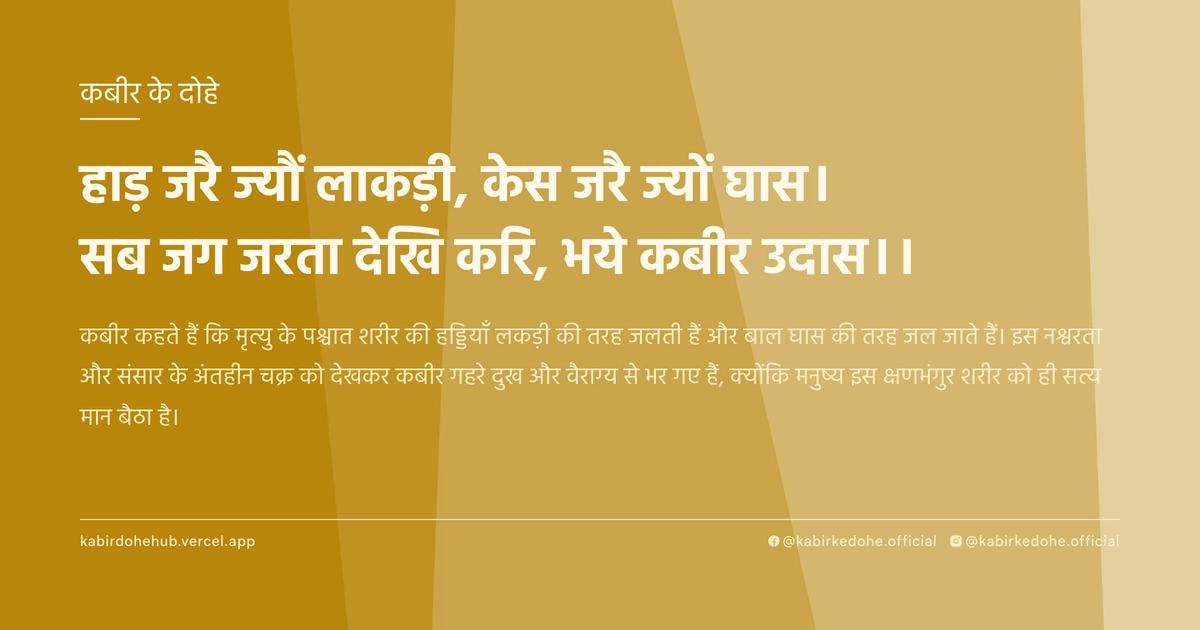
हाड़ जरै ज्यौं लाकड़ी, केस जरै ज्यों घास।
सब जग जरता देखि करि, भये कबीर उदास।।
Haad jarai jyaun lakadi, kes jarai jyaun ghaas. Sab jag jarta dekh kari, bhaye kabir udaas.
इस पृष्ठ पर इस कबीर दोहे का अर्थ (meaning), हिंदी व्याख्या और अंग्रेज़ी अनुवाद, दार्शनिक विश्लेषण और व्यावहारिक जीवन सीख दी गई है। यह दोहा मृतुक्यता (Mortality) विषय से जुड़ा है — Kabir doha meaning and explanation in Hindi and English.
अर्थ (Meaning):
कबीर कहते हैं कि मृत्यु के पश्चात शरीर की हड्डियाँ लकड़ी की तरह जलती हैं और बाल घास की तरह जल जाते हैं। इस नश्वरता और संसार के अंतहीन चक्र को देखकर कबीर गहरे दुख और वैराग्य से भर गए हैं, क्योंकि मनुष्य इस क्षणभंगुर शरीर को ही सत्य मान बैठा है।
Kabir observes that upon death, the bones of the body burn like dry wood and the hair vanishes like scorched grass. Witnessing the inevitable incineration of all worldly existence, Kabir is overcome with a profound, mystical sorrow, mourning how humanity clings to a transient physical form as if it were eternal.
व्याख्या (Interpretation):
शाब्दिक अर्थ में यह दोहा श्मशान की अग्नि का वर्णन है, परंतु आध्यात्मिक स्तर पर यह 'माया' के जलने की बात करता है। यहाँ 'हड्डियाँ' और 'बाल' केवल शारीरिक अंग नहीं, बल्कि अहंकार और सांसारिक आसक्तियों के प्रतीक हैं। कबीर यह समझाते हैं कि जिस शरीर पर मनुष्य गर्व करता है, वह अंततः राख में बदल जाता है। यह विरह और उदासी वास्तव में एक 'दिव्य शोक' है, जो साधक को यह एहसास कराता है कि केवल 'निर्गुण ब्रह्म' ही शाश्वत है। जब व्यक्ति यह समझता है कि वह शरीर नहीं बल्कि आत्मा है, तब वह द्वैत से मुक्त होकर अद्वैत की ओर बढ़ता है।
Literally, this couplet describes the cremation pyre, but metaphorically, it speaks of the incineration of 'Maya' (illusion). The 'bones' and 'hair' represent the rigid structures of ego and the fleeting attachments of desire. Kabir suggests that the pride humans take in their physical identity is a delusion, as the body is merely fuel for the fire of time. The 'sadness' mentioned is not worldly depression but a 'divine melancholy'—a catalyst for awakening. It highlights the central paradox: we spend our lives decorating a house that is destined to burn, ignoring the eternal Atman that survives the flames. This realization bridges the gap between the transient self and the non-dual Brahman.
दार्शनिक विश्लेषण (Philosophical Analysis):
कबीर का यह दोहा मध्यकालीन भारत के उस सामाजिक परिवेश में लिखा गया जहाँ कर्मकांड और बाहरी दिखावे का बोलबाला था। कबीर ने ritualism का विरोध करते हुए यह दिखाया कि अंत में न जाति, न धर्म और न ही धन काम आता है; केवल आत्मा का सत्य शेष रहता है। यह विचार अद्वैत वेदान्त के करीब है, जहाँ शरीर को एक मिथ्या आवरण माना गया है।
सूफी मत के 'फना' (अहंकार का विनाश) के सिद्धांत की तरह, यहाँ भी जलने की प्रक्रिया का वर्णन है। लेकिन यह जलना केवल मृत्यु के बाद नहीं, बल्कि जीवित रहते हुए अपनी वासनाओं को जलाने का आह्वान है। कबीर का 'उदासी' भाव वास्तव में करुणा है—उन लोगों के प्रति जो सोने के पिंजरे (शरीर) को अपना घर समझ रहे हैं।
यहाँ मनोवैज्ञानिक स्तर पर 'मृत्यु बोध' (Memento Mori) का उपयोग किया गया है। जब मनुष्य अपनी नश्वरता को गहराई से स्वीकार करता है, तब उसका अहंकार स्वतः ही ढहने लगता है। कबीर यह स्पष्ट करते हैं कि जो व्यक्ति शरीर के विनाश से डरता है, वह वास्तव में कभी जीवित ही नहीं था, क्योंकि जीवन केवल चेतना में है, मांस और हड्डियों में नहीं।
यह दोहा हमें सिखाता है कि वैराग्य का अर्थ संसार को छोड़ना नहीं, बल्कि संसार के प्रति मोह को छोड़ना है। जब हम देखते हैं कि सब कुछ जल रहा है, तब हम उस 'अविनाशी' की खोज शुरू करते हैं जो अग्नि से परे है। यह भौतिकता से आध्यात्मिकता की ओर संक्रमण की प्रक्रिया है।
अंततः, कबीर का संदेश यह है कि बाहरी पवित्रता और आडंबर व्यर्थ हैं। असली शुद्धि वह है जो आंतरिक अग्नि (ज्ञान) द्वारा की जाए, ताकि जब भौतिक शरीर जले, तब आत्मा शुद्ध और मुक्त होकर परमात्मा में विलीन हो सके।
Written during a period of intense ritualism in medieval India, Kabir's verse serves as a visceral critique of the obsession with external forms. By reducing the human body to 'wood' and 'grass,' he strips away the illusions of caste, creed, and social hierarchy, asserting that the cremation fire is the ultimate equalizer. This aligns with Advaita Vedanta, which posits that the physical body is a superimposition (Adhyasa) upon the true Self.
There is a strong resonance with the Sufi concept of 'Fana'—the annihilation of the lower self to realize the Higher Truth. Kabir's 'burning' is not merely a biological end but a spiritual necessity. To reach the Divine, the ego-centric identity must be incinerated. The 'sadness' Kabir expresses is a form of 'Ishq-e-Haqiqi' (Divine Love), where the soul grieves for its separation from the Source while witnessing the blindness of other souls.
Psychologically, Kabir employs the 'Memento Mori' technique. By forcing the reader to visualize their own decay, he triggers a cognitive shift from 'attachment' to 'detachment.' He corrects the misconception that spirituality is about escaping the world; rather, it is about seeing the world as it truly is—transient and illusory.
This teaching emphasizes that the only way to escape the cycle of birth and death (Samsara) is through the realization of the Nirgun (formless) aspect of God. If one identifies with the 'wood' (body), they will burn; if they identify with the 'witness' (Atman), they remain untouched by the flames of time.
Ultimately, Kabir challenges the reader to undergo a 'living cremation'—to burn their greed, hatred, and pride while still breathing. This internal alchemy transforms the lead of human suffering into the gold of spiritual liberation, ensuring that when the physical fire arrives, there is nothing left to burn but a shell.
मूल संदेश (Core Message):
- शरीर केवल मिट्टी और घास है, इसे सत्य न मानें।
- अहंकार की अग्नि को जीवित रहते हुए ही जला लें।
- नश्वरता का बोध ही वास्तविक आध्यात्मिक जागृति है।
- बाहरी आडंबर राख हो जाएंगे, केवल आंतरिक प्रेम बचेगा।
- अद्वैत सत्य को पहचानें: आप शरीर नहीं, अविनाशी आत्मा हैं।
- The body is but clay and grass; do not mistake it for the Truth.
- Incinerate the ego through awareness before the fire of death arrives.
- The realization of impermanence is the gateway to spiritual awakening.
- External rituals turn to ash; only internal love remains eternal.
- Embrace the non-dual truth: You are not the body, but the indestructible Soul.
व्यावहारिक उदाहरण (Practical Example):
वाराणसी के घाटों पर रहने वाले एक वृद्ध बुनकर, माधव, का जीवन केवल रेशमी साड़ियों के धागों में सिमटा था। वह अपनी कला पर बहुत गर्व करता था और मानता था कि उसकी बनाई साड़ियाँ उसे समाज में अमर बना देंगी। वह अक्सर अपने शिष्यों को सिखाता था कि कैसे बारीकी से धागों को पिरोया जाए, लेकिन वह अपने जीवन के धागों की नश्वरता को भूल गया था।
एक दिन माधव ने अपने सबसे पुराने मित्र का अंतिम संस्कार देखा। उसने देखा कि जिस शरीर ने कभी अद्भुत कलाकृतियाँ बनाई थीं, वह अब केवल लकड़ियों के ढेर में बदल गया था। उसने महसूस किया कि वह रेशमी साड़ियाँ, जिन्हें वह अपनी पहचान मानता था, उस अग्नि के सामने कितनी तुच्छ थीं।
उसे याद आया कि उसने अपना पूरा जीवन केवल 'बाहरी सुंदरता' को संवारने में बिता दिया, जबकि उसके भीतर का मनुष्य उपेक्षित रहा। वह सोचने लगा कि क्या उसकी कला ने उसे उस शांति से मिलवाया जिसकी तलाश हर इंसान को होती है, या उसने केवल अपनी अहंकार की दीवारें ऊँची की थीं।
माधव के मन में एक गहरा शून्य पैदा हुआ। उसने महसूस किया कि वह जिसे 'स्थायी' समझ रहा था, वह वास्तव में घास की तरह जल जाने वाला था। इस अहसास ने उसे अंदर से झकझोर दिया और वह घंटों गंगा के किनारे मौन बैठा रहा।
उसने अपनी सारी जमा पूँजी और अपनी बेहतरीन साड़ियाँ उन लोगों में बाँट दीं जिनके पास पहनने को कपड़े नहीं थे। उसने अब साड़ियाँ 'प्रसिद्धि' के लिए नहीं, बल्कि 'सेवा' के लिए बनाना शुरू किया।
उसका व्यवहार बदल गया; वह अब अहंकारी गुरु नहीं, बल्कि एक विनम्र सेवक बन गया था। उसने पाया कि जब उसने अपनी 'पहचान' की आग में अपने अहंकार को जला दिया, तो उसे एक ऐसी खुशी मिली जो रेशम की चमक से कहीं अधिक थी।
गाँव के लोग हैरान थे कि माधव अब पहले से अधिक शांत और प्रसन्न रहता था। वह अब मृत्यु से डरता नहीं था, क्योंकि उसने जीवित रहते हुए ही अपनी नश्वरता को स्वीकार कर लिया था।
माधव की यह यात्रा 'अहंकार के जलने' से 'आत्मा के जागने' की यात्रा थी। उसने समझ लिया था कि असली बुनावट वह है जो आत्मा को परमात्मा से जोड़े, न कि वह जो केवल शरीर को ढके।
In the ghats of Varanasi lived an elderly weaver named Madhav, whose entire existence was woven into the threads of silk sarees. He took immense pride in his craft, believing that his exquisite designs would grant him a form of immortality in the eyes of society. He spent his days teaching disciples the precision of the loom, completely oblivious to the fragility of his own life's thread.
One evening, Madhav witnessed the funeral pyre of his oldest friend. He watched as the body, which had once created wonders of art, was reduced to mere ash and charred wood. He realized that the silk sarees he cherished as his identity were utterly insignificant before the consuming fire of death.
He reflected on how he had spent his entire life polishing 'external beauty' while leaving his internal spirit neglected. He questioned whether his art had brought him closer to the eternal peace every human seeks, or if it had merely built higher walls around his ego.
A profound void opened within Madhav. He felt the truth of Kabir's words—that everything he deemed 'permanent' was as combustible as dry grass. This realization shook him to his core, and he sat in silence by the Ganges for hours.
Driven by this awakening, Madhav began distributing his accumulated wealth and his finest sarees to those who had nothing to wear. He stopped weaving for 'fame' and started weaving as an act of 'service' and devotion.
His demeanor shifted; he was no longer the arrogant master but a humble servant of humanity. He discovered that by burning his ego in the fire of awareness, he attained a joy far more radiant than the sheen of the finest silk.
The villagers were amazed by Madhav's newfound serenity. He no longer feared death because he had accepted his mortality while still alive, transforming his fear into liberation.
Madhav's journey was the transition from the 'burning of the ego' to the 'awakening of the soul.' He understood that the only weave worth perfecting is the one that connects the individual soul to the Universal Consciousness.
अभ्यास मार्गदर्शन (Practice Guidance):
- प्रतिदिन 15 मिनट श्मशान या प्रकृति के क्षय (जैसे गिरते पत्ते) का चिंतन करें ताकि शरीर के प्रति मोह कम हो।
- एक डायरी लिखें जिसमें यह दर्ज करें कि आपकी कौन सी आदतें या विचार 'अहंकार' के हैं और उन्हें मानसिक रूप से 'जलाने' का प्रयास करें।
- सेवा कार्य करें जहाँ आप अपनी पहचान (नाम, पद) को पूरी तरह गुप्त रखें, ताकि 'अहंकार' को पोषण न मिले।
- डायग्नोस्टिक चेकलिस्ट: क्या मैं अपनी उपलब्धियों पर गर्व करता हूँ? क्या मुझे मृत्यु का भय सताता है? क्या मैं दूसरों को उनकी सामाजिक स्थिति से आंकता हूँ? (यदि हाँ, तो आप अभी भी 'माया' के प्रभाव में हैं)।
- Spend 15 minutes daily contemplating the impermanence of the body by observing nature's decay (like falling leaves) or meditating on the reality of the cremation ground.
- Maintain a journal to identify specific ego-driven thoughts and consciously 'incinerate' them through self-inquiry and detachment.
- Engage in anonymous acts of service where your identity, rank, or name remains hidden, preventing the ego from feeding on recognition.
- Diagnostic Checklist: Do I derive my worth from material achievements? Do I harbor an instinctive fear of death? Do I judge others by their social status? (If yes, the illusion of Maya still dominates your perception).
चिंतन प्रश्न (Reflection Questions):
- यदि आज मेरा सब कुछ छीन लिया जाए, तो 'मैं' कौन बचूँगा?
- मेरी कौन सी ऐसी सामाजिक पहचान है जिसे मैं खोने से सबसे ज्यादा डरता हूँ?
- क्या मेरा धर्म और मेरी आस्था मुझे मृत्यु के भय से मुक्त करती है या उसे और बढ़ाती है?
- मैं अपनी डिजिटल पहचान (सोशल मीडिया) को कितना सच मानता हूँ, जबकि वह केवल एक आभासी परछाई है?
- क्या मैं वास्तव में दूसरों की मदद करता हूँ, या केवल अपनी 'अच्छे इंसान' होने की छवि को पुष्ट करता हूँ?
- If everything I possess were stripped away today, who would 'I' actually be?
- Which social identity am I most terrified of losing, and why does it define me?
- Does my religious practice liberate me from the fear of death, or does it merely provide a facade of security?
- How much of my 'digital ego' do I mistake for my true self, knowing it is but a flickering shadow?
- Am I truly serving others, or am I merely reinforcing the image of being a 'good person' for my own validation?