
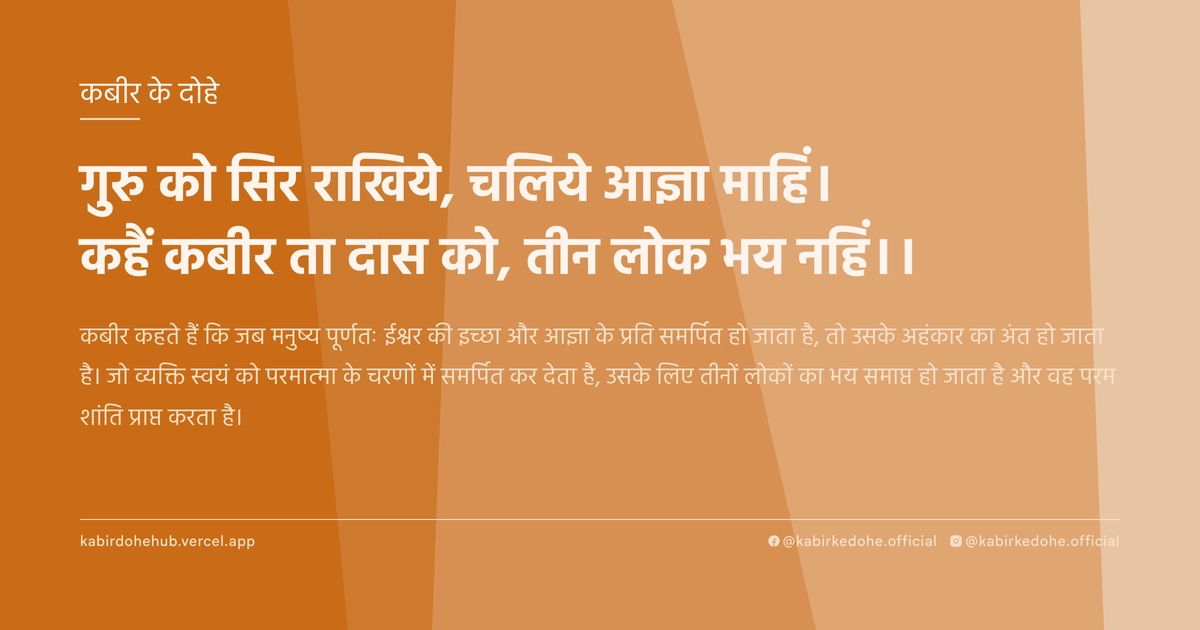
गुरु को सिर राखिये, चलिये आज्ञा माहिं।
कहैं कबीर ता दास को, तीन लोक भय नहिं।।
Guru ko sir rakhiye, chaliye aagya mahin. Kahein kabir ta daas ko, teen lok bhay nahin.
इस पृष्ठ पर इस कबीर दोहे का अर्थ (meaning), हिंदी व्याख्या और अंग्रेज़ी अनुवाद, दार्शनिक विश्लेषण और व्यावहारिक जीवन सीख दी गई है। यह दोहा प्रपत्ति (Surrender) विषय से जुड़ा है — Kabir doha meaning and explanation in Hindi and English.
अर्थ (Meaning):
कबीर कहते हैं कि जब मनुष्य पूर्णतः ईश्वर की इच्छा और आज्ञा के प्रति समर्पित हो जाता है, तो उसके अहंकार का अंत हो जाता है। जो व्यक्ति स्वयं को परमात्मा के चरणों में समर्पित कर देता है, उसके लिए तीनों लोकों का भय समाप्त हो जाता है और वह परम शांति प्राप्त करता है।
Kabir asserts that when a human being becomes completely surrendered to the Divine Will and command, the ego is annihilated. For the devotee who offers their very existence to the Almighty, the fear of the three worlds—heaven, earth, and hell—vanishes, leading to absolute liberation and peace.
व्याख्या (Interpretation):
इस दोहे का शाब्दिक अर्थ है कि अपना सिर (अहंकार) त्यागकर ईश्वर की आज्ञा में चलना चाहिए। रूपकात्मक रूप से, 'सिर' यहाँ बुद्धि और व्यक्तिगत पहचान का प्रतीक है जो अक्सर मनुष्य को सत्य से दूर रखता है। निर्गुण भक्ति के संदर्भ में, यह समर्पण किसी बाहरी मूर्ति के प्रति नहीं, बल्कि उस निराकार ब्रह्म के प्रति है जो सर्वव्यापी है। जब साधक यह अनुभव करता है कि वह और ब्रह्म एक ही हैं (अद्वैत), तो द्वैत का भय समाप्त हो जाता है। माया का पर्दा तब गिरता है जब 'मैं' का भाव 'वह' में विलीन हो जाता है। यह विरोधाभास है कि पूर्ण समर्पण के माध्यम से ही मनुष्य वास्तविक स्वतंत्रता प्राप्त करता है।
Literally, the verse suggests surrendering one's head—symbolizing the ego—to follow the Divine Command. Metaphorically, the 'head' represents the intellectual pride and the individual identity that creates a barrier between the self and the Truth. In the context of Nirgun Bhakti, this surrender is not to an external idol but to the Formless Brahman that permeates all existence. When the seeker realizes the non-duality of Atman and Brahman, the fear born of duality dissolves. The veil of Maya lifts only when the 'I' is subsumed into the 'Thou'. It is a profound paradox: only through total surrender does the human soul achieve absolute autonomy and liberation from cosmic fear.
दार्शनिक विश्लेषण (Philosophical Analysis):
कबीर का यह दर्शन उनके समय के कर्मकांडीय आडंबरों और जातिगत श्रेष्ठता के विरुद्ध एक सशक्त प्रहार था। उन्होंने सिखाया कि मोक्ष किसी विशेष मंदिर, मस्जिद या शास्त्र के अध्ययन से नहीं, बल्कि आंतरिक समर्पण और प्रेम से मिलता है। यह विचार अद्वैत वेदांत के 'अहं ब्रह्मास्मि' और सूफी मत के 'फना' (अहंकार का विनाश) के करीब है।
यहाँ 'आज्ञा' का अर्थ किसी बाहरी आदेश से नहीं, बल्कि ब्रह्मांडीय लय (Cosmic Rhythm) के साथ तालमेल बिठाना है। जब मनुष्य अपनी व्यक्तिगत इच्छाओं को सार्वभौमिक इच्छा के साथ जोड़ देता है, तो संघर्ष समाप्त हो जाता है। कबीर का तर्क है कि भय केवल वहीं होता है जहाँ 'स्व' (Ego) मौजूद होता है; यदि 'स्व' ही नहीं रहा, तो भय किसका होगा?
ऐतिहासिक रूप से, कबीर ने समाज को यह संदेश दिया कि ईश्वर किसी विशेष वर्ग की जागीर नहीं है। समर्पण का मार्ग सभी के लिए खुला है, चाहे वह बुनकर हो या राजा। यह मनोवैज्ञानिक रूपांतरण की प्रक्रिया है जहाँ व्यक्ति अपनी सीमित पहचान को छोड़कर अनंतता में प्रवेश करता है।
अक्सर लोग इस दोहे को अंध-आज्ञापालन समझ लेते हैं, जबकि कबीर यहाँ 'चेतन समर्पण' की बात कर रहे हैं। यह वह स्थिति है जहाँ विवेक यह जान लेता है कि व्यक्तिगत इच्छाएं केवल भ्रम हैं और केवल परमात्मा की इच्छा ही सत्य है।
अंततः, यह दर्शन हमें सिखाता है कि भय का मूल कारण हमारा अपनी पहचान से अत्यधिक लगाव है। जब हम इस पहचान को ईश्वर के चरणों में अर्पित कर देते हैं, तो हम तीनों लोकों के बंधनों से मुक्त हो जाते हैं, क्योंकि हम अब उस सत्ता का हिस्सा हैं जो स्वयं काल और स्थान से परे है।
Kabir's philosophy here serves as a potent critique of the ritualistic pomposity and caste-based hierarchies of his era. He taught that liberation is attained not through specific temples, mosques, or the rote study of scriptures, but through internal surrender and divine love. This perspective aligns closely with the Advaita Vedanta concept of 'Aham Brahmasmi' and the Sufi doctrine of 'Fana' (the annihilation of the self).
In this context, 'Command' (Aagya) does not refer to an external dictate but to aligning oneself with the Cosmic Rhythm. When a human synchronizes their personal will with the Universal Will, all internal and external conflict ceases. Kabir argues that fear exists only where the 'Ego' resides; if the ego is extinguished, who remains to experience fear?
Historically, Kabir signaled that the Divine is not the monopoly of any particular social class. The path of surrender is open to all, whether a weaver or a king. This is a process of psychological transformation where the individual transcends their limited identity to merge with the Infinite.
Common literalist misconceptions often mistake this for blind obedience. However, Kabir is advocating for 'conscious surrender.' This is the state where discernment realizes that personal desires are merely illusions and only the Divine Will is the ultimate reality.
Ultimately, this philosophy teaches us that the root of all fear is our excessive attachment to our perceived identity. By offering this identity at the feet of the Divine, we are liberated from the bonds of the three worlds, for we become one with the Essence that exists beyond time and space.
मूल संदेश (Core Message):
- अहंकार ही समस्त भयों का मूल कारण है।
- पूर्ण समर्पण ही वास्तविक स्वतंत्रता का एकमात्र द्वार है।
- व्यक्तिगत इच्छा का विसर्जन ही सार्वभौमिक सत्य का मिलन है।
- जब 'मैं' मिटता है, तब केवल 'वह' शेष रहता है।
- ईश्वर की आज्ञा में चलना ही परम शांति का मार्ग है।
- The ego is the root cause of all existential fears.
- Total surrender is the only gateway to authentic freedom.
- Dissolving personal will is the union with Universal Truth.
- When the 'I' vanishes, only the 'Divine' remains.
- Walking in the Divine Will is the path to ultimate peace.
व्यावहारिक उदाहरण (Practical Example):
वाराणसी के घाटों पर रहने वाली एक वृद्ध विधवा, जानकी, का जीवन अत्यंत कठिन था। वह दूसरों के घरों में छोटे-मोटे काम करके अपना गुजारा करती थी। समाज ने उसे हाशिए पर धकेल दिया था और वह हमेशा इस डर में रहती थी कि कल उसके पास खाने को कुछ होगा या नहीं। वह अपनी नियति को कोसती और ईश्वर से शिकायत करती कि उसके साथ ही ऐसा क्यों हुआ।
एक दिन वह एक संत के पास गई और अपनी पीड़ा व्यक्त की। संत ने उसे कबीर का यह दोहा सुनाया और कहा, 'जानकी, तुम अपनी इच्छाओं और अपनी पहचान को बचाने की कोशिश कर रही हो, इसलिए तुम डरी हुई हो। बस यह मान लो कि जो हो रहा है, वह उसी की इच्छा है। अपना सिर उसके चरणों में रख दो।'
जानकी ने पहले तो इसे नहीं समझा, लेकिन धीरे-धीरे उसने एक प्रयोग शुरू किया। जब भी उसे कोई अपमानित करता या जब उसे भूख लगती, वह मन ही मन कहती, 'यह उसकी आज्ञा है, मैं केवल उसका यंत्र हूँ।'
शुरुआत में यह कठिन था, लेकिन धीरे-धीरे उसके भीतर एक अजीब सी शांति उतरने लगी। उसने यह महसूस किया कि जब वह अपनी स्थिति से लड़ना बंद कर देती है, तो वह वास्तव में मुक्त हो जाती है।
एक समय ऐसा आया जब उसकी आर्थिक स्थिति नहीं बदली, लेकिन उसका मानसिक दृष्टिकोण पूरी तरह बदल गया। अब उसे भविष्य की चिंता नहीं सताती थी।
वह अब घाटों पर अन्य दुखी महिलाओं की मदद करने लगी। उसकी आंखों में एक ऐसी चमक थी जो बड़े-बड़े पंडितों में भी नहीं थी।
उसने पाया कि जब उसने 'मैं' और 'मेरा दुख' का बोझ उतार दिया, तो वह स्वयं उस परमात्मा का विस्तार बन गई।
उसका डर गायब हो गया था क्योंकि अब वह जानती थी कि वह अकेली नहीं है; वह उस अनंत इच्छा का हिस्सा है जो कभी गलत नहीं हो सकती।
जानकी का जीवन अब एक उत्सव बन गया था, जहाँ हर कठिनाई ईश्वर का एक गुप्त संदेश प्रतीत होती थी।
उसने अनुभव किया कि वास्तविक स्वतंत्रता बाहरी सुखों में नहीं, बल्कि पूर्ण समर्पण के उस बिंदु पर है जहाँ 'मैं' समाप्त हो जाता है।
Janaki, an elderly widow living on the ghats of Varanasi, led a life of extreme hardship. She survived by doing menial chores in other people's homes. Society had pushed her to the margins, and she lived in constant fear of whether she would have enough to eat the next day. She spent her days cursing her fate and questioning why the Divine had been so cruel to her.
One day, she approached a wandering saint and poured out her grief. The saint recited this Doha of Kabir and told her, 'Janaki, you are struggling to protect your desires and your identity, and that is why you are afraid. Simply accept that whatever is happening is His will. Place your head at His feet.'
Janaki did not understand at first, but she began a small experiment. Whenever she was insulted or felt the pangs of hunger, she would whisper to herself, 'This is His command; I am but an instrument of His will.'
Initially, it was grueling, but gradually, a strange peace descended upon her. She realized that when she stopped fighting her circumstances, she actually became free.
Over time, while her economic status did not change, her mental landscape shifted entirely. The anxiety about the future ceased to haunt her.
She began helping other distressed women on the ghats. There was a radiance in her eyes that was absent even in the most learned scholars.
She discovered that once she dropped the burden of 'I' and 'my suffering,' she became an extension of the Divine itself.
Her fear vanished because she knew she was no longer alone; she was part of an infinite Will that could never be wrong.
Janaki's life transformed into a celebration, where every hardship seemed like a secret message from the Almighty.
She experienced that true freedom lies not in external comforts, but at that point of total surrender where the 'I' ceases to exist.
अभ्यास मार्गदर्शन (Practice Guidance):
- प्रतिदिन 20 मिनट मौन बैठें और अपने जीवन की उन घटनाओं को याद करें जिनसे आप डरते हैं; उन्हें 'ईश्वरीय इच्छा' के रूप में स्वीकार करने का अभ्यास करें।
- एक 'समर्पण जर्नल' बनाएँ जहाँ आप उन चीजों को लिखें जिन्हें आप नियंत्रित करने की कोशिश कर रहे हैं, और फिर उनके सामने लिखें: 'मैं इसे आपकी इच्छा को सौंपता/सौंपती हूँ'।
- व्यवहार परिवर्तन: जब भी कोई अप्रिय स्थिति आए, तुरंत प्रतिक्रिया देने के बजाय 3 सेकंड रुकें और सोचें कि यह स्थिति आपको क्या सिखाने के लिए आई है।
- निदान चेकलिस्ट: क्या आप अभी भी भविष्य की चिंता में हैं? क्या आप दूसरों को बदलने की कोशिश कर रहे हैं? क्या आप अपनी उपलब्धियों का श्रेय स्वयं को देते हैं? यदि हाँ, तो अहंकार अभी जीवित है।
- Sit in silence for 20 minutes daily and recall events in your life that cause you fear; practice accepting them as the 'Divine Will'.
- Maintain a 'Surrender Journal' where you list things you are trying to control, and next to them write: 'I surrender this to Your will'.
- Behavioral Change: When an unpleasant situation arises, instead of reacting instantly, pause for 3 seconds and contemplate what this situation is meant to teach you.
- Diagnostic Checklist: Are you still anxious about the future? Are you trying to force others to change? Do you take sole credit for your achievements? If yes, the ego is still active.
चिंतन प्रश्न (Reflection Questions):
- वह कौन सी एक चीज है जिसे आप किसी भी कीमत पर खोना नहीं चाहते? क्या वही आपका सबसे बड़ा डर है?
- आपकी 'सार्वजनिक छवि' (Public Identity) को बनाए रखने के लिए आप अंदर से कितना तनाव झेलते हैं?
- यदि आज आपकी सारी उपलब्धियाँ और पद छीन लिए जाएँ, तो क्या आपके भीतर कुछ शेष बचेगा जिसे आप 'मैं' कह सकें?
- क्या आपका 'समर्पण' वास्तव में समर्पण है, या यह केवल परिस्थितियों से हार मान लेना है?
- आपके जीवन के सबसे कठिन समय में, क्या आप वास्तव में ईश्वर की इच्छा देख पाए थे या केवल अपनी पीड़ा?
- What is the one thing you refuse to lose at any cost? Is that very thing your greatest fear?
- How much internal stress do you endure to maintain your 'public identity' and digital ego?
- If all your achievements and titles were stripped away today, would anything remain within you that you could call 'I'?
- Is your 'surrender' truly a spiritual offering, or is it merely resigning to circumstances out of helplessness?
- During the hardest times of your life, did you actually perceive the Divine Will, or only your own pain?