
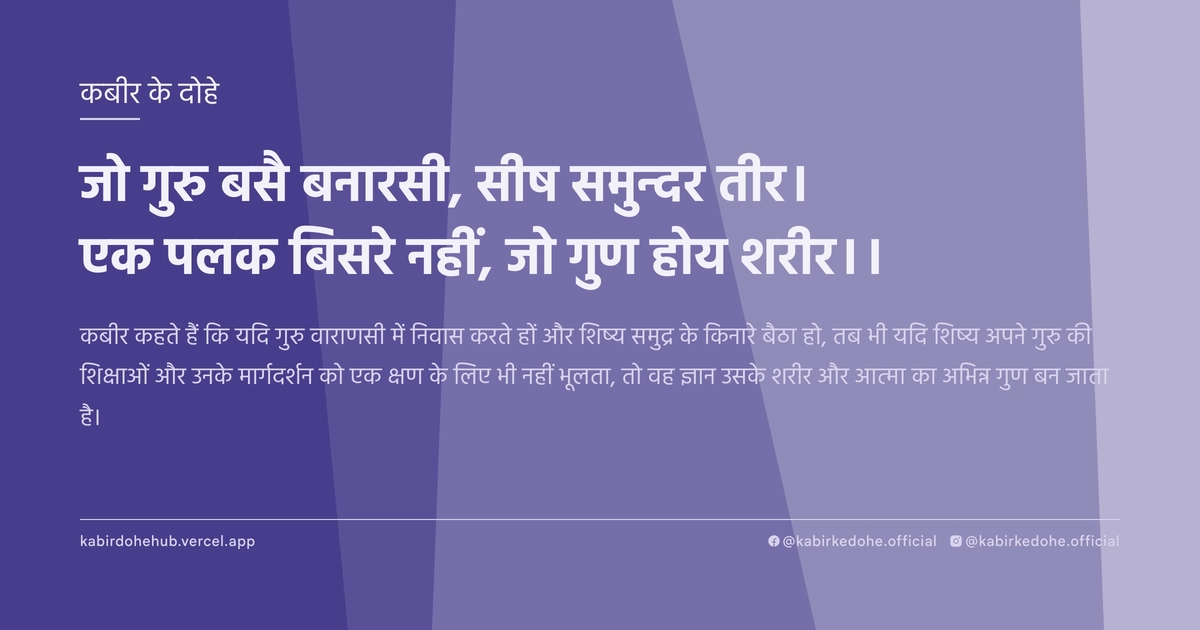
जो गुरु बसै बनारसी, सीष समुन्दर तीर।
एक पलक बिसरे नहीं, जो गुण होय शरीर।।
Jo guru basai banarsi, seesh samundar teer. Ek palak bisre nahin, jo gun hoye shareer.
इस पृष्ठ पर इस कबीर दोहे का अर्थ (meaning), हिंदी व्याख्या और अंग्रेज़ी अनुवाद, दार्शनिक विश्लेषण और व्यावहारिक जीवन सीख दी गई है। यह दोहा गुरु महत्व (The Guru's Importance) विषय से जुड़ा है — Kabir doha meaning and explanation in Hindi and English.
अर्थ (Meaning):
कबीर कहते हैं कि यदि गुरु वाराणसी में निवास करते हों और शिष्य समुद्र के किनारे बैठा हो, तब भी यदि शिष्य अपने गुरु की शिक्षाओं और उनके मार्गदर्शन को एक क्षण के लिए भी नहीं भूलता, तो वह ज्ञान उसके शरीर और आत्मा का अभिन्न गुण बन जाता है।
Kabir asserts that even if the Guru resides in Varanasi and the disciple is stationed by the distant shores of the ocean, if the disciple does not forget the Guru's teachings for a single moment, that wisdom becomes an inherent quality of their very existence.
व्याख्या (Interpretation):
यह दोहा भौतिक दूरी और आध्यात्मिक उपस्थिति के बीच के विरोधाभास को दर्शाता है। 'बनारस' और 'समुद्र' यहाँ केवल भौगोलिक स्थान नहीं, बल्कि चरम विपरीत ध्रुवों के प्रतीक हैं। इसका शाब्दिक अर्थ है कि गुरु और शिष्य के बीच की दूरी मायने नहीं रखती। आध्यात्मिक स्तर पर, यह 'निरगुण भक्ति' की ओर संकेत करता है, जहाँ गुरु केवल एक व्यक्ति नहीं बल्कि एक आंतरिक चेतना है। जब शिष्य अपनी जागरूकता को गुरु के शब्दों में विलीन कर देता है, तो वह 'माया' के भ्रम को पार कर जाता है। यहाँ 'गुण' शब्द का अर्थ है कि ज्ञान अब केवल स्मृति नहीं, बल्कि स्वभाव बन गया है। यह आत्मा और परमात्मा के अद्वैत संबंध की पुष्टि करता है, जहाँ दूरी एक भ्रम है और केवल स्मृति ही सत्य है।
This couplet explores the paradox between physical distance and spiritual presence. 'Varanasi' and the 'Ocean' are not merely geographical markers but symbols of extreme opposite poles. Literally, it suggests that the physical gap between teacher and student is irrelevant. On a metaphysical level, it points toward 'Nirgun Bhakti', where the Guru is not just a person but an internal consciousness. When the disciple merges their awareness with the Guru's teachings, they transcend the illusion of 'Maya'. The term 'Gun' implies that wisdom is no longer a remembered lesson but an inherent trait of being. It affirms the Advaita (non-dual) relationship between the Atman and Brahman, where distance is an illusion and only remembrance is reality.
दार्शनिक विश्लेषण (Philosophical Analysis):
कबीर का यह दोहा उस युग की प्रतिक्रिया है जहाँ धर्म केवल तीर्थयात्राओं और बाहरी कर्मकांडों तक सीमित था। बनारस को मोक्ष की नगरी माना जाता था, लेकिन कबीर यहाँ यह स्थापित कर रहे हैं कि मोक्ष किसी स्थान में नहीं, बल्कि गुरु के प्रति अटूट निष्ठा और आंतरिक अनुशासन में है। यह विचार सूफी मत के 'मुर्शिद' और शिष्य के संबंध से मेल खाता है, जहाँ गुरु की उपस्थिति शिष्य के हृदय में महसूस की जाती है, चाहे वे दुनिया के किसी भी कोने में हों।
अद्वैत वेदांत के परिप्रेक्ष्य में, यह दोहा 'साक्षी भाव' की बात करता है। जब शिष्य 'एक पलक' के लिए भी गुरु को नहीं भूलता, तो वह वास्तव में अपनी अहंकार-युक्त पहचान को मिटाकर उस सार्वभौमिक सत्य में विलीन हो रहा होता है। यह 'अहं' का विलोपन है, जो मोक्ष का एकमात्र मार्ग है। कबीर यहाँ यह स्पष्ट करते हैं कि ज्ञान का संचय करना पर्याप्त नहीं है; ज्ञान का 'गुण' बनना आवश्यक है, जिसका अर्थ है कि वह व्यवहार में उतरना चाहिए।
सामाजिक रूप से, कबीर जाति और वर्ग के बंधनों को तोड़ते हैं। वे यह संदेश देते हैं कि आध्यात्मिक पात्रता किसी विशेष कुल या स्थान से नहीं, बल्कि समर्पण और निरंतरता से आती है। यह उस समय के ब्राह्मणवादी वर्चस्व पर एक सूक्ष्म प्रहार था, जो केवल पवित्र स्थानों पर जाने को ही मुक्ति का मार्ग मानते थे।
मनोवैज्ञानिक स्तर पर, यह 'निरंतर स्मृति' (Constant Remembrance) की तकनीक है। जब मन एक ही बिंदु पर केंद्रित रहता है, तो वह बिखरना बंद कर देता है। यह एकाग्रता ही वह अग्नि है जो अज्ञान के पर्दे को जला देती है। यह मानसिक अनुशासन ही शिष्य को साधारण मनुष्य से एक 'गुणवान' व्यक्तित्व में बदल देता है।
अंततः, यह दोहा यह सिखाता है कि सत्य बाहरी दुनिया में खोजने की वस्तु नहीं है। यदि गुरु (ज्ञान का स्रोत) बाहर है, तो भी उसका प्रतिबिंब भीतर होना चाहिए। जब बाहरी मार्गदर्शन आंतरिक बोध बन जाता है, तब व्यक्ति स्वयं अपना मार्गदर्शक बन जाता है, और यही वास्तविक आध्यात्मिक यात्रा की पूर्णता है।
Kabir's couplet is a reaction to an era where religion was confined to pilgrimages and external rituals. Varanasi was considered the city of liberation, but Kabir establishes that salvation lies not in a location, but in unwavering loyalty to the Guru and internal discipline. This mirrors the Sufi concept of the 'Murshid' and disciple, where the teacher's presence is felt in the heart regardless of physical distance.
From the perspective of Advaita Vedanta, this verse speaks of 'Sakshi Bhav' (witness consciousness). When the disciple does not forget the Guru for 'a single blink', they are effectively dissolving their ego-driven identity into the universal truth. This is the annihilation of the 'Aham' (ego), which is the only path to liberation. Kabir clarifies that accumulating knowledge is insufficient; knowledge must become a 'Gun' (inherent quality), meaning it must manifest in behavior.
Socially, Kabir shatters the bonds of caste and class. He conveys that spiritual eligibility does not stem from a specific lineage or location, but from surrender and consistency. This was a subtle critique of the Brahmanical hegemony of his time, which viewed visiting holy sites as the primary route to salvation.
Psychologically, this is a technique of 'Constant Remembrance'. When the mind remains focused on a single point, it ceases to scatter. This concentration is the fire that burns away the veil of ignorance. This mental discipline transforms the disciple from an ordinary human into a 'virtuous' being.
Ultimately, the verse teaches that truth is not something to be sought in the external world. Even if the Guru (the source of knowledge) is outside, their reflection must exist within. When external guidance becomes internal realization, the individual becomes their own guide, marking the completion of the true spiritual journey.
मूल संदेश (Core Message):
- भौतिक दूरी आध्यात्मिक विच्छेद का कारण नहीं बनती।
- ज्ञान का वास्तविक प्रमाण स्मृति नहीं, बल्कि स्वभाव है।
- निरंतर जागरूकता ही अहंकार के विलीनीकरण का मार्ग है।
- आंतरिक गुरु की उपस्थिति बाहरी तीर्थयात्राओं से श्रेष्ठ है।
- समर्पण जब आदत बन जाता है, तब वह मुक्ति बन जाता है।
- Physical distance does not cause spiritual disconnection.
- The true proof of knowledge is character, not memory.
- Constant awareness is the path to the dissolution of ego.
- The presence of the inner Guru surpasses external pilgrimages.
- When surrender becomes a habit, it transforms into liberation.
व्यावहारिक उदाहरण (Practical Example):
एक समय की बात है, राजस्थान के एक छोटे से गाँव में रामू नाम का एक साधारण किसान रहता था। रामू के पास बहुत कम जमीन थी और वह गरीबी से जूझ रहा था। कई साल पहले, उसने एक wandering संत से जीवन जीने की कला और संतोष का पाठ सीखा था। वह संत अब बहुत दूर किसी शहर में चले गए थे, लेकिन रामू ने उनकी एक बात को अपने जीवन का मूलमंत्र बना लिया था: 'सेवा ही सबसे बड़ा धर्म है और संतोष ही सबसे बड़ा धन है।'
गाँव में अक्सर विवाद होते थे। लोग जमीन और पानी के लिए एक-दूसरे से लड़ते थे। रामू उन झगड़ों से दूर रहता था। वह अपनी छोटी सी फसल का एक हिस्सा चुपचाप उन लोगों के लिए छोड़ देता था जिनके पास कुछ नहीं था। गाँव वाले उसे मूर्ख समझते थे। वे कहते थे, 'रामू, तू इतना सीधा क्यों है? तू अपनी जमीन हड़पने की कोशिश क्यों नहीं करता?'
रामू बस मुस्कुराता और अपने भीतर उस संत की आवाज सुनता। वह संत की शिक्षाओं को केवल याद नहीं करता था, बल्कि उन्हें अपनी हर सांस में जीता था। उसके लिए संत की उपस्थिति भौतिक नहीं, बल्कि एक निरंतर अहसास थी। वह अपने काम को ही पूजा मानता था और मिट्टी की सेवा को ही ईश्वर की सेवा।
एक बार गाँव में भीषण अकाल पड़ा। फसलें सूख गईं और लोग भूखे मरने लगे। गाँव के अमीर जमींदार ने अनाज जमा कर लिया और उसे ऊँचे दामों पर बेचने लगा। गाँव में हाहाकार मच गया। लोग हताश होकर एक-दूसरे पर आरोप लगाने लगे।
ऐसे समय में रामू ने अपनी बची-कुची जमापूंजी और अनाज के छोटे से भंडार को गाँव के साझा चूल्हे में डाल दिया। उसने बिना किसी लालच के सबको भोजन कराया। जब लोगों ने उससे पूछा कि वह ऐसा क्यों कर रहा है, जबकि उसके पास खुद के लिए भी कम है, तो उसने कहा, 'मेरे गुरु ने सिखाया था कि जब हम दूसरों के दुख को अपना समझते हैं, तभी हम वास्तव में जीवित होते हैं।'
गाँव वालों ने देखा कि रामू के चेहरे पर एक ऐसी शांति थी जो जमींदार के पास करोड़ों रुपयों के बाद भी नहीं थी। रामू की यह स्थिरता और निस्वार्थता वास्तव में उसके गुरु की शिक्षाओं का 'गुण' बन चुकी थी। वह भौतिक रूप से अकेला था, लेकिन आध्यात्मिक रूप से वह अपने गुरु के साथ था।
धीरे-धीरे गाँव के अन्य लोग भी रामू से प्रेरित हुए। उन्होंने आपसी मतभेद भुलाकर एक-दूसरे की मदद करना शुरू किया। उन्होंने सीखा कि असली समृद्धि अनाज के गोदामों में नहीं, बल्कि साझा करुणा में है।
रामू की कहानी यह दिखाती है कि गुरु का ज्ञान तब तक प्रभावी नहीं होता जब तक वह केवल किताबों या यादों में रहे। जब वह ज्ञान व्यवहार में उतरता है, तो वह व्यक्ति के व्यक्तित्व का हिस्सा बन जाता है।
रामू ने यह सिद्ध कर दिया कि यदि शिष्य अपने गुरु के सिद्धांतों को एक पल के लिए भी नहीं भूलता, तो वह दुनिया की किसी भी विपरीत परिस्थिति में विचलित नहीं होता। उसकी सादगी ही उसकी सबसे बड़ी शक्ति बन गई।
Once, in a small village in Rajasthan, lived a simple farmer named Ramu. He owned very little land and struggled with poverty. Years ago, he had learned the art of living and contentment from a wandering saint. That saint had since moved to a distant city, but Ramu had made one teaching his life's mantra: 'Service is the highest religion, and contentment is the greatest wealth.'
Disputes were common in the village. People fought over land and water. Ramu stayed away from these conflicts. He would silently leave a portion of his small harvest for those who had nothing. The villagers considered him a fool. They would ask, 'Ramu, why are you so naive? Why don't you try to seize more land?'
Ramu would simply smile, hearing the saint's voice within him. He didn't just remember the saint's teachings; he lived them in every breath. For him, the saint's presence was not physical but a constant realization. He treated his work as worship and the service of the soil as the service of God.
One year, a severe famine struck the village. Crops withered, and people began to starve. The wealthy landlord hoarded grain to sell at exorbitant prices. Chaos ensued, and desperate people began blaming one another.
In this crisis, Ramu put his meager savings and small grain reserve into the village's communal kitchen. He fed everyone without any expectation of reward. When asked why he was doing this while having so little for himself, he replied, 'My Guru taught me that we are truly alive only when we perceive others' pain as our own.'
The villagers noticed a peace on Ramu's face that the landlord lacked despite his millions. Ramu's stability and selflessness were, in fact, the 'Gun' (inherent quality) of his Guru's teachings. He was physically alone, but spiritually, he was one with his teacher.
Gradually, other villagers were inspired by Ramu. They set aside their differences and began helping one another. They learned that true prosperity lies not in granaries, but in shared compassion.
Ramu's story demonstrates that a Guru's knowledge is ineffective if it remains only in books or memories. When that knowledge descends into behavior, it becomes a part of the person's essence.
Ramu proved that if a disciple does not forget the Guru's principles for a single moment, they remain unshaken by any adversity. His simplicity became his greatest strength.
अभ्यास मार्गदर्शन (Practice Guidance):
- दैनिक चिंतन: प्रतिदिन 15 मिनट मौन बैठें और अपने जीवन के सबसे महत्वपूर्ण नैतिक सिद्धांत (गुरु-मंत्र) का स्मरण करें।
- आत्म-पूछताछ जर्नल: दिन के अंत में लिखें कि कितनी बार आपने अपने आदर्शों को भुलाकर तात्कालिक क्रोध या लालच के वश में काम किया।
- व्यवहार परिवर्तन: किसी एक ऐसे गुण (जैसे क्षमा या धैर्य) को चुनें जिसे आप अपने गुरु या आदर्श से अपनाना चाहते हैं, और उसे पूरे दिन सचेत रूप से लागू करें।
- डायग्नोस्टिक चेकलिस्ट: क्या मैं तनाव में प्रतिक्रिया देता हूँ या प्रतिक्रिया के बजाय उत्तर देता हूँ? क्या मेरा आचरण मेरे शब्दों से मेल खाता है? क्या मैं बाहरी प्रशंसा के बिना भी अपने मूल्यों पर टिका रहता हूँ?
- Daily Contemplation: Sit in silence for 15 minutes daily, recalling the most important ethical principle (Guru-mantra) of your life.
- Self-Inquiry Journal: At the end of the day, record how many times you acted out of immediate anger or greed, forgetting your higher ideals.
- Behavioral Shift: Choose one specific virtue (e.g., forgiveness or patience) you wish to emulate from your mentor and consciously apply it throughout the day.
- Diagnostic Checklist: Do I react impulsively under stress, or do I respond with awareness? Does my conduct align with my words? Do I remain steadfast in my values even without external validation?
चिंतन प्रश्न (Reflection Questions):
- मेरे जीवन में 'गुरु' कौन है—एक व्यक्ति, एक पुस्तक, या मेरी अपनी अंतरात्मा?
- मैं अपनी सार्वजनिक छवि (Public Image) को बनाए रखने के लिए अपने आंतरिक मूल्यों से कितना समझौता करता हूँ?
- क्या मेरी डिजिटल पहचान (Social Media Ego) मेरे वास्तविक आध्यात्मिक विकास को बाधित कर रही है?
- वह कौन सा 'क्षण' है जब मैं सबसे अधिक अपने सिद्धांतों को भूल जाता हूँ, और क्यों?
- यदि मेरा बाहरी सहारा (गुरु, संस्था, धर्म) छीन लिया जाए, तो क्या मेरे भीतर का ज्ञान मुझे दिशा दे पाएगा?
- Who is the 'Guru' in my life—a person, a book, or my own inner voice?
- To what extent do I compromise my internal values to maintain my public image?
- Is my digital identity (social media ego) hindering my actual spiritual growth?
- At what specific 'moment' do I most frequently forget my principles, and why?
- If my external support (Guru, institution, religion) were removed, would the knowledge within me be enough to guide me?