
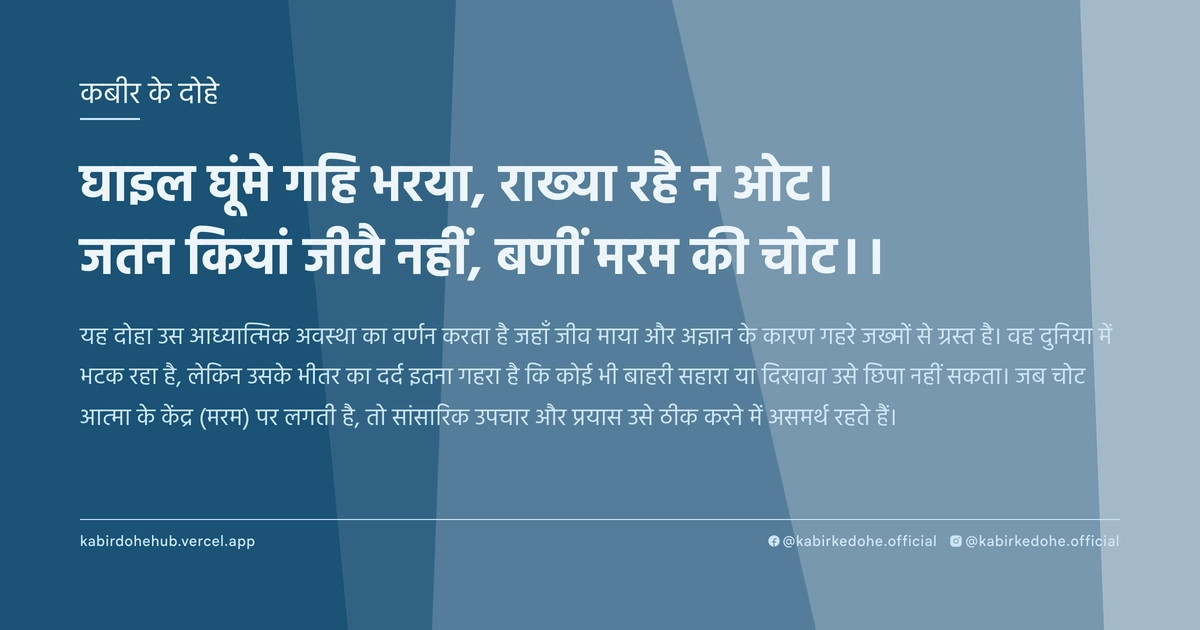
घाइल घूंमे गहि भरया, राख्या रहै न ओट।
जतन कियां जीवै नहीं, बणीं मरम की चोट।।
Ghayal ghoome gahi bharya, rakhya rahai na ot. Jatan kiya jivae nahi, bani maram ki chot.
इस पृष्ठ पर इस कबीर दोहे का अर्थ (meaning), हिंदी व्याख्या और अंग्रेज़ी अनुवाद, दार्शनिक विश्लेषण और व्यावहारिक जीवन सीख दी गई है। यह दोहा मृतुक्यता (Mortality) विषय से जुड़ा है — Kabir doha meaning and explanation in Hindi and English.
अर्थ (Meaning):
यह दोहा उस आध्यात्मिक अवस्था का वर्णन करता है जहाँ जीव माया और अज्ञान के कारण गहरे जख्मों से ग्रस्त है। वह दुनिया में भटक रहा है, लेकिन उसके भीतर का दर्द इतना गहरा है कि कोई भी बाहरी सहारा या दिखावा उसे छिपा नहीं सकता। जब चोट आत्मा के केंद्र (मरम) पर लगती है, तो सांसारिक उपचार और प्रयास उसे ठीक करने में असमर्थ रहते हैं।
This couplet describes a spiritual state where the soul is profoundly wounded by illusion (Maya) and ignorance. The seeker wanders through existence, but the internal agony is so pervasive that no external shield or pretense can conceal it. When the wound strikes the very core of being (the 'maram'), worldly remedies and superficial efforts fail to provide healing or survival.
व्याख्या (Interpretation):
शाब्दिक अर्थ में, यह एक ऐसे घायल व्यक्ति की बात करता है जो दर्द से व्याकुल है। रूपकात्मक रूप से, 'घायल' वह आत्मा है जो विरह और अज्ञान के कारण परमात्मा से अलग महसूस करती है। 'ओट' या पर्दा यहाँ सामाजिक प्रतिष्ठा और अहंकार का प्रतीक है, जो अंततः विफल हो जाता है। यह निर्गुण भक्ति के उस सत्य को दर्शाता है जहाँ आत्मा को यह अहसास होता है कि उसका असली दुख भौतिक नहीं, बल्कि आध्यात्मिक है। यह 'मरम की चोट' वास्तव में वह जागृति है जहाँ जीव को अपनी नश्वरता और माया के जाल का बोध होता है। अद्वैत वेदांत के अनुसार, यह द्वैत का वह दर्द है जो तब तक बना रहता है जब तक आत्मा स्वयं को ब्रह्म में विलीन नहीं कर लेती। यह विरोधाभास है कि यह विनाशकारी चोट ही वास्तव में मुक्ति का द्वार खोलती है।
Literally, it speaks of a wounded person wandering in agony. Metaphorically, the 'wounded' is the soul experiencing the excruciating separation from the Divine due to ignorance. The 'ot' or shield represents social prestige and the ego, which ultimately fail to hide the internal void. This reflects the truth of Nirgun Bhakti, where the soul realizes its suffering is not material but existential. The 'wound to the core' (maram ki chot) is actually the awakening to one's mortality and the deceptive nature of Maya. According to Advaita Vedanta, this is the pain of duality that persists until the Atman merges back into Brahman. It is a profound paradox: this devastating blow to the ego is the only catalyst that opens the door to liberation.
दार्शनिक विश्लेषण (Philosophical Analysis):
कबीर का यह दोहा उस युग की उपज है जहाँ धर्म केवल कर्मकांडों और बाहरी दिखावों तक सीमित था। कबीर ने पुरजोर तरीके से उन रीतियों का विरोध किया जो मनुष्य को उसके आंतरिक सत्य से दूर ले जाती थीं। यहाँ 'घायल' होना वास्तव में उस मानसिक और आध्यात्मिक संकट का संकेत है जो तब उत्पन्न होता है जब मनुष्य को यह समझ आता है कि मंदिर, मस्जिद या तीर्थ यात्राएं उसके आंतरिक शून्य को नहीं भर सकतीं। यह सूफी मत के 'इश्क-ए-हकीकी' (ईश्वरीय प्रेम) के समान है, जहाँ प्रेमी अपने अस्तित्व के मिटने (फना) के दर्द में तड़पता है ताकि वह खुदा में विलीन हो सके।
दार्शनिक स्तर पर, यह दोहा अहंकार के विनाश की प्रक्रिया है। जब तक मनुष्य अपनी पहचान को शरीर, जाति या पद से जोड़ता है, वह एक भ्रम में जीता है। लेकिन जब यह भ्रम टूटता है, तो वह एक 'चोट' की तरह महसूस होता है। यह चोट वास्तव में अज्ञान का अंत है। कबीर यहाँ यह समझा रहे हैं कि आध्यात्मिक प्रगति के लिए पहले इस बात की स्वीकृति आवश्यक है कि हम गहरे संकट में हैं। बिना इस 'मरम की चोट' के, कोई भी साधक वास्तव में सत्य की खोज नहीं करेगा क्योंकि वह अपनी झूठी शांति में संतुष्ट रहेगा।
अद्वैत वेदांत के परिप्रेक्ष्य में, यह विरह की अवस्था है। जीव स्वयं को ब्रह्म से अलग मानता है, और यही अलगाव सबसे बड़ा घाव है। यह घाव किसी बाहरी औषधि से ठीक नहीं हो सकता क्योंकि यह औषधि स्वयं उस चेतना के भीतर है जिसे हम भूल चुके हैं। कबीर का प्रहार उन लोगों पर है जो केवल ऊपरी उपचार (जैसे माला जपना या व्रत रखना) से संतुष्ट हो जाते हैं, जबकि उनकी आत्मा अभी भी अज्ञान के कारण लहूलुहान है।
मनोवैज्ञानिक रूप से, यह 'अंधेरी रात की आत्मा' (Dark Night of the Soul) की स्थिति है। यह वह बिंदु है जहाँ व्यक्ति का पुराना व्यक्तित्व ढह जाता है और वह पूरी तरह से असहाय महसूस करता है। इसी असहायता में वह पूर्ण समर्पण (Surrender) करता है। कबीर का दर्शन यह है कि जब तक हम अपनी पूर्ण विफलता और टूटन को स्वीकार नहीं करते, तब तक हम उस अनंत शक्ति के लिए जगह नहीं बना सकते जो हमें वास्तव में पूर्ण कर सकती है।
अंततः, यह दोहा हमें सिखाता है कि वास्तविक उपचार बाहरी दुनिया में नहीं, बल्कि उस घाव के केंद्र में उतरने में है। जब हम अपने दर्द से भागना बंद कर देते हैं और उसे साक्षी भाव से देखते हैं, तब वह दर्द ही प्रकाश बन जाता है। यह ritualism के विरुद्ध एक सशक्त घोषणा है, जो बताती है कि ईश्वर को पाने के लिए किसी बाहरी माध्यम की नहीं, बल्कि आंतरिक ईमानदारी और आत्म-पीड़ा की स्वीकृति की आवश्यकता है।
Kabir's couplet emerges from an era where religion was confined to rituals and external displays. He vehemently opposed practices that distanced humans from their internal truth. Being 'wounded' here signifies the mental and spiritual crisis that arises when a person realizes that temples, mosques, or pilgrimages cannot fill their internal void. This mirrors the Sufi concept of 'Ishq-e-Haqiqi' (Divine Love), where the lover suffers the agony of the annihilation of the self (Fana) to merge with the Beloved.
On a philosophical level, this is the process of the ego's destruction. As long as a human identifies with the body, caste, or status, they live in a delusion. When this delusion shatters, it feels like a 'blow' or a wound. This wound is, in reality, the end of ignorance. Kabir suggests that spiritual progress requires the admission of being in deep crisis. Without this 'wound to the core,' no seeker would truly search for the Truth, as they would remain complacent in their false peace.
From the perspective of Advaita Vedanta, this is the state of separation. The soul perceives itself as distinct from Brahman, and this perceived duality is the deepest wound. This cannot be healed by external remedies because the cure lies within the very consciousness that has been forgotten. Kabir attacks those who are satisfied with superficial treatments—like chanting beads or fasting—while their soul remains bleeding from the wound of ignorance.
Psychologically, this represents the 'Dark Night of the Soul.' It is the point where the old personality collapses, leaving the individual feeling utterly helpless. In this helplessness, total surrender occurs. Kabir's philosophy posits that until we accept our complete failure and brokenness, we cannot create space for the Infinite Power that truly completes us.
Ultimately, the couplet teaches that true healing is not found in the external world, but in descending into the center of the wound. When we stop fleeing from our pain and observe it with mindfulness, the pain itself transforms into light. It is a powerful declaration against ritualism, asserting that reaching the Divine requires internal honesty and the acceptance of spiritual suffering rather than external mediators.
मूल संदेश (Core Message):
- बाहरी दिखावा आंतरिक रिक्तता को कभी नहीं भर सकता।
- अहंकार का टूटना ही वास्तविक आध्यात्मिक जागृति की शुरुआत है।
- पीड़ा से भागना नहीं, बल्कि उसमें उतरना ही मुक्ति का मार्ग है।
- सत्य वह नहीं जो दुनिया देखती है, बल्कि वह है जो हम अकेले में महसूस करते हैं।
- जब 'मैं' मिटता है, तभी 'वह' (परमात्मा) प्रकट होता है।
- External pretenses can never fill the internal void.
- The shattering of the ego is the true beginning of spiritual awakening.
- The path to liberation is not fleeing from pain, but descending into it.
- Truth is not what the world sees, but what we feel in our deepest solitude.
- Only when the 'I' vanishes does the 'Divine' manifest.
व्यावहारिक उदाहरण (Practical Example):
एक समय की बात है, वाराणसी के घाटों पर रहने वाला एक वृद्ध विधवा, जिसे सब 'माई' कहते थे, अपनी पूरी जिंदगी धर्म-कर्म और कठिन व्रतों में बिता चुकी थी। वह शहर की सबसे सम्मानित महिला मानी जाती थी क्योंकि वह हर नियम का पालन करती थी। लेकिन रात के सन्नाटे में, माई एक अजीब सी बेचैनी और खालीपन से जूझती थी। उसे लगता था कि उसके भीतर कुछ टूट गया है, एक ऐसा घाव जिसे कोई भी पूजा या प्रार्थना नहीं भर पा रही थी।
वह अक्सर अन्य महिलाओं को उपदेश देती कि कैसे नियमों का पालन कर मोक्ष पाया जा सकता है, लेकिन अंदर ही अंदर वह खुद को एक 'घायल' आत्मा महसूस करती थी। उसने कई विद्वानों से बात की, कई तीर्थ किए, और अपनी पूरी संपत्ति दान कर दी, फिर भी वह आंतरिक टीस कम नहीं हुई। वह अपनी इस पीड़ा को एक 'ओट' या पर्दे के पीछे छिपाकर रखती थी ताकि समाज की नजरों में उसकी पवित्रता बनी रहे।
एक दिन, वह घाट पर बैठे एक फकीर के पास गई। फकीर ने उसकी आँखों में देखते ही कह दिया, "माई, तुम अपनी पवित्रता के लिबास में अपने जख्मों को छिपा रही हो। तुम जितना इसे छिपाओगी, यह उतना ही सड़ेगा।"
माई चौंक गई। उसने पूछा, "मैं तो हर नियम मानती हूँ, फिर यह दर्द क्या है?"
फकीर ने मुस्कुराते हुए कहा, "यह दर्द तुम्हारा सबसे बड़ा मित्र है। यह वह चोट है जो तुम्हें बता रही है कि तुम अब तक केवल बाहरी छिलकों से खेल रही थी। तुम जिसे मोक्ष समझ रही थी, वह केवल एक सामाजिक मुखौटा था। असली यात्रा तब शुरू होती है जब तुम इस दर्द को स्वीकार करो और इसे अपना मार्ग बनाओ।"
उस क्षण माई के भीतर कुछ टूट गया। उसने महसूस किया कि वह अब तक जिस 'पवित्रता' पर गर्व कर रही थी, वह वास्तव में उसके अहंकार की एक दीवार थी जिसने उसे उसकी अपनी आत्मा से अलग कर रखा था। उसने पहली बार स्वीकार किया कि वह डरी हुई है, वह अकेली है, और वह वास्तव में कुछ नहीं जानती।
उसने अपने सभी बाहरी दिखावे और नियमों को त्याग दिया। उसने अब पूजा इसलिए नहीं की कि उसे स्वर्ग चाहिए था, बल्कि इसलिए की क्योंकि वह उस अनंत शून्य में विलीन होना चाहती थी। उसने अपने दर्द को छिपाना बंद कर दिया और उसे एक प्रार्थना बना लिया।
धीरे-धीरे, वह बेचैनी एक गहरे मौन में बदल गई। उसने पाया कि जब उसने अपने 'घाव' को स्वीकार कर लिया, तो वह घाव ही वह द्वार बन गया जहाँ से ईश्वरीय प्रकाश उसके भीतर प्रवेश कर सका।
अब वह घाट पर केवल एक 'पवित्र' महिला नहीं थी, बल्कि एक ऐसी जीवंत आत्मा थी जिसके चेहरे पर एक ऐसी शांति थी जो किसी नियम या व्रत से नहीं, बल्कि अपनी टूटन को स्वीकार करने से आई थी।
Once, in the ghats of Varanasi, lived an elderly widow known to all as 'Mai.' She had spent her entire life in rigorous religious observances and strict fasts. She was regarded as one of the most respected women in the city because she followed every ritual to the letter. However, in the silence of the night, Mai struggled with a strange restlessness and an echoing void. She felt something within her had broken—a wound that no prayer or ritual could heal.
She often lectured other women on how to achieve salvation through discipline, but internally, she felt like a 'wounded' soul. She consulted scholars, visited numerous shrines, and donated her entire wealth, yet the internal ache persisted. She kept this agony behind an 'ot' or a veil of piety so that her image of purity remained intact in the eyes of society.
One day, she approached a wandering fakir sitting by the river. Looking into her eyes, the fakir simply said, "Mai, you are hiding your wounds beneath the garment of your piety. The more you hide them, the more they will fester."
Mai was startled. She asked, "I follow every rule, so what is this pain?"
The fakir smiled and replied, "This pain is your greatest friend. It is the blow that tells you that you have only been playing with the outer husks. What you thought was salvation was merely a social mask. The true journey begins when you accept this pain and make it your path."
At that moment, something snapped inside Mai. She realized that the 'purity' she had been proud of was actually a wall of ego that had separated her from her own soul. For the first time, she admitted that she was afraid, alone, and truly knew nothing.
She abandoned all external pretenses and rigid rules. She no longer prayed because she wanted heaven, but because she longed to dissolve into the infinite void. She stopped hiding her pain and turned it into a prayer.
Gradually, that restlessness transformed into a profound silence. She discovered that once she accepted her 'wound,' that very wound became the gateway through which the Divine Light could enter her.
She was no longer just a 'pious' woman on the ghats, but a living soul whose face radiated a peace that came not from rules or fasts, but from the courage to accept her own brokenness.
अभ्यास मार्गदर्शन (Practice Guidance):
- प्रतिदिन 20 मिनट 'साक्षी भाव' का अभ्यास करें: अपने भीतर के मानसिक और भावनात्मक दर्द को बिना किसी निर्णय के देखें। उसे ठीक करने की कोशिश न करें, बस उसे महसूस करें।
- आत्म-पूछताछ जर्नलिंग: लिखें कि आप दुनिया के सामने कौन सा 'मुखौटा' (ओट) पहनते हैं और वह कौन सा दर्द है जिसे आप सबसे अधिक छिपाते हैं।
- व्यवहारिक परिवर्तन: जब भी आप किसी की मदद करें, तो यह देखने का प्रयास करें कि क्या आप अपनी श्रेष्ठता सिद्ध करने के लिए ऐसा कर रहे हैं या वास्तव में दूसरे के दर्द के साथ जुड़ रहे हैं।
- डायग्नोस्टिक चेकलिस्ट: क्या मैं अपनी शांति के लिए बाहरी नियमों पर निर्भर हूँ? क्या मैं अपने दुख को छिपाने के लिए धर्म का सहारा ले रहा हूँ? क्या मैं अपनी कमियों को स्वीकार करने से डरता हूँ?
- Practice 20 minutes of 'Witness Consciousness' daily: Observe your internal mental and emotional pain without judgment. Do not try to fix it; simply feel it.
- Self-Inquiry Journaling: Write about the 'mask' (ot) you wear for the world and the specific pain you strive hardest to conceal.
- Behavioral Shift: Whenever you help someone, examine whether you are doing it to prove your superiority or to genuinely connect with the other's suffering.
- Diagnostic Checklist: Am I relying on external rules for my peace? Am I using religion as a shield to hide my grief? Am I afraid to acknowledge my own brokenness?
चिंतन प्रश्न (Reflection Questions):
- वह कौन सा 'पवित्र' मुखौटा है जिसे मैं समाज में बनाए रखने के लिए अपनी आत्मा का गला घोंट रहा हूँ?
- यदि मेरी सभी उपलब्धियां और पद छीन लिए जाएं, तो क्या मेरे पास ऐसा कुछ बचेगा जिसे मैं 'मैं' कह सकूँ?
- क्या मेरा धर्म मुझे वास्तव में मुक्त कर रहा है, या यह केवल मेरे डर को छिपाने का एक तरीका है?
- मैं अपने जीवन के सबसे गहरे घाव से क्या सीख सकता हूँ जिसे मैं अब तक एक अभिशाप मानता आया हूँ?
- क्या मैं वास्तव में सत्य की खोज में हूँ, या मैं केवल अपनी वर्तमान मान्यताओं की पुष्टि चाहता हूँ?
- What is the 'pious' mask I maintain in society that forces me to stifle my own soul?
- If all my achievements and titles were stripped away, would there be anything left that I could call 'I'?
- Is my spirituality truly liberating me, or is it merely a way to camouflage my fears?
- What can I learn from the deepest wound of my life that I have hitherto regarded as a curse?
- Am I truly in search of Truth, or am I merely seeking confirmation of my existing beliefs?