
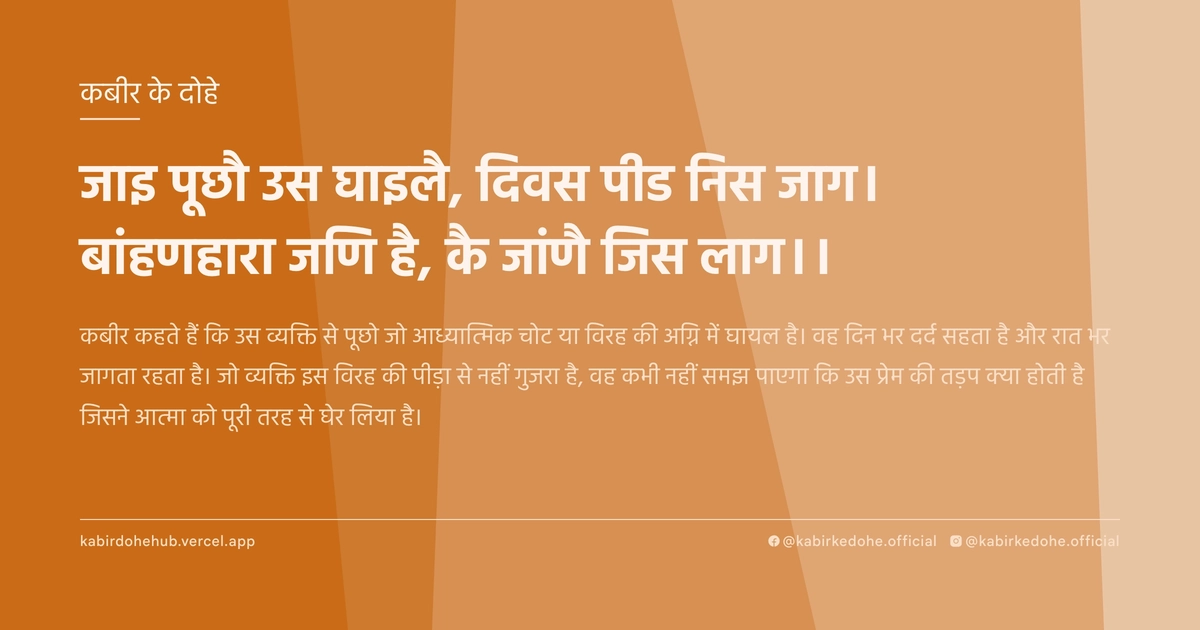
जाइ पूछौ उस घाइलै, दिवस पीड निस जाग।
बांहणहारा जणि है, कै जांणै जिस लाग।।
Jai puchhau us ghailai, divas peed nis jaag. Baanhanhara jani hai, kai jaanai jis laag.
इस पृष्ठ पर इस कबीर दोहे का अर्थ (meaning), हिंदी व्याख्या और अंग्रेज़ी अनुवाद, दार्शनिक विश्लेषण और व्यावहारिक जीवन सीख दी गई है। यह दोहा दुख और सुख (Sorrow and Joy) विषय से जुड़ा है — Kabir doha meaning and explanation in Hindi and English.
अर्थ (Meaning):
कबीर कहते हैं कि उस व्यक्ति से पूछो जो आध्यात्मिक चोट या विरह की अग्नि में घायल है। वह दिन भर दर्द सहता है और रात भर जागता रहता है। जो व्यक्ति इस विरह की पीड़ा से नहीं गुजरा है, वह कभी नहीं समझ पाएगा कि उस प्रेम की तड़प क्या होती है जिसने आत्मा को पूरी तरह से घेर लिया है।
Kabir suggests that one must ask the one who is wounded by spiritual longing. Such a soul suffers throughout the day and remains sleepless through the night. He asserts that those who have not experienced this profound ache of separation cannot possibly comprehend the intensity of the love that has completely consumed the seeker.
व्याख्या (Interpretation):
यहाँ 'घायल' होना शारीरिक चोट नहीं, बल्कि परमात्मा के प्रति तीव्र विरह (Longing) है। कबीर उस अवस्था का वर्णन कर रहे हैं जहाँ साधक को यह अहसास होता है कि वह अपने मूल स्रोत (ब्रह्म) से अलग है। यह विरह 'माया' के पर्दे को हटाने का पहला कदम है। जब तक हृदय में यह तड़प नहीं आती, तब तक ज्ञान केवल बौद्धिक रहता है। यह विरोधाभास है कि आध्यात्मिक पूर्णता प्राप्त करने के लिए पहले पूर्ण अभाव और पीड़ा का अनुभव करना आवश्यक है। यह अवस्था निर्गुण भक्ति की पराकाष्ठा है जहाँ भक्त और भगवान के बीच का द्वैत केवल विरह के रूप में शेष रहता है, जो अंततः अद्वैत में विलीन हो जाता है।
The term 'wounded' here does not refer to physical injury, but to the acute spiritual longing (Viraha) for the Divine. Kabir describes a state where the seeker realizes their separation from the primordial source (Brahman). This longing is the first step in piercing the veil of Maya. Until this ache manifests in the heart, spiritual knowledge remains merely intellectual. It is a profound paradox: to achieve spiritual wholeness, one must first experience the agony of absolute lack. This state represents the peak of Nirgun Bhakti, where the duality between the devotee and the Divine exists only as a longing, which eventually dissolves into the non-dual realization of Advaita.
दार्शनिक विश्लेषण (Philosophical Analysis):
कबीर का यह दोहा मध्यकालीन भारत के उस सामाजिक-धार्मिक परिवेश में लिखा गया था जहाँ धर्म केवल कर्मकांडों और बाहरी दिखावे तक सीमित था। कबीर ने मंदिर-मस्जिद की दीवारों को तोड़कर 'हृदय की पीड़ा' को वास्तविक पूजा माना। उनका दर्शन सूफीवाद के 'इश्क-ए-हकीकी' (दिव्य प्रेम) और वेदांत के 'आत्म-साक्षात्कार' का एक अद्भुत संगम है।
यहाँ विरह की अग्नि का अर्थ है अहंकार का दहन। जब तक 'मैं' (अहंकार) जीवित है, तब तक परमात्मा का अनुभव संभव नहीं है। यह पीड़ा वह आग है जो साधक के भीतर के कूड़े-कर्कट और झूठी पहचानों को जलाकर राख कर देती है। यह प्रक्रिया मनोवैज्ञानिक रूप से 'कैथार्सिस' की तरह है, जहाँ आत्मा अपने पुराने स्वरूप को त्यागकर नए सत्य को धारण करती है।
कबीर ritualism का विरोध करते हुए यह स्पष्ट करते हैं कि मोक्ष किसी तीर्थयात्रा या मंत्रोच्चार से नहीं, बल्कि उस आंतरिक तड़प से मिलता है जो मनुष्य को उसकी सीमित पहचान से ऊपर उठाती है। यह 'शून्य' की ओर बढ़ने की यात्रा है।
अद्वैत वेदांत के परिप्रेक्ष्य में, यह विरह वास्तव में एक भ्रम है क्योंकि आत्मा और परमात्मा कभी अलग थे ही नहीं। लेकिन, इस भ्रम (माया) को तोड़ने के लिए उस भ्रम की तीव्रता का अनुभव करना आवश्यक है। जब विरह चरम पर होता है, तब साधक को अहसास होता है कि जिसे वह बाहर खोज रहा था, वह उसके भीतर ही है।
अंततः, यह दोहा हमें सिखाता है कि आध्यात्मिक मार्ग पर चलने वाले के लिए 'दुःख' एक बाधा नहीं, बल्कि एक उपकरण है। यह वह धुरी है जिस पर घूमकर मनुष्य अपनी भौतिक पहचान को मिटाकर सार्वभौमिक चेतना में विलीन होता है।
This couplet was composed during a medieval Indian socio-religious era where faith was largely confined to rituals and outward displays. Kabir dismantled the walls of temples and mosques, proposing that the 'agony of the heart' is the only true form of worship. His philosophy is a sublime synthesis of the Sufi concept of 'Ishq-e-Haqiqi' (Divine Love) and the Vedantic pursuit of 'Atma-Sakshatkara' (Self-Realization).
The fire of longing described here signifies the incineration of the ego. As long as the 'I' (Ahamkara) persists, the experience of the Divine remains elusive. This pain is the alchemy that burns away the dross of false identities and societal conditioning. Psychologically, this mirrors a process of catharsis, where the soul sheds its limited persona to embrace a universal truth.
By rejecting ritualism, Kabir clarifies that liberation is not attained through pilgrimages or the rote chanting of mantras, but through an internal yearning that elevates a human being beyond their conditioned existence. It is a journey toward the 'Shunya' or the Void.
From the lens of Advaita Vedanta, this longing is technically an illusion, for the Atman and Brahman were never separate. However, to pierce the veil of Maya, one must first experience the intensity of that perceived separation. When the longing reaches its zenith, the seeker realizes that the object of their search is the very subject searching.
Ultimately, this Doha teaches that for the spiritual aspirant, 'suffering' is not an obstacle but a tool. It is the pivot upon which the human rotates from a localized, egoic identity into the expansive, universal consciousness.
मूल संदेश (Core Message):
- बाहरी पूजा केवल ढोंग है यदि हृदय में विरह की अग्नि नहीं है।
- आध्यात्मिक पीड़ा वास्तव में आत्मा की जागृति का संकेत है।
- अहंकार का अंत केवल तीव्र प्रेम और तड़प से संभव है।
- दुःख को बाधा नहीं, बल्कि परमात्मा तक पहुँचने का सेतु मानें।
- सच्चा ज्ञान बौद्धिक नहीं, बल्कि भावनात्मक और अनुभवात्मक होता है।
- External worship is a facade if the fire of longing is absent from the heart.
- Spiritual suffering is actually a signal of the soul's awakening.
- The annihilation of ego is possible only through intense love and yearning.
- View sorrow not as an obstacle, but as a bridge to the Divine.
- True knowledge is not intellectual, but emotional and experiential.
व्यावहारिक उदाहरण (Practical Example):
वाराणसी के एक पुराने घाट पर रहने वाले एक वृद्ध बुनकर थे, जिनका नाम माधव था। माधव अपनी पूरी ज़िंदगी रेशमी कपड़ों में बारीक धागे पिरोने में बिता चुके थे, लेकिन उनके मन में एक अजीब सी बेचैनी थी। वे रोज़ मंदिर जाते, पूजा करते और दान देते, फिर भी उन्हें लगता कि उनके जीवन में कुछ अधूरा है। वे धर्म के सभी नियमों का पालन करते थे, लेकिन शांति उनसे कोसों दूर थी।
एक दिन उनकी मुलाकात एक फकीर से हुई जिसने उन्हें कबीर का यह दोहा सुनाया। फकीर ने कहा, "माधव, तुम शांति खोज रहे हो, लेकिन क्या तुमने कभी उस दर्द को महसूस किया है जो तुम्हें तुम्हारी आत्मा की याद दिलाए?"
माधव ने पहले तो इसे बकवास समझा। लेकिन धीरे-धीरे उन्होंने अपनी बाहरी पूजा कम कर दी और मौन में बैठना शुरू किया। उन्होंने महसूस किया कि जिस 'अधूरेपन' से वे भाग रहे थे, वही वास्तव में परमात्मा की पुकार थी। उन्होंने अपने जीवन के दुखों—अपनी पत्नी की मृत्यु, बच्चों की दूरी—को अब बोझ नहीं, बल्कि एक 'पवित्र विरह' के रूप में देखना शुरू किया।
उन्होंने पाया कि जब वे अपने दर्द को दबाने के बजाय उसे पूरी तरह महसूस करते, तो उनके भीतर एक ऐसी तड़प पैदा होती जो उन्हें दुनिया की मोह-माया से ऊपर उठा देती। अब वे केवल कपड़े नहीं बुनते थे, बल्कि हर धागे में उस विरह और प्रेम को पिरोने लगे।
उनकी आँखों में अब हमेशा एक नमी रहती थी, लेकिन चेहरे पर एक ऐसी शांति थी जो पहले कभी नहीं थी। लोग उनसे पूछने लगे कि वे इतने शांत कैसे हो गए।
माधव ने मुस्कुराकर कहा, "मैं अब तक केवल पूजा कर रहा था, अब मैं उस दर्द को जी रहा हूँ जो मुझे मेरे मालिक से मिलाता है।"
उनकी यह समझ उनके व्यवहार में बदल गई। वे अब गरीब बुनकरों की मदद बिना किसी स्वार्थ के करने लगे, क्योंकि उन्हें हर घायल हृदय में वही विरह दिखाई देता था जो उनके अपने भीतर था।
अंततः, माधव ने जाना कि जिसे वे 'पीड़ा' समझकर डरते थे, वही वास्तव में वह कुंजी थी जिसने उनके हृदय के बंद दरवाज़े खोल दिए। उनकी पूरी ज़िंदगी एक प्रार्थना बन गई, जहाँ विरह ही मिलन का एकमात्र मार्ग था।
In the ancient ghats of Varanasi lived an elderly weaver named Madhav. Madhav had spent his entire life intertwining fine threads into silk fabrics, yet a strange restlessness lingered in his soul. He visited temples daily, performed rituals, and gave alms, but he felt a void that no amount of piety could fill. He followed every religious rule, yet peace remained a distant shore.
One day, he encountered a wandering Sufi who recited this specific Doha of Kabir. The Sufi asked, "Madhav, you seek peace, but have you ever embraced the pain that reminds you of your soul's origin?"
Initially, Madhav dismissed this as nonsense. However, he gradually reduced his external rituals and began practicing silence. He realized that the 'emptiness' he had been fleeing from was, in fact, the call of the Divine. He stopped viewing his life's sorrows—the loss of his wife, the distance from his children—as burdens and began seeing them as a 'sacred longing'.
He discovered that when he stopped suppressing his pain and instead felt it fully, a yearning emerged that lifted him above worldly attachments. He no longer just wove fabric; he began weaving that very longing and love into every thread.
His eyes now held a perpetual mist of tears, but his face bore a serenity he had never known before. People began to ask how he had become so tranquil.
Madhav smiled and replied, "Until now, I was merely performing worship; now, I am living the pain that connects me to my Master."
This realization transformed his behavior. He began helping struggling weavers without any expectation of reward, for he saw the same divine longing in every wounded heart that he felt in his own.
Ultimately, Madhav understood that what he had feared as 'suffering' was actually the key that unlocked the closed doors of his heart. His entire existence became a prayer, where separation was the only true path to union.
अभ्यास मार्गदर्शन (Practice Guidance):
- प्रतिदिन 20 मिनट मौन बैठें और अपने भीतर के उस 'अधूरेपन' या 'तड़प' को महसूस करें जिसे आप आमतौर पर दबा देते हैं।
- एक 'विरह जर्नल' बनाएँ: उन क्षणों को लिखें जब आप अकेलापन या उदासी महसूस करते हैं, और फिर विचार करें कि क्या यह वास्तव में भौतिक अभाव है या आत्मा की परमात्मा के लिए पुकार।
- व्यवहार परिवर्तन: जब भी किसी अन्य व्यक्ति को दुखी देखें, तो उसे केवल सहानुभूति से न देखें, बल्कि यह सोचें कि वह व्यक्ति भी उसी दिव्य विरह से गुजर रहा है जिससे आप।
- निदान चेकलिस्ट: क्या आप अभी भी केवल बाहरी कर्मकांडों में शांति खोज रहे हैं? क्या आप अपने दुखों से भाग रहे हैं? यदि हाँ, तो आप अभी भी 'घायल' होने की प्रक्रिया से बच रहे हैं।
- Sit in silence for 20 minutes daily and consciously feel that 'emptiness' or 'yearning' within you that you typically try to suppress.
- Maintain a 'Longing Journal': Record moments of loneliness or sadness, then contemplate whether this is a material lack or the soul's cry for the Divine.
- Behavioral Shift: When encountering a suffering person, move beyond mere sympathy; recognize that they are experiencing the same divine separation that you are.
- Diagnostic Checklist: Are you still seeking peace solely through external rituals? Are you fleeing from your inner pain? If so, you are avoiding the essential process of becoming 'wounded' by truth.
चिंतन प्रश्न (Reflection Questions):
- क्या मेरी 'धार्मिकता' वास्तव में प्रेम से उपजी है, या यह केवल सामाजिक छवि बनाए रखने का एक साधन है?
- मैं अपने जीवन के दुखों को मिटाने की कोशिश करता हूँ या उन्हें एक आध्यात्मिक रूपांतरण के अवसर के रूप में देखता हूँ?
- यदि मेरा सारा बाहरी परिचय (नाम, पद, संपत्ति) छीन लिया जाए, तो क्या मेरे भीतर कोई ऐसी तड़प शेष रहेगी जो मुझे सत्य की ओर ले जाए?
- क्या मैं दूसरों के दर्द को केवल एक समस्या के रूप में देखता हूँ, या उसमें छिपे दिव्य विरह को पहचान पाता हूँ?
- मेरी डिजिटल पहचान (Social Media Ego) मुझे वास्तविक आंतरिक मौन और पीड़ा से कितना दूर ले जा रही है?
- Is my 'religiosity' truly born of love, or is it merely a tool to maintain a social image?
- Do I strive to erase my life's sorrows, or do I view them as opportunities for spiritual transformation?
- If all my external identities (name, rank, wealth) were stripped away, would there remain a yearning within me that leads toward Truth?
- Do I perceive the pain of others merely as a problem to be solved, or can I recognize the divine longing hidden within it?
- To what extent is my digital identity (Social Media Ego) distancing me from authentic inner silence and sacred pain?