
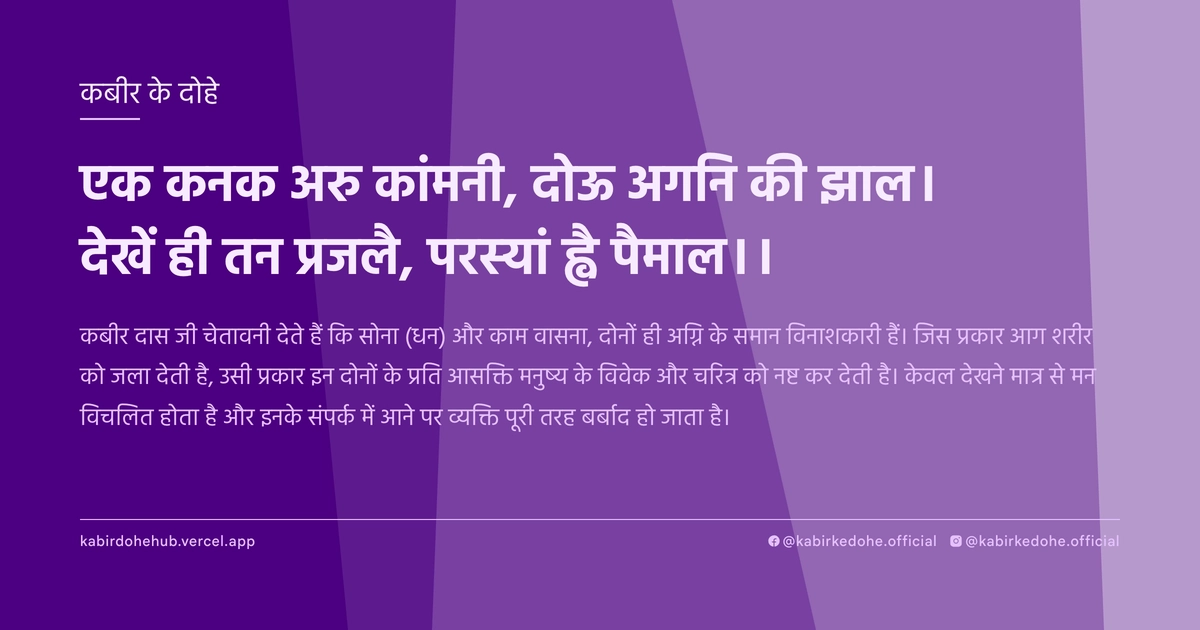
एक कनक अरु कांमनी, दोऊ अगनि की झाल।
देखें ही तन प्रजलै, परस्यां ह्वै पैमाल।।
Ek kanak aru kamani, dou agni ki jhal. Dekhen hi tan prajalai, parsyah hvai paimal.
इस पृष्ठ पर इस कबीर दोहे का अर्थ (meaning), हिंदी व्याख्या और अंग्रेज़ी अनुवाद, दार्शनिक विश्लेषण और व्यावहारिक जीवन सीख दी गई है। यह दोहा काम (Lust) विषय से जुड़ा है — Kabir doha meaning and explanation in Hindi and English.
अर्थ (Meaning):
कबीर दास जी चेतावनी देते हैं कि सोना (धन) और काम वासना, दोनों ही अग्नि के समान विनाशकारी हैं। जिस प्रकार आग शरीर को जला देती है, उसी प्रकार इन दोनों के प्रति आसक्ति मनुष्य के विवेक और चरित्र को नष्ट कर देती है। केवल देखने मात्र से मन विचलित होता है और इनके संपर्क में आने पर व्यक्ति पूरी तरह बर्बाद हो जाता है।
Kabir warns that gold (material wealth) and lust (carnal desire) are both like blazing fires. Just as fire consumes the physical body, an obsession with wealth and desire incinerates one's discernment and character. Merely glancing at these temptations ignites the fire of longing, and falling into their grip leads to total spiritual and moral ruin.
व्याख्या (Interpretation):
यहाँ 'कनक' और 'कामनी' केवल भौतिक वस्तुओं के प्रतीक नहीं हैं, बल्कि वे 'माया' के उन सूक्ष्म जाल हैं जो आत्मा को परमात्मा से अलग करते हैं। कबीर इसे 'अग्नि की झाल' कहते हैं, जिसका अर्थ है कि ये आकर्षण बाहर से चमकते हुए दिखते हैं, लेकिन भीतर से भस्म करने वाले होते हैं। यह निर्गुण भक्ति का मार्ग है जहाँ साधक को यह समझना होता है कि बाहरी सुख क्षणभंगुर हैं। जब मनुष्य इन बाहरी आकर्षणों में फंसता है, तो वह अपनी वास्तविक पहचान (आत्मा) को भूलकर अहंकार और वासना के अधीन हो जाता है। यह द्वैतवाद की स्थिति है जहाँ व्यक्ति स्वयं को शरीर और इच्छाओं का समूह मान लेता है। अंततः, यह दोहा हमें सिखाता है कि मुक्ति केवल तभी संभव है जब हम इन मानसिक और भौतिक बंधनों को पार कर शून्य या निराकार ब्रह्म में लीन हों।
Here, 'Kanak' (gold) and 'Kaamni' (lust) are not merely physical objects but symbols of the subtle webs of 'Maya' that sever the soul's connection with the Divine. Kabir describes them as 'flames of fire,' suggesting that while these attractions glitter externally, they are incinerating internally. This aligns with Nirgun Bhakti, where the seeker must realize that external pleasures are ephemeral. When a human becomes entangled in these attractions, they forget their true identity (Atman) and become slaves to ego and desire. This represents the state of duality, where the individual mistakenly identifies as a collection of bodily urges and social status. Ultimately, the couplet teaches that liberation is only possible when one transcends these mental and material shackles to merge with the formless Brahman.
दार्शनिक विश्लेषण (Philosophical Analysis):
कबीर का यह दोहा उस समय के सामाजिक और धार्मिक पाखंड पर प्रहार करता है जहाँ धर्म के नाम पर संचय और विलासिता को उचित ठहराया जाता था। कबीर ने स्पष्ट किया कि चाहे वह मंदिर का पुजारी हो या मस्जिद का मौलवी, यदि उसके भीतर लोभ और काम का वास है, तो उसकी सारी पूजा व्यर्थ है। यह विचार अद्वैत वेदांत के करीब है, जहाँ 'माया' को सत्य के आवरण के रूप में देखा जाता है। माया हमें यह विश्वास दिलाती है कि सुख बाहरी वस्तुओं में है, जबकि वास्तविक आनंद आत्मा के भीतर है।
सूफी मत के प्रभाव में, कबीर 'नफ्स' (अहंकार/इच्छाओं) के दमन की बात करते हैं। उनके अनुसार, जब तक मनुष्य अपनी इंद्रियों का दास है, वह ईश्वर का साक्षात्कार नहीं कर सकता। यह मनोवैज्ञानिक परिवर्तन की प्रक्रिया है जहाँ 'मैं' और 'मेरा' का भाव समाप्त हो जाता है। कबीर का विरोध केवल धन या स्त्री के प्रति नहीं था, बल्कि उस 'आसक्ति' (attachment) के प्रति था जो विवेक को नष्ट कर देती है।
ऐतिहासिक रूप से, कबीर ने जाति और वर्ण व्यवस्था को इसलिए नकारा क्योंकि ये व्यवस्थाएं भी एक प्रकार का सामाजिक 'कनक' (अहंकार) थीं। वे मानते थे कि आध्यात्मिक ऊंचाई किसी विशेष कुल से नहीं, बल्कि वासनाओं के त्याग और सत्य की खोज से प्राप्त होती है। यह एक क्रांतिकारी दृष्टिकोण था जिसने धर्म को कर्मकांडों से निकालकर आंतरिक शुद्धि की ओर मोड़ा।
अक्सर लोग इस दोहे को केवल वैराग्य या संन्यास के रूप में देखते हैं, लेकिन कबीर का संदेश 'संसार का त्याग' नहीं बल्कि 'मोह का त्याग' है। वे कहते हैं कि आप दुनिया में रहें, काम करें, लेकिन अपनी चेतना को इन आकर्षणों से ऊपर रखें। यह एक मानसिक संतुलन की स्थिति है जिसे 'सहज' कहा जाता है।
अंततः, यह विश्लेषण हमें बताता है कि वासना और लोभ केवल नैतिक बुराइयां नहीं हैं, बल्कि वे आध्यात्मिक बाधाएं हैं। वे आत्मा की उस ज्योति को ढक देती हैं जो हमें ब्रह्म के साथ एकाकार होने में मदद करती है। जब अहंकार की यह अग्नि शांत होती है, तभी सत्य का उदय होता है।
This couplet strikes at the heart of the social and religious hypocrisy of Kabir's era, where accumulation and luxury were often justified under the guise of piety. Kabir clarifies that whether it is a priest in a temple or a cleric in a mosque, if greed and lust reside within, all rituals are futile. This perspective resonates with Advaita Vedanta, where 'Maya' is viewed as a veil over the truth. Maya deceives the individual into believing that happiness lies in external objects, whereas true bliss is inherent within the Atman.
Influenced by Sufi mysticism, Kabir speaks of the subjugation of the 'Nafs' (the lower ego/desires). According to him, as long as a human remains a slave to their senses, the realization of the Divine is impossible. This is a process of psychological transformation where the notions of 'I' and 'Mine' are annihilated. Kabir's opposition was not to wealth or gender per se, but to the 'attachment' (Raga) that destroys discernment.
Historically, Kabir rejected the caste system because it was another form of social 'Kanak'—an ego-driven hierarchy. He asserted that spiritual elevation is not a birthright of a specific caste but is achieved through the renunciation of desires and the pursuit of Truth. This was a revolutionary shift, moving religion from outward ritualism to inward purification.
Common literalist misconceptions often frame this verse as a call for total asceticism or withdrawal from the world. However, Kabir's message is not the 'renunciation of the world' but the 'renunciation of attachment.' He advocates for living in the world while keeping the consciousness elevated above these lures—a state of equilibrium known as 'Sahaja.'
Ultimately, this analysis reveals that lust and greed are not merely moral failings but spiritual obstructions. They obscure the inner light that facilitates the union of the individual soul with the universal consciousness. Only when the fire of ego is extinguished can the light of Truth emerge.
मूल संदेश (Core Message):
- बाहरी चमक अक्सर आंतरिक विनाश का संकेत होती है।
- लोभ और वासना आत्मा की चेतना को धुंधला कर देते हैं।
- सच्ची स्वतंत्रता इच्छाओं के दास बनने में नहीं, बल्कि उन्हें जीतने में है।
- भौतिक संचय मानसिक कारागार का निर्माण करता है।
- शांति केवल तब मिलती है जब हम 'मेरा' के भ्रम को त्याग देते हैं।
- External glitter is often a signal of internal decay.
- Greed and lust cloud the consciousness of the soul.
- True freedom lies not in serving desires, but in conquering them.
- Material accumulation constructs a mental prison.
- Peace is attained only when the illusion of 'Mine' is relinquished.
व्यावहारिक उदाहरण (Practical Example):
वाराणसी के एक पुराने मोहल्ले में रामदीन नाम का एक वृद्ध बुनकर रहता था। वह अपनी कला में निपुण था, लेकिन उसका मन हमेशा और अधिक धन कमाने की लालसा में रहता था। उसने अपनी ईमानदारी छोड़कर घटिया धागों का उपयोग करना शुरू कर दिया ताकि वह अधिक मुनाफा कमा सके। उसे लगा कि यह 'कनक' (सोना) उसे समाज में सम्मान और सुख दिलाएगा।
जैसे-जैसे उसका धन बढ़ा, उसकी महत्वाकांक्षाएं भी बढ़ती गईं। वह अब अपने परिवार और पुराने मित्रों को तुच्छ समझने लगा। उसकी रातों की नींद उड़ गई थी क्योंकि वह हमेशा इस डर में रहता था कि कोई उसके धन को चुरा न ले। वह भौतिक रूप से समृद्ध हो रहा था, लेकिन मानसिक रूप से वह एक ऐसी आग में जल रहा था जिसने उसके संतोष को भस्म कर दिया था।
एक दिन उसकी मुलाकात एक घुमंतू साधु से हुई, जिसने रामदीन की बेचैनी को भांप लिया। साधु ने उसे एक छोटा सा प्रयोग करने को कहा। उसने रामदीन से कहा, "अपने सबसे कीमती रेशमी कपड़े को आग के पास ले जाओ और देखो कि वह कितनी जल्दी जल जाता है।" रामदीन ने ऐसा ही किया। देखते ही देखते वह कीमती कपड़ा राख हो गया।
साधु ने मुस्कुराते हुए कहा, "जिस सोने के पीछे तुम भाग रहे हो, वह भी इसी आग की तरह है। यह तुम्हें सुख का भ्रम देता है, लेकिन धीरे-धीरे तुम्हारी शांति, तुम्हारी नींद और तुम्हारे रिश्तों को जला देता है। तुम धन के मालिक नहीं बन रहे, बल्कि धन तुम्हारा मालिक बन गया है।"
रामदीन को अचानक कबीर के शब्दों की याद आई। उसने महसूस किया कि जिस 'कनक' को वह अपनी सुरक्षा समझ रहा था, वही वास्तव में उसकी आत्मा की बेड़ियाँ बन गया था। उसने देखा कि उसके पास धन तो था, लेकिन उसके घर में अब वह प्रेम और हंसी नहीं थी जो गरीबी के दिनों में हुआ करती थी।
उस रात रामदीन ने एक बड़ा निर्णय लिया। उसने अपने मुनाफे का एक बड़ा हिस्सा उन गरीब बुनकरों की मदद के लिए समर्पित कर दिया जिनके पास काम नहीं था। उसने घटिया धागों का मोह छोड़कर पुनः शुद्धता और ईमानदारी के साथ काम करना शुरू किया।
जैसे ही उसने लोभ का त्याग किया, उसे एक अजीब सी शांति महसूस हुई। उसे अब रात में डर नहीं लगता था। उसकी नींद वापस आ गई और उसके पुराने मित्र भी उसके पास लौटने लगे। उसने पाया कि असली समृद्धि बैंक के खातों में नहीं, बल्कि मन की संतुष्टि में है।
रामदीन अब केवल कपड़े नहीं बुनता था, बल्कि वह अपने जीवन के धागों को संतोष और प्रेम से बुन रहा था। उसने समझ लिया था कि जब हम बाहरी आकर्षणों की आग को बुझा देते हैं, तभी भीतर की दिव्य ज्योति प्रज्ज्वलित होती है।
In an old neighborhood of Varanasi lived an elderly weaver named Ramdeen. He was masterful in his craft, but his mind was always consumed by a longing for more wealth. He began using inferior threads to increase his profit margins, believing that this 'Kanak' (gold) would bring him social prestige and eternal happiness.
As his wealth grew, so did his ambitions. He started viewing his family and old friends as insignificant. His sleep vanished, replaced by a constant, gnawing fear that someone might steal his riches. While he was becoming materially prosperous, he was mentally burning in a fire that had incinerated his contentment.
One day, he encountered a wandering monk who sensed Ramdeen's inner turmoil. The monk asked him to perform a small experiment: "Take your most expensive silk cloth and hold it near a flame; see how quickly it vanishes." Ramdeen did as he was told, and in seconds, the precious fabric turned to ash.
The monk smiled and said, "The gold you chase is exactly like this fire. It offers an illusion of comfort, but slowly burns away your peace, your sleep, and your relationships. You are not becoming the master of wealth; wealth has become your master."
Suddenly, the words of Kabir echoed in Ramdeen's mind. He realized that the 'Kanak' he perceived as his security had actually become the shackles of his soul. He noticed that while he had money, the love and laughter that once filled his home during his days of poverty had disappeared.
That night, Ramdeen made a pivotal decision. He dedicated a large portion of his profits to help poor weavers who were struggling to survive. He abandoned the lure of inferior materials and returned to working with purity and honesty.
As he let go of greed, a strange sense of peace washed over him. The nighttime anxiety vanished, and his sleep returned. His old friends began to visit him again, drawn by his changed aura.
Ramdeen no longer just wove cloth; he began weaving the threads of his life with contentment and love. He understood that true prosperity does not lie in bank accounts, but in the stillness of a satisfied mind. He learned that only when we extinguish the fire of external attractions can the inner divine light truly shine.
अभ्यास मार्गदर्शन (Practice Guidance):
- दैनिक आत्म-निरीक्षण: प्रतिदिन 15 मिनट मौन बैठें और विचार करें कि आज दिन भर में किन भौतिक वस्तुओं या इच्छाओं ने आपके मन में अशांति पैदा की।
- इच्छाओं का विश्लेषण: एक डायरी लिखें जिसमें उन चीजों की सूची हो जिन्हें आप 'जरूरी' मानते हैं, और फिर ईमानदारी से पूछें कि क्या वे वास्तव में आपकी आत्मा की शांति के लिए आवश्यक हैं या केवल सामाजिक दिखावा हैं।
- सात्विक व्यवहार: सप्ताह में एक दिन ऐसा रखें जहाँ आप न्यूनतम संसाधनों के साथ जिएं, ताकि आप यह अनुभव कर सकें कि आपकी खुशी बाहरी वस्तुओं पर निर्भर नहीं है।
- निदान चेकलिस्ट: यदि आप छोटी सी हानि पर अत्यधिक क्रोधित होते हैं, दूसरों की सफलता से ईर्ष्या करते हैं, या नींद की कमी का कारण भविष्य की चिंता है, तो समझ लें कि 'कनक और कामनी' की अग्नि आपको जला रही है।
- Daily Self-Observation: Spend 15 minutes in silence daily, observing which material desires or attachments triggered restlessness or anxiety in your mind throughout the day.
- Desire Analysis: Maintain a journal listing things you consider 'essential.' Honestly question whether these are necessary for your soul's peace or merely tools for social validation.
- Sattvic Living: Dedicate one day a week to living with minimal resources to experimentally realize that your happiness is not contingent upon external acquisitions.
- Diagnostic Checklist: If you experience extreme anger over small losses, feel envy toward others' success, or suffer from insomnia due to future anxieties, recognize that the fire of 'Kanak and Kaamni' is consuming your peace.
चिंतन प्रश्न (Reflection Questions):
- क्या मेरी वर्तमान सफलता मेरी अपनी आंतरिक संतुष्टि है, या केवल दूसरों की नजरों में श्रेष्ठ दिखने की एक कोशिश?
- यदि आज मुझसे मेरी सारी भौतिक उपलब्धियां छीन ली जाएं, तो मेरे व्यक्तित्व में क्या बचेगा?
- मैं किन गुप्त इच्छाओं को अपनी 'जरूरत' बताकर खुद को धोखा दे रहा हूँ?
- क्या मेरा डिजिटल व्यक्तित्व (सोशल मीडिया) मेरे वास्तविक आंतरिक शून्य को भरने का एक प्रयास है?
- मेरे जीवन में 'प्रेम' और 'मोह' के बीच की महीन रेखा कहाँ है?
- Is my current success a reflection of inner satisfaction, or merely an attempt to appear superior in the eyes of others?
- If all my material achievements were stripped away today, what would remain of my identity?
- Which hidden desires am I disguising as 'necessities' to deceive myself?
- Is my digital persona a calculated effort to fill an internal void of emptiness?
- Where exactly is the thin line between 'pure love' and 'possessive attachment' in my life?