
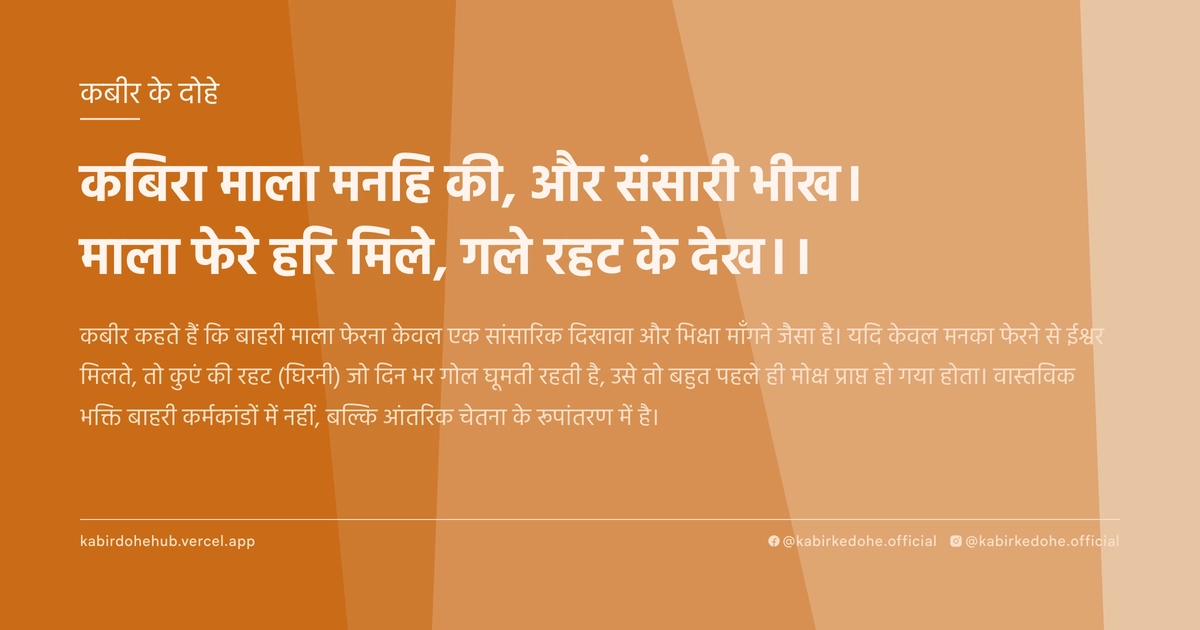
कबिरा माला मनहि की, और संसारी भीख।
माला फेरे हरि मिले, गले रहट के देख।।
Kabira maala manahi ki, aur sansari bheekh. Maala phere hari mile, gale rahat ke dekh.
इस पृष्ठ पर इस कबीर दोहे का अर्थ (meaning), हिंदी व्याख्या और अंग्रेज़ी अनुवाद, दार्शनिक विश्लेषण और व्यावहारिक जीवन सीख दी गई है। यह दोहा धार्मिक पाखंड (Religious Hypocrisy) विषय से जुड़ा है — Kabir doha meaning and explanation in Hindi and English.
अर्थ (Meaning):
कबीर कहते हैं कि बाहरी माला फेरना केवल एक सांसारिक दिखावा और भिक्षा माँगने जैसा है। यदि केवल मनका फेरने से ईश्वर मिलते, तो कुएं की रहट (घिरनी) जो दिन भर गोल घूमती रहती है, उसे तो बहुत पहले ही मोक्ष प्राप्त हो गया होता। वास्तविक भक्ति बाहरी कर्मकांडों में नहीं, बल्कि आंतरिक चेतना के रूपांतरण में है।
Kabir asserts that the act of rotating prayer beads is often a mere worldly performance, akin to begging for spiritual merit. He argues that if the mechanical repetition of beads were the key to finding the Divine, the leather strap of a well-pulley (rahat), which rotates incessantly, would have attained liberation long ago. True devotion lies not in external rituals, but in the internal transformation of consciousness.
व्याख्या (Interpretation):
इस दोहे का शाब्दिक अर्थ धार्मिक पाखंड पर प्रहार है, जहाँ कबीर 'माला' और 'रहट' की तुलना करते हैं। रूपकात्मक स्तर पर, माला 'अहंकार' के सूक्ष्म रूप का प्रतीक है, जहाँ साधक को लगता है कि वह क्रिया के माध्यम से ईश्वर को नियंत्रित कर सकता है। यह निरगुण भक्ति का सार है, जो किसी भी मूर्ति या भौतिक माध्यम को नकार कर 'शून्य' या 'निराकार' की खोज करता है। माया यहाँ उस भ्रम के रूप में है जो हमें विश्वास दिलाता है कि बाहरी अनुष्ठान आंतरिक शुद्धि का विकल्प हो सकते हैं। आत्मा और ब्रह्म की एकता तब तक संभव नहीं है जब तक कि 'कर्ता' होने का अहंकार समाप्त न हो जाए। कबीर यहाँ एक विरोधाभास प्रस्तुत करते हैं: जो सबसे अधिक प्रयास (माला फेरना) कर रहा है, वह वास्तव में सत्य से सबसे दूर है। अंततः, यह दोहा हमें यांत्रिक भक्ति से हटाकर सचेत जागरूकता की ओर ले जाता है।
Literally, this couplet is a scathing critique of religious hypocrisy, where Kabir draws a parallel between prayer beads and a well-pulley. Metaphorically, the 'mala' symbolizes a subtle form of ego, where the practitioner believes that divine grace can be engineered through mechanical action. This aligns with Nirgun Bhakti, which rejects all idols and physical intermediaries in favor of the 'Shunya' or the Formless Absolute. Maya manifests here as the illusion that external rituals can substitute for internal purification. The non-duality of Atman and Brahman remains obscured as long as the ego of the 'doer' persists. Kabir presents a profound paradox: the one who exerts the most visible effort in ritual is often the furthest from the truth. Ultimately, the verse shifts the focus from mechanical devotion to conscious, awakened presence.
दार्शनिक विश्लेषण (Philosophical Analysis):
कबीर का यह दोहा उस ऐतिहासिक कालखंड का प्रतिबिंब है जब भारतीय समाज कर्मकांडीय कट्टरता और बाहरी आडंबरों में जकड़ा हुआ था। उन्होंने ब्राह्मणवादी और सूफी दोनों परंपराओं के उन पहलुओं को चुनौती दी जो केवल बाहरी प्रतीकों पर जोर देते थे। उनका दर्शन 'अद्वैत वेदांत' के करीब है, जहाँ वे मानते हैं कि ईश्वर कहीं बाहर नहीं, बल्कि स्वयं के भीतर है। यदि ईश्वर सर्वव्यापी है, तो उसे पाने के लिए किसी विशेष उपकरण या माला की आवश्यकता नहीं है।
सूफीवाद के 'फना' (अहंकार का विनाश) के सिद्धांत की तरह, कबीर यहाँ 'माला फेरने वाले' के अहंकार को नष्ट करना चाहते हैं। वे समझाते हैं कि जब तक 'मैं' (अहंकार) मौजूद है, तब तक 'हरि' (परमात्मा) नहीं मिल सकते। यह एक मनोवैज्ञानिक रूपांतरण की मांग है, जहाँ व्यक्ति अपनी पहचान को सामाजिक या धार्मिक लेबल से हटाकर शुद्ध चेतना में विलीन करता है।
कबीर का विरोध केवल माला से नहीं, बल्कि उस मानसिकता से है जो धर्म को एक 'सौदे' की तरह देखती है—कि इतने मंत्र या इतनी माला फेरने पर मोक्ष मिलेगा। यह 'सांसारिक भीख' की तरह है, जहाँ व्यक्ति ईश्वर से कुछ माँग रहा है, जबकि वास्तविक भक्ति स्वयं को ईश्वर में समर्पित कर देने का नाम है।
वे इस बात पर जोर देते हैं कि आध्यात्मिक प्रगति का पैमाना बाहरी क्रियाएँ नहीं, बल्कि आंतरिक करुणा और सत्य का अनुभव है। उनके लिए, धर्म का अर्थ मंदिर या मस्जिद जाना नहीं, बल्कि अपने भीतर के अंधकार को मिटाना है।
अंततः, यह विश्लेषण हमें यह समझने में मदद करता है कि कबीर ने कैसे एक ऐसे मार्ग का निर्माण किया जो धर्मों के ऊपर था। उन्होंने सिखाया कि सत्य किसी विशेष पद्धति का मोहताज नहीं है, बल्कि वह सहज और स्वाभाविक है, जैसे सांस लेना।
This doha reflects the historical era of Kabir's time, when Indian society was gripped by ritualistic rigidity and external ostentation. He challenged elements of both Brahmanical and Sufi traditions that emphasized outward symbols over inner realization. His philosophy closely aligns with Advaita Vedanta, positing that the Divine is not external but resides within the self. If the Divine is omnipresent, there is no need for a specific tool or bead to access it.
Mirroring the Sufi concept of 'Fana' (the annihilation of the ego), Kabir seeks to destroy the ego of the one 'rotating the beads.' He explains that as long as the 'I' (the ego) exists, 'Hari' (the Absolute) cannot be realized. This demands a psychological transformation where the individual strips away social and religious labels to merge into pure consciousness.
Kabir's opposition is not to the beads themselves, but to the mindset that treats religion as a transaction—the belief that a specific number of mantras or beads will guarantee salvation. He calls this 'worldly begging,' where the practitioner asks something from God, whereas true devotion is the act of surrendering the self entirely into the Divine.
He emphasizes that the metric of spiritual progress is not external action, but the internal experience of compassion and truth. For Kabir, religion is not about visiting temples or mosques, but about extinguishing the darkness within one's own heart.
Ultimately, this analysis reveals how Kabir constructed a path that transcended organized religion. He taught that Truth is not dependent on a specific methodology; it is spontaneous and natural, as effortless as breathing.
मूल संदेश (Core Message):
- दिखावा सत्य का सबसे बड़ा अवरोध है।
- यांत्रिक भक्ति केवल अहंकार को पुष्ट करती है।
- ईश्वर कर्मकांडों में नहीं, चेतना में है।
- बाहरी प्रतीकों को त्यागकर आंतरिक सत्य को खोजें।
- परिवर्तन क्रिया से नहीं, भाव से आता है।
- Ostentation is the greatest barrier to Truth.
- Mechanical devotion only reinforces the ego.
- The Divine resides in consciousness, not in rituals.
- Discard external symbols to find internal Truth.
- Transformation comes from essence, not from action.
व्यावहारिक उदाहरण (Practical Example):
आर्यन एक उच्च पदस्थ कॉर्पोरेट मैनेजर था, जिसका जीवन 'चेकलिस्ट' और 'KPIs' के इर्द-गिर्द घूमता था। वह खुद को बहुत आध्यात्मिक मानता था क्योंकि वह हर सुबह एक घंटे ध्यान करता था और महंगे ध्यान केंद्रों में जाता था। उसके लिए आध्यात्मिकता एक और 'टारगेट' बन गया था जिसे उसे हासिल करना था।
वह अपने सहकर्मियों के साथ कठोर था, अपनी टीम को नीचा दिखाता था, लेकिन घर आकर वह खुद को एक 'शांत साधक' महसूस करता था। उसका ध्यान केवल एक यांत्रिक प्रक्रिया थी, ठीक वैसे ही जैसे कबीर की माला।
एक दिन, वह एक ग्रामीण क्षेत्र में गया जहाँ उसने एक वृद्ध व्यक्ति को देखा जो बिना किसी माला या मंत्र के, केवल अपनी सहजता में दूसरों की मदद कर रहा था। उस वृद्ध की आँखों में जो शांति थी, वह आर्यन के घंटों के ध्यान से कहीं अधिक गहरी थी।
आर्यन ने महसूस किया कि उसका ध्यान केवल उसके अहंकार को पोषण दे रहा था। वह 'ध्यान करने वाले' के गर्व में डूबा था, न कि वास्तव में ध्यान की स्थिति में।
उसने महसूस किया कि वह आध्यात्मिक जीवन को भी एक कॉर्पोरेट प्रोजेक्ट की तरह चला रहा था—बाहरी दिखावा पूर्ण था, लेकिन आंतरिक करुणा शून्य थी।
यह उसका 'कबीर मोमेंट' था। उसने अपनी यांत्रिक दिनचर्या को बदला। उसने ध्यान को एक 'कार्य' के बजाय एक 'भाव' बनाया।
अब उसने अपनी टीम के साथ सहानुभूति विकसित की। उसने पाया कि दूसरों की मदद करना और उनके प्रति दयालु होना, किसी भी बंद कमरे में माला फेरने से अधिक शांतिदायक था।
उसने सीखा कि वास्तविक शांति तब नहीं आती जब हम कुछ 'करते' हैं, बल्कि तब आती है जब हम उस 'कर्ता' को छोड़ देते हैं जो परिणाम की उम्मीद करता है।
उसका जीवन अब प्रदर्शन (Performance) से हटकर उपस्थिति (Presence) की ओर मुड़ गया था।
अंततः, आर्यन ने पाया कि जब उसने 'साधक' होने का ढोंग छोड़ा, तभी वह वास्तव में शांत हो पाया।
Aryan was a high-ranking corporate manager whose life revolved around checklists and KPIs. He considered himself deeply spiritual because he meditated for an hour every morning and attended expensive wellness retreats. For him, spirituality had become another 'target' to be achieved.
He was harsh with his colleagues and belittled his team, yet upon returning home, he felt like a 'peaceful seeker.' His meditation was merely a mechanical process, much like the prayer beads in Kabir's doha.
One day, while visiting a rural village, he encountered an elderly man who, without any beads or mantras, helped others with a natural, effortless grace. The peace in that man's eyes was far deeper than anything Aryan had achieved through hours of structured meditation.
Aryan realized that his spiritual practice was merely feeding his ego. He was immersed in the pride of being a 'meditator,' rather than actually being in a state of meditation.
He saw that he was running his spiritual life like a corporate project—the external display was perfect, but the internal compassion was nonexistent.
This was his 'Kabir Moment.' He shifted his mechanical routine. He transformed meditation from a 'task' into a 'feeling' of openness.
He began cultivating genuine empathy for his team. He discovered that being kind and helpful to others provided more peace than any closed-room ritual ever could.
He learned that true peace does not come from what we 'do,' but from letting go of the 'doer' who expects a specific result.
His life shifted from a focus on performance to a focus on presence.
Ultimately, Aryan found that only when he stopped pretending to be a 'seeker' did he actually find the stillness he was looking for.
अभ्यास मार्गदर्शन (Practice Guidance):
- दैनिक आत्म-निरीक्षण: दिन में तीन बार रुकें और पूछें, 'क्या मैं यह कार्य अहंकार की संतुष्टि के लिए कर रहा हूँ या वास्तविक सेवा के लिए?'
- यांत्रिकता का त्याग: किसी भी प्रार्थना या मंत्र को केवल दोहराने के बजाय, उस शब्द के पीछे के मौन और अर्थ को महसूस करने का प्रयास करें।
- अहंकार की पहचान: जब भी आप अपनी धार्मिक या नैतिक श्रेष्ठता महसूस करें, तो याद करें कि यह 'माला' है, सत्य नहीं।
- डायग्नोस्टिक चेकलिस्ट: यदि आप अपनी आध्यात्मिक उपलब्धियों के बारे में बात अधिक करते हैं और व्यवहार में विनम्रता कम है, तो आप 'रहट' की तरह केवल घूम रहे हैं।
- Daily Self-Inquiry: Stop three times a day and ask, 'Am I performing this action to satisfy my ego or out of genuine service?'
- Abandoning Mechanicality: Instead of merely repeating a prayer or mantra, attempt to feel the silence and the essence behind the words.
- Identifying the Ego: Whenever you feel a sense of religious or moral superiority, remind yourself that this is the 'mala' (the illusion), not the Truth.
- Diagnostic Checklist: If you talk more about your spiritual achievements than you exhibit humility in your behavior, you are merely rotating like the 'rahat' (the pulley).
चिंतन प्रश्न (Reflection Questions):
- मेरे जीवन में ऐसी कौन सी 'माला' है जिसे मैं दुनिया को दिखाने के लिए फेर रहा हूँ?
- क्या मेरी आध्यात्मिकता मुझे दूसरों के प्रति अधिक संवेदनशील बनाती है या अधिक निर्णय लेने वाला (judgmental)?
- यदि मेरे सभी धार्मिक प्रतीक छीन लिए जाएँ, तो मेरे भीतर क्या बचेगा?
- मैं अपनी 'आध्यात्मिक पहचान' का उपयोग अपने अहंकार को छिपाने के लिए कैसे करता हूँ?
- क्या मैं सत्य को खोज रहा हूँ, या केवल सत्य खोजने का ढोंग कर रहा हूँ?
- What is the 'mala' in my life that I rotate simply for the world to see?
- Does my spirituality make me more empathetic toward others, or more judgmental?
- If all my religious symbols were stripped away, what would remain within me?
- How do I use my 'spiritual identity' to mask my underlying ego?
- Am I truly seeking the Truth, or am I merely performing the act of seeking?