
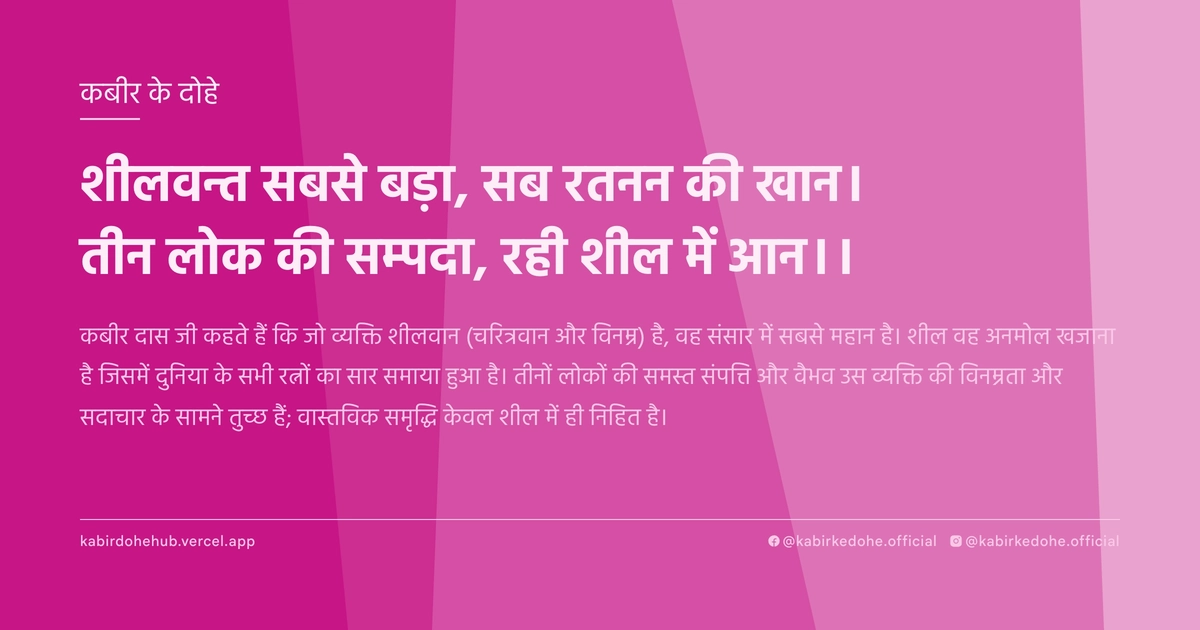
शीलवन्त सबसे बड़ा, सब रतनन की खान।
तीन लोक की सम्पदा, रही शील में आन।।
Sheelvant sabse bada, sab ratnan ki khan. Teen lok ki sampada, rahi sheel mein aan.
इस पृष्ठ पर इस कबीर दोहे का अर्थ (meaning), हिंदी व्याख्या और अंग्रेज़ी अनुवाद, दार्शनिक विश्लेषण और व्यावहारिक जीवन सीख दी गई है। यह दोहा विनम्रता (Humility) विषय से जुड़ा है — Kabir doha meaning and explanation in Hindi and English.
अर्थ (Meaning):
कबीर दास जी कहते हैं कि जो व्यक्ति शीलवान (चरित्रवान और विनम्र) है, वह संसार में सबसे महान है। शील वह अनमोल खजाना है जिसमें दुनिया के सभी रत्नों का सार समाया हुआ है। तीनों लोकों की समस्त संपत्ति और वैभव उस व्यक्ति की विनम्रता और सदाचार के सामने तुच्छ हैं; वास्तविक समृद्धि केवल शील में ही निहित है।
Kabir asserts that a person of 'Sheel' (virtuous character and humility) is the greatest of all. Such a person is like a mine of all precious gems. The combined wealth and opulence of the three realms—heaven, earth, and the underworld—pale in comparison to the dignity and grace found in a virtuous character; true abundance resides solely in one's moral integrity.
व्याख्या (Interpretation):
यहाँ 'शील' का अर्थ केवल शिष्टाचार नहीं, बल्कि आत्मा की वह अवस्था है जहाँ अहंकार का पूर्ण विसर्जन हो चुका है। कबीर इस दोहे के माध्यम से यह समझाते हैं कि बाहरी संपदा नश्वर है, जबकि आंतरिक शील शाश्वत है। यह निर्गुण भक्ति का वह मार्ग है जहाँ साधक स्वयं को शून्य कर ईश्वर की व्यापकता को आत्मसात करता है। जब मनुष्य अपनी पहचान को 'मैं' से हटाकर 'शील' में विलीन करता है, तब वह माया के बंधनों से मुक्त हो जाता है। यह अद्वैत वेदांत की उस स्थिति की ओर संकेत है जहाँ आत्मा और ब्रह्म का भेद समाप्त हो जाता है। शील वह सेतु है जो जीव को उसकी वास्तविक दैवीय प्रकृति से जोड़ता है। अंततः, यह विरोधाभास है कि जो सबसे अधिक झुकता है, वही वास्तव में सबसे ऊंचा उठता है।
Here, 'Sheel' does not merely denote etiquette, but a state of the soul where the ego has been completely dissolved. Kabir explains that external wealth is ephemeral, while inner virtue is eternal. This is the path of Nirgun Bhakti, where the seeker empties the self to accommodate the vastness of the Formless Divine. When a human shifts their identity from the 'I' to 'virtue,' they break the shackles of Maya (illusion). This points toward the Advaita Vedanta realization where the distinction between Atman and Brahman vanishes. Sheel is the bridge connecting the individual soul to its inherent divine nature. Ultimately, it presents the spiritual paradox: he who bows the lowest is the one who truly ascends the highest.
दार्शनिक विश्लेषण (Philosophical Analysis):
कबीर का यह दोहा उस युग की प्रतिक्रिया है जहाँ धर्म को बाहरी कर्मकांडों, जातिगत श्रेष्ठता और भौतिक संचय से मापा जाता था। कबीर ने इस सामाजिक संरचना को चुनौती देते हुए 'शील' को सर्वोच्च मूल्य घोषित किया। उनका दर्शन यह है कि यदि हृदय में विनम्रता नहीं है, तो वेदों का ज्ञान या तीर्थयात्राएं केवल अहंकार को पोषित करती हैं। यह दृष्टिकोण सूफीवाद के 'फना' (अहंकार का विनाश) के करीब है, जहाँ प्रेमी अपने अस्तित्व को मिटाकर सत्य में लीन हो जाता है।
दार्शनिक स्तर पर, कबीर यहाँ 'सगुण' और 'निर्गुण' के विवाद से ऊपर उठकर मानवीय गुणों की बात कर रहे हैं। वे तर्क देते हैं कि ईश्वर किसी मंदिर या मस्जिद में नहीं, बल्कि उस व्यक्ति के भीतर है जिसने अपने क्रोध, लोभ और अहंकार को जीत लिया है। यह मनोवैज्ञानिक रूपांतरण की प्रक्रिया है, जहाँ व्यक्ति अपनी बाहरी छवि (Persona) को त्यागकर अपनी वास्तविक आत्मा (Self) से मिलता है।
अद्वैत वेदांत के संदर्भ में, शील वह दर्पण है जिसमें ब्रह्म का प्रतिबिंब स्पष्ट दिखाई देता है। जब तक मन मैला है, सत्य ओझल रहता है। शील मन की उस स्वच्छता का नाम है जो द्वैत (दो होने का भ्रम) को समाप्त करती है। कबीर यह स्पष्ट करते हैं कि शील कोई अर्जित वस्तु नहीं है, बल्कि यह हमारी मूल प्रकृति है जिसे हमने सामाजिक कंडीशनिंग और अहंकार की परतों के नीचे दबा दिया है।
कबीर का विरोध उन पाखंडियों से था जो ऊपरी तौर पर धार्मिक दिखते थे लेकिन भीतर से घृणा और अहंकार से भरे थे। उनके लिए 'शील' एक क्रांतिकारी हथियार था जो जाति और वर्ग के भेदों को मिटा देता है। एक शीलवान व्यक्ति के लिए कोई छोटा या बड़ा नहीं होता, क्योंकि वह हर जीव में उसी एक चेतना का वास देखता है।
अंततः, यह शिक्षण हमें यह समझने पर मजबूर करता है कि वास्तविक 'संपदा' वह नहीं है जिसे तिजोरियों में रखा जाए, बल्कि वह है जिसे आचरण में उतारा जाए। शील का अर्थ कायरता नहीं, बल्कि वह आंतरिक शक्ति है जो विपरीत परिस्थितियों में भी शांत और करुणामयी बनी रहती है। यह अहंकार के विसर्जन और सार्वभौमिक प्रेम की प्राप्ति का मार्ग है।
This couplet is a reaction to an era where religion was measured by external rituals, caste superiority, and material accumulation. Kabir challenged this social structure by declaring 'Sheel' (virtuous character) as the supreme value. His philosophy posits that without humility, the knowledge of the Vedas or pilgrimages only serve to nourish the ego. This perspective aligns closely with the Sufi concept of 'Fana' (annihilation of the self), where the lover erases their existence to merge with the Truth.
On a philosophical level, Kabir transcends the debate between 'Saguna' (with form) and 'Nirguna' (formless) by focusing on human virtues. He argues that God resides not in temples or mosques, but within the individual who has conquered anger, greed, and pride. This is a process of psychological transformation, where one sheds the external 'Persona' to encounter the authentic 'Self.'
In the context of Advaita Vedanta, Sheel is the mirror in which the reflection of Brahman becomes clear. As long as the mind is clouded, Truth remains hidden. Sheel represents that mental purity which dissolves duality (the illusion of separation). Kabir clarifies that virtue is not something to be acquired, but our original nature, buried under layers of social conditioning and ego.
Kabir's opposition was directed toward hypocrites who appeared religious outwardly but were filled with hatred and arrogance internally. For him, 'Sheel' was a revolutionary tool that erased the distinctions of caste and class. To a virtuous person, no one is superior or inferior, as they perceive the same single consciousness residing in every living being.
Ultimately, this teaching forces us to realize that true 'wealth' is not that which is stored in vaults, but that which is embodied in conduct. Sheel does not mean cowardice; rather, it is the inner strength that remains calm and compassionate even in adversity. It is the path of ego-dissolution and the attainment of universal love.
मूल संदेश (Core Message):
- अहंकार बाहरी आवरण है, शील आंतरिक सत्य है।
- विनम्रता कमजोरी नहीं, बल्कि आत्मा की सर्वोच्च शक्ति है।
- सच्ची समृद्धि चरित्र की पवित्रता में निहित है।
- जब 'मैं' मिटता है, तब 'शील' प्रकट होता है।
- मानवता का उच्चतम शिखर निस्वार्थ सेवा और सरलता है।
- Ego is an external shell; virtue is the internal truth.
- Humility is not weakness, but the supreme power of the soul.
- True prosperity resides in the purity of one's character.
- When the 'I' dissolves, 'Sheel' manifests.
- The highest peak of humanity is selfless service and simplicity.
व्यावहारिक उदाहरण (Practical Example):
वाराणसी के एक पुराने घाट पर माधव नाम का एक वृद्ध बुनकर रहता था। माधव के पास धन तो नहीं था, लेकिन उसकी वाणी में ऐसी मिठास और व्यवहार में ऐसी विनम्रता थी कि पूरा मोहल्ला उसका सम्मान करता था।
उसी घाट के पास एक धनी व्यापारी रहता था, जिसे अपनी संपत्ति और ऊँची जाति का बहुत अहंकार था। वह अक्सर माधव का मज़ाक उड़ाता और उसे 'तुच्छ' कहकर पुकारता था।
एक बार शहर में एक बहुत बड़ा विद्वान आया। व्यापारी ने अपनी संपत्ति का प्रदर्शन कर उसे प्रभावित करने की कोशिश की, लेकिन विद्वान ने उसकी बातों में केवल अहंकार देखा और उसे अनदेखा कर दिया।
जब वह विद्वान माधव की छोटी सी कुटिया में गया, तो उसने देखा कि माधव एक घायल पक्षी की सेवा कर रहा था और साथ ही साथ एक गरीब बच्चे को निःशुल्क अक्षर ज्ञान दे रहा था।
माधव ने विद्वान का स्वागत बिना किसी दिखावे के, केवल एक गिलास पानी और सच्ची मुस्कान के साथ किया। विद्वान माधव की सादगी और उसके निस्वार्थ भाव से इतना प्रभावित हुआ कि उसने माधव के चरणों में सिर झुका दिया।
व्यापारी यह देखकर दंग रह गया। उसने पूछा, 'इस गरीब बुनकर के पास ऐसा क्या है जो मेरे पास नहीं, कि आप इसके सामने झुक रहे हैं?'
विद्वान ने उत्तर दिया, 'तुम्हारे पास सोने के सिक्के हैं, लेकिन इस व्यक्ति के पास 'शील' का खजाना है। तुम्हारी संपत्ति तुम्हें दूसरों से अलग करती है, लेकिन इसकी विनम्रता इसे पूरी दुनिया से जोड़ती है।'
यह सुनकर व्यापारी का अहंकार टूट गया। उसे समझ आया कि असली बड़प्पन कपड़ों या पैसों में नहीं, बल्कि इस बात में है कि हम दूसरों के साथ कैसा व्यवहार करते हैं।
उस दिन के बाद व्यापारी ने अपनी संपत्ति का उपयोग गरीबों की सेवा के लिए करना शुरू किया और माधव से विनम्रता का पाठ सीखने लगा।
माधव की 'शील' ने न केवल एक अहंकारी व्यक्ति का हृदय बदल दिया, बल्कि पूरे समुदाय में प्रेम और समानता का संचार कर दिया।
On an old ghat in Varanasi lived an elderly weaver named Madhav. Madhav possessed no wealth, but his speech held such sweetness and his behavior such humility that the entire neighborhood revered him.
Nearby lived a wealthy merchant who was deeply arrogant about his riches and high caste. He often mocked Madhav, calling him 'insignificant' and 'lowly.'
One day, a renowned scholar visited the city. The merchant tried to impress him by flaunting his opulence, but the scholar saw only ego in his words and ignored him.
When the scholar visited Madhav's tiny hut, he found Madhav tending to an injured bird while simultaneously teaching a poor child to read and write for free.
Madhav welcomed the scholar without any pretense, offering only a glass of water and a genuine smile. The scholar was so moved by Madhav's simplicity and selflessness that he bowed at the weaver's feet.
The merchant was stunned. He asked, 'What does this poor weaver possess that I do not, that causes you to bow before him?'
The scholar replied, 'You possess gold coins, but this man possesses the treasure of Sheel. Your wealth separates you from others, but his humility connects him to the entire world.'
Hearing this, the merchant's ego shattered. He realized that true greatness lies not in clothes or money, but in how we treat others.
From that day forward, the merchant began using his wealth for the service of the poor and sought to learn the art of humility from Madhav.
Madhav's 'Sheel' not only transformed an arrogant man's heart but infused the entire community with love and equality.
अभ्यास मार्गदर्शन (Practice Guidance):
- दैनिक अभ्यास: प्रतिदिन कम से कम एक ऐसा कार्य करें जिसमें आप अपनी इच्छा या अहंकार को त्यागकर किसी अन्य की सहायता करें, बिना किसी को बताए।
- आत्म-चिंतन जर्नल: रात को सोने से पहले लिखें—'आज मैंने कहाँ अपनी श्रेष्ठता सिद्ध करने की कोशिश की?' और 'कहाँ मैं विनम्र रह सकता था?'
- व्यवहारिक परिवर्तन: जब कोई आपकी आलोचना करे, तो तुरंत प्रतिक्रिया देने के बजाय 10 सेकंड रुकें और विचार करें कि क्या आपका अहंकार आहत हुआ है या आपका सत्य।
- डायग्नोस्टिक चेकलिस्ट: यदि आप दूसरों की गलती पर क्रोधित होते हैं या अपनी उपलब्धियों का बखान करते हैं, तो समझें कि शील की कमी है। यदि आप दूसरों की सफलता में वास्तव में खुश हैं, तो शील जागृत हो रहा है।
- Daily Practice: Perform at least one act of service daily where you surrender your ego and help someone else anonymously.
- Self-Inquiry Journal: Before sleep, write—'Where did I try to prove my superiority today?' and 'Where could I have remained more humble?'
- Behavioral Shift: When criticized, instead of reacting instantly, pause for 10 seconds and analyze whether it is your ego that is hurt or your truth.
- Diagnostic Checklist: If you feel anger at others' mistakes or a need to boast about achievements, recognize a lack of Sheel. If you feel genuine joy in others' success, Sheel is awakening.
चिंतन प्रश्न (Reflection Questions):
- क्या मेरी विनम्रता वास्तविक है, या यह दूसरों से प्रशंसा पाने का एक सामाजिक मुखौटा है?
- मैं उन लोगों के प्रति कैसा व्यवहार करता हूँ जिनसे मुझे जीवन में कोई लाभ मिलने की संभावना नहीं है?
- मेरे भीतर का वह कौन सा हिस्सा है जो अभी भी खुद को दूसरों से श्रेष्ठ मानता है?
- क्या मैं अपनी डिजिटल पहचान (Social Media) के माध्यम से एक कृत्रिम श्रेष्ठता का निर्माण कर रहा हूँ?
- यदि मेरी सारी भौतिक उपलब्धियाँ छीन ली जाएँ, तो मेरे व्यक्तित्व में क्या शेष बचेगा?
- क्या मैं अपनी गलतियों को स्वीकार करने में सक्षम हूँ, या मेरा अहंकार उन्हें सही ठहराने के तर्क ढूंढता है?
- Is my humility genuine, or is it a social mask designed to elicit praise from others?
- How do I treat those from whom I have absolutely nothing to gain in life?
- Which part of me still clings to the belief that I am superior to others?
- Am I constructing a synthetic superiority through my digital identity on social media?
- If all my material achievements were stripped away, what would remain of my personality?
- Am I capable of admitting my mistakes, or does my ego constantly manufacture justifications?