
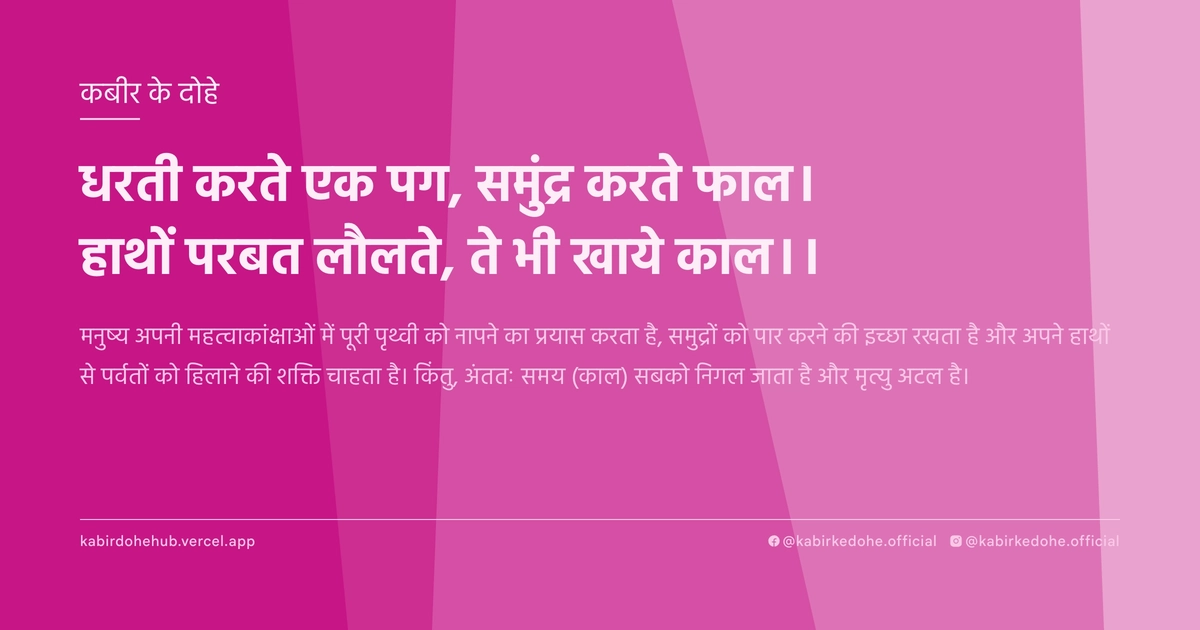
धरती करते एक पग, समुंद्र करते फाल।
हाथों परबत लौलते, ते भी खाये काल।।
Dharti karte ek pag, samundar karte faal. Haathon parbat laulate, te bhi khaaye kaal.
इस पृष्ठ पर इस कबीर दोहे का अर्थ (meaning), हिंदी व्याख्या और अंग्रेज़ी अनुवाद, दार्शनिक विश्लेषण और व्यावहारिक जीवन सीख दी गई है। यह दोहा अनित्य (Impermanence) विषय से जुड़ा है — Kabir doha meaning and explanation in Hindi and English.
अर्थ (Meaning):
मनुष्य अपनी महत्वाकांक्षाओं में पूरी पृथ्वी को नापने का प्रयास करता है, समुद्रों को पार करने की इच्छा रखता है और अपने हाथों से पर्वतों को हिलाने की शक्ति चाहता है। किंतु, अंततः समय (काल) सबको निगल जाता है और मृत्यु अटल है।
Man attempts to measure the entire earth with a single step, desires to cross the vast oceans, and seeks the power to move mountains with his hands. However, ultimately, Time (Kaal) consumes everything, and death remains the only absolute certainty.
व्याख्या (Interpretation):
यह दोहा भौतिक उपलब्धियों की निरर्थकता और समय की सर्वोपरि शक्ति का वर्णन करता है। 'एक पग' और 'फाल' यहाँ मानवीय अहंकार और विस्तारवाद के प्रतीक हैं। कबीर समझाते हैं कि चाहे कोई कितना भी शक्तिशाली या संचयकर्ता क्यों न हो, वह 'माया' के जाल में फंसा है। यह निर्गुण भक्ति का सार है, जहाँ बाहरी जगत को नश्वर मानकर अंतर्मुखी होने का आह्वान किया गया है। यहाँ 'काल' केवल मृत्यु नहीं, बल्कि वह ब्रह्मांडीय चक्र है जो हर अहंकार को शून्य में विलीन कर देता है। यह आत्मा और ब्रह्म के बीच के उस पर्दे को हटाने की बात है जिसे हम 'सफलता' कहते हैं।
This couplet describes the futility of material achievements and the supreme power of Time. 'One step' and 'crossing oceans' serve as metaphors for human ego and expansionism. Kabir explains that regardless of how powerful or acquisitive one becomes, they remain trapped in the web of 'Maya' (illusion). This is the essence of Nirgun Bhakti, calling for an inward turn by recognizing the transient nature of the external world. Here, 'Kaal' is not merely death, but the cosmic cycle that dissolves every ego into nothingness. It speaks of lifting the veil of 'success' to realize the non-duality of Atman and Brahman.
दार्शनिक विश्लेषण (Philosophical Analysis):
कबीर का यह दोहा 15वीं शताब्दी के सामाजिक और धार्मिक परिवेश में रचा गया, जहाँ बाहरी आडंबर और साम्राज्य विस्तार की होड़ चरम पर थी। कबीर ने स्पष्ट रूप से उन लोगों को चुनौती दी जो कर्मकांडों या भौतिक शक्ति के माध्यम से मोक्ष या अमरता प्राप्त करना चाहते थे। वे तर्क देते हैं कि जो व्यक्ति स्वयं को 'कर्ता' मानता है, वह वास्तव में अज्ञान में है।
अद्वैत वेदांत के परिप्रेक्ष्य में, यह दोहा 'अविद्या' (ignorance) पर प्रहार करता है। जब मनुष्य यह सोचता है कि वह प्रकृति को नियंत्रित कर सकता है, तो वह अपनी सीमितता को भूल जाता है। कबीर का दर्शन सूफीवाद के 'फना' (annihilation of self) के करीब है, जहाँ अहंकार का मिटना ही परमात्मा से मिलन का एकमात्र मार्ग है।
यहाँ 'काल' का उल्लेख केवल डराने के लिए नहीं, बल्कि एक आध्यात्मिक जागृति के लिए है। यह एक मनोवैज्ञानिक परिवर्तन की मांग करता है—बाहरी विजय से आंतरिक शांति की ओर। कबीर जाति और वर्ग के भेदों को निरर्थक बताते हैं क्योंकि मृत्यु सबको समान स्तर पर ले आती है।
सांसारिक उपलब्धियों को 'पर्वत हिलाने' जैसा बताया गया है, जो सुनने में महान लगता है लेकिन समय की अनंतता के सामने तुच्छ है। यह भौतिकवाद की उस गलतफहमी को सुधारता है कि संचय से सुरक्षा मिल सकती है।
अंततः, यह विश्लेषण हमें सिखाता है कि वास्तविक शक्ति 'करने' में नहीं, बल्कि 'होने' में है। जब कर्ता भाव समाप्त होता है, तब व्यक्ति काल के भय से मुक्त होकर शाश्वत सत्य (Sathya) का अनुभव करता है।
Kabir's couplet was composed within the 15th-century socio-religious milieu, where external rituals and the race for imperial expansion were at their peak. Kabir explicitly challenged those who sought liberation or immortality through ritualism or material power, arguing that anyone who perceives themselves as the 'doer' is fundamentally in ignorance.
From the perspective of Advaita Vedanta, this doha attacks 'Avidya' (ignorance). When a human believes they can control nature, they forget their inherent limitation. Kabir's philosophy aligns closely with the Sufi concept of 'Fana' (annihilation of the self), where the dissolution of the ego is the only path to union with the Divine.
The mention of 'Kaal' (Time/Death) is not intended to instill fear, but to trigger spiritual awakening. It demands a psychological shift—from external conquest to internal peace. Kabir renders caste and class distinctions irrelevant, as death levels all hierarchies.
Worldly achievements are likened to 'moving mountains,' which sounds magnificent but is trivial against the infinity of time. This corrects the materialist misconception that accumulation provides security.
Ultimately, this analysis teaches us that true power lies not in 'doing' but in 'being.' When the sense of agency (the ego as the doer) vanishes, the individual is liberated from the fear of time and experiences the Eternal Truth.
मूल संदेश (Core Message):
- बाहरी विजय एक मृगतृष्णा है, आंतरिक शांति ही एकमात्र सत्य है।
- अहंकार का विस्तार समय की एक लहर में विलीन हो जाता है।
- कर्ता होने के भ्रम को त्यागकर साक्षी भाव में स्थित हों।
- मृत्यु का भय केवल उस व्यक्ति को होता है जिसने कुछ संचित किया है।
- शाश्वत सत्य वह है जो जन्म और मृत्यु के चक्र से मुक्त है।
- External conquest is a mirage; inner peace is the only truth.
- The expansion of ego dissolves in a single wave of Time.
- Abandon the illusion of being the 'doer' and dwell in the witness state.
- Fear of death only haunts those who try to accumulate and cling.
- Eternal Truth is that which is liberated from the cycle of birth and death.
व्यावहारिक उदाहरण (Practical Example):
वाराणसी के घाटों पर रहने वाले एक वृद्ध बुनकर, माधव, की कहानी है। माधव अपने जीवन के चालीस वर्ष सबसे महीन रेशमी वस्त्र बनाने में लगा दिए। वह शहर का सबसे कुशल बुनकर था और उसका सपना था कि वह एक ऐसा वस्त्र बनाए जिसे राजा स्वयं पहनें और उसका नाम इतिहास में अमर हो जाए।
उसने दिन-रात एक कर दिए, अपनी नींद और स्वास्थ्य की परवाह किए बिना। उसने अपनी पूरी संपत्ति और समय उस 'परफेक्ट' वस्त्र में लगा दिया, यह सोचकर कि यह उसकी महानता का प्रमाण होगा। वह खुद को अन्य बुनकरों से श्रेष्ठ समझने लगा था।
एक दिन, जब वह अपने जीवन के सबसे भव्य वस्त्र को अंतिम रूप दे रहा था, उसके घर में भीषण आग लग गई। कुछ ही मिनटों में, उसकी पूरी कार्यशाला और वह बहुप्रतीक्षित वस्त्र राख हो गए। माधव टूट गया और सड़क पर बैठकर विलाप करने लगा कि उसकी सारी मेहनत और पहचान मिट गई।
तभी उसकी मुलाकात एक घुमंतू साधु से हुई, जिसने उसे कबीर का यह दोहा सुनाया। साधु ने कहा, 'माधव, तूने रेशम के धागों से पर्वत बनाने की कोशिश की, लेकिन समय की एक चिंगारी ने सब शून्य कर दिया। तू जिसे अपनी पहचान मान रहा था, वह केवल एक भ्रम था।'
माधव को पहली बार अहसास हुआ कि उसकी पूरी जिंदगी 'करने' और 'पाने' की दौड़ में बीती, जबकि वह यह भूल गया कि वह स्वयं कौन है। उसने महसूस किया कि उसकी श्रेष्ठता का अहंकार ही उसका असली बंधन था।
उस घटना के बाद, माधव ने फिर से बुनना शुरू किया, लेकिन अब उसका उद्देश्य 'नाम' कमाना नहीं था। वह अब गरीब बच्चों के लिए साधारण सूती कपड़े बुनता और उन्हें मुफ्त में बांट देता।
उसकी कला पहले से अधिक निखर गई क्योंकि अब उसमें अहंकार का बोझ नहीं था। वह अब वस्त्रों के माध्यम से अपनी महानता नहीं, बल्कि सेवा के माध्यम से शांति खोज रहा था।
माधव अब मृत्यु या नुकसान से नहीं डरता था, क्योंकि उसने जान लिया था कि जो 'काल' सब कुछ छीन लेता है, वह केवल उसी को ले जाता है जो कुछ पकड़ कर रखने की कोशिश करता है।
This is the story of Madhav, an elderly weaver living on the ghats of Varanasi. For forty years, Madhav dedicated his life to creating the finest silk textiles. He was the most skilled weaver in the city, and his dream was to create a garment so exquisite that the King himself would wear it, rendering Madhav's name immortal in history.
He worked tirelessly, ignoring his sleep and health. He invested all his wealth and time into this 'perfect' garment, believing it would be the ultimate proof of his greatness. He began to view himself as superior to all other weavers.
One day, while putting the final touches on his most magnificent piece, a devastating fire broke out in his home. Within minutes, his entire workshop and the long-awaited garment were reduced to ashes. Madhav was shattered and wept on the street, mourning the loss of his hard work and identity.
There, he encountered a wandering monk who recited this specific doha of Kabir. The monk said, 'Madhav, you tried to build mountains with silk threads, but a single spark of Time reduced everything to zero. What you considered your identity was merely an illusion.'
For the first time, Madhav realized that his entire life had been spent in a race of 'doing' and 'acquiring,' while he had forgotten who he truly was. He understood that the ego of superiority was his real bondage.
After that event, Madhav began weaving again, but his purpose was no longer to earn 'fame.' He started weaving simple cotton clothes for poor children and distributing them for free.
His art became even more refined because the burden of ego was gone. He was no longer seeking greatness through fabric, but peace through service.
Madhav no longer feared death or loss, for he had learned that Time only takes away from those who try to cling to things.
अभ्यास मार्गदर्शन (Practice Guidance):
- प्रतिदिन 15 मिनट 'शून्य ध्यान' का अभ्यास करें, जहाँ आप स्वयं को एक ऐसे बिंदु के रूप में देखें जो समय और उपलब्धियों से परे है।
- एक 'अहंकार पत्रिका' (Ego Journal) लिखें: दिन भर में उन क्षणों को दर्ज करें जब आपने अपनी सफलता का श्रेय केवल स्वयं को दिया या दूसरों से श्रेष्ठ महसूस किया।
- व्यवहार परिवर्तन: सप्ताह में एक बार ऐसा कार्य करें जिसका कोई सामाजिक श्रेय न मिले और जिसे आप गुप्त रखें, ताकि 'कर्ता' होने का भाव मिटे।
- निदान चेकलिस्ट: क्या मैं अपनी पहचान अपनी उपलब्धियों से जोड़ रहा हूँ? क्या मैं भविष्य की चिंता में वर्तमान की शांति खो रहा हूँ? क्या मैं मृत्यु के विचार से भयभीत हूँ?
- Practice 15 minutes of 'Zero Meditation' daily, visualizing yourself as a point existing beyond time and achievements.
- Maintain an 'Ego Journal': Record moments throughout the day when you attributed success solely to yourself or felt superior to others.
- Behavioral Change: Once a week, perform an act of service that brings no social recognition and keep it secret to dissolve the 'doer' identity.
- Diagnostic Checklist: Am I linking my identity to my achievements? Am I losing present peace to future anxieties? Does the thought of death evoke fear?
चिंतन प्रश्न (Reflection Questions):
- यदि आज आपकी सारी उपलब्धियाँ और पद छीन लिए जाएँ, तो आपके पास 'स्वयं' के रूप में क्या बचेगा?
- आपकी डिजिटल पहचान (सोशल मीडिया) आपके वास्तविक अस्तित्व को कितना ढक रही है?
- आप किन 'पर्वतों' को हिलाने की कोशिश कर रहे हैं, और क्या वे वास्तव में आपके जीवन के उद्देश्य के लिए आवश्यक हैं?
- क्या आपकी करुणा वास्तव में निस्वार्थ है, या यह आपकी छवि को बेहतर बनाने का एक सूक्ष्म तरीका है?
- आप समय को अपना शत्रु मानते हैं या एक शिक्षक जो आपको नश्वरता की याद दिलाता है?
- If all your achievements and titles were stripped away today, what would remain of 'you'?
- To what extent does your digital identity (social media) obscure your actual existence?
- Which 'mountains' are you trying to move, and are they truly necessary for your life's purpose?
- Is your compassion truly selfless, or is it a subtle way to enhance your own image?
- Do you perceive Time as an enemy or as a teacher reminding you of your transience?