
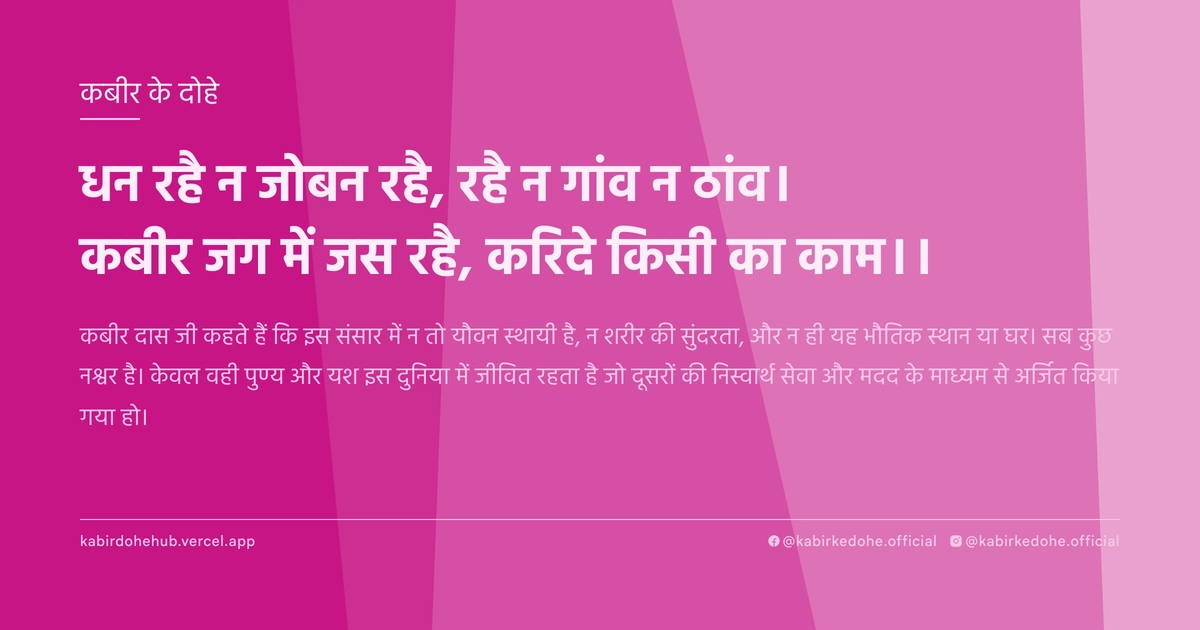
धन रहै न जोबन रहै, रहै न गांव न ठांव।
कबीर जग में जस रहै, करिदे किसी का काम।।
Dhan rahai na joban rahai, rahai na gaon na thaanv. Kabir jag mein jas rahai, karide kisi ka kaam.
इस पृष्ठ पर इस कबीर दोहे का अर्थ (meaning), हिंदी व्याख्या और अंग्रेज़ी अनुवाद, दार्शनिक विश्लेषण और व्यावहारिक जीवन सीख दी गई है। यह दोहा अनित्य (Impermanence) विषय से जुड़ा है — Kabir doha meaning and explanation in Hindi and English.
अर्थ (Meaning):
कबीर दास जी कहते हैं कि इस संसार में न तो यौवन स्थायी है, न शरीर की सुंदरता, और न ही यह भौतिक स्थान या घर। सब कुछ नश्वर है। केवल वही पुण्य और यश इस दुनिया में जीवित रहता है जो दूसरों की निस्वार्थ सेवा और मदद के माध्यम से अर्जित किया गया हो।
Kabir teaches that neither youth nor physical beauty lasts, nor do the places or homes we inhabit. Everything in the material world is transient. The only thing that remains as a lasting legacy in this world is the fame and grace earned through selfless service and helping others in need.
व्याख्या (Interpretation):
इस दोहे का शाब्दिक अर्थ समय की निष्ठुरता और भौतिकता के विनाश को दर्शाता है। रूपक के स्तर पर, 'जोबन' केवल शारीरिक युवावस्था नहीं, बल्कि अहंकार और सांसारिक आकर्षण का प्रतीक है। कबीर यहाँ 'माया' के भ्रम को उजागर करते हैं, जहाँ मनुष्य अपनी पहचान को शरीर और संपत्ति से जोड़ता है। जब वह कहते हैं कि 'गांव न ठांव' नहीं रहेगा, तो वे आत्मा की उस स्थिति की ओर संकेत कर रहे हैं जो किसी एक भौगोलिक या सामाजिक पहचान में बंधी नहीं है। यह निर्गुण भक्ति का सार है, जहाँ साधक को यह बोध होता है कि केवल 'परम तत्व' या 'करुणा' ही शाश्वत है। यहाँ विरोधाभास यह है कि जो हम अपने लिए बचाते हैं वह खो जाता है, और जो हम दूसरों को दे देते हैं, वही वास्तव में हमारा अपना बन जाता है। यह आत्मन और ब्रह्म की एकता का मार्ग है, जहाँ सेवा के माध्यम से अहंकार का विसर्जन होता है।
The literal meaning of this couplet highlights the ruthlessness of time and the decay of materiality. Metaphorically, 'joban' (youth) represents not just physical vigor, but the ego and the allure of worldly attachments. Kabir exposes the illusion of 'Maya,' where humans mistakenly anchor their identity to the body and possessions. By stating that neither 'village nor place' remains, he points toward the soul's state, which is not bound by geographical or social labels. This is the essence of Nirgun Bhakti, where the seeker realizes that only the 'Supreme Element' or 'Compassion' is eternal. The central paradox is that whatever we hoard for ourselves is lost, while whatever we give away to others becomes our only true possession. This is the path of Advaita, where the annihilation of the 'I' through service leads to the realization of the non-duality of Atman and Brahman.
दार्शनिक विश्लेषण (Philosophical Analysis):
कबीर का यह दोहा उस कालखंड की उपज है जब समाज कर्मकांडों और बाहरी आडंबरों में फंसा था। उन्होंने स्पष्ट किया कि मोक्ष किसी विशेष तीर्थ या कठिन तपस्या से नहीं, बल्कि मानवता की सेवा से मिलता है। यह विचार सूफीवाद के 'इश्क-ए-हकीकी' (ईश्वरीय प्रेम) के करीब है, जहाँ ईश्वर की सेवा उसके बंदों की सेवा में देखी जाती है।
दार्शनिक रूप से, कबीर यहाँ अद्वैत वेदांत के उस सिद्धांत को पुष्ट करते हैं कि शरीर नश्वर है और केवल चेतना शाश्वत है। जब हम किसी और का काम करते हैं, तो हम वास्तव में अपने भीतर के 'अहं' को मिटा रहे होते हैं। यह 'अहं' ही वह पर्दा है जो हमें सत्य से अलग करता है।
कबीर ने जाति और धर्म के भेदभाव को पूरी तरह नकार दिया। उनके लिए 'सेवा' ही सबसे बड़ा धर्म था। वे तर्क देते हैं कि यदि आप मंदिर या मस्जिद में घंटों बिताते हैं लेकिन किसी भूखे की मदद नहीं करते, तो आपकी भक्ति व्यर्थ है। यह बाहरी धार्मिकता के विरुद्ध एक सशक्त प्रहार था।
मनोवैज्ञानिक स्तर पर, यह दोहा मनुष्य को मृत्यु के भय से मुक्त करने का प्रयास करता है। जब व्यक्ति यह स्वीकार कर लेता है कि उसका भौतिक अस्तित्व समाप्त हो जाएगा, तो वह वर्तमान क्षण में सार्थक कार्य करने के लिए प्रेरित होता है। यह 'मृत्यु-बोध' ही जीवन को वास्तव में जीवंत बनाता है।
अंततः, कबीर यह समझाते हैं कि 'यश' (कीर्ति) सांसारिक प्रसिद्धि नहीं है, बल्कि वह आध्यात्मिक छाप है जो एक शुद्ध हृदय दूसरों के जीवन पर छोड़ता है। यह कर्मयोग का वह शिखर है जहाँ कर्ता का भाव समाप्त हो जाता है और केवल कर्म शेष रहता है, जो ब्रह्मांडीय चेतना के साथ एकाकार हो जाता है।
This couplet emerges from an era where society was deeply entrenched in ritualism and outward displays of piety. Kabir clarifies that liberation is not achieved through specific pilgrimages or rigorous asceticism, but through the service of humanity. This aligns closely with the Sufi concept of 'Ishq-e-Haqiqi' (Divine Love), where love for the Creator is manifested as love and service to His creation.
Philosophically, Kabir reinforces the Advaita Vedanta principle that the body is ephemeral and only consciousness is eternal. When we assist another, we are effectively dismantling the 'Aham' (ego). This ego is the veil that separates the individual soul from the ultimate truth.
Kabir completely rejected the hierarchies of caste and organized religion. For him, 'Seva' (selfless service) was the highest religion. He argues that spending hours in temples or mosques is futile if one ignores a hungry neighbor, delivering a powerful critique of performative religoursity.
On a psychological level, the verse attempts to liberate the human mind from the fear of death. By accepting the inevitability of physical decay, a person is motivated to perform meaningful actions in the present. This 'awareness of mortality' is what actually makes life vibrant and purposeful.
Ultimately, Kabir explains that 'Jas' (fame) is not worldly celebrity, but the spiritual imprint a pure heart leaves on others. This is the pinnacle of Karma Yoga, where the sense of 'doership' vanishes, and only the action remains, merging with the universal consciousness.
मूल संदेश (Core Message):
- शारीरिक सौंदर्य और यौवन केवल क्षणभंगुर भ्रम हैं।
- भौतिक संपत्तियां और स्थान आत्मा के साथ नहीं जाते।
- अहंकार का विसर्जन ही वास्तविक आध्यात्मिक प्रगति है।
- निस्वार्थ सेवा ही इस नश्वर संसार में एकमात्र स्थायी निवेश है।
- मानवता की सेवा ही ईश्वर की सच्ची आराधना है।
- Physical beauty and youth are merely fleeting illusions.
- Material possessions and locations do not accompany the soul.
- The dissolution of the ego is the only true spiritual progress.
- Selfless service is the only permanent investment in this transient world.
- Serving humanity is the highest form of worship of the Divine.
व्यावहारिक उदाहरण (Practical Example):
वाराणसी के एक पुराने घाट पर रामदीन नाम का एक वृद्ध नाविक रहता था। वह जीवन भर केवल अपने मुनाफे और अपनी छोटी सी नाव की सुरक्षा के लिए जिया। वह अन्य नाविकों की मदद नहीं करता था और हमेशा अपनी संपत्ति को संजोकर रखता था।
समय बीता और रामदीन की उम्र बढ़ गई। उसकी मांसपेशियां कमजोर हो गईं और वह अब नाव चलाने में असमर्थ था। जिस 'जोबन' और शक्ति पर उसे गर्व था, वह रेत की तरह फिसल गया।
एक समय ऐसा आया जब वह गंभीर रूप से बीमार पड़ गया। उसके पास धन तो था, लेकिन उसके पास कोई ऐसा व्यक्ति नहीं था जो उसे पानी पिला सके या उसके माथे पर पट्टी रख सके, क्योंकि उसने जीवन भर दूसरों को अनदेखा किया था।
एक दिन, एक युवा नाविक, जिसे रामदीन ने वर्षों पहले एक छोटी सी मदद देने से मना कर दिया था, उसके पास आया। उस युवक ने बिना किसी द्वेष के रामदीन की सेवा करना शुरू किया।
रामदीन ने आश्चर्यचकित होकर पूछा, "मैंने तो तुम्हारा कभी साथ नहीं दिया, फिर तुम मेरी सेवा क्यों कर रहे हो?"
युवक ने मुस्कुराकर कहा, "काका, मुझे आपके धन से मतलब नहीं है। मुझे बस यह संतोष चाहिए कि मैं किसी की मदद कर सकूँ।"
यह सुनकर रामदीन की आँखों में आँसू आ गए। उसे कबीर का वह दोहा याद आया कि न शरीर रहता है, न स्थान, केवल दूसरों के काम आना ही सच है।
उस पल रामदीन का अहंकार पूरी तरह टूट गया। उसने महसूस किया कि उसकी सारी जमा पूँजी व्यर्थ थी और इस युवक की निस्वार्थ करुणा ही वास्तविक संपत्ति है।
अपने अंतिम दिनों में, रामदीन ने अपनी बची हुई सारी संपत्ति एक सामुदायिक रसोई (लंगर) के लिए दान कर दी, ताकि कोई भी भूखा न रहे।
उसकी मृत्यु के बाद, वाराणसी के घाटों पर लोग उसे उसके धन के लिए नहीं, बल्कि उसकी अंतिम करुणा और दान के लिए याद करने लगे।
On an old ghat in Varanasi lived an elderly boatman named Ramdeen. Throughout his life, he lived only for his profit and the security of his small boat. He never helped other boatmen and always hoarded his meager wealth.
Time passed, and Ramdeen grew old. His muscles weakened, and he became unable to row. The 'joban' and strength he once prided himself on slipped away like sand through fingers.
Eventually, he fell gravely ill. Though he had money, there was no one to give him a sip of water or place a cool cloth on his forehead, for he had ignored everyone throughout his life.
One day, a young boatman—whom Ramdeen had refused to help with a small favor years ago—came to him. Without any malice, the youth began to serve and care for the old man.
Astonished, Ramdeen asked, "I never supported you, so why are you serving me?"
The youth smiled and replied, "Uncle, I do not care for your money. I only seek the contentment that comes from helping another."
Hearing this, tears welled up in Ramdeen's eyes. He recalled Kabir's words: neither the body nor the place remains; only the act of helping others is true.
In that moment, Ramdeen's ego completely shattered. He realized that all his accumulated wealth was useless and that the youth's selfless compassion was the only real treasure.
In his final days, Ramdeen donated all his remaining assets to a community kitchen (langar) so that no one in the vicinity would go hungry.
After his passing, the people of the Varanasi ghats remembered him not for his wealth, but for his final act of compassion and generosity.
अभ्यास मार्गदर्शन (Practice Guidance):
- प्रतिदिन 10 मिनट मौन ध्यान करें और विचार करें कि आपकी कौन सी पहचान (पद, रूप, संपत्ति) स्थायी नहीं है।
- एक 'निस्वार्थ सेवा डायरी' बनाएँ: प्रतिदिन एक ऐसा कार्य करें जिससे किसी अजनबी को लाभ हो, बिना किसी प्रशंसा की इच्छा के।
- आत्म-पूछताछ: जब भी अहंकार बढ़े, स्वयं से पूछें, 'यदि आज मेरा सब कुछ छिन जाए, तो मेरे पीछे क्या बचेगा?'
- निदान चेकलिस्ट: यदि आप दूसरों की मदद करते समय बदले में सम्मान या लाभ की उम्मीद करते हैं, तो आप अभी भी 'माया' के प्रभाव में हैं। यदि सेवा में आनंद मिलता है, तो आप सही मार्ग पर हैं।
- Practice 10 minutes of silent meditation daily, contemplating which of your identities (status, looks, wealth) are impermanent.
- Maintain a 'Selfless Service Diary': Perform one act daily that benefits a stranger, without any desire for praise or recognition.
- Self-Inquiry: Whenever the ego rises, ask yourself, 'If everything I own were taken away today, what would actually remain of me?'
- Diagnostic Checklist: If you expect respect or a return favor while helping others, you are still under the influence of 'Maya.' If the act of serving itself brings joy, you are aligning with the truth.
चिंतन प्रश्न (Reflection Questions):
- आपकी वह कौन सी उपलब्धि है जिसे आप अपना मानते हैं, लेकिन वह वास्तव में समय के साथ नष्ट हो जाएगी?
- क्या आपकी दयालुता केवल उन लोगों तक सीमित है जिनसे आपको भविष्य में लाभ मिल सकता है?
- यदि आपका सामाजिक पद और नाम छीन लिया जाए, तो क्या आप स्वयं को स्वीकार कर पाएंगे?
- आपकी 'डिजिटल पहचान' (सोशल मीडिया इमेज) आपके वास्तविक आंतरिक स्वरूप से कितनी अलग है?
- क्या आप दूसरों की मदद इसलिए करते हैं ताकि आप स्वयं को 'अच्छा' महसूस करा सकें, या वास्तव में दूसरे के दुख को मिटाने के लिए?
- Which achievement do you claim as your own that is actually destined to perish with time?
- Is your kindness limited only to those from whom you might derive a future benefit?
- If your social status and name were stripped away, would you still be able to accept yourself?
- How different is your 'digital identity' (social media image) from your actual internal state?
- Do you help others to make yourself feel 'good' (ego-boost), or truly to alleviate the other's suffering?