
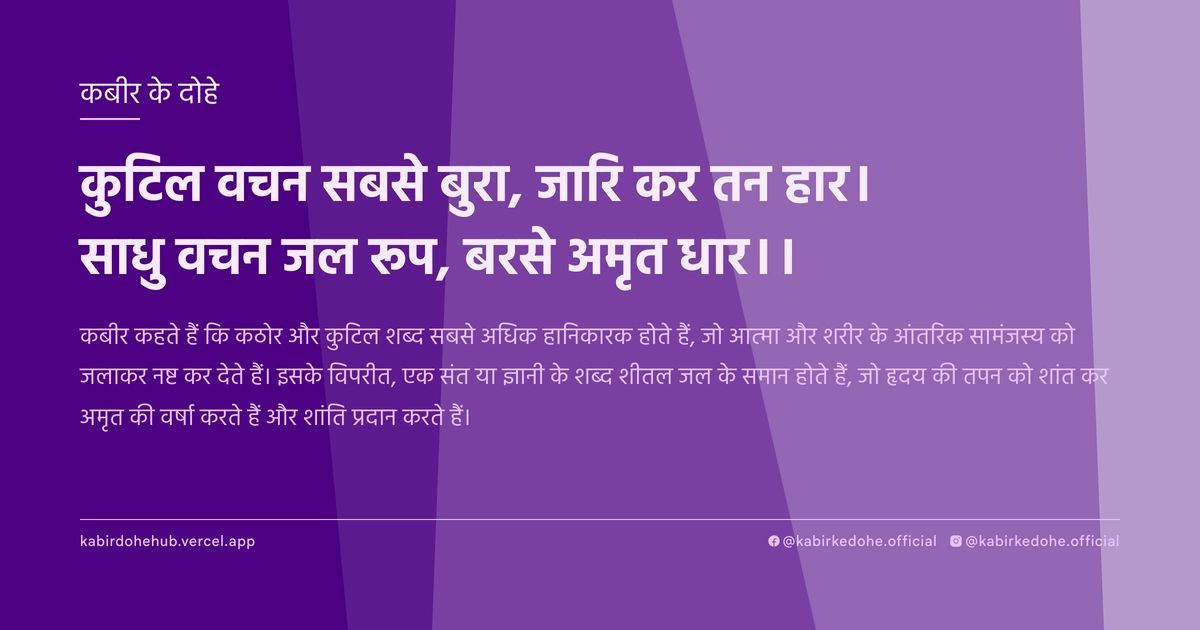
कुटिल वचन सबसे बुरा, जारि कर तन हार।
साधु वचन जल रूप, बरसे अमृत धार।।
Kutil vachan sabse bura, jaari kar tan haar. Sadhu vachan jal roop, barse amrit dhaar.
इस पृष्ठ पर इस कबीर दोहे का अर्थ (meaning), हिंदी व्याख्या और अंग्रेज़ी अनुवाद, दार्शनिक विश्लेषण और व्यावहारिक जीवन सीख दी गई है। यह दोहा संयम (Self-discipline) विषय से जुड़ा है — Kabir doha meaning and explanation in Hindi and English.
अर्थ (Meaning):
कबीर कहते हैं कि कठोर और कुटिल शब्द सबसे अधिक हानिकारक होते हैं, जो आत्मा और शरीर के आंतरिक सामंजस्य को जलाकर नष्ट कर देते हैं। इसके विपरीत, एक संत या ज्ञानी के शब्द शीतल जल के समान होते हैं, जो हृदय की तपन को शांत कर अमृत की वर्षा करते हैं और शांति प्रदान करते हैं।
Kabir asserts that crooked and harsh words are the most destructive force, capable of incinerating the inner harmony of the soul and body. Conversely, the words of a realized soul or a sage are like cool water, quenching the fire of suffering and raining down a nectar of peace that heals the spirit.
व्याख्या (Interpretation):
शाब्दिक रूप से, यह दोहा वाणी के प्रभाव की तुलना अग्नि और जल से करता है। आध्यात्मिक स्तर पर, 'कुटिल वचन' केवल बाहरी शब्द नहीं हैं, बल्कि अहंकार (Ahamkara) और द्वेष से उपजी ऊर्जा है जो माया के प्रभाव में व्यक्ति को दूसरों से अलग करती है। जब हम कठोर बोलते हैं, तो हम वास्तव में अपने ही भीतर के ब्रह्म के स्वरूप को नकार रहे होते हैं। 'साधु' यहाँ केवल एक संन्यासी नहीं, बल्कि वह है जिसने अपनी इंद्रियों पर विजय पा ली है। Nirgun Bhakti के अनुसार, ईश्वर किसी मूर्ति में नहीं बल्कि शुद्ध चेतना और प्रेम में है। जब वाणी इस शुद्धता को प्राप्त करती है, तो वह 'अमृत' बन जाती है, जो अज्ञानता के पर्दे को हटाकर आत्मा और परमात्मा के अद्वैत (Non-duality) को प्रकट करती है। यह विरोधाभास है कि शब्द, जो संसार में विभाजन पैदा करते हैं, वही शब्द जब सत्य से प्रेरित होते हैं, तो संपूर्ण ब्रह्मांड को एक सूत्र में पिरो देते हैं।
Literally, this couplet compares the impact of speech to fire and water. On a spiritual plane, 'crooked words' are not merely external utterances but energy arising from ego (Ahamkara) and malice, fueled by Maya, which alienates the individual from others. When we speak harshly, we are essentially denying the divine essence within ourselves. The 'Sadhu' here is not merely a monastic, but anyone who has conquered their senses. According to Nirgun Bhakti, the Divine resides not in idols but in pure consciousness and love. When speech attains this purity, it becomes 'Amrit' (nectar), stripping away the veil of ignorance to reveal the non-duality (Advaita) of Atman and Brahman. It is a profound paradox that words, which typically create division in the world, can become the very bridge to universal unity when inspired by Truth.
दार्शनिक विश्लेषण (Philosophical Analysis):
कबीर का यह दोहा उनके समय के सामाजिक और धार्मिक पाखंड के विरुद्ध एक सशक्त प्रहार है। उस युग में, धार्मिक विद्वान अक्सर अपनी श्रेष्ठता सिद्ध करने के लिए कठोर और विभाजनकारी भाषा का उपयोग करते थे। कबीर ने इस 'बौद्धिक अहंकार' को चुनौती दी और यह स्थापित किया कि वास्तविक आध्यात्मिकता बाहरी कर्मकांडों में नहीं, बल्कि वाणी की विनम्रता और हृदय की करुणा में निहित है।
अद्वैत वेदांत के परिप्रेक्ष्य में, यदि सब कुछ एक ही ब्रह्म है, तो किसी दूसरे को दिए गए कठोर शब्द वास्तव में स्वयं को ही दिए गए घाव हैं। कुटिलता का मूल कारण 'माया' है, जो हमें यह विश्वास दिलाती है कि हम अलग-अलग इकाइयाँ हैं। जब यह भ्रम टूटता है, तब वाणी में वह 'जल रूप' आता है जो दूसरे की पीड़ा को अपनी पीड़ा समझने लगता है।
सूफी मत के 'इश्क-ए-हकीकी' (ईश्वरीय प्रेम) के साथ इसका गहरा संबंध है। सूफी संत मानते हैं कि शब्द ईश्वर की सांस हैं। यदि शब्द में प्रेम नहीं है, तो वह केवल शोर है। कबीर यहाँ वाणी के मनोविज्ञान पर जोर दे रहे हैं—कैसे एक शब्द व्यक्ति के मानसिक स्वास्थ्य और आध्यात्मिक प्रगति को बाधित या प्रेरित कर सकता है।
कबीर का विरोध केवल शब्दों से नहीं, बल्कि उस 'अहंकार' से था जो शब्दों के पीछे छिपा होता है। वे सिखाते हैं कि जब तक साधक अपने भीतर के 'मैं' (Ego) को नहीं जलाता, उसकी वाणी अमृत नहीं बन सकती। यह अहंकार का विलोपन ही वास्तविक मोक्ष है।
अंततः, यह दोहा हमें यह समझाता है कि सत्य केवल वह नहीं है जो हम जानते हैं, बल्कि वह है जिसे हम व्यक्त करते हैं। यदि आपका ज्ञान आपको दूसरों के प्रति कठोर बनाता है, तो वह ज्ञान नहीं, बल्कि अज्ञानता का एक परिष्कृत रूप है। वास्तविक ज्ञान वह है जो शीतल करे और जोड़ दे।
This couplet is a powerful critique of the social and religious hypocrisy of Kabir's era. During that time, religious scholars often used harsh and divisive language to assert their superiority. Kabir challenged this 'intellectual ego,' establishing that true spirituality lies not in external rituals but in the humility of speech and the compassion of the heart.
From the perspective of Advaita Vedanta, if everything is one single Brahman, then harsh words directed at another are essentially wounds inflicted upon oneself. The root cause of such crookedness is 'Maya,' the illusion that convinces us we are separate entities. When this illusion shatters, speech acquires that 'water-like' quality, recognizing the suffering of another as one's own.
There is a profound connection here with the Sufi concept of 'Ishq-e-Haqiqi' (Divine Love). Sufi saints believe that words are the breath of God; if speech lacks love, it is mere noise. Kabir emphasizes the psychology of utterance—how a single word can either obstruct or catalyze a person's mental health and spiritual evolution.
Kabir's opposition was not just to words, but to the 'ego' lurking behind them. He teaches that until the seeker incinerates the internal 'I' (Ahamkara), their speech cannot become nectar. This annihilation of the ego is the only true liberation.
Ultimately, this couplet teaches us that Truth is not just what we know, but how we express it. If your knowledge makes you harsh toward others, it is not wisdom, but a sophisticated form of ignorance. True wisdom is that which cools the fire of conflict and binds the fragmented world together.
मूल संदेश (Core Message):
- कठोरता अहंकार का मुखौटा है, विनम्रता आत्मा का स्वभाव है।
- शब्द केवल ध्वनि नहीं, बल्कि आपकी आंतरिक ऊर्जा का विस्तार हैं।
- दूसरों को जलाकर आप स्वयं को भी राख कर देते हैं।
- सत्य वही है जो हृदय को शीतल करे, न कि वह जो घाव दे।
- वाणी का शुद्धिकरण ही वास्तव में मन का शुद्धिकरण है।
- प्रेमपूर्ण शब्द अज्ञानता के अंधकार को मिटाने वाले दीपक हैं।
- Harshness is the mask of ego; humility is the nature of the soul.
- Words are not mere sounds, but extensions of your internal energy.
- By burning others with words, you reduce yourself to ashes.
- Truth is that which cools the heart, not that which inflicts wounds.
- The purification of speech is the actual purification of the mind.
- Loving words are lamps that dispel the darkness of ignorance.
व्यावहारिक उदाहरण (Practical Example):
एक समय की बात है, वाराणसी के घाटों पर रामदीन नाम का एक वृद्ध बुनकर रहता था। रामदीन अपनी कला में निपुण था, लेकिन उसका स्वभाव अत्यंत क्रोधी और कड़वा था। वह अपनी गलतियों के लिए दूसरों को कोसता और अपनी वाणी से सबको अपमानित करता था। उसके शब्दों की कड़वाहट ऐसी थी कि उसके अपने बच्चे भी उससे दूर रहने लगे थे। वह मानता था कि उसकी कठोरता ही उसकी ईमानदारी है।
एक दिन, रामदीन की मुलाकात एक शांत स्वभाव के घुमक्कड़ साधु से हुई। साधु ने देखा कि रामदीन एक युवा सहायक को उसकी एक छोटी सी गलती के लिए बहुत बुरी तरह भला-बुरा कह रहा था। रामदीन के शब्द आग की तरह थे, जिसने उस युवक की आँखों में आँसू ला दिए और उसके आत्मविश्वास को तोड़ दिया।
साधु ने मुस्कुराते हुए रामदीन से पूछा, 'भाई, यदि तुम इस कपड़े पर गर्म लोहा लगाओ, तो क्या होगा?' रामदीन ने उत्तर दिया, 'वह जल जाएगा और बर्बाद हो जाएगा।' साधु ने धीरे से कहा, 'तुम्हारी वाणी भी उसी गर्म लोहे की तरह है। तुम सामने वाले को सुधारना चाहते हो, लेकिन तुम उसे जला रहे हो। जला हुआ कपड़ा कभी सुंदर नहीं दिखता, और जला हुआ मन कभी सत्य को नहीं समझता।'
रामदीन को पहली बार महसूस हुआ कि उसकी 'ईमानदारी' वास्तव में उसका अहंकार था। उसने देखा कि कैसे उसके शब्द उसके अपने जीवन में अकेलेपन की दीवार खड़ी कर चुके थे। उसने महसूस किया कि वह दूसरों को सुधारने के नाम पर वास्तव में अपनी आंतरिक कुंठा को बाहर निकाल रहा था।
अगले कुछ महीनों तक, रामदीन ने एक कठिन अभ्यास शुरू किया। जब भी वह क्रोधित होता, वह चुप हो जाता और सोचता कि क्या उसके शब्द 'अग्नि' हैं या 'जल'। उसने धीरे-धीरे अपने शब्दों में करुणा लाना शुरू किया। उसने अपने सहायक से माफी मांगी और उसे प्यार से सिखाना शुरू किया।
परिवर्तन चमत्कारिक था। जिस कार्यशाला में पहले तनाव और डर का माहौल था, वहाँ अब हंसी और सहयोग था। उसका सहायक अब अधिक कुशलता से काम करने लगा क्योंकि उसे डर नहीं, बल्कि प्रोत्साहन मिल रहा था।
रामदीन के परिवार ने भी उसके व्यवहार में बदलाव देखा। उसके बच्चे वापस उसके पास आने लगे। उसने पाया कि जब उसने अपनी वाणी को बदला, तो उसके आसपास की दुनिया बदल गई। उसकी आंतरिक शांति अब उसके चेहरे पर झलकने लगी थी।
एक दिन, वही युवा सहायक, जिसे उसने कभी अपमानित किया था, उसने रामदीन के पैर छुए और कहा, 'काका, आपकी बातों ने मुझे एक बेहतर इंसान बना दिया।' रामदीन की आँखों में आँसू थे। उसने समझ लिया कि 'अमृत धार' केवल दूसरों को नहीं मिलती, बल्कि वह बोलने वाले के हृदय को भी पवित्र कर देती है।
Once, on the ghats of Varanasi, lived an elderly weaver named Ramdin. Ramdin was a master of his craft, but his nature was incredibly volatile and bitter. He would berate others for their mistakes and humiliate everyone with his speech. The bitterness of his words was such that even his own children began to distance themselves from him. He believed his harshness was a sign of his honesty.
One day, Ramdin encountered a serene wandering monk. The monk observed Ramdin viciously insulting a young apprentice for a minor mistake. Ramdin's words were like fire, bringing tears to the youth's eyes and shattering his confidence.
Smiling, the monk asked Ramdin, 'Brother, if you press a hot iron onto this fabric, what happens?' Ramdin replied, 'It will burn and be ruined.' The monk softly said, 'Your speech is like that hot iron. You wish to correct the boy, but you are burning him. A burnt cloth never looks beautiful, and a burnt mind can never perceive the Truth.'
For the first time, Ramdin realized that his 'honesty' was actually his ego. He saw how his words had built a wall of loneliness around his own life. He realized that in the name of correcting others, he was merely venting his internal frustrations.
Over the next few months, Ramdin began a rigorous practice. Whenever he felt anger rising, he would fall silent and ask himself: 'Are my words fire or water?' He gradually began to infuse his speech with compassion. He apologized to his apprentice and started teaching him with love.
The transformation was miraculous. The workshop, once filled with tension and fear, was now a place of laughter and cooperation. His apprentice became more skilled because he was driven by encouragement rather than fear.
Ramdin's family also noticed the change. His children returned to him. He discovered that when he changed his speech, the world around him shifted. His inner peace began to radiate from his face.
One day, the same young apprentice he had once humiliated touched Ramdin's feet and said, 'Uncle, your words have made me a better human being.' Tears filled Ramdin's eyes. He understood that the 'nectar-stream' does not only benefit the listener; it purifies the heart of the speaker as well.
अभ्यास मार्गदर्शन (Practice Guidance):
- मौन का अभ्यास: प्रतिदिन कम से कम एक घंटा पूर्ण मौन रहें। जब आप बोलें, तो पहले विचार करें कि क्या आपके शब्द आवश्यक, सत्य और दयालु हैं।
- वाणी-निरीक्षण जर्नल: दिन के अंत में उन क्षणों को लिखें जब आपने कठोरता का प्रयोग किया। विश्लेषण करें कि उस समय आपके भीतर कौन सा अहंकार या डर सक्रिय था।
- करुणा का संकल्प: किसी ऐसे व्यक्ति से विनम्रतापूर्वक बात करें जिससे आपके संबंध तनावपूर्ण रहे हैं, बिना किसी अपेक्षा के केवल शांति प्रदान करने के उद्देश्य से।
- निदान चेकलिस्ट: क्या आप दूसरों की गलती पर तुरंत प्रतिक्रिया देते हैं? क्या आपकी बातचीत में 'मैं' और 'मेरा' अधिक है? क्या आपके शब्द दूसरों को छोटा महसूस कराते हैं? यदि हाँ, तो आप अभी भी 'कुटिल वचन' के प्रभाव में हैं।
- Practice of Silence: Observe total silence for at least one hour daily. Before speaking, ask yourself if your words are necessary, true, and kind.
- Speech-Observation Journal: At the end of each day, record moments where you used harshness. Analyze which ego-trigger or fear was active within you at that moment.
- Vow of Compassion: Speak with genuine humility to someone with whom you have a strained relationship, with no expectation other than providing peace.
- Diagnostic Checklist: Do you react instantly to others' mistakes? Is your conversation dominated by 'I' and 'Mine'? Do your words make others feel inferior? If yes, you are still under the influence of 'crooked speech'.
चिंतन प्रश्न (Reflection Questions):
- क्या मेरी 'ईमानदारी' वास्तव में दूसरों को नीचा दिखाने का एक बहाना है?
- जब मैं किसी पर चिल्लाता हूँ, तो मैं वास्तव में किस आंतरिक कमी या डर को छिपाने की कोशिश कर रहा होता हूँ?
- मेरे डिजिटल संवाद (सोशल मीडिया/मैसेज) में मेरी वाणी कितनी 'कुटिल' या 'अमृत' है?
- क्या मैं केवल उन लोगों के प्रति विनम्र हूँ जिनसे मुझे कुछ लाभ मिलना है?
- यदि आज मेरी वाणी ही मेरा एकमात्र परिचय होती, तो लोग मुझे कैसे याद रखते?
- मेरे भीतर का वह कौन सा हिस्सा है जो दूसरों की गलती पर क्रोधित होकर अपनी श्रेष्ठता सिद्ध करना चाहता है?
- Is my 'honesty' actually a pretext for making others feel inferior?
- When I shout at someone, what internal deficiency or fear am I actually trying to hide?
- In my digital interactions (social media/messages), is my tone 'crooked' or 'nectar-like'?
- Am I humble only toward those from whom I expect some benefit?
- If my speech were my only identity today, how would people remember me?
- Which part of me seeks to prove its superiority by reacting with anger to others' mistakes?