
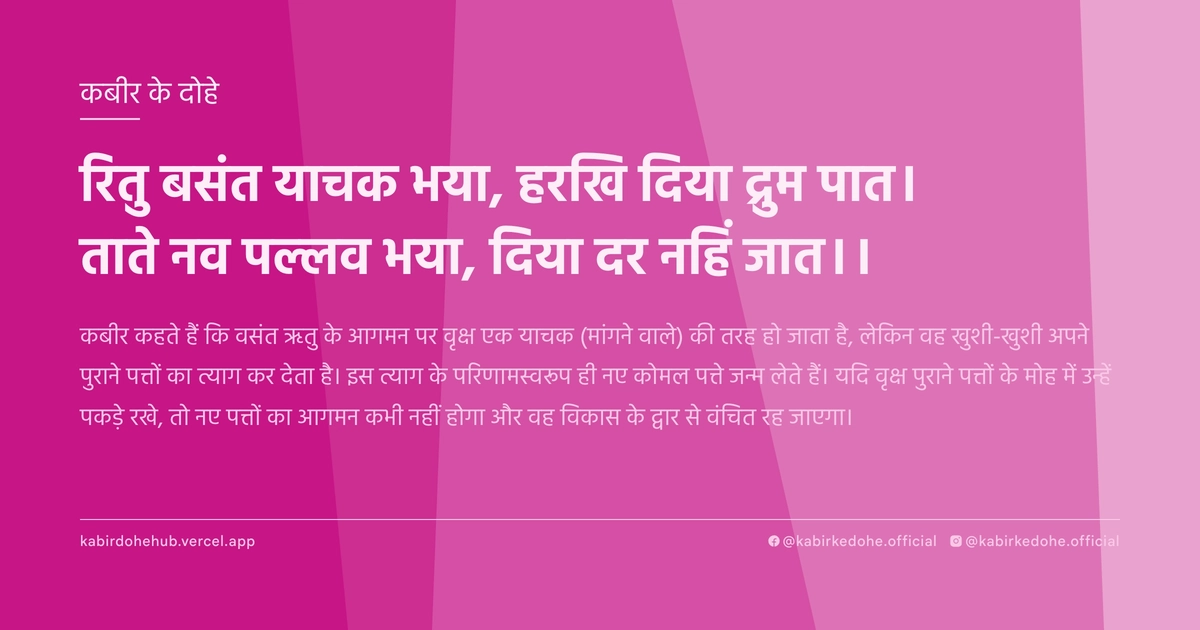
रितु बसंत याचक भया, हरखि दिया द्रुम पात।
ताते नव पल्लव भया, दिया दर नहिं जात।।
Ritu basant yaachak bhaya, harkhi diya drum paat. Taate nav pallav bhaya, diya dar nahin jaat.
इस पृष्ठ पर इस कबीर दोहे का अर्थ (meaning), हिंदी व्याख्या और अंग्रेज़ी अनुवाद, दार्शनिक विश्लेषण और व्यावहारिक जीवन सीख दी गई है। यह दोहा दान (Generosity) विषय से जुड़ा है — Kabir doha meaning and explanation in Hindi and English.
अर्थ (Meaning):
कबीर कहते हैं कि वसंत ऋतु के आगमन पर वृक्ष एक याचक (मांगने वाले) की तरह हो जाता है, लेकिन वह खुशी-खुशी अपने पुराने पत्तों का त्याग कर देता है। इस त्याग के परिणामस्वरूप ही नए कोमल पत्ते जन्म लेते हैं। यदि वृक्ष पुराने पत्तों के मोह में उन्हें पकड़े रखे, तो नए पत्तों का आगमन कभी नहीं होगा और वह विकास के द्वार से वंचित रह जाएगा।
Kabir observes that with the arrival of spring, the tree becomes like a seeker or a beggar, joyfully shedding its old leaves. Through this act of letting go, new tender foliage is born. If the tree were to cling to its old leaves out of attachment, the new growth would never emerge, and it would remain shut away from the door of renewal.
व्याख्या (Interpretation):
यहाँ 'वसंत' आध्यात्मिक जागृति का प्रतीक है और 'वृक्ष' मानव आत्मा का। पुराने पत्तों का गिरना अहंकार और संचित संस्कारों के विसर्जन को दर्शाता है। कबीर समझाते हैं कि जब तक हम अपनी पुरानी पहचान, पूर्वाग्रहों और 'मैं' के बोध को नहीं छोड़ते, तब तक दिव्य चेतना का नया अंकुर नहीं फूट सकता। यह निर्गुण भक्ति का सार है—शून्य होना ताकि पूर्णता प्राप्त हो सके। माया हमें पुराने पत्तों (मोह) से चिपकाए रखती है, जबकि अद्वैत वेदांत सिखाता है कि आत्मा का वास्तविक विस्तार केवल तब होता है जब वह सीमित पहचान का त्याग कर देती है। यह एक आध्यात्मिक विरोधाभास है: पाने के लिए पहले सब कुछ खोना पड़ता है।
Here, 'Spring' symbolizes spiritual awakening and the 'Tree' represents the human soul. The shedding of old leaves signifies the dissolution of ego and accumulated karmic impressions (Samskaras). Kabir explains that until we relinquish our old identities, prejudices, and the notion of 'I', the new sprout of divine consciousness cannot emerge. This is the essence of Nirgun Bhakti—becoming empty to become full. Maya keeps us clung to the old leaves of attachment, while Advaita Vedanta teaches that the soul's true expansion occurs only when it discards its limited identity. It is a spiritual paradox: to attain everything, one must first lose everything.
दार्शनिक विश्लेषण (Philosophical Analysis):
कबीर का यह दोहा मध्यकालीन भारत के उस दौर का है जब धर्म कर्मकांडों और बाहरी आडंबरों में जकड़ा हुआ था। कबीर ने ritualism का विरोध करते हुए आंतरिक रूपांतरण पर जोर दिया। वे कहते हैं कि जैसे वसंत के बिना पत्तों का बदलना असंभव है, वैसे ही बिना 'विरह' और 'त्याग' के आत्म-साक्षात्कार असंभव है।
दार्शनिक स्तर पर, यह सूफी मत के 'फना' (अहंकार का विनाश) और अद्वैत वेदांत के 'नेति-नेति' (यह नहीं, वह नहीं) के सिद्धांत से मेल खाता है। कबीर तर्क देते हैं कि मनुष्य अपनी पुरानी आदतों और सामाजिक प्रतिष्ठा के प्रति इतना आसक्त रहता है कि वह नए सत्य को स्वीकार करने की क्षमता खो देता है।
यह विश्लेषण स्पष्ट करता है कि आध्यात्मिक प्रगति कोई बाहरी उपलब्धि नहीं, बल्कि एक आंतरिक छंटाई है। जिस प्रकार एक माली सूखे पत्तों को हटाता है ताकि पौधा बढ़ सके, उसी प्रकार साधक को अपने भीतर के 'अहं' को हटाना होता है।
कबीर यहाँ जाति और वर्ग के भेदों को भी पुराने पत्तों की तरह त्यागने का संकेत देते हैं। उनके लिए सत्य वह है जो सार्वभौमिक है और जो किसी विशेष पहचान में नहीं बंधा है।
अंततः, यह दोहा मनोवैज्ञानिक परिवर्तन की बात करता है। जब तक हम अतीत के दुखों या सफलताओं को पकड़े रहते हैं, हम वर्तमान की अनंत संभावनाओं के द्वार नहीं खोल पाते। यह 'त्याग' दुखद नहीं, बल्कि 'हरखि' (खुशी) के साथ होना चाहिए, क्योंकि यह विकास की अनिवार्य शर्त है।
This couplet originates from a period in medieval India when religion was stifled by rigid rituals and outward displays. Kabir opposed ritualism, emphasizing internal transformation. He argues that just as the shedding of leaves is inevitable in spring, spiritual realization is impossible without 'Viraha' (longing) and 'Tyaga' (renunciation).
Philosophically, this aligns with the Sufi concept of 'Fana' (annihilation of the ego) and the Advaita Vedanta principle of 'Neti-Neti' (not this, not that). Kabir posits that humans are so attached to old habits and social prestige that they lose the capacity to embrace a new truth.
This analysis clarifies that spiritual progress is not an external achievement but an internal pruning. Just as a gardener removes dead leaves to allow a plant to grow, a seeker must remove the 'Aham' (ego) within.
Kabir also hints at discarding caste and class distinctions like old leaves. For him, Truth is universal and cannot be bound by a specific identity.
Ultimately, the doha addresses psychological transformation. As long as we cling to past sorrows or successes, we cannot open the doors to the infinite possibilities of the present. This 'letting go' should not be mournful but joyful ('Harakhi'), as it is the essential condition for growth.
मूल संदेश (Core Message):
- पुराना मोह ही नए सत्य का सबसे बड़ा अवरोध है।
- त्याग दुख नहीं, बल्कि विकास का उत्सव होना चाहिए।
- अहंकार का विसर्जन ही दिव्य चेतना का द्वार है।
- परिवर्तन प्रकृति का नियम है; विरोध केवल पीड़ा देता है।
- शून्यता में ही अनंत की संभावना छिपी होती है।
- आत्मा का विस्तार केवल सीमित पहचान छोड़ने से संभव है।
- Attachment to the old is the greatest barrier to new truth.
- Renunciation should be a celebration of growth, not a sorrow.
- The dissolution of ego is the only gateway to divine consciousness.
- Change is the law of nature; resistance only brings suffering.
- The potential for the infinite is hidden within emptiness.
- Expansion of the soul is possible only by leaving limited identities.
व्यावहारिक उदाहरण (Practical Example):
एक समय की बात है, वाराणसी के घाटों पर रहने वाले एक वृद्ध कुम्हार थे, जिनका नाम माधव था। माधव अपनी कला में निपुण थे, लेकिन वे एक विशेष तरीके से मिट्टी के बर्तन बनाने के प्रति बहुत जिद्दी थे। उन्होंने दशकों से वही पुरानी तकनीक अपनाई थी और मानते थे कि वही एकमात्र सही तरीका है।
उनके बेटे ने, जो शहर से नई तकनीक सीखकर आया था, उन्हें सुझाव दिया कि यदि वे मिट्टी को गूँथने का तरीका बदलें, तो बर्तन अधिक मजबूत और सुंदर बनेंगे। लेकिन माधव ने उसे झिड़क दिया। वे अपनी पुरानी पद्धति को अपनी पहचान मानते थे।
एक दिन, माधव ने देखा कि उनके द्वारा बनाए गए पुराने ढर्रन के बर्तन बाजार में नहीं बिक रहे थे, जबकि नए प्रयोगों वाले बर्तन लोग हाथों-हाथ ले जा रहे थे। उनके मन में क्रोध और दुख आया। उन्हें लगा कि उनकी पूरी जिंदगी की मेहनत बेकार गई।
तभी उनकी मुलाकात एक घुमक्कड़ फकीर से हुई, जिसने उन्हें कबीर का यह दोहा सुनाया। फकीर ने कहा, 'माधव, तुम उस वृक्ष की तरह हो जो पुराने पत्तों को पकड़े बैठा है, जबकि वसंत आ चुका है। यदि तुम अपनी पुरानी तकनीक का मोह नहीं छोड़ोगे, तो तुम्हारी कला में नए पत्ते कभी नहीं आएंगे।'
माधव को बात समझ आई। उन्होंने महसूस किया कि उनकी 'महारत' वास्तव में उनका 'अहंकार' बन गई थी। उन्होंने पहली बार अपनी पुरानी पद्धति को पूरी तरह त्यागने का निर्णय लिया।
शुरुआत में उन्हें डर लगा, लेकिन उन्होंने खुशी-खुशी नए तरीके को अपनाया। उन्होंने मिट्टी को नए ढंग से गूँथना शुरू किया और अपनी पुरानी धारणाओं को विसर्जित कर दिया।
कुछ ही महीनों में, माधव के बर्तनों में एक नई चमक और मजबूती आई। वे अब पहले से कहीं अधिक रचनात्मक महसूस कर रहे थे।
इस 'कबीर ट्विस्ट' ने माधव को केवल एक बेहतर कुम्हार नहीं बनाया, बल्कि उन्हें मानसिक शांति दी। उन्होंने सीखा कि विकास के लिए पुराने को छोड़ना अनिवार्य है। अब वे अपनी कला को अपनी पहचान नहीं, बल्कि एक निरंतर बहने वाली नदी मानते थे।
Once, in the ghats of Varanasi, lived an elderly potter named Madhav. Madhav was skilled in his craft, but he was stubbornly attached to a specific way of shaping clay. For decades, he had used the same old technique and believed it was the only correct method.
His son, who had returned from the city with new learnings, suggested that if they changed the way they kneaded the clay, the pots would be stronger and more beautiful. But Madhav dismissed him. He viewed his old method as his very identity.
One day, Madhav noticed that his traditional pots were no longer selling in the market, while those made with new experiments were being bought instantly. He felt anger and sorrow, believing his life's work had been wasted.
Then, he met a wandering fakir who recited this doha of Kabir. The fakir said, 'Madhav, you are like that tree clinging to old leaves while spring has already arrived. If you do not let go of the attachment to your old ways, new leaves of art will never sprout in your life.'
Madhav understood. He realized that his 'mastery' had actually become his 'ego'. For the first time, he decided to completely renounce his old method.
Initially, he felt afraid, but he embraced the new way with joy. He began kneading the clay differently and discarded his old assumptions.
Within a few months, Madhav's pots acquired a new luster and strength. He felt more creative than ever before.
This 'Kabir Twist' did not just make Madhav a better potter; it gave him mental peace. He learned that letting go of the old is mandatory for growth. He no longer saw his art as a fixed identity, but as a constantly flowing river.
अभ्यास मार्गदर्शन (Practice Guidance):
- दैनिक चिंतन: प्रतिदिन 15 मिनट मौन बैठें और विचार करें कि ऐसी कौन सी पुरानी धारणा या आदत है जो आपकी प्रगति को रोक रही है।
- आत्म-पूछताछ जर्नल: लिखें—'यदि मैं अपनी वर्तमान पहचान (पद, प्रतिष्ठा, छवि) को पूरी तरह छोड़ दूँ, तो मैं वास्तव में कौन हूँ?'
- व्यवहारिक परिवर्तन: सप्ताह में एक बार किसी ऐसी बात पर अपनी जिद छोड़ें जिस पर आप लंबे समय से अड़े हुए हैं, और इसे 'वसंत के त्याग' के रूप में देखें।
- निदान चेकलिस्ट: क्या आप बदलाव से डरते हैं? क्या आप अपनी पुरानी गलतियों को पकड़कर बैठे हैं? क्या आप दूसरों को सुधारने की कोशिश करते हैं बजाय खुद को बदलने के? यदि हाँ, तो आप अभी भी 'पुराने पत्तों' से चिपके हैं।
- Daily Contemplation: Sit in silence for 15 minutes daily and reflect on which old belief or habit is currently hindering your growth.
- Self-Inquiry Journal: Write—'If I completely let go of my current identity (position, prestige, image), who am I really?'
- Behavioral Change: Once a week, consciously give up a stubborn stance you've held for a long time, viewing it as the 'Shedding of Spring'.
- Diagnostic Checklist: Do you fear change? Are you clinging to old mistakes? Do you try to fix others instead of evolving yourself? If yes, you are still clinging to the 'old leaves'.
चिंतन प्रश्न (Reflection Questions):
- आपकी वह कौन सी 'पुरानी पहचान' है जिसे आप खोने के डर से नया अनुभव नहीं कर पा रहे हैं?
- क्या आपका डिजिटल व्यक्तित्व (Social Media Image) एक ऐसा 'पुराना पत्ता' बन गया है जिसे आप छोड़ने से डरते हैं?
- जब आप किसी विवाद में हारते हैं, तो क्या आप वास्तव में अपनी गलती स्वीकार करते हैं या केवल ऊपरी तौर पर सहमत होते हैं?
- आपके जीवन का 'वसंत' क्या है, और आप उसे आने देने के लिए क्या त्यागने को तैयार हैं?
- क्या आप अपनी सफलताओं के मोह में अपनी सीखने की क्षमता को खो चुके हैं?
- यदि आज आपकी सारी सामाजिक मान्यताएं छीन ली जाएं, तो आपके भीतर क्या बचेगा?
- What is that 'old identity' you are afraid to lose, which prevents you from experiencing something new?
- Has your digital persona (Social Media Image) become an 'old leaf' that you are terrified to shed?
- When you lose an argument, do you truly accept your mistake, or do you merely agree on the surface?
- What is the 'Spring' in your life, and what are you willing to sacrifice to let it arrive?
- Have you lost your capacity to learn because you are too attached to your past successes?
- If all your social validations were stripped away today, what would remain inside you?