
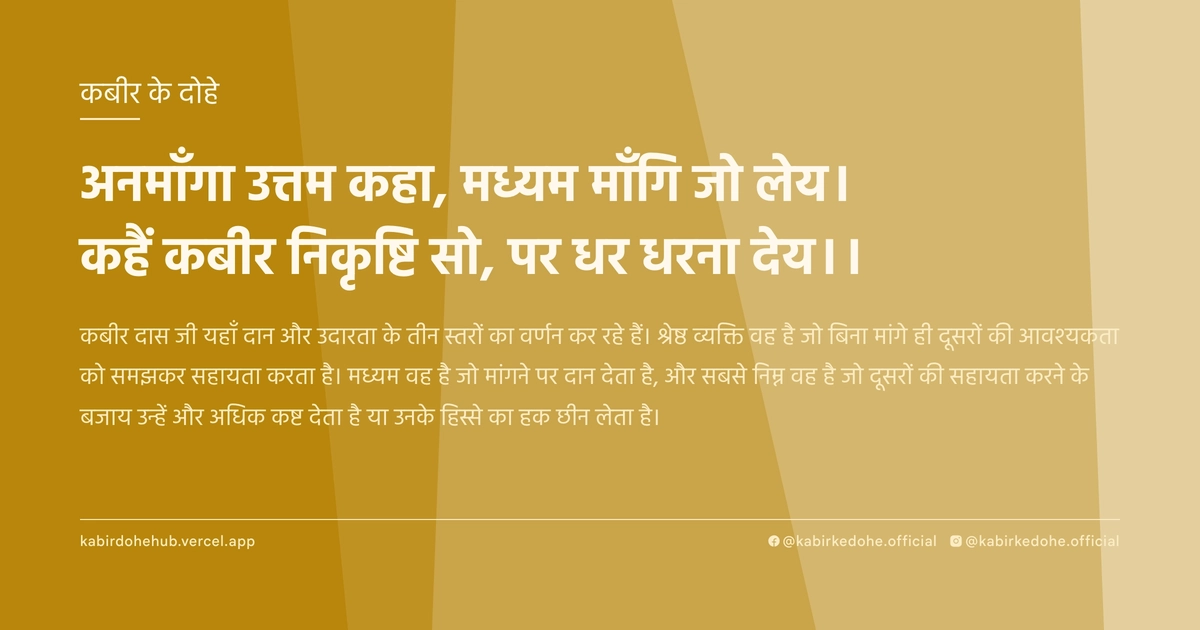
अनमाँगा उत्तम कहा, मध्यम माँगि जो लेय।
कहैं कबीर निकृष्टि सो, पर धर धरना देय।।
Anmaanga uttam kaha, madhyam maangi jo ley. Kahein Kabir nikrishti so, par dhar dharna dey.
इस पृष्ठ पर इस कबीर दोहे का अर्थ (meaning), हिंदी व्याख्या और अंग्रेज़ी अनुवाद, दार्शनिक विश्लेषण और व्यावहारिक जीवन सीख दी गई है। यह दोहा दान (Generosity) विषय से जुड़ा है — Kabir doha meaning and explanation in Hindi and English.
अर्थ (Meaning):
कबीर दास जी यहाँ दान और उदारता के तीन स्तरों का वर्णन कर रहे हैं। श्रेष्ठ व्यक्ति वह है जो बिना मांगे ही दूसरों की आवश्यकता को समझकर सहायता करता है। मध्यम वह है जो मांगने पर दान देता है, और सबसे निम्न वह है जो दूसरों की सहायता करने के बजाय उन्हें और अधिक कष्ट देता है या उनके हिस्से का हक छीन लेता है।
Kabir describes three levels of generosity and human nature. The highest (Uttam) is the one who gives spontaneously without being asked. The middle (Madhyam) is the one who gives only upon request. The lowest (Nikrisht) is the one who not only refuses to help but actively imposes burdens or takes away from others, causing further distress.
व्याख्या (Interpretation):
यह दोहा केवल भौतिक दान के बारे में नहीं है, बल्कि चेतना के विकास के बारे में है। 'उत्तम' अवस्था वह है जहाँ व्यक्ति और दूसरे के बीच का द्वैत समाप्त हो जाता है, और वह 'अद्वैत' भाव से स्वतः सेवा करता है। 'मध्यम' अवस्था में अभी भी अहंकार और 'दाता-ग्रहिता' का भाव मौजूद है। 'निकृष्ट' अवस्था माया और अज्ञान के गहरे प्रभाव को दर्शाती है, जहाँ व्यक्ति स्वयं को दूसरों से अलग मानकर उनके प्रति क्रूर हो जाता है। यह आध्यात्मिक पतन की स्थिति है जहाँ आत्मा पूरी तरह से अहंकार के अधीन है। कबीर यहाँ संकेत करते हैं कि वास्तविक भक्ति बाहरी कर्मकांडों में नहीं, बल्कि इस बात में है कि हम दूसरों के प्रति कितने संवेदनशील हैं।
This couplet transcends mere material charity, addressing the evolution of consciousness. The 'Uttam' state represents the dissolution of duality, where the practitioner acts from a state of Advaita (non-duality), serving others spontaneously because they see themselves in the other. The 'Madhyam' state still harbors the ego's distinction between the 'giver' and the 'receiver.' The 'Nikrisht' state illustrates the profound grip of Maya (illusion), where the individual perceives a separation so stark that it manifests as cruelty or exploitation. It is a state of spiritual regression where the Atman is eclipsed by the ego. Kabir suggests that true devotion is not found in rituals but in the depth of one's empathy and selfless action.
दार्शनिक विश्लेषण (Philosophical Analysis):
कबीर का यह दृष्टिकोण उनके सामाजिक और आध्यात्मिक विद्रोह का प्रतिबिंब है। उन्होंने अपने समय के उन धार्मिक पाखंडियों की आलोचना की जो दिखावे के लिए दान देते थे लेकिन मन में अहंकार रखते थे। यहाँ 'उत्तम' का अर्थ है वह स्थिति जहाँ 'मैं' का विलोप हो गया है, जो कि सूफीवाद के 'फना' (अहंकार का विनाश) और वेदांत के 'अहं ब्रह्मास्मि' के करीब है।
वेदांत के अनुसार, जब हम यह अनुभव करते हैं कि पूरी सृष्टि एक ही चेतना का विस्तार है, तो सहायता करना कोई 'परोपकार' नहीं रह जाता, बल्कि वह स्वयं की सेवा बन जाता है। कबीर इस मनोवैज्ञानिक परिवर्तन पर जोर देते हैं कि दान केवल वस्तु का नहीं, बल्कि करुणा का होना चाहिए।
निकृष्ट व्यक्ति वह है जो धर्म के नाम पर दूसरों को डराता है या उनका शोषण करता है। कबीर यहाँ जाति और वर्ग के भेदभाव को नकारते हुए यह स्पष्ट करते हैं कि मनुष्य की श्रेष्ठता उसके जन्म से नहीं, बल्कि उसके हृदय की उदारता और निस्वार्थता से तय होती है।
यह दोहा हमें सिखाता है कि आध्यात्मिक प्रगति का पैमाना यह है कि हम दूसरों की पीड़ा को कितनी सहजता से महसूस करते हैं। जो व्यक्ति बिना मांगे देता है, वह वास्तव में उस परमात्मा के साथ एकाकार हो चुका है जो बिना किसी शर्त के संपूर्ण जगत का पोषण करता है।
अंततः, यह विश्लेषण हमें यह समझने पर मजबूर करता है कि वास्तविक धर्म बाहरी आडंबरों में नहीं, बल्कि आंतरिक रूपांतरण में है। जब अहंकार मरता है, तब केवल निस्वार्थ प्रेम शेष रहता है, जो कि निर्गुण भक्ति का मूल तत्व है।
Kabir's perspective is a reflection of his social and spiritual rebellion. He critiqued the religious hypocrites of his era who practiced charity for public acclaim while harboring immense ego. The 'Uttam' state refers to the annihilation of the 'I', mirroring the Sufi concept of 'Fana' (extinction of the self) and the Vedantic realization of 'Aham Brahmasmi' (I am Brahman).
According to Advaita Vedanta, when one realizes that the entire universe is an extension of a single consciousness, helping another is no longer 'charity' but an act of self-service. Kabir emphasizes this psychological shift: the gift must not be of an object, but of compassion.
The 'Nikrisht' individual is one who uses religion to intimidate or exploit others. By rejecting caste and class hierarchies, Kabir clarifies that human superiority is determined not by birth, but by the generosity and selflessness of the heart.
This couplet teaches that the metric of spiritual progress is the ease with which one feels the suffering of others. One who gives without being asked has aligned themselves with the Divine, which sustains the universe unconditionally.
Ultimately, this analysis forces us to understand that true religion lies not in external rituals but in internal transformation. When the ego dies, only selfless love remains—the core essence of Nirgun Bhakti.
मूल संदेश (Core Message):
- अहंकार ही करुणा के मार्ग में सबसे बड़ी बाधा है।
- बिना माँगे देना ही वास्तविक आध्यात्मिक जागृति है।
- दाता और याचक का भेद मिटाना ही अद्वैत है।
- दूसरों के कष्ट को अपना मानना ही सच्ची भक्ति है।
- बाहरी दान से अधिक महत्वपूर्ण आंतरिक उदारता है।
- परम सत्य वह है जहाँ 'मैं' समाप्त और 'हम' प्रारंभ होता है।
- Ego is the greatest obstacle on the path of compassion.
- Giving without being asked is the mark of true spiritual awakening.
- Erasing the distinction between giver and receiver is Advaita.
- True devotion is feeling the suffering of others as your own.
- Internal generosity is far more vital than external charity.
- The ultimate truth is where 'I' ends and 'We' begins.
व्यावहारिक उदाहरण (Practical Example):
एक समय की बात है, बनारस के घाटों पर माधव नाम का एक पुराना बुनकर रहता था। माधव बहुत गरीब था, लेकिन उसका हृदय विशाल था। वह दिन भर कठिन परिश्रम करता और जो कुछ भी कमाता, उसमें से एक छोटा हिस्सा चुपचाप उन लोगों के लिए रख देता जो उससे भी अधिक अभाव में थे।
उसी गली में एक धनी व्यापारी रहता था, जो हर त्यौहार पर बड़े ढोल-नगाड़ों के साथ गरीबों में अनाज बाँटता था। लेकिन वह अनाज केवल उन्हीं को देता था जो उसके पैरों में गिरकर विनती करते थे और उसकी प्रशंसा करते थे। वह 'मध्यम' श्रेणी का व्यक्ति था, जो दान तो देता था, पर बदले में सम्मान और अहंकार की तुष्टि चाहता था।
वहीं एक अन्य व्यक्ति था, जो स्वयं को धर्म का रक्षक कहता था, लेकिन वह गरीब मजदूरों की मजदूरी काट लेता था और उन्हें डराता था कि यदि वे विरोध करेंगे तो उनका धर्म भ्रष्ट हो जाएगा। वह 'निकृष्ट' था, जो दूसरों के हक को छीनकर अपना पेट भरता था।
एक बार शहर में भीषण अकाल पड़ा। धनी व्यापारी ने अपनी तिजोरियाँ बंद कर लीं क्योंकि अब लोग उसकी प्रशंसा करने के बजाय केवल भूख से तड़प रहे थे। वह अब दान देने के लिए 'माँगने' वालों की प्रतीक्षा नहीं कर रहा था, बल्कि अपनी संपत्ति बचाने में लगा था।
दूसरी ओर, माधव ने देखा कि उसके पड़ोस में एक वृद्ध महिला भूख से बेहोश हो गई है। उसने बिना किसी से पूछे, बिना किसी के मांगे, अपनी अंतिम रोटी उस महिला को खिला दी और खुद पानी पीकर सो गया। उसने यह नहीं सोचा कि वह क्या कर रहा है; उसके लिए वह महिला वह स्वयं ही थी।
जब उस वृद्ध महिला की चेतना वापस आई, तो उसने देखा कि माधव चुपचाप अपने काम पर लौट गया है। उसने माधव को धन्यवाद देने के लिए बुलाया, लेकिन माधव ने मुस्कुराकर कहा, 'माँ, जब प्यास लगती है तो पानी पीना पड़ता है, वैसे ही जब भूख लगी थी तो रोटी देनी थी। इसमें धन्यवाद कैसा?'
यह माधव का 'उत्तम' भाव था। उसने यह नहीं देखा कि वह किसे दे रहा है, न ही उसने अपनी महानता का ढिंढोरा पीटा। उसने केवल उस क्षण की आवश्यकता को महसूस किया और उसे पूरा किया।
इस घटना ने उस गली के अन्य लोगों को झकझोर दिया। उन्होंने महसूस किया कि असली धर्म वह नहीं है जो प्रदर्शन के लिए किया जाए, बल्कि वह है जो बिना किसी शोर के, बिना किसी अपेक्षा के, केवल करुणा के वशीभूत होकर किया जाए। माधव की निस्वार्थता ने उनके भीतर के अहंकार को तोड़ दिया और वे भी धीरे-धीरे दूसरों की मदद करने के लिए प्रेरित हुए।
Once, on the ghats of Varanasi, lived an old weaver named Madhav. Madhav was very poor, but his heart was vast. He worked hard all day and silently set aside a small portion of his earnings for those even more destitute than himself.
In the same lane lived a wealthy merchant who distributed grain to the poor with great fanfare during festivals. However, he only gave to those who fell at his feet, pleaded, and praised him. He was the 'Madhyam' type, giving charity but seeking respect and ego-gratification in return.
There was another man who called himself a protector of faith, yet he cheated poor laborers of their wages and threatened them, saying their religion would be corrupted if they protested. He was 'Nikrisht,' stealing the rights of others to enrich himself.
One year, a severe famine struck the city. The wealthy merchant locked his vaults because people were now suffering from hunger rather than praising him. He was no longer waiting for 'beggars' to request aid; he was focused on preserving his wealth.
Meanwhile, Madhav noticed an elderly woman faint from hunger in his neighborhood. Without being asked, without any request, he fed her his last piece of bread and went to sleep after drinking only water. He didn't consciously think about his act; to him, the woman was an extension of himself.
When the elderly woman regained consciousness, she saw Madhav quietly returning to his loom. She called him to thank him, but Madhav smiled and said, 'Mother, when one is thirsty, one drinks water; similarly, when there was hunger, the bread had to be given. Why thank me?'
This was Madhav's 'Uttam' state. He didn't consider who he was helping, nor did he trumpet his nobility. He simply felt the necessity of the moment and fulfilled it.
This incident shook the other residents of the lane. They realized that true religion is not what is performed for show, but what is done without noise, without expectation, driven solely by compassion. Madhav's selflessness broke their ego and inspired them to help others silently.
अभ्यास मार्गदर्शन (Practice Guidance):
- दैनिक अवलोकन: दिन भर में कम से कम एक ऐसा कार्य करें जहाँ आप किसी की आवश्यकता को उनके माँगने से पहले ही पहचानें और उसे पूरा करें।
- आत्म-पूछताछ जर्नल: हर रात लिखें कि आज आपने कितनी बार 'दाता' होने का अहंकार महसूस किया और कितनी बार आप केवल एक 'माध्यम' बने।
- मौन सेवा: किसी की मदद इस तरह करें कि उस व्यक्ति को पता भी न चले कि मदद किसने की है।
- निदान चेकलिस्ट: क्या मैं मदद करते समय प्रशंसा की उम्मीद करता हूँ? क्या मैं केवल तब देता हूँ जब मुझे याद दिलाया जाता है? क्या मैं दूसरों की कमियों का लाभ उठाता हूँ? (यदि हाँ, तो आप अभी 'उत्तम' अवस्था से दूर हैं)।
- Daily Observation: Perform at least one act per day where you identify someone's need before they ask and fulfill it spontaneously.
- Self-Inquiry Journal: Every night, record how many times you felt the ego of being a 'giver' and how many times you acted as a mere 'channel' for grace.
- Silent Service: Help someone in such a way that the recipient remains unaware of who provided the assistance.
- Diagnostic Checklist: Do I expect praise when helping? Do I only give when reminded or asked? Do I exploit the weaknesses of others? (If yes, you are currently distant from the 'Uttam' state).
चिंतन प्रश्न (Reflection Questions):
- क्या मेरा दान वास्तव में निस्वार्थ है, या मैं अपनी सामाजिक छवि को बेहतर बनाने के लिए दान देता हूँ?
- जब मैं किसी की मदद करता हूँ, तो क्या मैं मन ही मन खुद को उस व्यक्ति से श्रेष्ठ महसूस करता हूँ?
- मेरे जीवन में ऐसे कौन से क्षेत्र हैं जहाँ मैं 'निकृष्ट' व्यवहार करता हूँ, भले ही मैं दुनिया के सामने 'धार्मिक' दिखूँ?
- यदि मुझे कभी कोई धन्यवाद न मिले, तो क्या मैं फिर भी दूसरों की सहायता करना जारी रखूँगा?
- क्या मैं अपनी सुख-सुविधाओं को दूसरों के अधिकारों से ऊपर रखता हूँ?
- मेरी 'मदद' करने की इच्छा के पीछे क्या कोई छिपा हुआ नियंत्रण या शक्ति का भाव है?
- Is my charity truly selfless, or do I give to enhance my social image?
- When I help someone, do I subconsciously feel superior to that person?
- In which areas of my life do I behave in a 'Nikrisht' manner, despite appearing 'religious' to the world?
- If I were never thanked, would I still continue to help others?
- Do I prioritize my own comforts over the fundamental rights of others?
- Is there a hidden desire for control or power behind my urge to 'help'?