
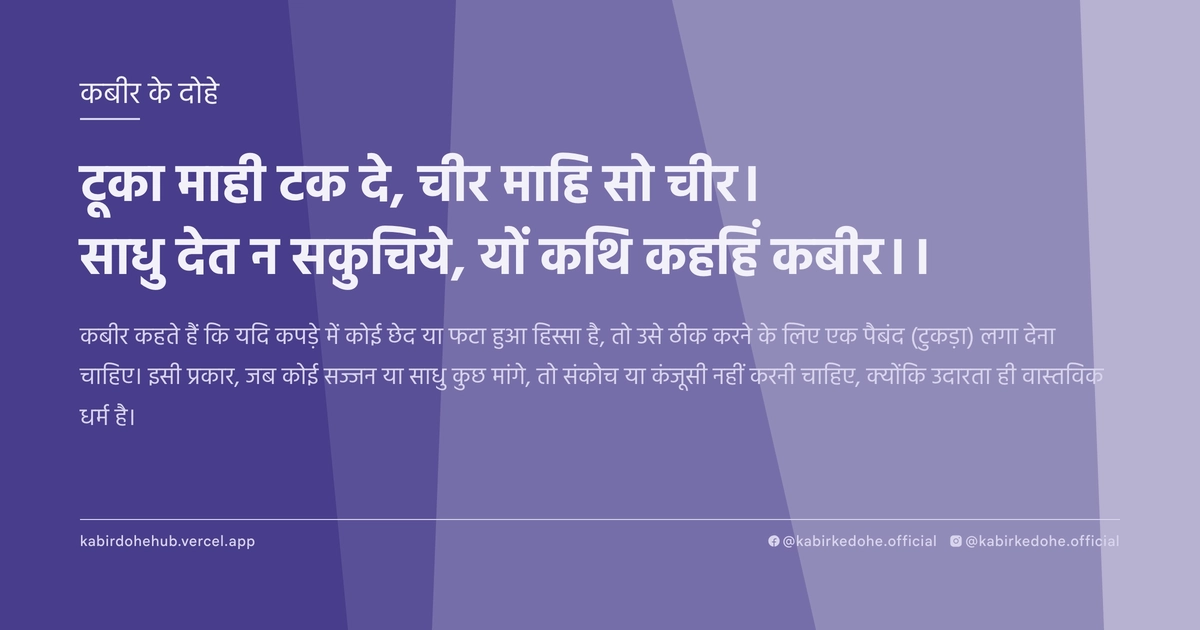
टूका माही टक दे, चीर माहि सो चीर।
साधु देत न सकुचिये, यों कथि कहहिं कबीर।।
Tuka mahi tak de, cheer mahi so cheer. Sadhu det na sakuchiye, yon kathi kahahin Kabir.
इस पृष्ठ पर इस कबीर दोहे का अर्थ (meaning), हिंदी व्याख्या और अंग्रेज़ी अनुवाद, दार्शनिक विश्लेषण और व्यावहारिक जीवन सीख दी गई है। यह दोहा दान (Generosity) विषय से जुड़ा है — Kabir doha meaning and explanation in Hindi and English.
अर्थ (Meaning):
कबीर कहते हैं कि यदि कपड़े में कोई छेद या फटा हुआ हिस्सा है, तो उसे ठीक करने के लिए एक पैबंद (टुकड़ा) लगा देना चाहिए। इसी प्रकार, जब कोई सज्जन या साधु कुछ मांगे, तो संकोच या कंजूसी नहीं करनी चाहिए, क्योंकि उदारता ही वास्तविक धर्म है।
Kabir suggests that if a garment is torn, one should mend it with a patch to make it whole again. Similarly, when a seeker or a saint asks for help, one should not hesitate or feel reluctant to give, for true spiritual practice lies in selfless generosity and the removal of egoic attachment.
व्याख्या (Interpretation):
यहाँ 'चीर' (कपड़ा) मानव शरीर और अहंकार का प्रतीक है। फटा हुआ कपड़ा उस खंडित चेतना को दर्शाता है जो माया के कारण ईश्वर से अलग हो गई है। 'टुकड़ा' लगाना उस आध्यात्मिक मरम्मत की प्रक्रिया है जहाँ सेवा और दान के माध्यम से आत्मा की रिक्तता भरी जाती है। यह दोहा निरगुण भक्ति के उस पहलू को उजागर करता है जहाँ बाहरी कर्मकांडों के बजाय हृदय की करुणा को प्राथमिकता दी गई है। कबीर यह समझाते हैं कि साधु को देना केवल भौतिक दान नहीं है, बल्कि अपने अहंकार को मिटाने का एक साधन है, जिससे जीव और ब्रह्म की अद्वैत स्थिति प्राप्त होती है।
The 'cheer' (cloth) serves as a metaphor for the human ego and the physical vessel of the soul. A tear in the cloth represents the fragmented consciousness, severed from the Divine by the veil of Maya. The act of patching is the spiritual restoration where the void within the soul is filled through acts of compassion and selfless service. This verse emphasizes the Nirgun Bhakti path, prioritizing the purity of heart over rigid ritualism. Kabir posits that giving to a seeker is not merely a material transaction but a psychological tool to dissolve the 'I-ness,' facilitating the non-dual realization of Atman and Brahman.
दार्शनिक विश्लेषण (Philosophical Analysis):
कबीर का यह दोहा तत्कालीन समाज में व्याप्त पाखंड और संकीर्णता पर प्रहार करता है। उन्होंने देखा कि लोग बड़े-बड़े अनुष्ठान करते थे, लेकिन एक भूखे या जरूरतमंद के प्रति उनके मन में दया नहीं थी। कबीर का दर्शन अद्वैत वेदांत और सूफीवाद का संगम है, जहाँ 'सब कुछ एक है' की भावना सर्वोपरि है। यदि हम सभी एक ही परमात्मा का अंश हैं, तो दूसरे की मदद करना वास्तव में स्वयं की ही सेवा करना है।
यहाँ 'साधु' शब्द केवल भगवा वस्त्र पहनने वाले व्यक्ति के लिए नहीं है, बल्कि उस 'शुद्ध चेतना' के लिए है जो किसी भी रूप में प्रकट हो सकती है। कबीर का तर्क है कि दान देने में संकोच करना वास्तव में माया के प्रति आसक्ति है। जब हम संकोच करते हैं, तो हम यह मानते हैं कि वस्तु 'हमारी' है, जबकि अद्वैत के अनुसार कोई भी वस्तु किसी व्यक्ति की नहीं, बल्कि ईश्वर की है।
सूफी परंपरा के 'फना' (अहंकार का विनाश) के समान, कबीर यहाँ दान को अहंकार के विनाश का मार्ग बताते हैं। जब एक व्यक्ति अपनी प्रिय वस्तु का त्याग करता है, तो वह उस सूक्ष्म बंधन को तोड़ता है जो उसे संसार से बांधता है। यह मनोवैज्ञानिक रूपांतरण है जहाँ 'मेरा' और 'तेरा' का भेद समाप्त हो जाता है।
कबीर ने जाति और वर्ग के भेदों को पूरी तरह नकार दिया। उनके लिए, एक सच्चा साधु वह है जिसने अपनी इंद्रियों पर विजय पा ली है। इस दोहे के माध्यम से वे यह संदेश देते हैं कि आध्यात्मिक उन्नति केवल माला जपने या तपस्या करने से नहीं, बल्कि मानवता के प्रति संवेदनशीलता से आती है।
अंततः, यह दोहा हमें सिखाता है कि जीवन की छोटी-छोटी कमियों (फटे हुए कपड़े की तरह) को सुधारने का तरीका प्रेम और उदारता है। जो व्यक्ति संकोच छोड़ देता है, वह वास्तव में उस मानसिक अवरोध को हटा देता है जो उसे परमात्मा के साथ एकाकार होने से रोकता है।
Kabir’s verse is a sharp critique of the hypocrisy and spiritual rigidity prevalent in his era. He observed a society obsessed with elaborate rituals while remaining indifferent to the suffering of the marginalized. His philosophy is a synthesis of Advaita Vedanta and Sufism, where the core premise is the fundamental unity of all existence. If every being is a manifestation of the same Divine Spark, then serving another is an act of serving oneself.
The term 'Sadhu' here transcends the image of a saffron-clad ascetic; it refers to the 'Pure Consciousness' that can manifest in any form. Kabir argues that hesitation in giving is a symptom of attachment to Maya. When we hesitate, we reinforce the illusion of ownership, whereas Advaita teaches that nothing truly belongs to the individual—everything is a loan from the Infinite.
Parallel to the Sufi concept of 'Fana' (the annihilation of the self), Kabir presents generosity as a mechanism for ego-death. By relinquishing a prized possession, the practitioner severs the subtle psychic cords that bind them to the material world. This is a profound psychological shift where the duality of 'mine' and 'thine' dissolves into a singular experience of being.
Kabir systematically dismantled the barriers of caste and social hierarchy. For him, a true saint is one who has mastered their internal impulses. He asserts that spiritual evolution is not achieved through the mechanical repetition of mantras or severe austerity, but through an active, empathetic engagement with humanity.
Ultimately, the metaphor of the patch suggests that the fragmented nature of human existence can be mended through love and altruism. The act of giving without reluctance removes the mental blockage that prevents the individual soul from merging back into the Universal Truth, transforming a mundane act of charity into a sacred rite of liberation.
मूल संदेश (Core Message):
- अहंकार की संकीर्णता ही आध्यात्मिक विकास में सबसे बड़ी बाधा है।
- उदारता केवल दान नहीं, बल्कि स्वयं के अहंकार का विसर्जन है।
- जीवन की कमियों को करुणा और सेवा के पैबंद से भरा जा सकता है।
- सच्चा साधु वह है जो हमें अपनी निस्वार्थता का दर्पण दिखाता है।
- जब 'मेरा' समाप्त होता है, तब 'ब्रह्म' का अनुभव प्रारंभ होता है।
- The narrowness of the ego is the primary obstacle to spiritual evolution.
- Generosity is not merely charity, but the dissolution of the self.
- Life's imperfections can be mended with the patches of compassion.
- A true seeker is a mirror reflecting our own capacity for selflessness.
- When the illusion of 'mine' ends, the experience of the Universal begins.
व्यावहारिक उदाहरण (Practical Example):
वाराणसी के एक पुराने घाट पर माधव नाम का एक बुनकर रहता था। माधव अपनी कला में निपुण था, लेकिन वह स्वभाव से अत्यंत कंजूस और संकीर्ण था। वह मानता था कि उसकी संपत्ति उसकी कड़ी मेहनत का परिणाम है और उसे किसी के साथ साझा नहीं करना चाहिए। वह अक्सर साधु-संतों को अपने घर के सामने से जाते देखता, लेकिन कभी उन्हें एक लोटा पानी तक नहीं दिया।
एक दिन माधव ने एक बहुत ही सुंदर और महंगा रेशमी कपड़ा बुना, जिसे वह एक बड़े व्यापारी को बेचने वाला था। जब वह उसे अंतिम रूप दे रहा था, तभी उसके हाथ से एक नुकीली सुई फिसल गई और कपड़े के बीचों-बीच एक छोटा सा छेद हो गया। माधव घबरा गया; वह कपड़ा अब अधूरा और दोषपूर्ण था।
उसने कई तरीकों से उसे छिपाने की कोशिश की, लेकिन वह छेद साफ दिख रहा था। तभी उसकी नजर खिड़की के बाहर एक वृद्ध, फटेहाल साधु पर पड़ी, जो धूप में तप रहा था और जिसके पास पहनने के लिए ठीक से कपड़े भी नहीं थे। माधव के मन में अचानक एक विचार आया। उसने उस महंगे कपड़े का एक छोटा सा टुकड़ा काटा और उस छेद पर एक सुंदर पैबंद लगा दिया।
जैसे ही उसने वह टुकड़ा काटा, उसे महसूस हुआ कि वह कपड़ा अब और भी अधिक कलात्मक लग रहा था। लेकिन असली बदलाव तब आया जब उसने वह कटा हुआ टुकड़ा और अपने पास रखे कुछ पुराने लेकिन साफ कपड़े उस साधु को दे दिए। साधु की आँखों में जो संतोष और चमक थी, उसने माधव के भीतर कुछ तोड़ दिया।
माधव ने महसूस किया कि अब तक वह अपनी संपत्ति को 'सुरक्षित' रखने के चक्कर में अपने हृदय को संकीर्ण कर चुका था। उसने देखा कि जिस छेद को वह अपनी 'हानि' समझ रहा था, उसी ने उसे उदार बनने का अवसर दिया।
उस दिन के बाद, माधव ने अपनी दुकान के बाहर एक छोटा सा कोना बना दिया जहाँ वह जरूरतमंदों को मुफ्त में कपड़े देता था। उसने पाया कि जितना वह दूसरों को देता, उसकी अपनी मानसिक शांति और समृद्धि उतनी ही बढ़ती गई।
उसका अहंकार, जो कभी एक अभेद्य दीवार की तरह था, अब एक खुले द्वार में बदल गया था। वह अब केवल कपड़ों का बुनकर नहीं था, बल्कि मानवीय संबंधों को जोड़ने वाला एक सेतु बन गया था।
माधव की कहानी यह सिखाती है कि जीवन के 'छेद' या कमियाँ वास्तव में वे द्वार हैं जिनसे करुणा भीतर प्रवेश करती है। जब हम संकोच छोड़कर देना शुरू करते हैं, तो हम वास्तव में अपनी आत्मा के फटे हुए हिस्सों को भर रहे होते हैं।
In the ancient alleys of Varanasi lived a weaver named Madhav. Madhav was a master of his craft, but he was notoriously miserly and narrow-minded. He believed that his wealth was solely the result of his toil and should never be shared. He would often watch saints and seekers pass by his doorstep, yet he would not even offer them a cup of water.
One day, Madhav wove an exquisite, expensive silk cloth intended for a wealthy merchant. As he was putting the finishing touches, a sharp needle slipped, creating a small but noticeable hole right in the center of the fabric. Madhav was devastated; the cloth was now flawed and imperfect.
He tried various ways to hide the tear, but the hole remained visible. As he stared in frustration, he noticed an elderly, frail seeker outside his window, shivering in the wind with barely a rag to cover his shoulders. A sudden impulse struck Madhav. He cut a small, matching piece of silk from the edge and meticulously patched the hole.
To his surprise, the patch actually added a unique, artistic character to the cloth, making it look more intentional and beautiful. But the real transformation happened when he took the leftover scraps and some other clean, old garments and gave them to the shivering seeker. The look of pure gratitude in the seeker's eyes shattered something inside Madhav.
Madhav realized that in his obsession with 'protecting' his wealth, he had constricted his own heart. He saw that the 'hole' he perceived as a loss was actually the opening that allowed him to experience the joy of giving.
From that day forward, Madhav dedicated a small corner of his shop to provide free clothing to those in need. He discovered a paradox: the more he gave away, the more his own inner peace and prosperity seemed to flourish.
His ego, which had once been an impenetrable wall, became an open door. He was no longer just a weaver of threads, but a weaver of human connections and compassion.
Madhav's story illustrates that the 'tears' or imperfections in our lives are often the very portals through which compassion enters. When we stop hesitating to give, we are not losing material goods, but rather mending the fragmented pieces of our own souls.
अभ्यास मार्गदर्शन (Practice Guidance):
- दैनिक चिंतन: प्रतिदिन 10 मिनट इस विचार पर मनन करें कि आपके पास जो कुछ भी है, वह वास्तव में आपका नहीं बल्कि एक धरोहर है जिसे आपको दूसरों के साथ साझा करना है।
- निस्वार्थ सेवा का अभ्यास: सप्ताह में एक बार किसी ऐसे व्यक्ति की मदद करें जिससे आपको बदले में कुछ मिलने की कोई उम्मीद न हो, और इस प्रक्रिया के दौरान अपने भीतर उठने वाले 'संकोच' या 'कंजूसी' को तटस्थ होकर देखें।
- आत्म-पूछताछ जर्नलिंग: लिखें कि आपके जीवन में वे कौन से 'छेद' (कमियाँ या दुख) हैं जिन्हें आप छिपाने की कोशिश कर रहे हैं, और सोचें कि कैसे उदारता के माध्यम से उन्हें भरा जा सकता है।
- डायग्नोस्टिक चेकलिस्ट: क्या मैं मदद करते समय यह सोचता हूँ कि मेरा क्या नुकसान होगा? क्या मैं केवल उन्हीं की मदद करता हूँ जो मेरे सामाजिक स्तर के हैं? यदि हाँ, तो यह संकेत है कि अहंकार अभी भी प्रभावी है।
- Daily Contemplation: Spend 10 minutes reflecting on the idea that everything you possess is not your own, but a trust held for the benefit of others.
- Practice of Selfless Giving: Once a week, help someone from whom you expect absolutely nothing in return. Observe the internal 'hesitation' or 'reluctance' that arises and witness it without judgment.
- Self-Inquiry Journaling: List the 'holes' (deficiencies or pains) in your life that you try to hide, and explore how acts of generosity could potentially mend these internal voids.
- Diagnostic Checklist: Do I calculate my loss while helping others? Do I only assist those within my social or ideological circle? If yes, it is a sign that the ego is still dominating the heart.
चिंतन प्रश्न (Reflection Questions):
- क्या मेरी उदारता वास्तव में निस्वार्थ है, या मैं इसे अपनी सामाजिक छवि (Digital Ego) को सुधारने के लिए उपयोग कर रहा हूँ?
- जब मैं किसी की मदद करने में संकोच करता हूँ, तो वह डर वास्तव में किस चीज़ का होता है—पैसे खोने का या नियंत्रण खोने का?
- मेरे जीवन का वह कौन सा 'फटा हुआ हिस्सा' है जिसे मैं दुनिया से छिपाता हूँ, और क्या मैं दूसरों की उसी तरह की कमियों के प्रति दयालु हूँ?
- क्या मैं केवल उन्हीं लोगों को 'साधु' या सम्मानजनक मानता हूँ जो मेरी मान्यताओं से मेल खाते हैं?
- यदि आज मुझसे मेरा सब कुछ छीन लिया जाए, तो मेरे पास ऐसा क्या बचेगा जिसे मैं गर्व से 'मेरा' कह सकूँ?
- Is my generosity truly selfless, or am I using it to curate a virtuous public image (Digital Ego)?
- When I hesitate to help, what is the root of that fear—the loss of material wealth or the loss of control?
- What is the 'torn part' of my own life that I hide from the world, and am I compassionate toward the similar flaws in others?
- Do I only recognize 'saints' or worthy people in those who mirror my own beliefs and biases?
- If everything I possess were taken away today, what would remain that I could honestly call 'mine'?