
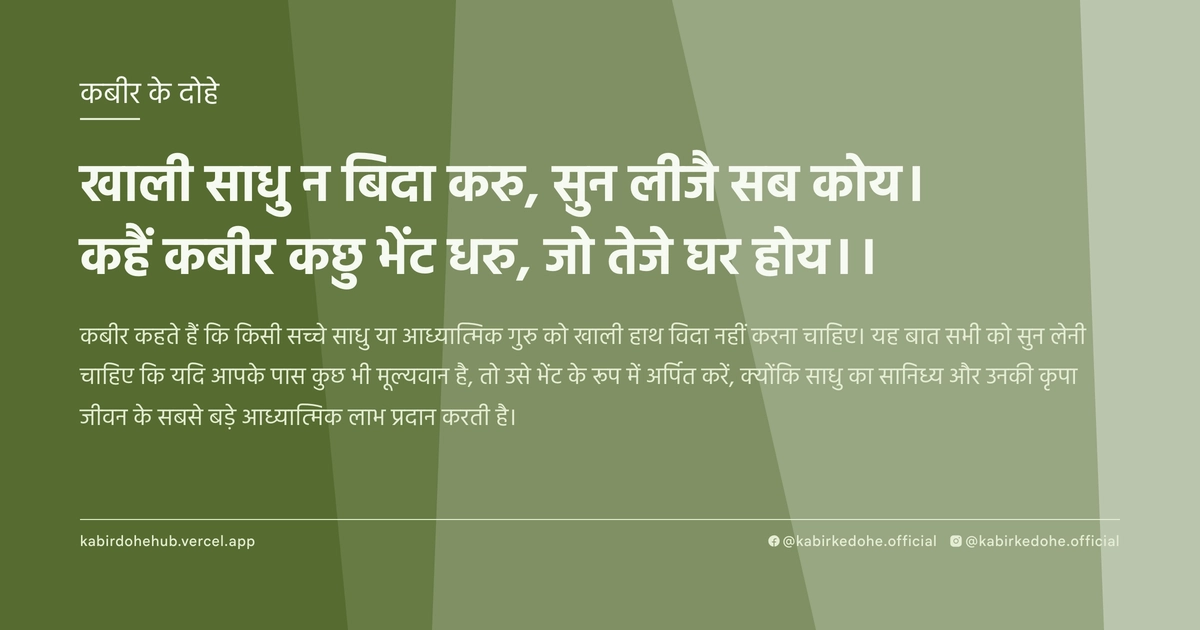
खाली साधु न बिदा करु, सुन लीजै सब कोय।
कहैं कबीर कछु भेंट धरु, जो तेजे घर होय।।
Khaali sadhu na bida karu, sun leeje sab koye. Kahen Kabir kachhu bhent dharu, jo teje ghar hoye.
इस पृष्ठ पर इस कबीर दोहे का अर्थ (meaning), हिंदी व्याख्या और अंग्रेज़ी अनुवाद, दार्शनिक विश्लेषण और व्यावहारिक जीवन सीख दी गई है। यह दोहा दान (Generosity) विषय से जुड़ा है — Kabir doha meaning and explanation in Hindi and English.
अर्थ (Meaning):
कबीर कहते हैं कि किसी सच्चे साधु या आध्यात्मिक गुरु को खाली हाथ विदा नहीं करना चाहिए। यह बात सभी को सुन लेनी चाहिए कि यदि आपके पास कुछ भी मूल्यवान है, तो उसे भेंट के रूप में अर्पित करें, क्योंकि साधु का सानिध्य और उनकी कृपा जीवन के सबसे बड़े आध्यात्मिक लाभ प्रदान करती है।
Kabir advises that a true seeker or spiritual guide should not be sent away empty-handed. He urges everyone to listen: if there is anything of value within your home or heart, offer it as a gift, for the presence of a realized soul is a rare opportunity to receive spiritual grace and transformative wisdom.
व्याख्या (Interpretation):
शाब्दिक रूप से यह दोहा अतिथि सत्कार और दान की बात करता है, लेकिन आध्यात्मिक स्तर पर 'साधु' वह आंतरिक चेतना या गुरु है जो हमें सत्य का मार्ग दिखाता है। 'खाली विदा करना' का अर्थ है उस अवसर को खो देना जब आत्मा जागृत होने के करीब होती है। यहाँ 'भेंट' केवल भौतिक वस्तु नहीं, बल्कि अहंकार का विसर्जन और पूर्ण समर्पण है। यह निर्गुण भक्ति का संकेत है जहाँ बाहरी आडंबरों के बजाय आंतरिक शुद्धि को महत्व दिया जाता है। माया के प्रभाव में मनुष्य केवल भौतिक दान को देखता है, जबकि कबीर यहाँ आत्म-समर्पण की बात कर रहे हैं। यह अद्वैत वेदांत के उस सिद्धांत से जुड़ा है जहाँ साधक अपनी सीमित पहचान को मिटाकर अनंत ब्रह्म में विलीन होने का प्रयास करता है। अंततः, यह दोहा इस विरोधाभास को दर्शाता है कि हम जिसे 'देना' समझते हैं, वास्तव में वह हमारे स्वयं के बोझ (अहंकार) को हल्का करने की प्रक्रिया है।
Literally, this couplet speaks of hospitality and charity, but on a metaphysical level, the 'Sadhu' represents the inner consciousness or the Satguru who reveals the path to Truth. To 'send away empty' signifies missing the pivotal moment of spiritual awakening. The 'gift' (bhent) is not merely a material object but the offering of one's ego and total surrender. This aligns with Nirgun Bhakti, emphasizing internal purification over external rituals. Under the veil of Maya, humans perceive only physical charity, whereas Kabir advocates for the surrender of the self. It connects to Advaita Vedanta, where the seeker strives to dissolve the limited individual identity into the infinite Brahman. Ultimately, the doha highlights the paradox that what we perceive as 'giving' is actually the process of lightening our own burden of ego.
दार्शनिक विश्लेषण (Philosophical Analysis):
कबीर का यह दोहा उस सामाजिक और धार्मिक परिवेश में लिखा गया था जहाँ कर्मकांड और बाहरी दिखावे की प्रधानता थी। कबीर ने सदैव इस बात पर जोर दिया कि ईश्वर किसी मंदिर या मस्जिद में नहीं, बल्कि मनुष्य के भीतर है। यहाँ 'साधु' का सम्मान करना वास्तव में उस दिव्य तत्व का सम्मान करना है जो एक प्रबुद्ध व्यक्ति के माध्यम से प्रकट होता है। कबीर का दृष्टिकोण सूफीवाद के 'फना' (अहंकार का विनाश) और वेदांत के 'अहं ब्रह्मास्मि' के बीच एक सेतु बनाता है।
ritualism (कर्मकांड) के प्रति उनकी अस्वीकृति यहाँ स्पष्ट है; वे यह नहीं कह रहे कि केवल धन दान करें, बल्कि वे उस 'तेजे' (तेज या मूल्यवान वस्तु) की बात कर रहे हैं जो घर के भीतर है—अर्थात आत्मा की शुद्धता। जाति और वर्ग के भेदों को मिटाते हुए, कबीर यह संदेश देते हैं कि आध्यात्मिक ज्ञान किसी विशेष वर्ग की बपौती नहीं है, बल्कि यह समर्पण और पात्रता पर निर्भर करता है।
मनोवैज्ञानिक स्तर पर, यह दोहा 'लेने' और 'देने' के चक्र को तोड़ता है। जब हम किसी को कुछ देते हैं, तो हम अक्सर अपनी श्रेष्ठता का अनुभव करते हैं। लेकिन कबीर यहाँ साधु को एक माध्यम बता रहे हैं जिसके जरिए हम अपने अहंकार को विसर्जित कर सकते हैं। यह एक प्रकार का आध्यात्मिक विनिमय है जहाँ भौतिक वस्तु का त्याग मानसिक मुक्ति का मार्ग प्रशस्त करता है।
अद्वैत वेदांत के अनुसार, जब तक 'मैं' और 'मेरा' का भाव रहता है, तब तक सत्य का साक्षात्कार असंभव है। 'भेंट' देना वास्तव में इस 'मेरेपन' को समाप्त करने का अभ्यास है। कबीर यहाँ चेतावनी दे रहे हैं कि यदि आप उस दिव्य अवसर (साधु) को बिना कुछ दिए (बिना समर्पण के) जाने देते हैं, तो आप अपनी मुक्ति का द्वार स्वयं बंद कर रहे हैं।
अंततः, यह दोहा हमें सिखाता है कि वास्तविक दान वह है जो हमें स्वयं से मुक्त करे। यह भौतिकवाद और आध्यात्मिकता के बीच के संघर्ष को सुलझाता है, यह बताते हुए कि भौतिक संसाधनों का उपयोग यदि आध्यात्मिक उत्थान के लिए किया जाए, तो वे बंधन के बजाय मुक्ति का साधन बन सकते हैं।
This doha was composed in a socio-religious climate dominated by rigid rituals and outward displays of piety. Kabir consistently emphasized that the Divine resides not in temples or mosques, but within the human heart. Honoring the 'Sadhu' is, in essence, honoring the divine element manifested through an enlightened being. Kabir’s perspective builds a bridge between the Sufi concept of 'Fana' (annihilation of the ego) and the Vedantic realization of 'Aham Brahmasmi'.
His rejection of ritualism is evident here; he is not merely advocating for monetary charity, but referring to the 'Tej' (radiance or value) within the home—meaning the purity of the soul. By dismantling caste and class hierarchies, Kabir asserts that spiritual knowledge is not the monopoly of any specific group but depends entirely on surrender and readiness.
Psychologically, this doha breaks the cycle of 'taking' and 'giving'. Often, when we give, we subconsciously reinforce our own sense of superiority. However, Kabir presents the Sadhu as a medium through which we can dissolve the ego. It is a spiritual exchange where the relinquishing of material attachment paves the way for mental liberation.
According to Advaita Vedanta, as long as the sense of 'I' and 'Mine' persists, the realization of Truth remains impossible. Offering a 'gift' is a practice in eradicating this possessiveness. Kabir warns that if the divine opportunity (the Sadhu) departs without a gift (without surrender), the seeker is effectively closing the door to their own liberation.
Ultimately, the doha teaches that true charity is that which liberates us from ourselves. It resolves the conflict between materialism and spirituality, suggesting that material resources, when utilized for spiritual elevation, can transform from shackles into instruments of freedom.
मूल संदेश (Core Message):
- बाहरी दान से अधिक आंतरिक समर्पण मूल्यवान है।
- अहंकार का विसर्जन ही वास्तविक आध्यात्मिक भेंट है।
- गुरु या साधु केवल एक माध्यम हैं, लक्ष्य आंतरिक जागृति है।
- माया भौतिक वस्तुओं में है, सत्य समर्पण में है।
- जब 'मैं' मिटता है, तभी 'वह' प्रकट होता है।
- Internal surrender is far more valuable than external charity.
- The dissolution of ego is the only true spiritual offering.
- The Guru or Sadhu is a medium; the goal is inner awakening.
- Maya resides in material objects; Truth resides in surrender.
- Only when the 'I' vanishes does the 'Divine' manifest.
व्यावहारिक उदाहरण (Practical Example):
वाराणसी के एक पुराने घाट पर माधव नाम का एक वृद्ध नाविक रहता था। माधव का जीवन केवल नाव चलाने और पर्यटकों को घुमाने तक सीमित था, लेकिन उसके मन में हमेशा एक बेचैनी रहती थी कि जीवन का वास्तविक उद्देश्य क्या है। वह अक्सर घाटों पर बैठने वाले संतों को देखता, लेकिन कभी उनके पास जाने का साहस नहीं जुटा पाया क्योंकि उसे लगता था कि वह एक साधारण और अछूत नाविक है, जबकि वे महान विद्वान हैं।
एक दिन, एक साधारण सी चादर ओढ़े एक फकीर उसकी नाव पर सवार हुआ। उस फकीर की आँखों में एक अजीब सी शांति और गहराई थी। पूरी यात्रा के दौरान फकीर ने कुछ नहीं कहा, लेकिन माधव को महसूस हुआ कि उसकी उपस्थिति मात्र से उसके मन का शोर शांत हो रहा है। जब यात्रा समाप्त हुई, तो फकीर उतरकर जाने लगा।
माधव के पास देने के लिए बहुत कुछ नहीं था। उसके पास केवल कुछ पुराने सिक्के और एक छोटी सी पोटली में थोड़ा सा सूखा अनाज था। तभी उसे कबीर का यह दोहा याद आया कि साधु को खाली हाथ नहीं भेजना चाहिए। उसने सोचा, 'मेरे पास धन तो नहीं है, लेकिन क्या मेरे पास कुछ ऐसा है जो वास्तव में मूल्यवान हो?'
उसने महसूस किया कि उसका सबसे बड़ा मूल्य उसका 'अहंकार' था—यह विचार कि वह छोटा है और वह फकीर बड़ा है। उसने फकीर के चरणों में गिरकर अपनी सारी मानसिक उलझनें, अपना डर और अपनी लघुता का भाव अर्पित कर दिया। उसने कहा, 'महाराज, मेरे पास देने को कुछ नहीं है सिवाय मेरी इस व्याकुलता के, इसे स्वीकार करें।'
फकीर मुस्कुराया और बोला, 'यही वह भेंट है जिसकी मुझे तलाश थी। तुमने अपनी कमी को स्वीकार कर लिया, और यही तुम्हारी सबसे बड़ी समृद्धि है।' उस क्षण माधव के भीतर कुछ टूट गया। उसे अनुभव हुआ कि वह अब तक जिसे अपनी 'गरीबी' समझ रहा था, वह वास्तव में उसकी 'अज्ञानता' थी।
इस अनुभव के बाद माधव का व्यवहार पूरी तरह बदल गया। वह अब केवल नाव नहीं चलाता था, बल्कि हर यात्री के साथ करुणा और प्रेम से बात करता था। उसने नाव चलाने को एक सेवा बना लिया। वह अब घाट के अन्य नाविकों के बीच विवाद सुलझाने लगा और अपनी कमाई का एक हिस्सा गरीबों में बांटने लगा।
उसने पाया कि जब उसने अपना 'स्व' (ego) भेंट कर दिया, तो उसके जीवन में एक ऐसी प्रचुरता आ गई जिसे वह पहले कभी नहीं जान पाया था। वह अब किसी से डरता नहीं था और न ही किसी से ईर्ष्या करता था।
माधव की कहानी यह दिखाती है कि 'भेंट' भौतिक नहीं, बल्कि आंतरिक रूपांतरण है। जब हम अपनी सीमाओं को स्वीकार कर उन्हें सत्य के चरणों में समर्पित करते हैं, तभी वास्तविक आध्यात्मिक यात्रा शुरू होती है।
On an ancient ghat in Varanasi lived an elderly boatman named Madhav. Madhav's life was confined to rowing his boat and guiding tourists, yet a persistent restlessness gnawed at him, questioning the true purpose of existence. He often watched the saints lounging on the ghats, but never dared approach them, believing himself to be a mere lowly boatman while they were great scholars.
One day, a dervish clad in a simple sheet boarded his boat. There was an uncanny peace and depth in the dervish's eyes. Throughout the journey, the dervish remained silent, yet Madhav felt the noise of his mind settling just by the man's presence. As the journey ended, the dervish prepared to depart.
Madhav had very little to give. He possessed only a few old coins and a small pouch of dried grain. Suddenly, Kabir's doha echoed in his mind: a Sadhu should not be sent away empty-handed. He wondered, 'I have no wealth, but do I possess anything truly valuable?'
He realized that his most significant 'possession' was his ego—the ingrained belief that he was inferior and the dervish was superior. He fell at the dervish's feet and offered all his mental turmoil, his fears, and his sense of insignificance. He pleaded, 'Maharaj, I have nothing to give except this restlessness of mine; please accept it.'
The dervish smiled and replied, 'This is the very gift I was seeking. By accepting your lack, you have found your greatest abundance.' In that moment, something within Madhav shattered. He realized that what he had perceived as 'poverty' was actually his 'ignorance'.
Following this experience, Madhav's behavior transformed completely. He no longer just rowed a boat; he spoke to every passenger with profound compassion and love. He turned his profession into a service. He began resolving disputes among other boatmen and shared a portion of his earnings with the poor.
He discovered that by gifting his 'self' (ego), an abundance entered his life that he had never known before. He no longer feared anyone, nor did he harbor jealousy.
Madhav's story illustrates that the 'gift' is not material, but an internal transformation. When we acknowledge our limitations and surrender them at the feet of Truth, the real spiritual journey begins.
अभ्यास मार्गदर्शन (Practice Guidance):
- दैनिक चिंतन: प्रतिदिन 15 मिनट मौन बैठें और विचार करें कि आपके भीतर ऐसा कौन सा 'अहंकार' या 'संलग्नता' है जिसे आप आज विसर्जित कर सकते हैं।
- आत्म-पूछताछ जर्नल: लिखें कि जब आप किसी की मदद करते हैं, तो क्या आप वास्तव में निस्वार्थ होते हैं या आप अपनी श्रेष्ठता महसूस कर रहे होते हैं? इस द्वंद्व का विश्लेषण करें।
- व्यवहार परिवर्तन: दिन में कम से कम एक बार किसी ऐसे व्यक्ति की निस्वार्थ सेवा करें जिससे आपको कोई लाभ न मिलने वाला हो, और इसे गुप्त रखें।
- डायग्नोस्टिक चेकलिस्ट: क्या आप अभी भी अपनी उपलब्धियों का श्रेय स्वयं लेते हैं? क्या आप दूसरों को अपने से छोटा समझते हैं? यदि हाँ, तो आप अभी भी 'खाली हाथ' हैं।
- Daily Contemplation: Sit in silence for 15 minutes daily and reflect on which specific 'ego' or 'attachment' within you can be relinquished today.
- Self-Inquiry Journal: Document whether your acts of kindness are truly selfless or if they secretly reinforce a sense of superiority. Analyze this duality.
- Behavioral Shift: Perform one act of selfless service daily for someone from whom you expect absolutely nothing in return, and keep this act secret.
- Diagnostic Checklist: Do you still take sole credit for your achievements? Do you perceive others as inferior? If yes, you are still 'empty-handed' in the spiritual sense.
चिंतन प्रश्न (Reflection Questions):
- यदि आपसे आपकी सारी सामाजिक पहचान (पद, प्रतिष्ठा, जाति) छीन ली जाए, तो आप 'भेंट' में क्या देंगे?
- क्या आपका दान वास्तव में त्याग है, या यह आपके अहंकार को संतुष्ट करने का एक तरीका है?
- आप अपने जीवन में 'साधु' (दिव्य मार्गदर्शन) को कहाँ खोज रहे हैं—बाहर या भीतर?
- वह कौन सी मानसिक जकड़न है जिसे आप छोड़ने से सबसे ज्यादा डरते हैं?
- क्या आपकी डिजिटल पहचान (सोशल मीडिया) आपके वास्तविक आध्यात्मिक शून्य को छिपाने का एक मुखौटा है?
- If all your social identities (rank, prestige, caste) were stripped away, what would you have left to 'offer'?
- Is your charity a true act of renunciation, or is it a mechanism to satisfy your ego?
- Where are you searching for the 'Sadhu' (divine guidance)—externally or within?
- What is the specific mental attachment that you are most afraid to let go of?
- Is your digital identity a mask used to conceal your actual spiritual void?