
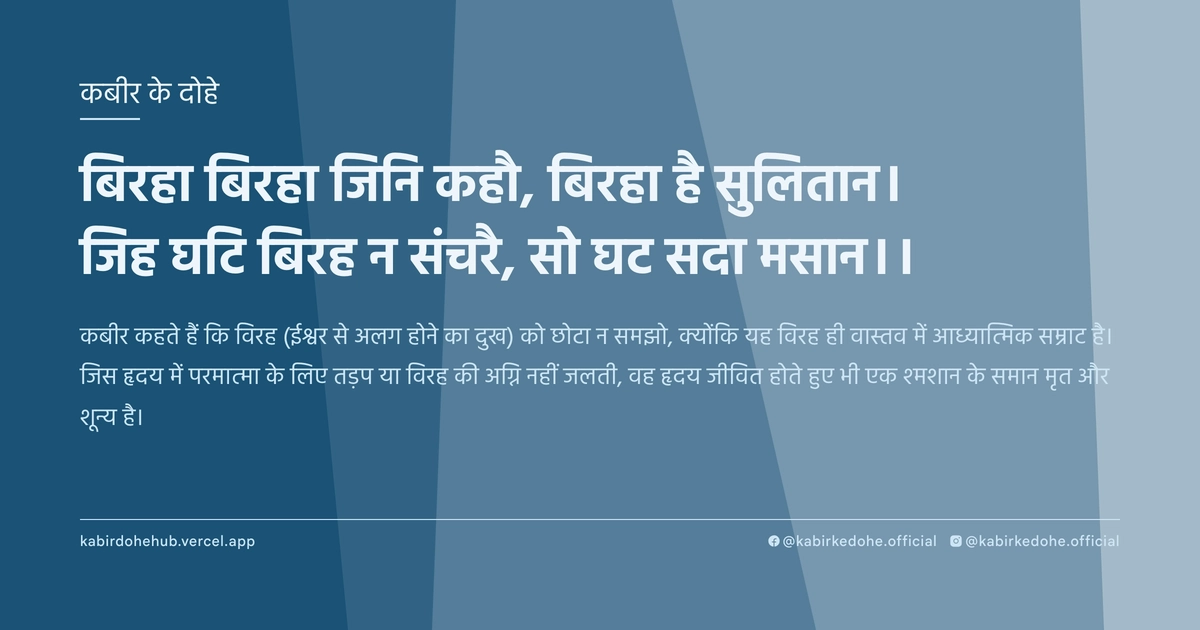
बिरहा बिरहा जिनि कहौ, बिरहा है सुलितान।
जिह घटि बिरह न संचरै, सो घट सदा मसान।।
Birha birha jini kahau, birha hai sulitaan. Jih ghat birah na sancharai, so ghat sada masaan.
इस पृष्ठ पर इस कबीर दोहे का अर्थ (meaning), हिंदी व्याख्या और अंग्रेज़ी अनुवाद, दार्शनिक विश्लेषण और व्यावहारिक जीवन सीख दी गई है। यह दोहा भक्ति (Bhakti) विषय से जुड़ा है — Kabir doha meaning and explanation in Hindi and English.
अर्थ (Meaning):
कबीर कहते हैं कि विरह (ईश्वर से अलग होने का दुख) को छोटा न समझो, क्योंकि यह विरह ही वास्तव में आध्यात्मिक सम्राट है। जिस हृदय में परमात्मा के लिए तड़प या विरह की अग्नि नहीं जलती, वह हृदय जीवित होते हुए भी एक श्मशान के समान मृत और शून्य है।
Kabir asserts that one should not dismiss the pain of separation (Viraha) from the Divine, for this longing is the true sovereign ruler of the soul. The heart that does not experience this sacred ache for the Eternal is nothing more than a cremation ground—spiritually dead and void of life.
व्याख्या (Interpretation):
यहाँ 'विरह' केवल भौतिक वियोग नहीं, बल्कि आत्मा की परमात्मा से मिलने की तीव्र व्याकुलता है। कबीर इसे 'सुलितान' (सुल्तान) कहते हैं क्योंकि यह वह शक्ति है जो अहंकार को तोड़ती है और साधक को विनम्र बनाती है। निरगुण भक्ति में, जब साधक को यह अहसास होता है कि वह अपने वास्तविक स्वरूप (ब्रह्म) से अलग है, तब एक आंतरिक रिक्तता पैदा होती है। यह रिक्तता ही विरह है। यह विरह माया के पर्दे को हटाता है और अद्वैत की स्थिति की ओर ले जाता है। यदि हृदय में यह तड़प नहीं है, तो व्यक्ति सांसारिक सुखों में इतना लीन है कि वह अपनी आध्यात्मिक मृत्यु को नहीं देख पाता। अतः, विरह वह अग्नि है जो अशुद्धियों को जलाकर आत्मा को शुद्ध करती है।
In this context, 'Viraha' is not mere physical longing but the profound spiritual ache of the Atman yearning for its union with the Nirgun Brahman. Kabir labels this longing as 'Sultan' because it is the supreme authority that dismantles the ego and renders the seeker humble. In the path of formless devotion, the realization of separation from the Eternal creates a sacred void. This void is the catalyst for awakening, stripping away the illusions of Maya to reveal the non-duality of existence. Without this divine restlessness, a person remains trapped in a state of spiritual slumber, their heart becoming a 'masaan' or cremation ground—physically alive but spiritually extinct. Thus, the pain of separation is actually a grace, a purifying fire that consumes the dross of the ego to prepare the soul for ultimate merger.
दार्शनिक विश्लेषण (Philosophical Analysis):
कबीर का यह दोहा मध्यकालीन भारत के सामाजिक और धार्मिक परिवेश में रचा गया, जहाँ कर्मकांड और बाहरी दिखावे का बोलबाला था। कबीर ने मंदिर-मस्जिद के विवादों से ऊपर उठकर 'हृदय की तड़प' को वास्तविक पूजा माना। उनका दर्शन सूफी मत के 'इश्क-ए-इलाही' (ईश्वरीय प्रेम) और अद्वैत वेदांत के 'जीव-ब्रह्म' संबंध का संगम है। सूफीवाद में 'विरह' को ईश्वर तक पहुँचने का सबसे तीव्र मार्ग माना गया है, क्योंकि जब प्रेमी अपने प्रिय से अलग होता है, तो उसका पूरा अस्तित्व केवल उस प्रिय के इर्द-गिर्द सिमट जाता है।
यहाँ कबीर ritualism (कर्मकांड) का खंडन करते हैं। वे कहते हैं कि माला जपने या तीर्थ यात्रा करने से अधिक महत्वपूर्ण वह आंतरिक तड़प है जो मनुष्य को उसकी सीमित पहचान से मुक्त करती है। यह विरह वास्तव में मनोवैज्ञानिक रूपांतरण की प्रक्रिया है। जब व्यक्ति को यह महसूस होता है कि संसार की कोई भी वस्तु उसे पूर्ण नहीं कर सकती, तब वह उस 'अपूर्णता' को स्वीकार करता है। यही स्वीकारोक्ति अहंकार के विसर्जन की शुरुआत है।
अद्वैत वेदांत के अनुसार, हम वास्तव में अलग नहीं हैं, लेकिन अज्ञान (Avidya) के कारण हमें अलगाव महसूस होता है। कबीर इस अलगाव के दुख को एक उपकरण की तरह उपयोग करते हैं। वे सिखाते हैं कि इस दुख से भागना नहीं है, बल्कि इसमें डूबना है। जब विरह अपनी चरम सीमा पर पहुँचता है, तो 'मैं' और 'तू' का भेद मिट जाता है और केवल 'वह' शेष रह जाता है।
ऐतिहासिक रूप से, कबीर ने जाति और धर्म की दीवारों को तोड़ने के लिए प्रेम और विरह को आधार बनाया। उन्होंने यह स्थापित किया कि ईश्वर किसी विशेष समुदाय का नहीं, बल्कि उस हर हृदय का है जो उसके लिए तड़पता है। यह एक लोकतांत्रिक आध्यात्मिकता थी, जहाँ पात्रता का पैमाना ज्ञान या कुल नहीं, बल्कि प्रेम की तीव्रता थी।
अंततः, यह दोहा हमें चेतावनी देता है कि आध्यात्मिक उदासीनता (Spiritual Apathy) सबसे बड़ा पाप है। वह व्यक्ति जो यह मानता है कि वह पूर्ण है और उसे किसी उच्च सत्य की खोज की आवश्यकता नहीं है, वह वास्तव में मृत है। विरह वह जीवन-शक्ति है जो हमें निरंतर ऊपर की ओर खींचती है और हमें याद दिलाती है कि हम इस नश्वर संसार के नहीं, बल्कि उस अविनाशी तत्व के अंश हैं।
This couplet emerges from the socio-religious crucible of medieval India, a time dominated by rigid ritualism and sectarian divides. Kabir transcends the conflict between temple and mosque by elevating 'internal longing' as the only authentic form of worship. His philosophy is a profound synthesis of the Sufi concept of 'Ishq-e-Ilahi' (Divine Love) and the Advaita Vedanta premise of the relationship between the Jiva (individual soul) and Brahman (Universal Consciousness). In Sufism, the pain of separation is viewed as the most potent vehicle for spiritual ascent, as the lover's entire existence becomes centered solely on the Beloved.
Kabir explicitly rejects ritualism here. He suggests that the mechanical recitation of beads or the physical act of pilgrimage is hollow compared to the visceral ache of the heart. This 'Viraha' is a psychological transformation process. When an individual realizes that no worldly acquisition can provide ultimate fulfillment, they confront a profound sense of incompleteness. This admission is the first crack in the fortress of the ego, allowing the light of truth to enter.
According to Advaita Vedanta, the separation is an illusion caused by Avidya (ignorance); we are already one with the Divine. However, Kabir utilizes the *feeling* of separation as a spiritual tool. He teaches that one should not flee from this pain but immerse themselves in it. When the intensity of longing reaches its zenith, the duality of 'I' and 'Thou' dissolves, leaving only the Absolute.
Historically, Kabir used love and longing to dismantle caste and religious hierarchies. He established that the Divine belongs not to a specific community, but to any heart that burns with desire for Truth. This was a radical democratization of spirituality, where the criterion for eligibility was not scholarly knowledge or lineage, but the intensity of one's emotional surrender.
Ultimately, this Doha warns against spiritual apathy. The person who believes they are complete and feels no need for a higher truth is, in essence, spiritually dead. Viraha is the vital force that prevents stagnation, reminding the seeker that they are not products of this ephemeral world, but fragments of the Eternal, destined for a return to the Source.
मूल संदेश (Core Message):
- आध्यात्मिक प्यास ही परमात्मा तक पहुँचने का एकमात्र मार्ग है।
- अहंकार का अंत केवल तीव्र विरह की अग्नि में ही संभव है।
- बाहरी कर्मकांड मृत हृदय को जीवित नहीं कर सकते।
- दुख को दबाना नहीं, बल्कि उसे रूपांतरित करना ही साधना है।
- सच्ची जीवंतता उस तड़प में है जो हमें पूर्णता की ओर ले जाए।
- Spiritual thirst is the only authentic gateway to the Divine.
- The annihilation of ego is possible only in the fire of intense longing.
- External rituals cannot revive a spiritually dead heart.
- Sadhana is not the suppression of pain, but its transformation.
- True vitality lies in the restlessness that drives one toward Wholeness.
व्यावहारिक उदाहरण (Practical Example):
वाराणसी के एक पुराने मोहल्ले में माधव नाम का एक बुनकर रहता था। वह अपने काम में निपुण था और समाज में सम्मानित था, लेकिन उसके भीतर एक अजीब सी बेचैनी थी। वह रोज पूजा करता, दान देता और धर्म के सभी नियमों का पालन करता, फिर भी उसे लगता कि उसके जीवन में कुछ बुनियादी खालीपन है। वह इस खालीपन को भरने के लिए और अधिक धन कमाने और सामाजिक प्रतिष्ठा पाने की कोशिश करता रहा।
एक दिन उसकी मुलाकात एक फकीर से हुई जिसने उसकी आँखों में देखा और कहा, "माधव, तुम उस प्यास से डर रहे हो जो तुम्हें सही रास्ते पर ले जाएगी। तुम अपने खालीपन को भरने की कोशिश कर रहे हो, जबकि तुम्हें उस खालीपन को उत्सव बनाना चाहिए।"
माधव को पहले यह बात समझ नहीं आई। उसने पूछा, "खालीपन में उत्सव कैसा? क्या दुख में भी सुख हो सकता है?"
फकीर ने मुस्कुराकर कहा, "जब एक बच्चा अपनी माँ को खो देता है, तो वह रोता है। वह रोना इस बात का प्रमाण है कि वह अपनी माँ से प्रेम करता है। यदि वह नहीं रोता, तो इसका अर्थ है कि वह माँ के अस्तित्व से ही अनजान है। तुम्हारा यह दुख, यह अधूरापन ही इस बात का प्रमाण है कि तुम उस परमात्मा से प्रेम करते हो। इस विरह को दबाओ मत, इसे अपनी शक्ति बनाओ।"
माधव ने पहली बार महसूस किया कि वह जिस मानसिक तनाव और उदासी को 'बीमारी' समझकर दूर करना चाहता था, वह वास्तव में उसकी आत्मा की पुकार थी। उसने बाहरी दिखावे और कर्मकांडों को छोड़कर अपने भीतर की उस तड़प को महसूस करना शुरू किया। उसने प्रार्थना करना बंद किया और 'प्रतीक्षा' करना शुरू किया।
उसने देखा कि जब वह इस विरह को स्वीकार करता है, तो उसका क्रोध कम होने लगता है। वह अब दूसरों की गलतियों पर चिल्लाता नहीं था, क्योंकि उसे महसूस हुआ कि हर इंसान उसी विरह की अग्नि में जल रहा है। उसकी करुणा जाग गई।
उसका काम अब केवल आजीविका नहीं रहा, बल्कि उसकी बुनाई एक ध्यान बन गई। वह हर धागे में उस परमात्मा की याद बुनने लगा। उसकी बेचैनी अब उसे परेशान नहीं करती थी, बल्कि उसे एक गहरे सुकून की ओर ले जाती थी।
एक दिन माधव ने महसूस किया कि जिस 'परमात्मा' को वह बाहर खोज रहा था और जिसके लिए वह तड़प रहा था, वह तड़प ही वास्तव में परमात्मा का रूप थी। विरह ने उसे इतना विनम्र बना दिया कि उसके भीतर का 'अहंकार' पूरी तरह गल गया।
अब माधव के चेहरे पर एक ऐसी शांति थी जो पहले कभी नहीं थी। लोग उससे पूछने लगे कि उसने कौन सा नया मंत्र सीखा है। उसने बस इतना कहा, "मैंने केवल रोना सीखा है, और उस रोने में मुझे मेरा ईश्वर मिल गया।"
माधव का जीवन अब एक श्मशान नहीं, बल्कि एक खिलता हुआ बगीचा था, क्योंकि उसने विरह के सुल्तान को अपने हृदय पर राज करने दिया था।
In an ancient lane of Varanasi lived a weaver named Madhav. He was skilled in his craft and respected in society, yet an inexplicable restlessness gnawed at his soul. He performed daily rituals, gave alms, and adhered to every religious tenet, but he felt a fundamental void within him. He spent years trying to fill this void with material wealth and social prestige.
One day, he encountered a wandering dervish who looked into his eyes and said, "Madhav, you are fearing the very thirst that will lead you to the Truth. You are trying to fill your emptiness, whereas you should be celebrating it."
Madhav was perplexed. "How can there be celebration in emptiness? Can there be joy in sorrow?"
The dervish smiled and replied, "When a child loses its mother, it cries. That cry is the proof that the child loves the mother. If the child does not cry, it means the child is unaware of the mother's existence. Your sorrow, your incompleteness, is the proof that you love the Divine. Do not suppress this longing; make it your strength."
For the first time, Madhav realized that the mental distress and melancholy he had treated as a 'disease' were actually the cries of his soul. He stopped the mechanical prayers and began the practice of 'waiting.' He shifted from seeking a destination to embracing the longing itself.
He noticed that as he accepted this Viraha, his anger began to dissipate. He stopped judging others' failures because he realized that every human being was burning in the same fire of separation. His compassion awakened.
His weaving ceased to be a mere livelihood and became a meditation. He began to weave the remembrance of the Divine into every thread. The restlessness no longer troubled him; instead, it guided him toward a profound inner stillness.
One day, Madhav realized that the 'God' he was searching for outside, and for whom he was longing, was actually present in the longing itself. The Viraha had made him so humble that the fortress of his ego completely dissolved.
Now, a serenity radiated from Madhav's face that was never there before. People asked him what new mantra he had mastered. He simply replied, "I only learned how to weep, and in that weeping, I found my God."
Madhav's life was no longer a spiritual cremation ground, but a blooming garden, for he had allowed the Sultan of Longing to reign over his heart.
अभ्यास मार्गदर्शन (Practice Guidance):
- दैनिक चिंतन: प्रतिदिन 15 मिनट मौन बैठें और अपने भीतर की उस 'अपूर्णता' या 'खालीपन' को महसूस करें। इसे दूर करने की कोशिश न करें, बल्कि इसे एक अतिथि की तरह स्वीकार करें।
- आत्म-पूछताछ जर्नल: लिखें कि आप जीवन में किस चीज की कमी महसूस करते हैं। फिर पूछें, "क्या यह कमी किसी भौतिक वस्तु की है, या यह वास्तव में उस अनंत सत्य के लिए एक पुकार है?"
- व्यवहार परिवर्तन: जब भी आप उदास या अकेला महसूस करें, तो उसे 'दुख' के बजाय 'दिव्य विरह' के रूप में देखें। इस भावना को दूसरों के प्रति करुणा में बदलें।
- डायग्नोस्टिक चेकलिस्ट: क्या आप हर समय मानसिक रूप से व्यस्त रहते हैं? क्या आप अकेलेपन से डरते हैं? क्या आप केवल बाहरी उपलब्धियों में खुशी खोज रहे हैं? यदि हाँ, तो आपका हृदय 'मसान' (सुप्त) होने की स्थिति में है।
- Daily Contemplation: Sit in silence for 15 minutes daily and consciously feel the 'incompleteness' or 'void' within. Do not try to fix it; instead, welcome it as a sacred guest.
- Self-Inquiry Journaling: Document the things you feel are missing in your life. Then ask, "Is this a lack of a material object, or is it actually a call for the Infinite Truth?"
- Behavioral Shift: Whenever you feel sadness or loneliness, reframe it as 'Divine Longing' rather than 'suffering.' Channel this emotion into compassion for others who are also longing.
- Diagnostic Checklist: Do you constantly keep yourself distracted? Do you fear solitude? Do you seek happiness solely in external achievements? If yes, your heart may be in a state of 'Masaan' (spiritual dormancy).
चिंतन प्रश्न (Reflection Questions):
- क्या मेरी उपलब्धियाँ मेरे भीतर के खालीपन को वास्तव में भर रही हैं, या वे केवल उस पर पर्दा डाल रही हैं?
- मैं अपने अकेलेपन से इतना डरता क्यों हूँ? क्या वह अकेलापन वास्तव में परमात्मा से मिलने का निमंत्रण है?
- मेरा 'डिजिटल ईगो' (सोशल मीडिया इमेज) मुझे वास्तविक आंतरिक तड़प से कैसे दूर रख रहा है?
- यदि मेरा सारा सामाजिक सम्मान और पद छीन लिया जाए, तो क्या मेरे भीतर कोई ऐसी तड़प बचेगी जो मुझे जीवित रखे?
- क्या मैं अपनी आध्यात्मिक यात्रा में केवल 'सुख' खोज रहा हूँ, या मैं 'पवित्र दुख' को स्वीकार करने का साहस रखता हूँ?
- Are my achievements actually filling my inner void, or are they merely masking it?
- Why do I fear my loneliness so much? Could that solitude actually be an invitation from the Divine?
- How does my 'digital ego' (social media image) distract me from the authentic internal longing?
- If all my social status and titles were stripped away, would there be a longing left within me that keeps me spiritually alive?
- Am I seeking only 'bliss' in my spiritual journey, or do I have the courage to embrace 'sacred suffering'?