
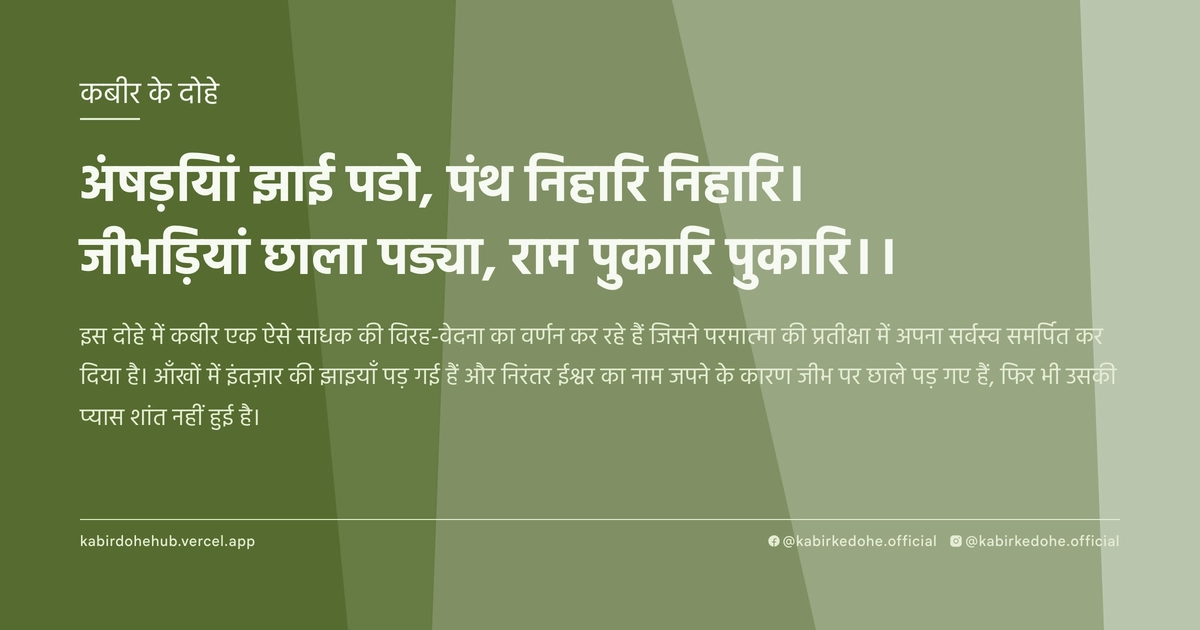
अंषड़यिां झाई पडो, पंथ निहारि निहारि।
जीभड़ियां छाला पड्या, राम पुकारि पुकारि।।
Anshadayian jhai pado, panth nihari nihari. Jeebhadiyan chaala padya, Ram pukari pukari.
इस पृष्ठ पर इस कबीर दोहे का अर्थ (meaning), हिंदी व्याख्या और अंग्रेज़ी अनुवाद, दार्शनिक विश्लेषण और व्यावहारिक जीवन सीख दी गई है। यह दोहा भक्ति (Bhakti) विषय से जुड़ा है — Kabir doha meaning and explanation in Hindi and English.
अर्थ (Meaning):
इस दोहे में कबीर एक ऐसे साधक की विरह-वेदना का वर्णन कर रहे हैं जिसने परमात्मा की प्रतीक्षा में अपना सर्वस्व समर्पित कर दिया है। आँखों में इंतज़ार की झाइयाँ पड़ गई हैं और निरंतर ईश्वर का नाम जपने के कारण जीभ पर छाले पड़ गए हैं, फिर भी उसकी प्यास शांत नहीं हुई है।
In this couplet, Kabir depicts the intense agony of separation experienced by a seeker who has surrendered everything in anticipation of the Divine. The eyes have grown weary and shadowed from constant gazing upon the path, and the tongue is blistered from the ceaseless chanting of 'Ram', yet the spiritual thirst remains unquenched.
व्याख्या (Interpretation):
शाब्दिक अर्थ में यह एक प्रेमी की तड़प है, लेकिन आध्यात्मिक स्तर पर यह 'विरह' की अवस्था है। 'पंथ निहारना' केवल सड़क देखना नहीं, बल्कि चेतना के उस स्तर पर पहुँचना है जहाँ आत्मा परमात्मा के मिलन की प्रतीक्षा करती है। यहाँ 'राम' दशरथ पुत्र नहीं, बल्कि निर्गुण ब्रह्म हैं जो कण-कण में व्याप्त हैं। यह स्थिति माया के पर्दे को हटाने की प्रक्रिया है, जहाँ साधक अपनी भौतिक पहचान को पूरी तरह मिटा देता है। जब तक 'मैं' (अहंकार) जीवित है, तब तक विरह बना रहता है; जैसे ही 'मैं' मिटता है, मिलन घटित होता है। यह विरोधाभास है कि परमात्मा हमारे भीतर है, फिर भी हम उसे बाहर खोजते हैं, जिससे यह पीड़ा उत्पन्न होती है।
Literally, this describes a lover's longing, but spiritually, it represents the state of 'Viraha' or divine separation. 'Gazing upon the path' is not a physical act but a state of consciousness where the Atman yearns for union with the Brahman. Here, 'Ram' does not refer to the historical king, but to the Nirgun (formless) Absolute pervading every atom. This state marks the process of piercing through the veil of Maya, where the seeker systematically dismantles their material identity. The central paradox lies in the fact that while the Divine resides within, the illusion of separation creates a desperate outward search. Only when the 'I' (ego) is completely annihilated does the separation end and union occur.
दार्शनिक विश्लेषण (Philosophical Analysis):
कबीर का यह दोहा भक्ति काल की उस धारा का प्रतिनिधित्व करता है जहाँ प्रेम ही एकमात्र साधन है। यह सूफी मत के 'इश्क-ए-हकीकी' (दिव्य प्रेम) और अद्वैत वेदांत के 'जीवो ब्रह्मैव नापरः' (जीव और ब्रह्म एक ही हैं) के मिलन बिंदु पर स्थित है। कबीर यहाँ कर्मकांडीय पूजा का खंडन करते हैं; वे बताते हैं कि ईश्वर मंदिर या मस्जिद में नहीं, बल्कि उस तड़प में मिलता है जो साधक को उसकी नींद से जगा दे।
ऐतिहासिक रूप से, कबीर ने एक ऐसे समाज को चुनौती दी जहाँ धर्म बाहरी प्रतीकों और जातिगत श्रेष्ठता पर टिका था। उनके लिए, जीभ के छाले किसी मंत्र के यांत्रिक जाप का परिणाम नहीं, बल्कि हृदय की सच्ची पुकार का प्रमाण हैं। यह 'शून्य' की ओर बढ़ने की प्रक्रिया है, जहाँ साधक अपनी समस्त वासनाओं को जलाकर भस्म कर देता है।
मनोवैज्ञानिक स्तर पर, यह विरह वास्तव में एक 'शुद्धिकरण' (Catharsis) है। जब मनुष्य को यह अहसास होता है कि संसार की कोई भी वस्तु उसे पूर्ण नहीं कर सकती, तब वह उस परम तत्व की ओर मुड़ता है। यह अवसाद नहीं, बल्कि एक उच्च स्तर की आध्यात्मिक व्याकुलता है जो अहंकार के विनाश का मार्ग प्रशस्त करती है।
अद्वैत वेदांत के अनुसार, यह विरह एक भ्रम है क्योंकि आत्मा कभी परमात्मा से अलग थी ही नहीं। लेकिन जब तक अज्ञान (Avidya) है, तब तक यह दूरी महसूस होती है। कबीर इस दूरी को 'पीड़ा' के माध्यम से पाटने का प्रयास करते हैं, क्योंकि पीड़ा ही मनुष्य को उसकी जड़ता से मुक्त करती है।
अंततः, यह दोहा सिखाता है कि आध्यात्मिक उपलब्धि बौद्धिक विमर्श से नहीं, बल्कि भावनात्मक समर्पण से आती है। जब साधक की पुकार उसकी अपनी पहचान को मिटा देती है, तब वह 'राम' के साथ एकाकार हो जाता है। यह पूर्ण आत्म-समर्पण ही मोक्ष का द्वार है।
This couplet represents the current of the Bhakti movement where love is the sole vehicle for liberation. It sits at the intersection of the Sufi concept of 'Ishq-e-Haqiqi' (Divine Love) and the Advaita Vedanta principle of 'Jivo Brahmaiva Naparah' (the individual soul is none other than the Absolute). Kabir rejects ritualistic worship, asserting that the Divine is found not in temples or mosques, but in the searing longing that awakens the seeker from spiritual slumber.
Historically, Kabir challenged a society anchored in external symbols and caste hierarchies. For him, the blisters on the tongue are not the result of mechanical mantra repetition, but evidence of a sincere cry from the depths of the heart. This is the process of moving toward 'Shunya' (the Void), where the seeker incinerates all worldly desires.
Psychologically, this longing is a form of spiritual catharsis. When a human realizes that no worldly object can provide ultimate fulfillment, they turn toward the Absolute. This is not clinical depression, but a high-order spiritual restlessness that paves the way for the annihilation of the ego.
According to Advaita Vedanta, this separation is an illusion (Maya) because the Atman was never separate from Brahman. However, as long as ignorance (Avidya) persists, the distance is felt. Kabir attempts to bridge this gap through 'pain', as suffering is often the only force powerful enough to break human inertia.
Ultimately, the poem teaches that spiritual attainment comes not through intellectual discourse, but through emotional surrender. When the seeker's cry erases their own identity, they merge with 'Ram'. This total surrender is the only gateway to Moksha.
मूल संदेश (Core Message):
- बाहरी खोज केवल थकान और भ्रम पैदा करती है।
- सच्ची तड़प ही अहंकार को गलाने का एकमात्र तरीका है।
- ईश्वर कोई गंतव्य नहीं, बल्कि स्वयं की खोज है।
- विरह की अग्नि में जलकर ही मिलन का आनंद मिलता है।
- मौन ही वह भाषा है जिसमें परमात्मा उत्तर देता है।
- External searching produces only exhaustion and illusion.
- Genuine longing is the only way to dissolve the ego.
- The Divine is not a destination, but the discovery of the Self.
- Only by burning in the fire of separation is the joy of union found.
- Silence is the only language in which the Absolute answers.
व्यावहारिक उदाहरण (Practical Example):
एक समय की बात है, वाराणसी के घाटों पर माधव नाम का एक वृद्ध बुनकर रहता था। माधव ने अपना पूरा जीवन कपड़ों की बुनाई में बिताया, लेकिन उसका मन हमेशा एक अनजानी खोज में भटकता रहता था। वह शहर के बड़े पंडितों के पास गया, कठिन व्रत रखे और तीर्थ यात्राएं कीं, फिर भी उसे वह शांति नहीं मिली जिसकी उसे तलाश थी।
वह अक्सर घंटों गंगा किनारे बैठकर शून्य में देखता रहता। लोग उसे पागल समझने लगे थे। उसकी आँखों के नीचे काले घेरे पड़ गए थे क्योंकि वह रातों को सोता नहीं था, बस इस इंतज़ार में रहता था कि कब वह 'परम सत्य' उसके सामने प्रकट होगा। वह दिन-रात एक ही नाम जपता रहता, जिससे उसकी आवाज़ बैठ गई थी।
एक दिन, एक साधारण सा फकीर उसके पास आया और पूछा, "तुम किसे खोज रहे हो, माधव?"
माधव ने रोते हुए कहा, "मैं उस ईश्वर को खोज रहा हूँ जिसने मुझे बनाया, लेकिन वह कहीं नहीं मिलता। मेरी आँखें थक गई हैं, मेरी जीभ थक गई है, पर वह नहीं आया।"
फकीर मुस्कुराया और माधव के सीने पर हाथ रखकर बोला, "तुम जिस रास्ते को देख रहे हो, वह रास्ता बाहर नहीं, भीतर की ओर जाता है। तुम बाहर देख रहे हो, इसलिए तुम्हारी आँखें थक रही हैं। तुम बाहर पुकार रहे हो, इसलिए तुम्हारी जीभ पर छाले पड़ रहे हैं।"
माधव को अचानक एक गहरा झटका लगा। उसे अहसास हुआ कि वह अब तक ईश्वर को एक 'वस्तु' या 'व्यक्ति' की तरह खोज रहा था, जबकि ईश्वर स्वयं वह 'खोजने वाली चेतना' है।
उस पल माधव की सारी बाहरी खोज समाप्त हो गई। उसने अपनी आँखें बंद कीं और उस मौन को सुना जो उसके भीतर गूँज रहा था। उसे महसूस हुआ कि जिसे वह बाहर ढूंढ रहा था, वह तो उसके हर सांस में, हर धड़कन में मौजूद था।
उसकी व्याकुलता अब एक गहरे आनंद में बदल गई। उसने बुनाई करना जारी रखा, लेकिन अब वह केवल कपड़ा नहीं बुन रहा था, बल्कि हर धागे में उस परमात्मा की उपस्थिति को महसूस कर रहा था।
उसका व्यवहार बदल गया। अब वह लोगों को उपदेश नहीं देता था, बल्कि उसकी शांति ही दूसरों को आकर्षित करने लगी। उसने जान लिया था कि मिलन के लिए कहीं जाने की ज़रूरत नहीं, बस 'मैं' के पर्दे को हटाना ज़रूरी है।
माधव अब एक 'पागल' बुनकर नहीं, बल्कि एक जागृत आत्मा बन चुका था, जिसने विरह की अग्नि में तपकर एकता का अमृत पा लिया था।
Once, in the ghats of Varanasi, lived an elderly weaver named Madhav. Madhav had spent his entire life weaving cloth, but his mind always wandered in search of an unknown truth. He visited great scholars, observed rigorous fasts, and went on pilgrimages, yet the peace he sought remained elusive.
He would often sit by the Ganges for hours, staring into the void. People began to call him mad. Dark circles formed under his eyes because he spent sleepless nights waiting for the 'Ultimate Truth' to manifest before him. He chanted a single name day and night until his voice grew hoarse.
One day, a simple wandering dervish approached him and asked, "Who are you searching for, Madhav?"
Madhav replied with tears, "I am searching for the God who created me, but He is nowhere to be found. My eyes are exhausted, my tongue is blistered, yet He has not appeared."
The dervish smiled and placed a hand on Madhav's chest, saying, "The path you are gazing upon does not lead outward, but inward. You look outside, so your eyes tire. You call outward, so your tongue blisters."
Madhav felt a sudden, profound jolt. He realized he had been searching for God as if He were an 'object' or a 'person' to be found, whereas God is the very 'consciousness' that is doing the searching.
In that instant, Madhav's external search ceased. He closed his eyes and listened to the silence echoing within him. He felt that the one he sought was present in every breath, every heartbeat.
His restlessness transformed into a deep, abiding bliss. He continued his weaving, but he was no longer just making cloth; he felt the Divine presence in every single thread.
His behavior changed. He no longer preached to people; instead, his innate peace began to attract others. He understood that union requires no travel, only the removal of the veil of 'I'.
Madhav was no longer a 'mad' weaver, but an awakened soul who had passed through the fire of separation to taste the nectar of oneness.
अभ्यास मार्गदर्शन (Practice Guidance):
- प्रतिदिन 20 मिनट 'मौन साक्षी' अभ्यास करें: अपनी इच्छाओं और व्याकुलताओं को बिना किसी निर्णय के देखें, जैसे वे किसी और की हों।
- आत्म-पूछताछ जर्नल: लिखें कि 'मैं' वास्तव में कौन हूँ? क्या मैं वह शरीर हूँ जो थक रहा है, या वह चेतना जो इस थकान को देख रही है?
- व्यवहार परिवर्तन: जब भी किसी बाहरी चीज़ (सफलता, व्यक्ति, वस्तु) से पूर्णता की उम्मीद करें, तो रुकें और याद करें कि पूर्णता भीतर है।
- निदान चेकलिस्ट: क्या आप अभी भी ईश्वर या शांति को 'भविष्य' में या 'कहीं और' खोज रहे हैं? यदि हाँ, तो आप अभी भी माया के प्रभाव में हैं।
- Practice 'Silent Witnessing' for 20 minutes daily: Observe your desires and restlessness without judgment, as if they belong to someone else.
- Self-Inquiry Journaling: Write and explore the question, "Who am I really?" Am I the body that grows weary, or the consciousness observing this weariness?
- Behavioral Shift: Whenever you seek fulfillment from an external source (success, a person, an object), stop and remind yourself that wholeness is internal.
- Diagnostic Checklist: Are you still searching for God or peace in the 'future' or 'somewhere else'? If yes, you are still operating under the influence of Maya.
चिंतन प्रश्न (Reflection Questions):
- मेरी वह कौन सी 'बाहरी खोज' है जिसने मुझे मानसिक रूप से थका दिया है?
- क्या मैं वास्तव में सत्य की तलाश में हूँ, या मैं केवल अपनी इच्छाओं की पूर्ति के लिए तड़प रहा हूँ?
- मेरे जीवन में 'राम' का अर्थ क्या है—एक व्यक्ति, एक विचार, या एक अनुभव?
- यदि आज मेरी सारी बाहरी पहचान (पद, प्रतिष्ठा, संबंध) छीन ली जाए, तो मेरे भीतर क्या बचेगा?
- क्या मेरी प्रार्थनाएँ ईश्वर को पाने के लिए हैं, या केवल मेरी अपनी मांगों की सूची हैं?
- What is the 'external search' in my life that has left me mentally exhausted?
- Am I truly seeking Truth, or am I merely longing for the fulfillment of my desires?
- What does 'Ram' mean in my life—a person, an idea, or an experience?
- If all my external identities (status, reputation, relationships) were stripped away today, what would remain within me?
- Are my prayers intended to reach the Divine, or are they merely a shopping list of my own demands?