
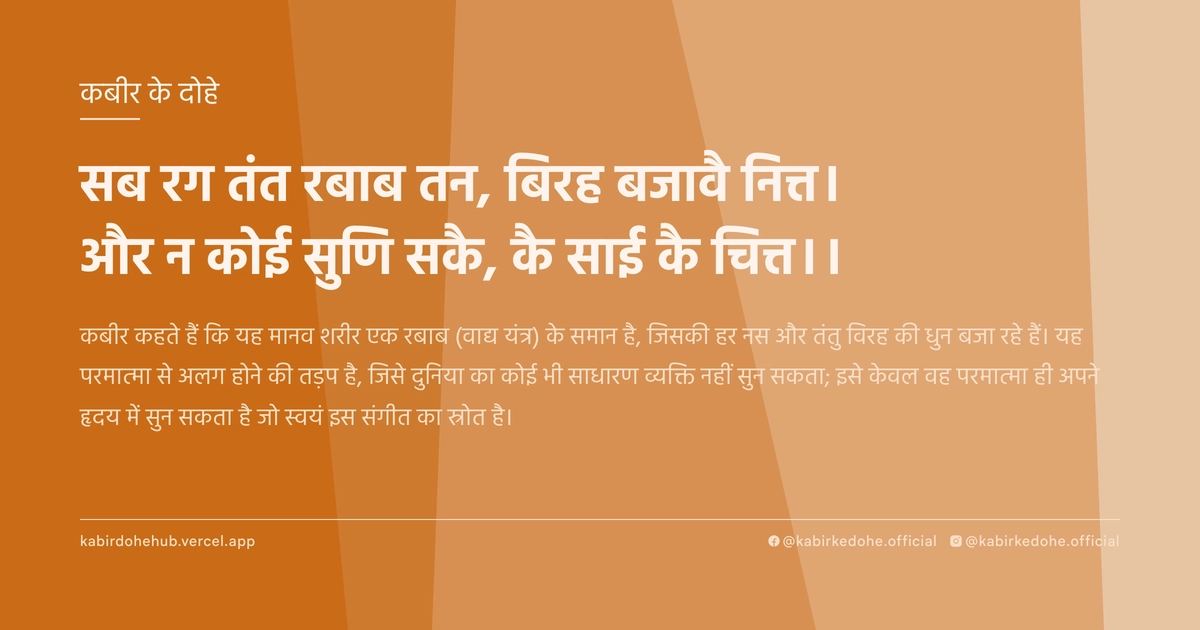
सब रग तंत रबाब तन, बिरह बजावै नित्त।
और न कोई सुणि सकै, कै साई कै चित्त।।
Sab rag tant rabaab tan, birah bajavai nitt. Aur na koi suni sakai, kai sai kai chitt.
इस पृष्ठ पर इस कबीर दोहे का अर्थ (meaning), हिंदी व्याख्या और अंग्रेज़ी अनुवाद, दार्शनिक विश्लेषण और व्यावहारिक जीवन सीख दी गई है। यह दोहा भक्ति (Bhakti) विषय से जुड़ा है — Kabir doha meaning and explanation in Hindi and English.
अर्थ (Meaning):
कबीर कहते हैं कि यह मानव शरीर एक रबाब (वाद्य यंत्र) के समान है, जिसकी हर नस और तंतु विरह की धुन बजा रहे हैं। यह परमात्मा से अलग होने की तड़प है, जिसे दुनिया का कोई भी साधारण व्यक्ति नहीं सुन सकता; इसे केवल वह परमात्मा ही अपने हृदय में सुन सकता है जो स्वयं इस संगीत का स्रोत है।
Kabir asserts that the human body is like a rabab, a stringed instrument, where every nerve and fiber constantly vibrates with the melody of longing. This is the ache of separation from the Divine, a silent symphony that remains inaudible to the worldly ear; it can only be heard and understood by the Lord Himself, within His own consciousness.
व्याख्या (Interpretation):
यहाँ शरीर को एक संगीत यंत्र के रूप में चित्रित किया गया है, जहाँ 'विरह' (separation) वह ऊर्जा है जो जीवन को संचालित करती है। शाब्दिक अर्थ में, यह आत्मा की परमात्मा से मिलने की व्याकुलता है। रूपक के स्तर पर, यह 'निर्गुण भक्ति' का चरम है, जहाँ साधक यह अनुभव करता है कि उसका अस्तित्व ही एक प्रार्थना है। यह माया के पर्दे को हटाकर यह दर्शाता है कि हम केवल हाड़-मांस के पुतले नहीं, बल्कि ईश्वरीय संगीत के माध्यम हैं। यह अद्वैत वेदांत के उस सत्य को पुष्ट करता है जहाँ जीव और ब्रह्म के बीच का अंतर केवल एक भ्रम है, और यह विरह वास्तव में उस एकता की ओर लौटने की पुकार है।
The body is envisioned here as a musical instrument, where 'Viraha' (longing) is the kinetic energy driving existence. Literally, it describes the soul's agonizing yearning for the Divine. Metaphorically, this represents the zenith of Nirgun Bhakti, where the seeker realizes their very existence is a living prayer. It strips away the veil of Maya, revealing that we are not merely biological entities but conduits for divine resonance. This aligns with Advaita Vedanta, suggesting that the perceived separation between Atman and Brahman is an illusion; the pain of longing is actually the gravitational pull of the soul returning to its non-dual source.
दार्शनिक विश्लेषण (Philosophical Analysis):
कबीर का यह दोहा उनके युग के उस सामाजिक और धार्मिक संघर्ष का प्रतिबिंब है जहाँ धर्म केवल बाहरी कर्मकांडों और मूर्तियों तक सीमित था। कबीर ने इन बाहरी ढाँचों को नकारते हुए 'हृदय की संगीत' पर जोर दिया। यह सूफी मत के 'इश्क-ए-हकीकी' (दिव्य प्रेम) के बहुत करीब है, जहाँ प्रेमी और प्रियतम के बीच का विरह ही आध्यात्मिक उन्नति का मार्ग है।
दार्शनिक रूप से, यह शरीर को एक बाधा के बजाय एक माध्यम मानता है। जहाँ अधिकांश परंपराएँ शरीर को माया का जाल मानकर त्यागने की बात करती हैं, कबीर इसे एक 'रबाब' कहते हैं, जिसका अर्थ है कि यदि इसे सही ढंग से ट्यून किया जाए, तो यह ईश्वर की ध्वनि उत्पन्न कर सकता है। यह शरीर और आत्मा के द्वैत को समाप्त करने का प्रयास है।
यहाँ 'साई' (ईश्वर) का उल्लेख यह दर्शाता है कि परमात्मा केवल ऊपर आकाश में नहीं, बल्कि उस विरह की गूँज में है जो मनुष्य के भीतर है। यह अहंकार के विसर्जन की प्रक्रिया है; जब तक 'मैं' का संगीत बजता है, तब तक 'उसका' संगीत सुनाई नहीं देता। जब अहंकार मिटता है, तब शरीर स्वयं एक वाद्य बन जाता है।
यह विश्लेषण हमें बताता है कि कबीर के लिए भक्ति कोई क्रिया नहीं, बल्कि एक अवस्था है। यह अवस्था तब आती है जब मनुष्य अपनी सामाजिक पहचान (जाति, धर्म, पद) को पूरी तरह भुला देता है और केवल एक 'तंतु' बनकर रह जाता है। यह पूर्ण समर्पण की वह स्थिति है जिसे सूफी 'फना' कहते हैं।
अंततः, यह दोहा इस सत्य को उजागर करता है कि आध्यात्मिक यात्रा बाहरी तीर्थों से नहीं, बल्कि आंतरिक मौन और उस मौन में छिपी चीख से शुरू होती है। यह विरह ही वह अग्नि है जो अशुद्धियों को जलाकर आत्मा को कुंदन बनाती है, जिससे वह परमात्मा के साथ एकाकार हो सके।
This couplet reflects the socio-religious friction of Kabir's era, where spirituality was often reduced to external rituals and idol worship. Kabir rejects these superficial structures, emphasizing the 'music of the heart.' This resonates deeply with the Sufi concept of 'Ishq-e-Haqiqi' (Divine Love), where the agony of separation is the primary catalyst for spiritual evolution.
Philosophically, Kabir transforms the body from an obstacle into a medium. While many ascetic traditions view the physical form as a trap of Maya to be discarded, Kabir describes it as a 'Rabab.' This implies that if the instrument of the self is properly tuned through discipline and love, it can resonate with the frequency of the Divine. It is an attempt to dissolve the duality between the physical and the spiritual.
The reference to 'Sai' (the Lord) suggests that the Divine is not a distant entity in the heavens, but is present within the very echo of the longing felt by the human soul. This is the process of ego-annihilation; as long as the 'I' plays its own tune, the Divine melody remains unheard. Only when the ego vanishes does the body become a true instrument.
Kabir posits that Bhakti is not an act but a state of being. This state is achieved when a human transcends their social identity—caste, creed, and status—becoming merely a 'string' in the cosmic instrument. This total surrender is what Sufis refer to as 'Fana' (annihilation of the self in the Divine).
Ultimately, the verse reveals that the spiritual journey begins not with external pilgrimages, but with internal silence and the scream hidden within that silence. This longing is the purifying fire that burns away impurities, refining the soul into a state of purity capable of merging with the Absolute.
मूल संदेश (Core Message):
- बाहरी शोर को शांत करें ताकि आंतरिक विरह सुनाई दे।
- दुख को शिकायत नहीं, बल्कि परमात्मा तक पहुँचने का सेतु बनाएँ।
- शरीर केवल एक माध्यम है, वास्तविक संगीत आत्मा का है।
- अहंकार का विसर्जन ही दिव्य संगीत की पहली शर्त है।
- परमात्मा वह है जो हमारे मौन की चीख को सुनता है।
- अद्वैत का सत्य यह है कि विरह और मिलन एक ही सिक्के के दो पहलू हैं।
- Silence the external noise to hear the internal longing.
- Transform sorrow from a complaint into a bridge to the Divine.
- The body is merely an instrument; the true music belongs to the soul.
- The dissolution of ego is the primary condition for divine resonance.
- The Divine is the one who hears the scream within our silence.
- The truth of non-duality is that longing and union are two sides of the same coin.
व्यावहारिक उदाहरण (Practical Example):
एक समय की बात है, वाराणसी के घाटों पर माधव नाम का एक वृद्ध बुनकर रहता था। माधव अपने जीवन के साठ साल केवल कपड़े बुनने में बिता चुका था। वह एक कुशल कारीगर था, लेकिन उसका मन हमेशा अशांत रहता था। उसे लगता था कि उसकी मेहनत का फल केवल पेट भरने तक सीमित है, जीवन में कोई गहरा अर्थ नहीं है।
वह अक्सर देखता कि लोग मंदिरों में घंटों प्रार्थना करते, लेकिन उनके चेहरों पर वही तनाव और क्रोध होता जो बाजार के दुकानदारों में था। माधव को यह सब ढोंग लगता था। वह खुद को अकेला महसूस करता था, जैसे वह एक ऐसी भाषा बोल रहा हो जिसे कोई नहीं समझता।
एक दिन, एक फकीर उसके पास आया और उसकी बुनाई की लय को देखते हुए बोला, "माधव, तुम धागों को तो सही जोड़ रहे हो, लेकिन क्या तुमने अपने भीतर के तार को छुआ है? तुम्हारा दुख वास्तव में तुम्हारी सबसे बड़ी संपत्ति है।"
माधव हैरान था। उसने पूछा, "दुख संपत्ति कैसे हो सकता है? मैं तो बस इस खालीपन से छुटकारा चाहता हूँ।"
फकीर ने मुस्कुराते हुए कहा, "यह खालीपन नहीं, यह विरह है। जैसे एक रबाब के तार खिंचे होते हैं तभी संगीत निकलता है, वैसे ही तुम्हारा यह दर्द तुम्हें परमात्मा के करीब ला रहा है। बस इसे शिकायत मत बनाओ, इसे संगीत बना लो।"
उस दिन के बाद माधव ने अपनी बुनाई का तरीका बदल दिया। वह अब केवल कपड़े नहीं बुनता था, बल्कि हर धागे के साथ अपने उस विरह को जोड़ देता था। उसने प्रार्थना करना छोड़ दिया और केवल 'महसूस' करना शुरू किया।
धीरे-धीरे, माधव के व्यवहार में एक अद्भुत परिवर्तन आया। वह अब दूसरों के दुखों को देखकर विचलित नहीं होता था, बल्कि उन्हें अपने भीतर के संगीत का हिस्सा मानने लगा। उसकी आँखों में एक ऐसी शांति आ गई जो किसी मंदिर की शांति से अधिक गहरी थी।
एक बार एक अमीर व्यापारी उसके पास आया और पूछा, "तुम्हारी इस शांति का रहस्य क्या है? तुम इतने गरीब हो, फिर भी इतने संतुष्ट कैसे हो?"
माधव ने बस इतना कहा, "मैं अब केवल एक तार हूँ, जिसे वह बजा रहा है। जब संगीत उसका है, तो दुख मेरा कैसे हो सकता है?"
व्यापारी को समझ नहीं आया, लेकिन माधव के चेहरे का तेज देखकर वह निशब्द रह गया। माधव ने जान लिया था कि उसका जीवन कोई बोझ नहीं, बल्कि एक दिव्य राग था जिसे केवल ईश्वर सुन रहा था और वह उसी संगीत में विलीन हो चुका था।
Once, on the ghats of Varanasi, lived an elderly weaver named Madhav. For sixty years, Madhav had spent his life weaving cloth. He was a master craftsman, yet his mind was perpetually restless. He felt his hard work served only to fill his stomach, leaving his life devoid of deeper meaning.
He often observed people praying for hours in temples, yet their faces bore the same stress and anger as the merchants in the marketplace. To Madhav, this seemed like a facade. He felt profoundly alone, as if he spoke a language that no one else understood.
One day, a wandering dervish approached him. Observing the rhythm of his weaving, the dervish remarked, "Madhav, you are joining the threads correctly, but have you touched the strings within you? Your sorrow is actually your greatest asset."
Madhav was bewildered. He asked, "How can sorrow be an asset? I only wish to be rid of this emptiness."
The dervish smiled and replied, "This is not emptiness; it is Viraha (longing). Just as the strings of a rabab must be stretched to produce music, your pain is drawing you closer to the Divine. Stop treating it as a complaint; turn it into a melody."
From that day on, Madhav changed the way he wove. He no longer just created fabric; with every thread, he wove in his longing. He stopped reciting formal prayers and began simply to 'feel.'
Gradually, a profound transformation occurred in Madhav's demeanor. He no longer became distressed by the suffering of others; instead, he began to perceive it as part of the universal symphony. A peace settled in his eyes, deeper than any found in the grandest temples.
Once, a wealthy merchant approached him and asked, "What is the secret of your tranquility? You are so poor, yet how are you so content?"
Madhav simply replied, "I am now merely a string, played upon by Him. When the music is His, how can the sorrow be mine?"
The merchant did not fully comprehend, but he stood speechless before the radiance of Madhav's face. Madhav had realized that his life was not a burden, but a divine raga heard only by the Lord, and he had finally merged into that music.
अभ्यास मार्गदर्शन (Practice Guidance):
- प्रतिदिन 20 मिनट मौन बैठें और अपने भीतर उठने वाले दुख या विरह को बिना किसी निर्णय के महसूस करें। इसे 'दर्द' के बजाय 'दिव्य संगीत' के रूप में देखें।
- एक डायरी लिखें जिसमें आप अपनी उन इच्छाओं को दर्ज करें जो भौतिक नहीं हैं, बल्कि आत्मा की गहराई से जुड़ी हैं। पूछें: "मैं वास्तव में किसे खोज रहा हूँ?"
- व्यवहार परिवर्तन: जब भी किसी दूसरे व्यक्ति में पीड़ा देखें, तो उसे एक अलग व्यक्ति के रूप में नहीं, बल्कि उसी सार्वभौमिक विरह के एक तार के रूप में देखें।
- निदान चेकलिस्ट: क्या आप अभी भी अपनी समस्याओं के लिए दूसरों को दोष दे रहे हैं? (यदि हाँ, तो आप अभी भी 'अहंकार' के तार बजा रहे हैं)। क्या आप अपने अकेलेपन में शांति महसूस करते हैं? (यदि हाँ, तो आप 'साई' के संगीत को सुन रहे हैं)।
- Sit in silence for 20 minutes daily, observing the arising feelings of sorrow or longing without judgment. Perceive this not as 'pain,' but as 'divine music.'
- Maintain a journal to record longings that are not material but emerge from the depths of the soul. Ask: "Who is it that I am truly searching for?"
- Behavioral Shift: Whenever you encounter suffering in another, do not see them as a separate entity, but as another string vibrating with the same universal longing.
- Diagnostic Checklist: Are you still blaming others for your struggles? (If yes, you are still playing the strings of the 'ego'). Do you feel a sense of peace within your loneliness? (If yes, you are beginning to hear the music of the 'Sai').
चिंतन प्रश्न (Reflection Questions):
- मेरी वह कौन सी 'चुप्पी' है जिसे मैं दुनिया से छिपाता हूँ, लेकिन वह मुझे अंदर ही अंदर तड़पाती है?
- क्या मेरी आध्यात्मिक खोज वास्तव में परमात्मा के लिए है, या मैं केवल अपने मानसिक तनाव से मुक्ति चाहता हूँ?
- यदि मेरा पूरा सामाजिक व्यक्तित्व (नाम, पद, प्रतिष्ठा) छीन लिया जाए, तो मेरे भीतर कौन सा संगीत बचेगा?
- मैं अपनी पीड़ा को 'बलि' (sacrifice) बना रहा हूँ या उसे 'अहंकार' को पालने का जरिया बना रहा हूँ?
- क्या मैं वास्तव में अकेले होने से डरता हूँ, या मैं उस मौन से डरता हूँ जहाँ मुझे अपनी असलियत दिखती है?
- मेरे जीवन का 'रबाब' अभी किस धुन पर है—शिकायत की या समर्पण की?
- What is that 'silence' within me that I hide from the world, yet which consumes me from inside?
- Is my spiritual quest truly for the Divine, or am I merely seeking an escape from mental stress?
- If my entire social identity—name, rank, reputation—were stripped away, what music would remain within me?
- Am I transforming my pain into a 'sacrifice' or using it as a fuel to feed my ego?
- Do I truly fear being alone, or do I fear the silence where my authentic self is revealed?
- On what note is the 'rabab' of my life currently tuned—the note of complaint or the note of surrender?