
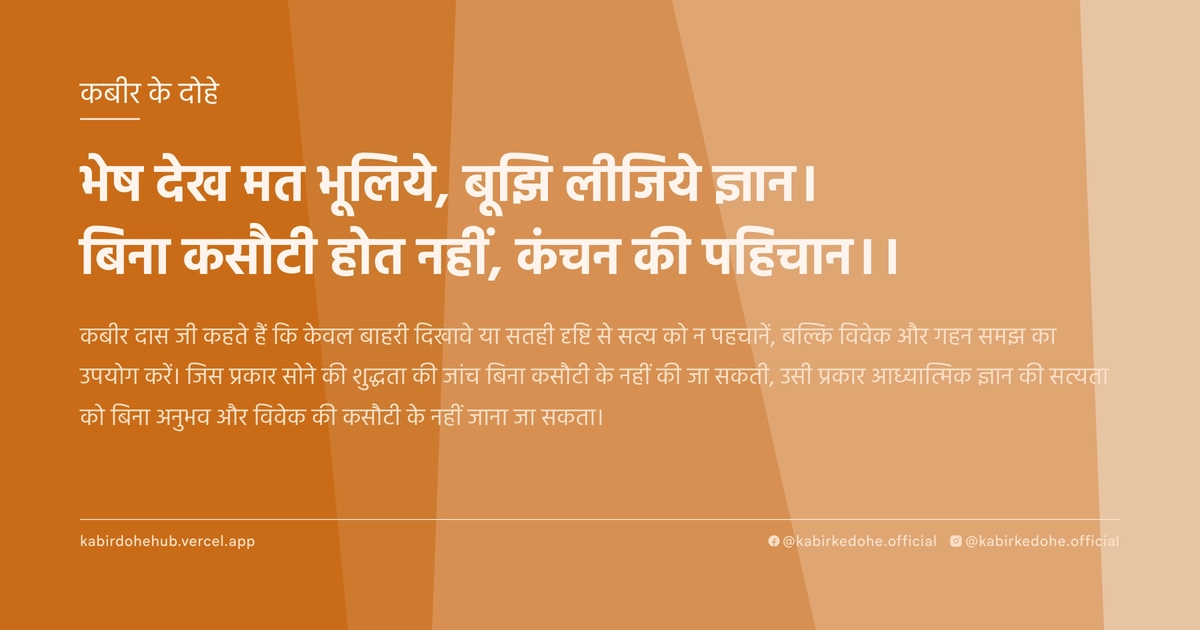
भेष देख मत भूलिये, बूझि लीजिये ज्ञान।
बिना कसौटी होत नहीं, कंचन की पहिचान।।
Bhesh dekh mat bhuliye, bujhi leeje gyan. Bina kasauti hot nahi, kanchan ki pahichan.
इस पृष्ठ पर इस कबीर दोहे का अर्थ (meaning), हिंदी व्याख्या और अंग्रेज़ी अनुवाद, दार्शनिक विश्लेषण और व्यावहारिक जीवन सीख दी गई है। यह दोहा सत्य (Truth) विषय से जुड़ा है — Kabir doha meaning and explanation in Hindi and English.
अर्थ (Meaning):
कबीर दास जी कहते हैं कि केवल बाहरी दिखावे या सतही दृष्टि से सत्य को न पहचानें, बल्कि विवेक और गहन समझ का उपयोग करें। जिस प्रकार सोने की शुद्धता की जांच बिना कसौटी के नहीं की जा सकती, उसी प्रकार आध्यात्मिक ज्ञान की सत्यता को बिना अनुभव और विवेक की कसौटी के नहीं जाना जा सकता।
Kabir emphasizes that one should not be deceived by superficial appearances but should seek deep understanding. Just as the purity of gold cannot be verified without a touchstone, the authenticity of spiritual knowledge cannot be recognized without the rigorous application of discernment and personal experience.
व्याख्या (Interpretation):
इस दोहे का शाब्दिक अर्थ है कि सोने को पहचानने के लिए कसौटी अनिवार्य है। आध्यात्मिक स्तर पर, 'सोना' वह परम सत्य या आत्म-ज्ञान है जिसे हम खोज रहे हैं, और 'कसौटी' हमारा विवेक और निष्पक्ष अनुभव है। कबीर यहाँ चेतावनी देते हैं कि मायावी दुनिया में सत्य और असत्य बहुत समान दिखते हैं। निर्गुण भक्ति के संदर्भ में, ईश्वर किसी मूर्ति या मंदिर में नहीं, बल्कि चेतना की गहराई में है। जब तक साधक अपने अहंकार को मिटाकर स्वयं को कसौटी बनाता है, तब तक वह ब्रह्म और माया के बीच का सूक्ष्म अंतर नहीं समझ सकता। यह अद्वैत वेदांत के उस सिद्धांत को पुष्ट करता है जहाँ ज्ञाता, ज्ञान और ज्ञेय एक हो जाते हैं। अंततः, यह दोहा हमें बाहरी प्रमाणों के बजाय आंतरिक सत्यापन की ओर प्रेरित करता है।
Literally, the verse asserts that a touchstone is essential to verify gold. Metaphorically, 'gold' represents the Ultimate Truth or Self-realization, while the 'touchstone' symbolizes discernment (Viveka) and direct experiential validation. Kabir warns that in the realm of Maya, the illusory and the real appear strikingly similar. Within the framework of Nirgun Bhakti, the Divine is not found in idols or rituals but in the depths of consciousness. Until the seeker dissolves the ego to become the touchstone themselves, the subtle distinction between Brahman and Maya remains obscured. This aligns with Advaita Vedanta's non-duality, where the knower and the known merge. Ultimately, the doha urges a shift from external validation to internal verification, highlighting the paradox that the tool for finding Truth is the Truth itself.
दार्शनिक विश्लेषण (Philosophical Analysis):
कबीर का यह कथन उनके युग के धार्मिक पाखंड और अंधविश्वास पर एक कड़ा प्रहार है। 15वीं शताब्दी में, लोग केवल इसलिए किसी गुरु या ग्रंथ पर विश्वास कर लेते थे क्योंकि वे प्रतिष्ठित थे, बिना यह जाँचे कि क्या वह ज्ञान उनके जीवन में परिवर्तन ला रहा है। कबीर ने इस 'अंध-श्रद्धा' को चुनौती दी और 'अनुभव' को सर्वोच्च प्रमाण माना।
दार्शनिक रूप से, यह विचार सूफीवाद के 'धौक' (आंतरिक अनुभव) और वेदांत के 'साक्षी भाव' से मेल खाता है। कबीर का तर्क है कि शास्त्र केवल संकेत हैं, गंतव्य नहीं। यदि कोई कहता है कि उसने ईश्वर को पा लिया है, तो उसकी कसौटी उसका व्यवहार और उसकी शांति होनी चाहिए, न कि उसके द्वारा पहने गए वस्त्र या उसके द्वारा बोले गए कठिन शब्द।
यहाँ 'माया' को एक ऐसे भ्रम के रूप में देखा गया है जो सोने जैसा चमकता है लेकिन वास्तव में पीतल है। अहंकार (Ego) वह पर्दा है जो हमें कसौटी का उपयोग करने से रोकता है। जब तक मनुष्य अपनी पहचान सामाजिक पद या जाति से जोड़ता है, वह सत्य को नहीं देख पाता क्योंकि उसकी दृष्टि पक्षपाती होती है।
कबीर का दृष्टिकोण मनोवैज्ञानिक रूपांतरण पर केंद्रित है। वे चाहते हैं कि साधक एक 'संदेहवादी' (Skeptic) बने—न कि नकारात्मक अर्थ में, बल्कि एक जिज्ञासु के रूप में जो तब तक संतुष्ट न हो जब तक सत्य उसके अपने हृदय में गूँजे न। यह बौद्ध धर्म के 'तथागत' अनुभव के करीब है जहाँ स्वयं का अनुभव ही अंतिम सत्य है।
अंततः, यह दोहा हमें सिखाता है कि सत्य का कोई शॉर्टकट नहीं है। जिस प्रकार सोने को आग में तपना पड़ता है, उसी प्रकार ज्ञान को अनुभव की अग्नि में तपाकर शुद्ध करना पड़ता है। बिना इस प्रक्रिया के, जिसे हम ज्ञान समझते हैं, वह केवल सूचना (Information) है, बोध (Realization) नहीं।
Kabir's assertion is a sharp critique of the religious hypocrisy and blind faith prevalent during his era. In the 15th century, people often blindly followed gurus or texts based on prestige rather than verifying if that knowledge catalyzed actual transformation. Kabir challenged this 'blind faith,' establishing 'experience' (Anubhav) as the supreme evidence.
Philosophically, this mirrors the Sufi concept of 'Dhauq' (direct tasting/experience) and the Vedantic 'Sakshi' (witness consciousness). Kabir argues that scriptures are merely signposts, not the destination. If someone claims to have attained God, the touchstone should be their conduct and inner peace, not their attire or the complexity of their vocabulary.
'Maya' is presented here as an illusion that glitters like gold but is merely brass. The ego is the veil that prevents the seeker from using the touchstone. As long as an individual identifies with social status or caste, their vision remains biased, rendering them unable to perceive the Absolute Truth.
Kabir's approach focuses on psychological transformation. He encourages the seeker to be a 'skeptic'—not in a cynical sense, but as an inquirer who remains unsatisfied until the truth resonates within their own heart. This parallels the Buddhist emphasis on 'Ehipassiko' (come and see for yourself).
Ultimately, the doha teaches that there are no shortcuts to Truth. Just as gold must endure the fire, knowledge must be purified in the fire of experience. Without this process, what we perceive as wisdom is merely information, not realization.
मूल संदेश (Core Message):
- बाहरी चमक अक्सर आंतरिक रिक्तता को छिपाने का मुखौटा होती है।
- सत्य की पहचान केवल व्यक्तिगत अनुभव और विवेक से संभव है।
- अंधश्रद्धा ज्ञान का मार्ग नहीं, बल्कि उसकी सबसे बड़ी बाधा है।
- अनुभव ही वह एकमात्र कसौटी है जो सत्य को असत्य से अलग करती है।
- आंतरिक सत्यापन के बिना कोई भी ज्ञान केवल उधार ली गई सूचना है।
- External brilliance is often a mask hiding internal emptiness.
- Truth can only be recognized through personal experience and discernment.
- Blind faith is not the path to knowledge, but its greatest obstacle.
- Experience is the only touchstone that separates truth from falsehood.
- Without internal verification, all knowledge is merely borrowed information.
व्यावहारिक उदाहरण (Practical Example):
एक समय की बात है, वाराणसी के घाटों पर रहने वाला एक वृद्ध बुनकर था, जिसका नाम माधव था। माधव अपनी कला में निपुण था, लेकिन वह बहुत परेशान था क्योंकि शहर में कई नए लोग आए थे जो दावा कर रहे थे कि वे उसे 'दिव्य वस्त्र' बनाना सिखा सकते हैं जो पहनने वाले को तुरंत मोक्ष दिला देगा।
एक दिन एक प्रभावशाली व्यक्ति रेशमी वस्त्र पहनकर आया और उसने माधव को एक विशेष मंत्र दिया, यह कहते हुए कि यदि वह इस मंत्र का जाप करते हुए बुनाई करेगा, तो उसका कपड़ा सोने जैसा चमकेगा और उसे दुनिया का सबसे महान बुनकर माना जाएगा। माधव ने उसकी बातों पर विश्वास कर लिया और महीनों तक केवल उस मंत्र पर ध्यान केंद्रित किया, अपनी कला की बारीकियों को नजरअंदाज कर दिया।
परिणामस्वरूप, उसके कपड़े दिखने में तो सुंदर थे, लेकिन वे बहुत कमजोर थे और पहली ही धुलाई में फट गए। माधव निराश हो गया। तब उसकी मुलाकात एक साधारण से फकीर से हुई, जिसने माधव से कहा, 'बेटा, तूने चमक को देखा, लेकिन मजबूती को नहीं परखा। तूने मंत्र को कसौटी मान लिया, जबकि असली कसौटी तो वह धागा और उसकी बुनाई है जिसे तूने भुला दिया।'
माधव को समझ आया कि वह बाहरी चमक-धमक और बड़े वादों के भ्रम में फंस गया था। उसने महसूस किया कि असली ज्ञान वह नहीं है जो कोई दूसरा उसे 'दे' रहा था, बल्कि वह है जो वह अपने काम के प्रति ईमानदारी और सूक्ष्म अवलोकन से प्राप्त कर सकता था।
उसने फिर से अपने करघे पर ध्यान लगाया, लेकिन इस बार वह केवल परिणाम के लिए नहीं, बल्कि प्रक्रिया के आनंद के लिए काम करने लगा। उसने हर धागे को महसूस करना शुरू किया और यह देखा कि कैसे धैर्य और एकाग्रता ही वास्तव में 'दिव्य' हैं।
धीरे-धीरे, माधव के कपड़ों में एक ऐसी गुणवत्ता आई जो किसी मंत्र से नहीं, बल्कि उसके आंतरिक रूपांतरण से आई थी। अब लोग उसके पास केवल सुंदरता के लिए नहीं, बल्कि उस शांति के लिए आते थे जो उसके कपड़ों के स्पर्श में महसूस होती थी।
उसने सीखा कि किसी भी गुरु या मार्गदर्शक की बातों को तब तक सत्य नहीं मानना चाहिए जब तक कि वह उसके अपने जीवन के अनुभवों की कसौटी पर खरा न उतरे।
माधव अब केवल एक बुनकर नहीं था, वह एक साधक बन गया था जिसने यह जान लिया था कि सत्य बाहरी शोर में नहीं, बल्कि आंतरिक मौन और कर्म की शुद्धता में छिपा है।
Once, in the ghats of Varanasi, lived an elderly weaver named Madhav. Madhav was skilled in his craft, but he was troubled because several newcomers had arrived in the city claiming they could teach him to weave 'divine fabrics' that would grant instant liberation to the wearer.
One day, an influential man dressed in opulent silks approached Madhav and gave him a secret mantra, claiming that if he chanted it while weaving, his cloth would shine like gold and he would be recognized as the world's greatest weaver. Madhav believed him and spent months focusing solely on the mantra, neglecting the intricate technicalities of his craft.
Consequently, while the fabrics looked beautiful, they were structurally weak and tore during the first wash. Madhav was devastated. He then met a simple wandering dervish who told him, 'Son, you looked at the glitter but failed to test the strength. You took the mantra as the touchstone, whereas the real touchstone was the thread and the weave that you ignored.'
Madhav realized he had been deceived by external brilliance and grand promises. He understood that true knowledge was not something someone else could 'give' him, but something he could attain through honesty and meticulous observation of his own work.
He returned to his loom, but this time he worked not for the result, but for the joy of the process. He began to feel every thread and realized that patience and concentration were the truly 'divine' elements.
Gradually, a quality emerged in Madhav's work that no mantra could produce—a quality born of internal transformation. People now came to him not just for the beauty of the cloth, but for the peace they felt upon touching it.
He learned that the words of any guru or guide should not be accepted as truth until they are verified against the touchstone of one's own life experiences.
Madhav was no longer just a weaver; he had become a seeker who understood that truth is not found in external noise, but in internal silence and the purity of action.
अभ्यास मार्गदर्शन (Practice Guidance):
- दैनिक चिंतन: प्रतिदिन 15 मिनट मौन बैठें और अपने दिन के दौरान लिए गए निर्णयों का विश्लेषण करें। क्या वे निर्णय डर, अहंकार या वास्तविक विवेक पर आधारित थे?
- आत्म-पूछताछ जर्नल: एक डायरी लिखें जिसमें आप उन मान्यताओं को सूचीबद्ध करें जिन्हें आपने बिना सवाल किए स्वीकार कर लिया है। फिर पूछें, 'क्या इसका कोई व्यक्तिगत अनुभव प्रमाण है?'
- व्यवहारिक परिवर्तन: किसी भी आध्यात्मिक दावे या सलाह को तुरंत स्वीकार करने के बजाय, उसे छोटे स्तर पर अपने जीवन में लागू करके देखें और उसके परिणामों का निरीक्षण करें।
- निदान चेकलिस्ट: यदि आप दूसरों की राय से विचलित होते हैं या केवल बाहरी प्रतीकों (जैसे माला, तिलक, या विशेष वस्त्र) से शांति खोज रहे हैं, तो समझें कि आप 'कसौटी' का उपयोग नहीं कर रहे हैं।
- Daily Contemplation: Sit in silence for 15 minutes daily and analyze the decisions made throughout the day. Were they based on fear, ego, or genuine discernment?
- Self-Inquiry Journal: Maintain a diary listing beliefs you have accepted without questioning. Then ask, 'Is there any personal experiential evidence for this?'
- Behavioral Shift: Instead of immediately accepting spiritual claims or advice, apply them on a small scale in your life and observe the actual outcomes.
- Diagnostic Checklist: If you are easily swayed by others' opinions or seek peace solely through external symbols (beads, marks, or specific attire), recognize that you are failing to use the 'touchstone'.
चिंतन प्रश्न (Reflection Questions):
- मेरे जीवन में वे कौन सी 'मान्यताएं' हैं जिन्हें मैं केवल इसलिए मानता हूँ क्योंकि वे मेरे परिवार या समाज द्वारा दी गई हैं?
- क्या मैं अपनी आध्यात्मिक प्रगति को बाहरी प्रतीकों या दूसरों की प्रशंसा से मापता हूँ, या आंतरिक शांति से?
- जब मैं किसी प्रभावशाली व्यक्ति की बात सुनता हूँ, तो क्या मेरा विवेक सक्रिय रहता है या मैं उनके प्रभाव में दब जाता हूँ?
- मेरे व्यक्तित्व का वह कौन सा हिस्सा है जो 'सोने' जैसा चमकने की कोशिश करता है, जबकि अंदर से वह 'पीतल' की तरह खोखला है?
- यदि आज मेरे पास कोई धार्मिक पहचान या सामाजिक पद न रहे, तो मेरे पास सत्य को पहचानने के लिए क्या बचेगा?
- What are the 'beliefs' in my life that I hold simply because they were handed down by my family or society?
- Do I measure my spiritual progress by external symbols and others' praise, or by internal peace?
- When I listen to an influential person, does my discernment remain active, or do I succumb to their charisma?
- Which part of my personality strives to glitter like 'gold' while remaining hollow like 'brass' inside?
- If I were stripped of all religious identities and social status today, what would remain for me to recognize the Truth?